
See a Demo
You're just one step away from seeing Call Loop in action.
Enter your information below to watch a demo right now.

You're just one step away from seeing Call Loop in action.
Enter your information below to watch a demo right now.

An automatic reply text message is exactly what it sounds like: a pre-written SMS response that goes out the instant a customer contacts you. Think of it as a virtual assistant who immediately acknowledges every single inquiry, letting customers know you got their message and setting the right expectations for when they'll hear back from you.
Imagine having an assistant who greets every customer, answers their first question, and never takes a single day off. That’s the real power behind an automatic reply text message. It’s an instant, automated response that confirms you’ve received a customer’s message the moment it hits your inbox.
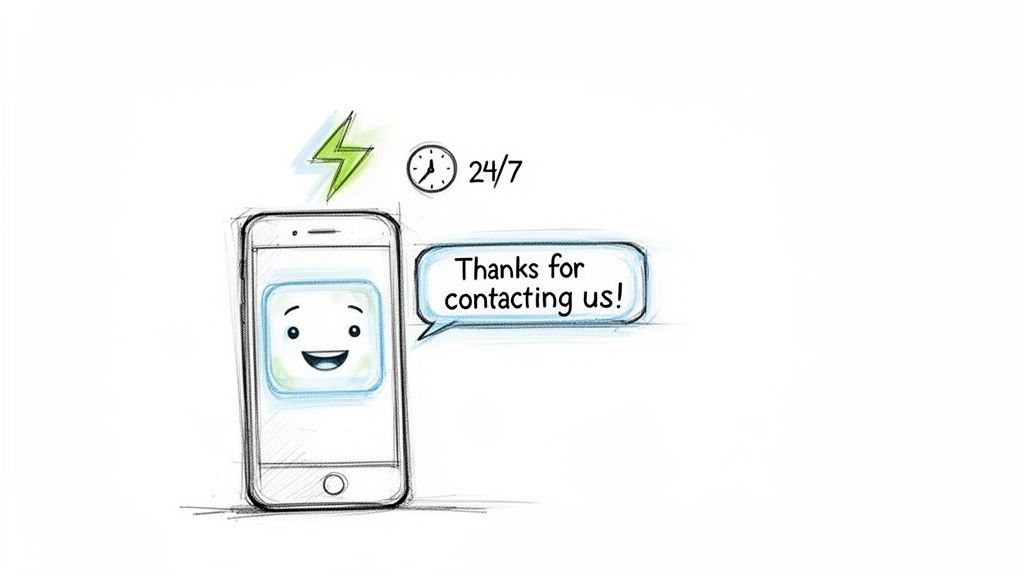
In a world where speed is everything, this simple tool is no longer just a nice-to-have; it's a must-have. It meets the modern demand for immediate communication and sets a professional, positive tone from the very first touchpoint.
The whole strategy works because of how incredibly engaging SMS is. While your emails might sit unopened for hours (or even days), text messages are almost always seen right away. This simple truth is completely changing how businesses of all sizes approach their customer communication.
The numbers don't lie. Let's take a look at why automatic reply text messages are such a big deal.
This table breaks down the core benefits and shows why you can't afford to ignore this channel.
Simply put, the high visibility of SMS makes automated texts the perfect tool for critical communications.
An automatic reply text doesn't just send information; it sends reassurance. It tells customers, "We got your message and you're important to us," which is a massive first step in building a real, lasting relationship.
Getting your auto-reply set up is a non-negotiable for modern business growth, but it's also just the beginning. That initial text can trigger a more complex communication sequence, like an automatic follow-up ringless voicemail a few days later to add a personal touch. A ringless voicemail drop delivers a pre-recorded audio message directly to a person's voicemail without their phone ever ringing, making it a non-intrusive way to connect.
By using powerful SMS autoresponders, you can build out entire customer journeys that run on autopilot. This frees up your time while making the customer experience even better.
In our on-demand world, customers don't just prefer fast replies; they expect them. This isn't just a fleeting trend—it's a fundamental shift in how people behave, and it has a direct impact on your bottom line. An automatic reply text message is your first and most critical response to this need for speed.
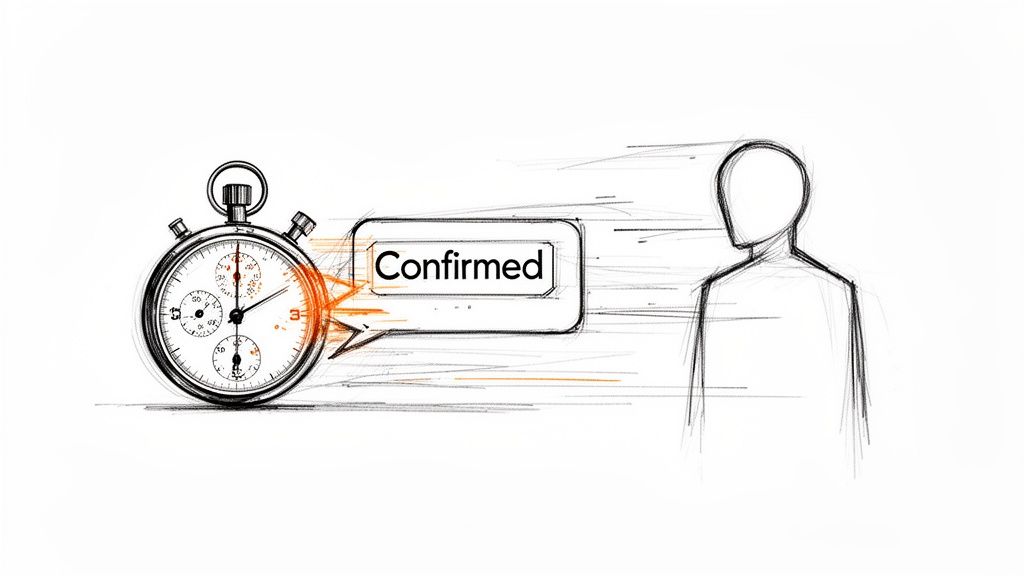
If you fail to provide that immediate acknowledgment, your business can seem slow or, even worse, like nobody's home. The moment a potential lead reaches out, a stopwatch starts in their mind. Without an instant confirmation, they're already looking for a competitor who can get back to them faster. That’s a lost opportunity you just can't afford.
An automatic reply does way more than just confirm you got the message. It works on a psychological level, easing a customer's anxiety and immediately starting to build a foundation of trust. That simple, instant text reassures them that they've been heard and that you value their time.
This small act of instant confirmation sets a tone of reliability that separates you from the competition. It's your business's first line of defense for things like:
To make sure you're always staying ahead and capturing leads when they're hottest, implementing smart text message automation is a must. It’s not just about being fast; it’s about making a great first impression that sticks.
“Today, speed isn't just a feature; it's the entire product. An automatic text reply is your promise to the customer that their time matters, turning a moment of uncertainty into one of confidence and trust.”
The demand for quick responses is backed by some serious data. A staggering 90% of customers rate an immediate reply as "important or very important" when they have a question. And what do they consider immediate? 60% define 'immediate' as under 10 minutes. This shows a clear shift where businesses are judged almost entirely on their responsiveness.
This is where a well-crafted automatic reply text message becomes your secret weapon. It meets this expectation head-on, delivering the acknowledgment customers crave within seconds, not minutes or hours.
For a deeper dive into how to put this into practice, check out our guide on how to send automated texts for your business. It's all about creating an immediate, positive, and reassuring experience right from the very first interaction.
Okay, let's move from theory to reality. An automatic reply text message is a true workhorse, easily adapting to the unique rhythm and challenges of pretty much any business. Its real magic isn't in the tech itself, but in how it solves everyday problems and smooths out operations across countless fields.
The trick is to use specific triggers—like a customer texting a keyword or you missing their call—to deliver exactly the right information at precisely the right moment. This simple bit of automation can completely change how you connect with people, turning what could've been a missed opportunity into a genuinely positive experience.
For real estate agents, every second counts. When a potential buyer drives past a house for sale and wants the details now, they aren't going to wait around for a callback. This is the perfect job for a keyword-triggered auto-reply.
This isn't just about instant gratification. It's about automatically qualifying leads and saving agents a ton of time.
In the cutthroat world of ecommerce, clear communication is everything. It builds loyalty and, just as importantly, cuts down on the flood of support tickets. Auto-replies can handle the most common questions on the spot, making for a much smoother customer journey. For a deeper dive, our guide to SMS marketing for ecommerce has even more strategies to boost sales.
Think about a customer who just placed an order and is already wondering about shipping. An auto-reply can jump in immediately.
Example Message: "Thanks for your order from Style Threads! We've received it and will notify you as soon as it ships. For tracking info, reply with 'STATUS' at any time. For other questions, our team will reply within 24 hours."
This one message does three things: confirms the purchase, sets clear expectations, and offers a self-service option, all of which lightens the load on your support team.
Service businesses live and die by their calendars. A full appointment book is a happy appointment book. An automatic reply text message is a simple but incredibly effective way to confirm bookings and send reminders, which can slash the number of costly no-shows.
When a client books a massage or signs up for a class, an instant text confirmation feels professional and gives them peace of mind.
Your automated follow-up doesn't have to end with a single text. That first auto-reply can be just the beginning of a smarter, more layered sequence. Keywords like ringless voicemail drops and voice broadcasting are part of this advanced strategy.
For example, after sending an initial text confirmation for a high-value appointment, you could schedule a ringless voicemail to be delivered 24 hours beforehand. This adds a personal touch without being intrusive since the message lands directly in their voicemail without ever making their phone ring. It's a fantastic way to blend the efficiency of automation with a more human feel.
Ready to get your first automatic reply text message up and running? It’s way easier than you might think, and you definitely don’t need to be a tech wizard. Modern platforms are built for regular business owners, letting you set up a smart auto-reply in just a few minutes.
The whole thing really comes down to three simple steps: pick a trigger, write your message, and set the timing. Just think of it like creating a simple "if this happens, then do that" rule for your business. Let's break down how it works.
First up, you need a trigger. This is just the specific event that kicks off your automatic reply—the "if this happens..." part of the rule. Nailing the right trigger is key because it makes sure your message gets sent at the perfect moment, so your communication feels timely and genuinely helpful.
Some of the most common triggers you can use are:
Getting this first step right is the foundation of a great campaign. It ensures your automatic reply text message makes sense in the context of the conversation and provides immediate value.
Next, you'll write the actual text message. The best auto-replies are short, to the point, and manage expectations. This is your chance to make a fantastic first impression, so it pays to spend a few minutes getting the words just right.
A great auto-reply doesn’t just say "we got your message." It provides immediate value. Tell them what's next, offer a useful link, or just reassure them that a real human will follow up soon.
To make your message feel less like a robot and more like a person, use personalization tags. These are just little placeholders that automatically pull in a contact's info, like their first name.
For instance, instead of something generic, you could write:
"Hi [First Name], thanks for reaching out! We've got your message and someone from our team will get back to you within 2 business hours."
Last but not least, you need to decide when your auto-reply should be active. You probably don't want to send an "our office is closed" message at noon on a Tuesday. This is where scheduling and setting "office hours" for your automation is a lifesaver.
Most platforms let you set up timing rules, like:
This level of control makes sure your automated texts align perfectly with how your business actually runs. Once you’ve set these three steps, you're good to go. Your new automated assistant is officially on the job, ready to provide instant, professional responses 24/7.
That first automatic reply text message is a fantastic start, but it's really just the tip of the iceberg. The real magic happens when you stop seeing that text as a one-off event and start treating it as the starting pistol for a full, multi-channel follow-up system. This is how you build a communication engine that works for you 24/7.
Let's walk through what this looks like. A potential customer texts your keyword. Boom—they get your automated SMS instantly. But the system is just getting warmed up. Two days later, it automatically sends a ringless voicemail drop, adding a personal, human touch without ever interrupting their day. A week after that, a tailored email follows up with more details. You've just created a sophisticated lead nurturing sequence that runs completely on its own.
The secret to making this engine hum is segmentation. By setting up different keywords or using separate inquiry forms, you can automatically sort your audience into different buckets. Someone who texts "PRICING" is clearly at a different stage than someone who texts "DEMO," so they shouldn't get the same messages.
This simple tweak lets you send highly relevant, targeted communication that speaks directly to what they need at that moment. You can layer SMS, voice broadcasting, and ringless voicemail into one powerful system that scales up your outreach and drives conversions without you lifting a finger.
This simple flowchart shows just how straightforward it is to get an automatic reply triggered, created, and sent out.

As you can see, a powerful automated campaign can be broken down into just three core, easy-to-manage components.
Think about it—different channels have different strengths. An SMS is perfect for immediate, bite-sized info. A ringless voicemail can deliver your tone and personality in a way text just can't. And an email gives you the space for more detailed, long-form content.
When you layer these channels together, you create a much more dynamic and effective outreach strategy.
An automated communication engine does more than just blast out messages; it builds a persistent, positive presence. It makes sure your business stays top-of-mind by engaging leads across different platforms at perfectly timed intervals, making your follow-up feel both personal and professional.
When you're mapping out your own communication engine, using tools like real estate marketing automation software can be a game-changer, guaranteeing no lead ever gets left behind. The whole point is to design a system where every piece works in concert, seamlessly guiding a prospect from their first flicker of interest to a final conversion, all on autopilot.
With great power comes great responsibility. An automatic reply text message is a fantastic tool, but you've got to use it the right way—both ethically and legally. Getting the rules right isn't just about CYA (covering your assets); it's about building a solid foundation of trust with every single person who texts you.
The absolute cornerstone of all text message marketing is consent. This is the big one. You must have clear, undeniable permission from someone before you send them automated marketing messages. This isn't just a suggestion; it's a non-negotiable rule baked into the Telephone Consumer Protection Act (TCPA).
Think of it as the golden rule of texting: only message people who've actually asked to hear from you.
The best way to stay on the right side of the law is by getting express written consent. Don't worry, this doesn't mean you need a pen and paper. It can be as simple as an electronic form, a checkbox on your website's signup page, or a customer texting a specific keyword to your number.
Always be crystal clear about what people are signing up for. Any confusion can lead to complaints and legal headaches. A simple line like, "By texting JOIN, you agree to receive promotional messages from us," is crucial.
Just as important as getting someone to opt in is giving them an easy way to opt out. Every single automated campaign must include simple instructions for people to unsubscribe, like the classic "Reply STOP to cancel."
Honoring these requests immediately isn't just good manners—it’s a legal requirement and the mark of a business that respects its customers.
Your automatic reply is also a direct reflection of your brand. Keep these best practices in mind:
Stick to these guidelines, and your automated messages won't just be effective—they'll build positive, trusting relationships with your audience from the very first text.
Got questions about setting up an automatic reply text message? Let's clear up a few of the most common ones we hear.
Good question, and an important one for staying compliant. For the very first auto-reply, you generally don't need prior permission. Think of it this way: since the customer texted you first, your immediate response is considered an expected part of the conversation, falling under implied consent.
However—and this is a big one—any promotional messages you send after that initial reply absolutely require explicit opt-in consent to keep you on the right side of TCPA guidelines.
Absolutely. In fact, you should! A key feature of any professional SMS platform is the ability to schedule messages.
You can easily set up one automatic reply text message for business hours ("Thanks for reaching out, we'll be with you shortly!") and a completely different one for after-hours, weekends, or holidays. This makes sure your replies are always relevant to the situation.
A ringless voicemail is a fantastic follow-up to an initial auto-reply. It's a neat piece of tech that sends a pre-recorded audio message straight to someone's voicemail box without ever making their phone ring. This technique is often called a ringless voicemail drop.
This is a powerful way to add a personal touch to your automated follow-ups. You get the efficiency of automation but with the warmth and personality of a human voice. It's an excellent tool for nurturing leads who have already shown interest by texting you.
Ready to build a communication engine that works for you 24/7? Call Loop makes it simple to set up automatic SMS replies, ringless voicemail drops, and multi-channel campaigns that save you time and drive growth. Start your free trial today and see the difference.
Chris Brisson
Chris is the co-founder and CEO at Call Loop. He is focused on marketing automation, growth hacker strategies, and creating duplicatable systems for growing a remote and bootstrapped company. Chat with him on X at @chrisbrisson


Trusted by over 45,000 people, organizations, and businesses like


