
See a Demo
You're just one step away from seeing Call Loop in action.
Enter your information below to watch a demo right now.

You're just one step away from seeing Call Loop in action.
Enter your information below to watch a demo right now.

Sending a text to a 5-digit number is straightforward. Just pop open your phone’s messaging app, type the 5-digit short code (like 77223) where you'd normally put a phone number, and enter the specific keyword (like 'JOIN') in the message body. Hit send, and you're in. That simple action usually opts you into a business's text list for things like promotions, alerts, or updates.
The consumer texting flow, the most common short-code use cases, and the rules that separate a legitimate program from a spammy one are all important. Four things readers usually need answered fast are: how the send process works, what a 5-digit SMS number is, why people receive texts from them, and what businesses must do before using one.
Short codes were compared with the two business-texting alternatives people most often confuse them with: 10DLC local numbers and toll-free texting. That matters because many companies do not need a dedicated short code, and many consumers do not realize that a 5-digit number is only one part of the broader A2P messaging ecosystem. Compliance expectations referenced CTIA messaging principles, the FCC's TCPA guidance, and registry information from the US Short Code Registry.
My main takeaway after reviewing current guidance is simple: the sending step is easy, but legitimacy depends on consent, clear disclosures, and recognizable brand behavior. That is where most confusion starts.
A 5-digit text number is usually a short code: a carrier-approved number used by businesses and organizations to send or receive large volumes of text messages. In the U.S., people most often encounter short codes for marketing offers, account alerts, appointment reminders, shipping updates, and verification codes. The US Short Code Registry is the official source for U.S. short code leasing and program setup, which is one reason these numbers tend to be associated with established brands rather than casual person-to-person texting.
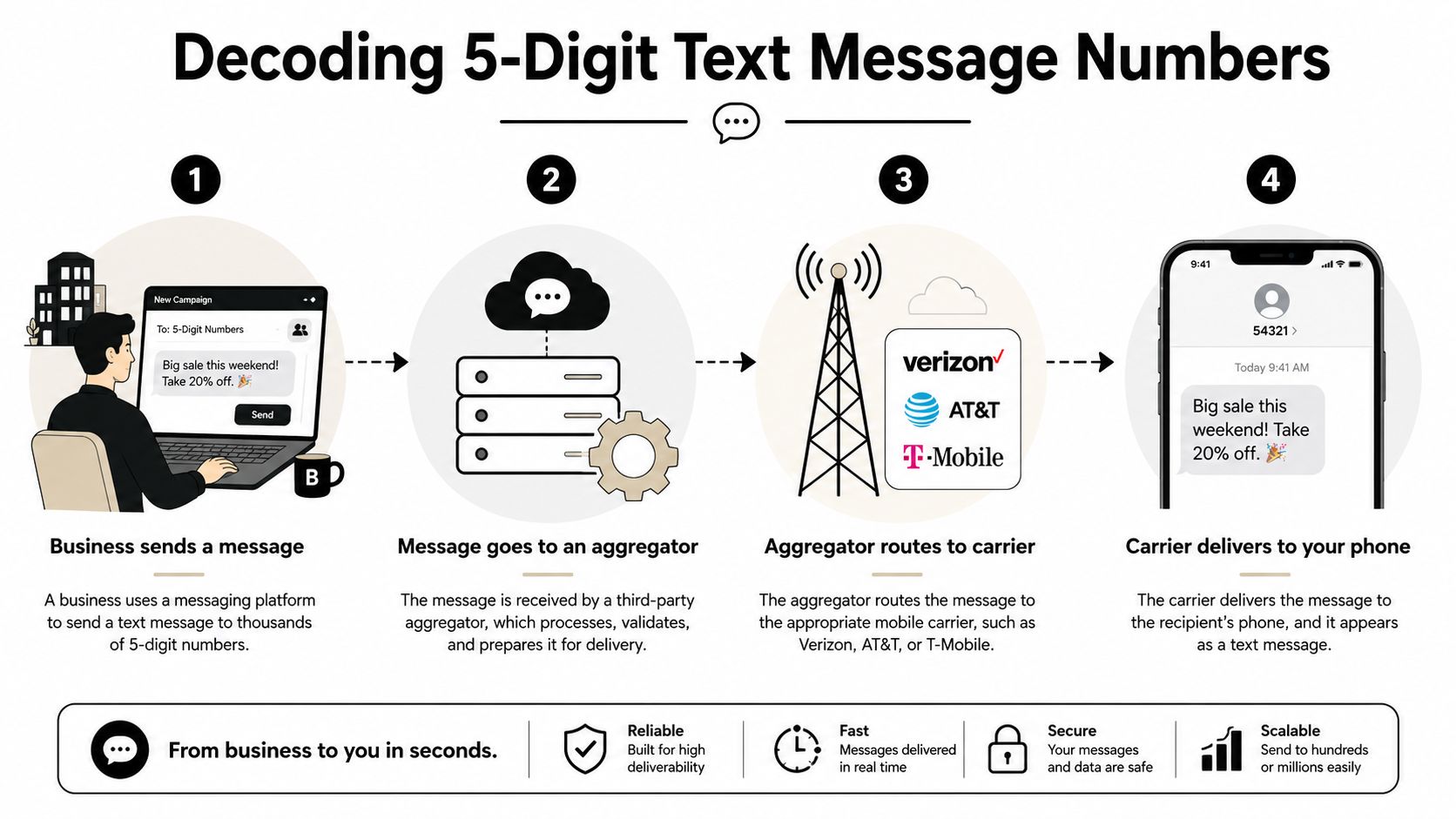
That practical distinction matters. A regular 10-digit mobile number is built for one-to-one messaging. A short code is built for application-to-person messaging at scale, with carrier review and program controls layered on top. In this update, one of the clearest patterns I found is that people do not usually care about the technical term first; they want to know whether a 5-digit SMS code is normal, why it contacted them, and whether replying is safe.
In everyday conversation, people often lump 5-digit and 6-digit SMS numbers together. In practice, U.S. short codes are commonly 5 or 6 digits, and both serve the same broad purpose: high-volume business messaging. The exact length is less important than the function. If the number is short, memorable, and tied to an automated brand program, it is generally operating as a shortcode-style messaging channel rather than a standard mobile line.
Outside the U.S., short codes can vary more widely by country and carrier program. The CTIA messaging framework and carrier onboarding standards are part of why U.S. programs feel more standardized to consumers: the brand, opt-in language, and support commands are expected to be consistent.
Most 5-digit numbers fall into one of four buckets:
That taxonomy is more useful than calling every short-code text "marketing." For example, a bank fraud alert and a retail discount may both come from a short number, but they sit in different compliance and expectation categories. The FCC's TCPA page and CTIA best practices both hinge on this distinction because consent and disclosure requirements are stricter for promotional messages than for some purely informational texts.
A short-code message can feel random even when it is not. In many cases, the text follows a prior action: you entered your number at checkout, signed up for shipping updates, logged in and requested a verification code, booked an appointment, or previously joined a brand's alert list. The first reply in a legitimate program should identify the brand, explain the purpose of the messages, and tell you how to get help or opt out.
I think most consumer confusion stems from the opt-in occurring earlier, often on a website or paper form, so a later text can feel unexpected. If the message does not identify the sender or explain why you are hearing from them, treat it cautiously.
The biggest difference is that short codes are built for throughput, automation, and carrier-reviewed messaging programs. They were adopted to make it easier for organizations to run text campaigns and service notifications without relying on ordinary phone numbers. For businesses, that means memorable numbers and predictable message handling. For users, it means the number is usually tied to a defined workflow rather than a person manually typing back.
Here’s a simple comparison of the common numbers businesses use for texting, showing what makes each one different.
| Number Type | What It Looks Like | Best For | Message Speed |
|---|---|---|---|
| Short Code | 5-6 digits (e.g., 77223) | High-volume marketing, alerts, voting | Fastest (100+ MPS) |
| 10DLC | 10-digit local number | Conversations, appointments, support | Moderate (varies) |
| Toll-Free | 8XX number (e.g., 888-555-1234) | Customer support, high-volume alerts | Fast (40+ MPS) |
Understanding this basic framework makes it clear why short codes are so common for big brands. They offer a direct, instant line of communication that’s easy for customers to remember and powerful enough for companies to bet their major campaigns on.
A short code is more than just a short number; it's a high-throughput channel designed for reliability. While a regular number is like a neighborhood street, a short code is a multi-lane highway built for sending messages at enterprise scale.
The keyword is the command that tells the automated system what action to trigger next. It may start a subscription, request a coupon, pull up listing details, or confirm a service workflow.
Getting the keyword exactly right is critical because the system is usually matching specific approved inputs. That is one of the simplest failure points, and it came up repeatedly as I reviewed common shortcode issues.
Of course, SMS is just one piece of the puzzle. Some businesses also use other powerful tools to round out their communication. For instance, ringless voicemail lets a company drop a pre-recorded message directly into someone's voicemail without their phone ever ringing. It’s a great, non-intrusive way to deliver updates that don’t need an immediate text back.
To learn more about how businesses bring these tools together, check out our guide on leveraging SMS short codes for effective campaigns.
If you want the short version, this is the exact flow:
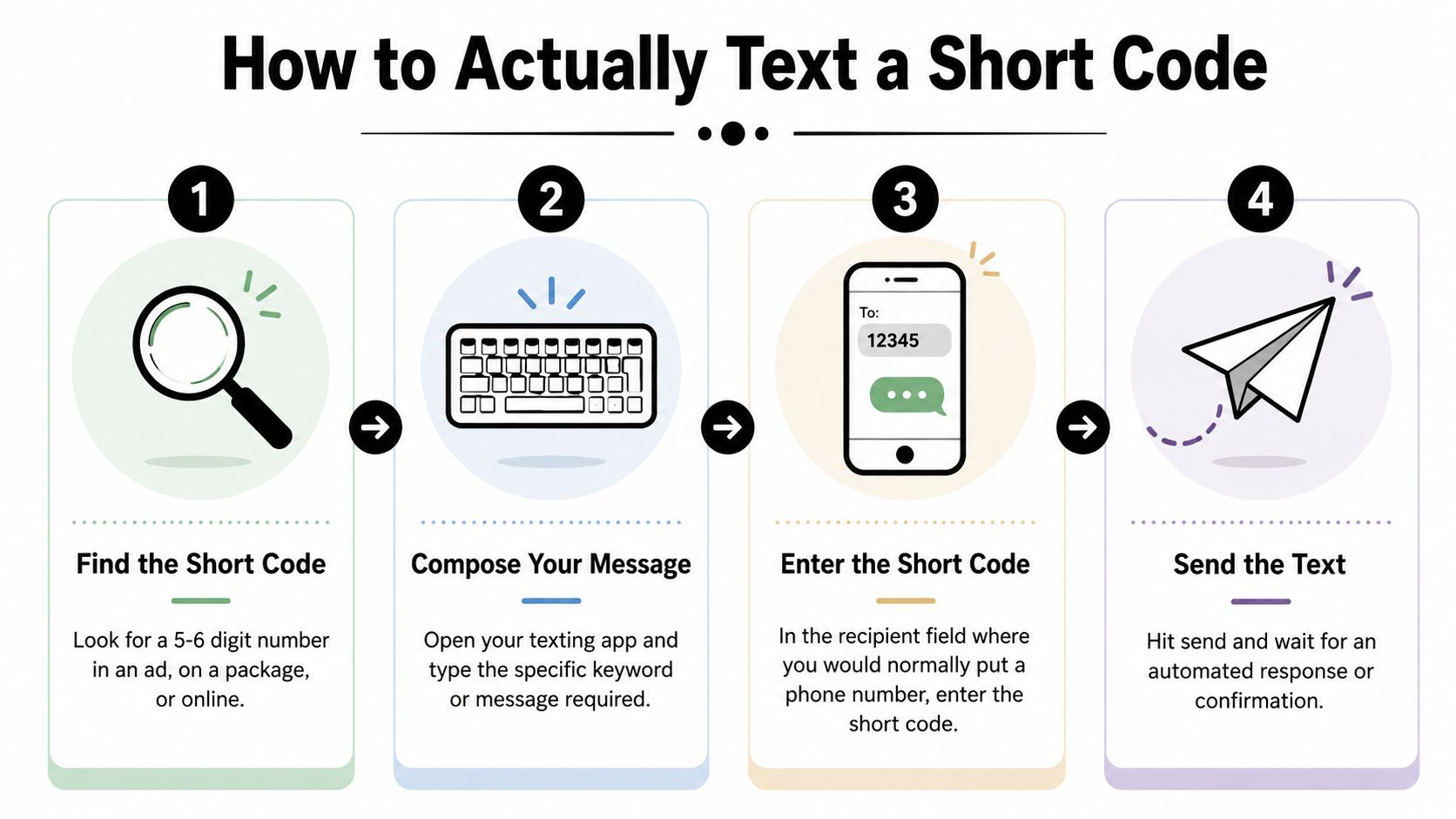
That four-step process is the direct answer for most readers. No extra app is required, and in most cases the only thing that trips people up is entering the wrong keyword.
In my view, the confirmation message is the checkpoint. If the reply is vague, missing the brand name, or does not include support and opt-out language, that is a warning sign.
The message itself is usually just the exact keyword you were told to send. If the instruction says "Text PIZZA to 25252," type only PIZZA unless the campaign says otherwise.
Typing a variation like "I want PIZZA" or misspelling the word may not work because short-code programs often depend on exact matching. Once you send the right keyword, you should generally receive an automated response quickly.
This first reply should confirm what happened, identify the sender, and explain how to get help or stop messages. CTIA program standards expect support language such as HELP and STOP, and the FCC's TCPA guidance reinforces the need for proper consent before promotional texting begins.
That’s the core of how you text a 5-digit number. Businesses love this for text-to-join campaigns, which let customers easily subscribe to updates. You can see more on how businesses use these text-to-join features to build their subscriber lists and keep their audience engaged.
If your message does not work, check these issues first:
The most common problem I see in plain-language terms is not technical at all: people send the right number with the wrong word, or the campaign ended and the ad is still floating around somewhere.
Keywords are way more versatile than just signing you up for a list. They can trigger all sorts of automated actions, which is what makes them so powerful for businesses.
Here are a few real-world examples:
This system just works because it's fast and requires almost no effort from the user. For businesses, having that direct line of communication is gold for building customer relationships.
Businesses invest in 5-digit short codes for one main reason: speed and reliability at a massive scale.
When a brand needs to blast a flash sale alert to 100,000 customers at the exact same moment, a short code is the only tool built for the job. Their entire infrastructure is designed for high-throughput messaging, sending texts at speeds of over 100 messages per second.
But it's not the only option on the table. The world of business texting has a few key alternatives, each with its own strengths. The right choice really comes down to your business goals, your scale, and the kind of conversation you want to have with your audience.
Short codes are the heavyweights of SMS marketing. Their biggest advantage is that unmatched delivery speed.
Because they are pre-approved by mobile carriers, messages sent from short codes bypass many of the filters that can slow down or block texts from other numbers. This pre-vetting process makes them reliable for any time-sensitive communication.
Think about these common scenarios where speed is everything:
A short code is like having a dedicated express lane on the information highway. While other numbers merge into traffic, short codes have a clear path straight to your recipient's inbox, making them essential for any high-volume, mission-critical messaging.
As the name suggests, a 10-Digit Long Code (10DLC) is just a regular-looking 10-digit phone number that's been approved for business messaging. These numbers feel way more personal and are perfect for one-on-one or small group conversations. For small businesses that want to build real relationships, 10DLC is the go-to.
Instead of mass blasting promotions, 10DLC is much better suited for things like:
While they can’t touch the raw speed of a short code, 10DLC numbers offer a familiar, human touch that a 5-digit number sometimes lacks. It feels like you're texting with a person, not a marketing machine.
Toll-free numbers (like the ones starting with 888 or 877) have become another popular option for business texting. They manage to blend some of the benefits of both short codes and 10DLC.
They're widely recognized and trusted by consumers, and they can handle a higher volume of messages than a standard 10DLC number—though still not as much as a dedicated short code. This makes them a great middle-of-the-road solution for customer support channels, where a business might need to handle a steady stream of incoming questions but doesn't need to send massive promotional blasts.
Here's a quick breakdown of how the three main options stack up:
| Feature | Short Codes | 10DLC Numbers | Toll-Free Numbers |
|---|---|---|---|
| Appearance | 5-6 digits | 10-digit local number | 10-digit 8XX number |
| Best For | Mass marketing, alerts, 2FA | Two-way conversations | Customer support, alerts |
| Throughput | Very High (100+ MPS) | Lower (Varies by carrier) | High (40+ MPS) |
| Cost | Highest | Lowest | Moderate |
| Feel | Automated, official | Personal, conversational | Trusted, professional |
Rounding out the modern communication toolkit is ringless voicemail. This technology allows a business to send a pre-recorded audio message directly to a recipient's voicemail inbox without making their phone ring. It’s a powerful, non-intrusive method for delivering detailed or personal updates that aren't suited for a quick text message.
This technique, sometimes called a ringless voicemail drop, is perfect for scenarios where a voice's tone and nuance are important. For example, a non-profit could send a heartfelt thank you message, or a sales professional could deliver a personalized follow-up after a meeting. Ringless voicemail complements an SMS strategy by providing another layer of communication that can capture attention differently than a standard text.
The safest way to judge a 5-digit texting program is not by the number alone, but by the behavior around it. A legitimate short-code campaign should make four things obvious in the first interaction: who the brand is, what messages you are signing up for, how often they may arrive, and how to get help or stop them. Those expectations come directly from industry and legal guardrails, including the CTIA messaging principles and the FCC's TCPA guidance.
When you text a valid keyword to a legitimate program, the response should typically include:
That is much more useful than vague claims about "compliance." If a first reply omits those basics, I would be skeptical. Good programs are explicit because carriers and regulators expect them to be explicit.
For marketing messages, businesses need clear permission before they start texting. The FCC explains that the TCPA restricts telemarketing texts sent without the recipient's prior consent, and the details become even stricter depending on the campaign type. In practical terms, that means a business cannot collect a phone number and assume texting permission came with it.
Common valid consent paths include a user texting a keyword, checking an unchecked signup box, or completing a form that clearly discloses the SMS program terms. The FCC's consumer guidance on unwanted texts and CTIA best practices both reinforce the same idea: consent and opt-out controls are not optional extras.
Carrier filtering is one reason a text to or from a shortcode may fail, but it is not the only one. Carriers and messaging providers look at the campaign setup, the approved use case, content, links, and whether the sender followed onboarding requirements. That review process is part of why short codes are trusted for high-volume programs in the first place.
For consumers, the takeaway is simple: an approved short code is not just a random five-digit number somebody starts using overnight. For businesses, it means setup requires carrier review, provisioning, and program approval through official channels such as the US Short Code Registry and messaging providers that work within carrier rules.
Businesses do not casually "get" a 5-digit number in an afternoon. A company typically leases a short code, configures the campaign details, submits the intended use case, and goes through provider and carrier review before launch. The US Short Code Registry process exists precisely to formalize ownership, leasing, and administration.
That is also why free dedicated short codes are not a realistic business option. In most cases, a company either leases its own code or uses a shared keyword arrangement through a platform that already manages compliant messaging infrastructure. This is one of the biggest gaps in lower-quality guides: they make shortcode setup sound instant when it is governed, reviewed, and tied to documented campaign behavior.
For a closer look at what we consider responsible messaging, you can check out our strict anti-spam policy.
If you want a 5-digit SMS number for your business, the first thing to know is that a true short code is usually leased, reviewed, and approved rather than created on demand. The official U.S. path runs through the US Short Code Registry, typically with a messaging platform or provider guiding the application and campaign setup.
There are three realistic options:
A dedicated short code is reserved for one business. This gives the company full control over the number, the keywords, and the messaging program structure. It is the best fit for brands sending large volumes of alerts, promotions, or authentication texts and needing a single number associated only with their business.
The tradeoff is cost, review time, and operational overhead. A dedicated code is not the low-friction option.
Some platforms let businesses join a shared shortcode environment where the provider controls the number and the business claims one or more keywords. This is often the more accessible route for promotions and list building because the shortcode infrastructure is already in place.
For many small and midsize businesses, this is the practical middle ground. You get the consumer-friendly shortcode experience without taking on the full burden of managing a dedicated number from scratch.
If your business needs conversational texting, appointment reminders, support, or moderate outbound volume, a toll-free or 10DLC number may be the smarter choice. In a lot of real business cases, that is what I would recommend first because it is usually more affordable and easier to launch while still supporting legitimate A2P messaging.
Not in the way commonly meant. A true business short code is not generally free because it involves leasing, administration, and approval. Some providers may offer lower-cost access to a shared shortcode keyword or a promotional trial on another messaging channel. That is different from owning or leasing a dedicated 5-digit code.
If budget is the main concern, a 10DLC or toll-free setup is often the better starting point. A short code makes the most sense when your volume, speed requirements, and brand workflow justify the extra approval and expense.
So, you're ready to make 5-digit short codes a part of your marketing. Where do you even start? It's not just about blasting out texts; it’s about building a solid, compliant communication channel that gets people to take action.
Your first move is to claim a keyword on a shared short code. This is your brand's unique trigger word—think "DEALS" or "VIP"—that customers text to your shared 5-digit number to get on your list. This first text is everything. It’s where you get their permission and kick off the entire relationship.
The foundation of any good SMS strategy is your text list. And I can't stress this enough: you must get explicit permission before you send a single marketing message. This means your subscribers have to take a clear, intentional step to join.
A few methods that just plain work:
The key here is transparency. Be upfront about what they're signing up for and how often you'll be hitting them up.
Quick tip from experience: a smaller list of genuinely interested subscribers is always better than a massive list of people who couldn't care less. Focus on getting quality opt-ins. You want your messages to be welcomed, not swiped away.
Alright, you've got a list. Now what? It's time to write messages that grab attention and drive action. Your texts need to be short, valuable, and have a crystal-clear call-to-action. Generic messages get deleted. Personalized and timely ones get results.

Feel free to swipe these templates for common situations:
This whole process boils down to a simple, compliant flow: get their consent, send your message, and always give them an easy way out.
As you can see, every step revolves around the user's consent and control. That’s how you build trust and keep people subscribed.
Timing is everything. Sending a lunch special at 4 PM is a wasted effort. With a platform like Call Loop, you can schedule your campaigns ahead of time so they land at the perfect moment—right during peak shopping hours or just before a big event.
But sending is only half the job. You need to know what's working. Use your analytics to track performance. Tracking your metrics is essential if you want to fine-tune your strategy and prove you're getting a return on your investment.
Keep a close eye on these key performance indicators (KPIs):
By building your list the right way, crafting messages that matter, and constantly checking your results, you can turn 5-digit texting into a real engine for growth and customer engagement.
Even though texting a 5-digit number is pretty straightforward, a few questions always seem to pop up. It's totally normal to wonder about the cost, what to do if your message doesn't send, or why you're even texting a short number instead of a regular one. Let's clear up some of that confusion right now.
This is usually the first thing people ask. The short answer? In most cases, no.
These texts typically fall under your regular plan, which is why you always see that "message and data rates may apply" disclaimer. It just means it's treated like any other text message. However, some specific services—like voting on a TV show or donating to charity—might have premium charges. These have to be spelled out clearly before you opt in, so you'll know upfront.
It's frustrating to text a keyword to a short code and get nothing back. Usually, it's a simple fix.
The most common culprit is a typo. Automated systems are picky and need the keyword to be exact, so a quick double-check of your spelling before you hit send can save you a headache.
Another frequent issue is a block on your mobile plan for premium or commercial messages. This is a setting you can typically change by giving your carrier a quick call. Less often, the campaign itself might be over, or the system could just be having a temporary glitch.
Pro Tip: If you're sure the keyword is spelled right and you're still not getting a reply, try texting the word "HELP" to the same number. Legitimate services are expected to provide help or support details, which aligns with CTIA shortcode program expectations.
Usually because you interacted with a business or service earlier, even if it did not feel memorable at the time. Common triggers include signing up for sale alerts, checking a shipping-update box, requesting a login code, confirming an appointment, or replying to a prior campaign.
To figure out whether the text is legitimate, start with four checks:
If the text has no clear sender identity, no explanation, and no opt-out path, don't engage with links inside it.
Start with the easiest source: the campaign itself. A legitimate shortcode program should identify the brand in the initial confirmation or help response. Texting HELP may return support details, a website, or the business name.
For businesses and researchers, shortcode administration in the U.S. is tied to the US Short Code Registry, which handles leasing and program management rather than functioning like a public reverse-lookup directory. In practical terms, that means consumers usually identify the operator through the message content, the original opt-in point, the brand's published SMS terms, or customer-support channels.
Not at all. While you probably see them most often for marketing promotions, that's just scratching the surface. Their speed and massive capacity make them essential for all kinds of critical alerts.
Think about it: banks use them for two-factor authentication (2FA) codes to keep your account secure. FedEx and other shippers send delivery updates, and your doctor's office probably sends appointment reminders via short code. These are all "transactional" messages—they're functional, not promotional.
This versatility is exactly why they're still so popular. They are a powerful tool for any business that needs to send a high volume of texts quickly and reliably. SMS authentication is also widely used because short codes are designed for high-volume, carrier-approved messaging flows, even though security experts continue to point out the weaknesses of SMS-based verification in general, as discussed in this overview of SMS authentication security.
Ready to harness the power of SMS, voice, and even ringless voicemail for your own business? Call Loop provides all the tools you need to create compliant, high-impact outreach campaigns that get results. Start your journey with Call Loop today!
Chris Brisson
Chris is the co-founder and CEO at Call Loop. He is focused on marketing automation, growth hacker strategies, and creating duplicatable systems for growing a remote and bootstrapped company. Chat with him on X at @chrisbrisson
Chris Brisson
Chris is the co-founder and CEO at Call Loop. He is focused on marketing automation, growth hacker strategies, and creating duplicatable systems for growing a remote and bootstrapped company. Chat with him on X at @chrisbrisson


Trusted by over 45,000 people, organizations, and businesses like


