
See a Demo
You're just one step away from seeing Call Loop in action.
Enter your information below to watch a demo right now.

You're just one step away from seeing Call Loop in action.
Enter your information below to watch a demo right now.

Let's get right to it: standard SMS messages are not encrypted.
Think of sending a text like sending a postcard. Anyone who gets their hands on it along its journey can read the entire message. This isn't a bug or an oversight; it's just how SMS technology was designed from the ground up, decades ago.
To really get why your texts aren't private, you have to picture the path they take. When you hit "send," your message doesn't just zap directly to your friend's phone.
Instead, it travels in plain, readable text across a network of cell towers and carrier systems. Like a postcard passing through different mail sorting facilities, your message is exposed at multiple points before it ever reaches its final destination.
The protocol behind SMS (Short Message Service) was built for one thing: getting a short message from A to B reliably. Confidentiality just wasn't part of the equation back then.
Here's the simplest way to think about the difference between SMS and modern messaging apps:
This one difference is a really big deal. It’s why sending any kind of sensitive info over a standard text is a huge gamble. Industry data has shown time and again that SMS messages are vulnerable to being intercepted precisely because they travel in plain text.
Because SMS messages travel unencrypted, they lack the basic privacy protections we've come to expect from modern communication tools. This vulnerability is not a bug; it's a feature of an aging system.
To get a better handle on how this all fits into the bigger picture of keeping data safe, it's worth digging into understanding the role of encryption in information security. While SMS is a familiar tool, it's critical to know its limitations.
For a quick side-by-side comparison, this table breaks down the key security differences between old-school texting and modern encrypted apps.
As you can see, the security gap is massive. When privacy is a concern, standard SMS just doesn't measure up to the protections offered by modern encrypted messaging services.
The reason your texts aren't private is baked right into the technology itself. SMS runs on a system called Signaling System No. 7 (SS7) protocol, which was designed decades ago. Back then, the engineers were focused on making sure a text from a Verizon phone could get to an AT&T phone—reliability and compatibility were the names of the game. Security wasn't even on the radar.
It helps to think of it like the old-school postal service. You write a message on a postcard, drop it in a mailbox, and trust that every single person who handles it along the way will ignore what you wrote. The SS7 system was built on a similar foundation of trust; it simply assumes every network carrier is a good, secure actor. That assumption just doesn't fly anymore.
This old-school design means your messages are essentially traveling in the open once they leave your phone. While there's a little bit of encryption protecting the signal between your phone and the nearest cell tower, that protection stops there. The moment your message hits the carrier's network, it might as well be an open book.
To really get why this is a problem, let's trace the path a standard text message takes from sender to receiver.
This infographic lays out the simple—and shockingly vulnerable—journey of an SMS, showing how it's left wide open as it hops between carrier networks.
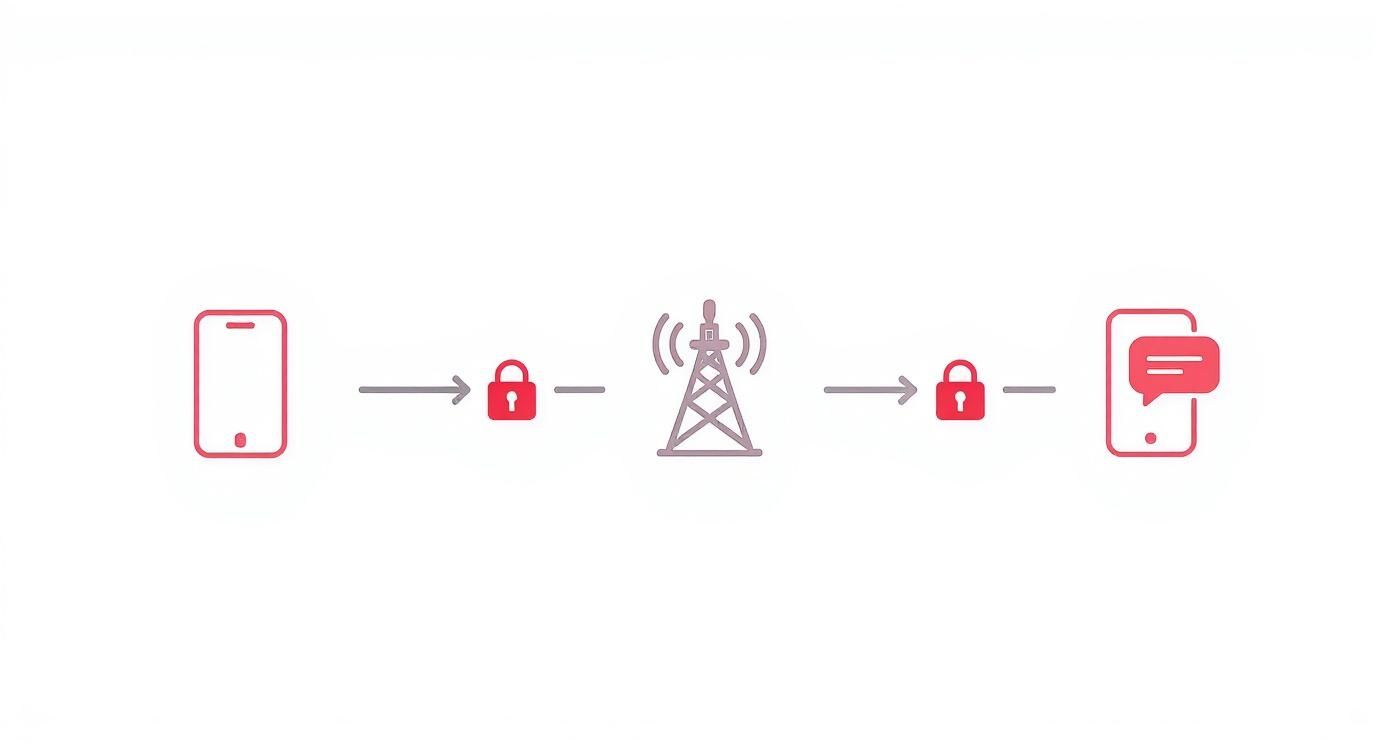
The big takeaway here is that your message is only briefly scrambled for that first leg of its trip over the airwaves. Once it’s inside the network, it’s completely exposed and vulnerable to being intercepted. This isn't a bug in a particular app; it's a fundamental feature of how SMS works.
This exposure opens the door to all sorts of security nightmares. Hackers who get access to the SS7 network can exploit its built-in weaknesses to intercept, re-route, or just plain read your messages, all without ever touching your phone.
This design flaw is so massive that the National Institute of Standards and Technology (NIST) officially warned against using SMS for authentication years ago, pointing directly to how easily messages can be intercepted and faked.
The most common threats are surveillance and what's known as a "man-in-the-middle" attack. In these attacks, a bad actor basically sits between you and the person you're texting, silently reading every message as it passes through. Because the SMS is unencrypted, they can see everything in plain text.
This isn't just about someone snooping on your private chats. This security gap has real, tangible consequences for your digital life. Many online services still use SMS to send you two-factor authentication (2FA) codes. If a hacker can intercept that text, they can waltz right into your bank account, email, or social media.
This vulnerability also affects newer communication methods that piggyback on the same carrier networks. For example, some businesses use ringless voicemail drops to send marketing messages straight to a user's voicemail. While it's a clever way to reach people, the underlying technology has the same security flaws as SMS. Other tactics, like voice broadcasting, also rely on carrier networks that may not be fully secure. The security of these services depends entirely on the provider's infrastructure.
It all comes back to the core question: is SMS encrypted in any meaningful way? The answer is a hard no. Its entire foundation was built for delivery, not privacy, leaving a trail of digital "postcards" for anyone to read. Relying on it for anything sensitive is a major gamble for individuals and businesses alike.
The technical flaws we’ve talked about aren't just abstract problems for security nerds. They translate directly into tangible, everyday dangers. When your text messages are essentially open postcards, they become ridiculously easy targets for anyone looking to get their hands on sensitive information.
This isn’t just a theoretical "what if" scenario; it has serious consequences for you, your family, and your business.
One of the most common threats you’ll run into is smishing—which is just a fancy word for phishing attacks that happen over SMS. Scammers blast out texts pretending to be your bank, a delivery service, or even a government agency. Their whole game is to trick you into clicking a malicious link or coughing up personal info like passwords or credit card numbers.
This makes sending any sensitive data through a standard text a huge gamble. Things like two-factor authentication codes, bank details, or private health updates can be snatched right out of the air, opening the door to account takeovers and full-blown identity theft.
The scope of this issue is pretty staggering. Projections show that by 2025, over 3.5 billion people will get spam texts every single day. Even worse, credential phishing attacks have skyrocketed by an alarming 967%.
Despite these massive risks, SMS is still a universal channel. With 8.5 billion mobile subscribers worldwide, it highlights a massive global security gap. You can dig into more details in this report on messaging channel trends.
This is why the question "is SMS encrypted?" is so critical. The answer—a firm "no"—has direct financial and personal security implications for billions of people.
A compromised text message can be the first domino to fall in a major security breach. What starts as an intercepted password reset code can quickly escalate into a full-blown account takeover.
For businesses, the stakes are even higher. A single unsecured message containing customer data can lead to a world of pain:
These security concerns aren't just limited to texting. They bleed over into related communication tech, too.
For example, ringless voicemail is a great tool for dropping a message directly into someone's voicemail box without their phone ever ringing. But the systems used to manage these campaigns have to be buttoned up to protect user data and stay compliant. A secure ringless voicemail provider will implement robust measures to safeguard the data used in campaigns, from contact lists to message content.
A solid communication strategy means thinking about security across every single channel. The simple lack of encryption in standard SMS makes it a terrible choice for any communication that needs to stay confidential, forcing businesses to find more secure platforms to protect themselves and their customers.
After seeing the clear security gaps in standard SMS, the obvious question is: what should I be using instead? Thankfully, a whole world of powerful, easy-to-use, and secure alternatives has popped up to fill the void left by old-school texting. These options were built from day one with privacy as the main event.
The gold standard for any private conversation is end-to-end encryption (E2EE).
Think of E2EE like creating a private, unbreakable tunnel between you and the person you're messaging. When you hit send, your message gets scrambled into unreadable gibberish right on your device. It only gets unscrambled when it lands on your friend's device. No one in the middle—not the app maker, not your internet provider, and definitely not a hacker—can read a single word.
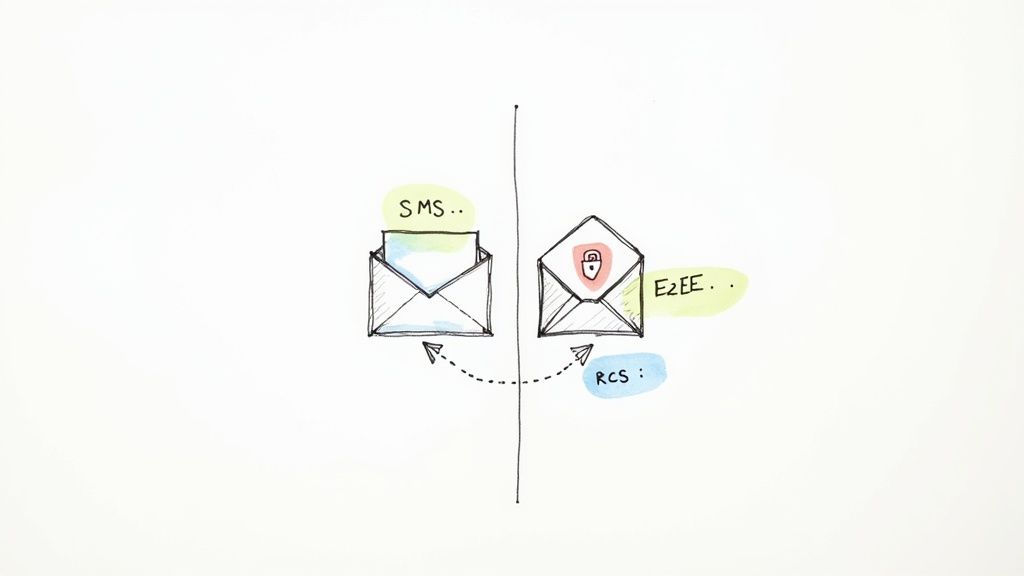
This super-strong security is exactly why platforms like Signal and WhatsApp blew up in popularity. They offer a level of privacy that SMS just can't touch, making them perfect for any conversation that needs to stay confidential. When you're in an E2EE app, you can be sure your messages are for your eyes only.
Several apps have staked their entire reputation on providing secure, E2EE-powered messaging. Here’s a quick look at a few of the most popular options available today.
This table breaks down some popular messaging services, highlighting their encryption standards, key privacy features, and what they're generally best for.
As you can see, while options exist, the level of security can vary. The massive global shift to apps like WhatsApp really puts a spotlight on the question of is SMS encrypted. The clear answer is no, and the market has responded by demanding better.
Another big name you'll hear is Rich Communication Services (RCS), which is often talked about as the modern replacement for SMS. Pushed heavily by Google and wireless carriers, RCS brings modern features like typing indicators, read receipts, and high-quality photo sharing right into the default messaging app on Android phones.
But when it comes to security, it's a bit of a mixed bag.
While Google's version of RCS does use end-to-end encryption for one-on-one chats, that protection isn't guaranteed across the board. Encryption for group chats is still being rolled out, and if you text someone whose phone or carrier doesn't support the universal RCS profile, your message often just defaults back to plain, unencrypted SMS.
This inconsistency means you can't always be certain your conversation is actually private.
While RCS is a huge step up from the postcard-like security of SMS, its spotty encryption means it hasn't completely solved the privacy problem yet.
For any business handling sensitive information, relying on default messaging just isn't an option. Organizations that truly prioritize confidentiality need to explore platforms offering dedicated secure SMS capabilities. These business-grade tools provide far stronger security controls and compliance features than any consumer app ever could.
Now that we know the answer to "is SMS encrypted?" is a resounding no, it's on businesses to get proactive about security. Relying on an insecure channel for sensitive customer info or even internal chatter isn't just risky—it's a straight path to serious compliance violations and a fast way to lose customer trust. The very first move? Create a clear, comprehensive communication policy.
This policy needs to be the go-to guide for your entire team. It should spell out exactly what kind of information is too sensitive for a standard text message. Think financial details, login credentials, or any personally identifiable information (PII). A well-defined policy gets rid of the guesswork and builds a solid security foundation for every single interaction.
Your communication policy needs to be specific and dead simple to follow. Think of it as putting up digital guardrails to protect your business and your customers. This shouldn't be a "set it and forget it" document, either—it needs to be updated regularly and driven home through team training.
A strong policy should include:
For businesses putting these safeguards in place, it's also smart to think about the bigger picture of building secure scalable infrastructure to properly support all your communication channels.
Let's be clear: navigating the regulatory landscape is non-negotiable. Rules like GDPR in Europe and HIPAA in the United States have strict requirements for handling personal data, and unencrypted SMS just doesn't cut it. One slip-up can lead to massive fines and a damaged reputation that’s hard to repair.
The lack of encryption in SMS is drawing more and more heat from regulators. In the U.S., where SMS advertising spend is on track to hit $318.5 million in 2025, businesses are waking up to these risks. While the industry is getting better at fraud detection, those measures don't fix the fundamental encryption problem.
Partnering with a communications vendor that actually understands and follows compliance standards like HIPAA is critical. A compliant vendor isn't just a service provider; they're a key partner in your security strategy, offering the right tools and protocols to protect sensitive data.
This means you have to vet potential partners carefully. Make sure they offer solid security features and are upfront about how they handle data. A good place to start is by reviewing a vendor's privacy policy to see what they're committed to. In the end, choosing the right partners and setting clear internal rules are the cornerstones of secure business communication.
Let's cut to the chase: standard SMS is not encrypted. Thinking of it like sending a postcard through the mail is the perfect analogy—anyone along its route can take a peek.
That might sound a little scary, but the good news is you're not stuck. Plenty of powerful, easy-to-use, and secure alternatives are already out there. The whole world of digital communication is shifting, and privacy is finally becoming a core feature, not just a nice-to-have.
Sure, we'll eventually see wider adoption of technologies like Rich Communication Services (RCS), which is trying to make encryption the default. But its rollout has been patchy at best. For right now, the single most important thing you can do is to start making conscious, security-first choices in how you communicate.
Feeling empowered to make smarter messaging choices just takes a few practical tweaks. These steps can seriously dial down your exposure to the risks we've talked about.
For Your Personal Use:
For Your Business Operations:
At the end of the day, just knowing the answer to "is SMS encrypted?" is the first step. The real win comes from taking decisive action to protect your privacy and the trust people place in you. By embracing secure alternatives and setting clear ground rules, you can communicate with total confidence.
For businesses ready to put secure, compliant, and effective messaging into practice, Call Loop provides a multi-channel platform with HIPAA compliance built right in. Explore how Call Loop can secure your customer communications.
Chris Brisson
Chris is the co-founder and CEO at Call Loop. He is focused on marketing automation, growth hacker strategies, and creating duplicatable systems for growing a remote and bootstrapped company. Chat with him on X at @chrisbrisson


Trusted by over 45,000 people, organizations, and businesses like


