
See a Demo
You're just one step away from seeing Call Loop in action.
Enter your information below to watch a demo right now.

You're just one step away from seeing Call Loop in action.
Enter your information below to watch a demo right now.

Let's cut through the noise. A mass texting service is a platform that lets your business send SMS and MMS messages to a whole list of contacts all at once. But it's so much more than a giant group chat. These services are packed with tools for automation, compliance, and analytics, turning a simple text into a powerful way to handle marketing, send alerts, and talk to your customers.
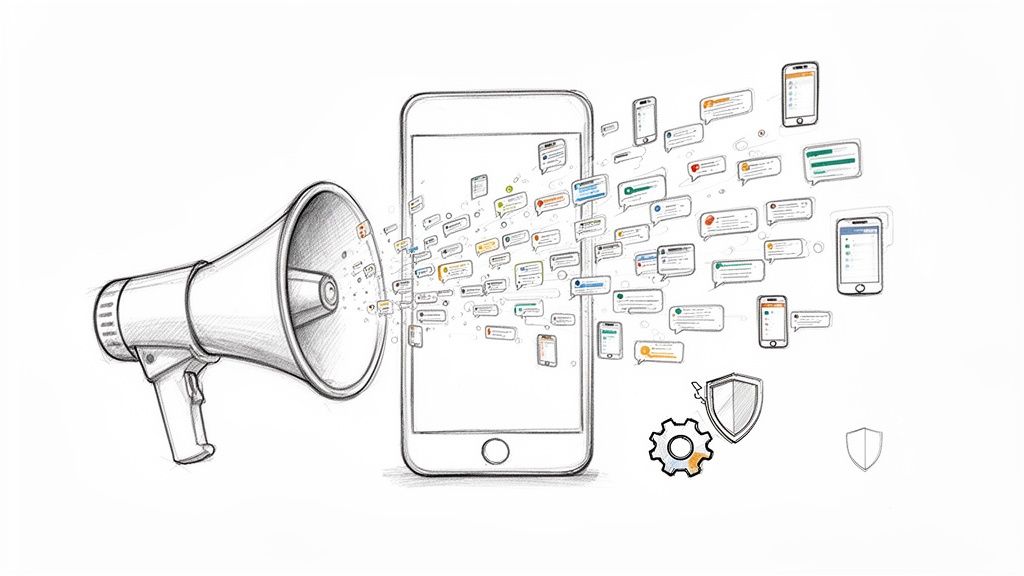
Think of it like a megaphone that can whisper a unique, personalized message directly into thousands of customers' ears at the exact same moment. That’s the magic of a mass texting service. It blows the doors off the limitations of your standard mobile phone, letting you connect with your entire audience at scale.
This isn't just about blasting out the same message to everyone. It's a strategic tool. A good platform lets you slice your audience into specific groups, personalize messages with names or order details, and schedule them to go out at the perfect time. Suddenly, a simple text becomes a real conversation starter.
It’s easy to think, "Why can't I just use my phone's group chat?" The reality is, using a personal phone for business messaging is like trying to run a restaurant out of your home kitchen—it works for a few people, but it quickly becomes messy, unprofessional, and can even get you in trouble.
Here's a quick breakdown of why a professional service is a completely different league:
As you can see, a dedicated service is built from the ground up for professional, compliant, and effective communication that a personal phone just can't handle.
Many modern platforms don’t just stop at text. They also integrate powerful tools like ringless voicemail and voice broadcasting. A ringless voicemail lets you drop a pre-recorded audio message straight into someone's voicemail box without their phone ever ringing.
Imagine sending a flash sale alert via SMS, then following up an hour later with a personal voicemail from the founder. This combination creates a multi-touch experience that feels far more personal and human than text alone. It elevates the platform from a simple notification tool to a core part of your customer engagement strategy.
This is exactly why so many businesses are jumping on board. Today, around 39% of businesses use texting to talk with customers. And get this—an incredible 97% of those companies say they communicate more efficiently because of it. You can dig into more of these trends over at emarsys.com.
A mass texting service is not just a tool for sending texts. It's a complete communication system designed to build relationships, drive action, and deliver measurable business results through the most direct channel available today.
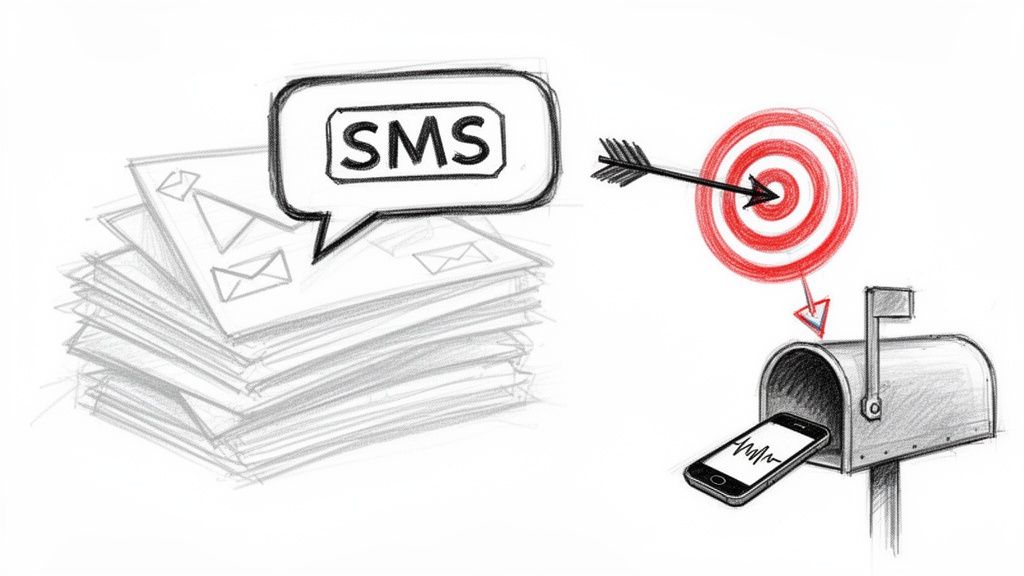
Let's face it: the average email inbox is a war zone. It’s an overflowing battleground where every brand is fighting for a sliver of attention. Text messages, on the other hand, slice right through the noise. This isn’t just a small edge; it’s a complete game-changer for how you can actually reach people.
The real power of a mass texting service for business comes down to speed and visibility. While an important email might sit unopened for days, a text is almost always seen right away. It's a direct line for anything time-sensitive, whether that's a flash sale ending in two hours or an urgent appointment reminder. When you absolutely, positively need a message to be seen, SMS is the most reliable tool you've got.
The engagement gap between texting and pretty much every other channel isn't just big—it's monumental.
Text messages have a staggering 98% open rate. For context, that number crushes the typical 20% open rate for email marketing. But the real magic is in the speed. An incredible 90% of texts are read within the first three minutes of hitting someone's phone.
That kind of immediacy creates a sense of urgency and relevance that other marketing just can’t replicate. On top of that, SMS campaigns can see click-through rates that blow past what most marketers would consider a huge win for email. If you want to dig into the numbers, you can review more statistics on text message marketing.
This direct connection drives real, tangible action. By getting in front of customers at just the right moment, you can:
While the speed of SMS is a massive advantage, sometimes a message needs a more human element. That's where a complementary tool like ringless voicemail can make a huge difference. A ringless voicemail drop lets you deliver a pre-recorded audio message directly into a customer's voicemail inbox without making their phone ring.
Think about how you could combine these.
This one-two punch creates a much richer, more memorable experience. The text gives them the instant call-to-action, but the voicemail adds a layer of warmth and personality that a simple text just can't match. It’s a powerful, non-intrusive way to make a human connection at scale.
By combining the instant impact of SMS with the personal touch of ringless voicemail, businesses can build stronger relationships, increase conversions, and create a communication strategy that truly stands out.
At the end of the day, using a professional mass texting service for business is about more than just broadcasting messages. It’s about respecting your customers' time and attention by meeting them on the channel they actually prefer. That kind of instant, direct connection isn't just a "nice to have" anymore—it's a critical piece of the puzzle for any business trying to grow.
Theory is one thing, but seeing how it works in the real world is what really matters. A mass texting service for business isn't just another communication channel; it's a serious engine for growth, making things run smoother and keeping customers happy across all sorts of industries.
Let's break down how different businesses are using these platforms to tackle everyday problems and get fantastic results.
Picture a busy e-commerce store gearing up for a flash sale. Instead of just sending an email or posting on social media and hoping for the best, they send a targeted SMS right at noon: "Hi [FirstName]! Our 40% OFF flash sale is LIVE for the next 4 hours only. Shop now before it's gone!"
The message has a direct link to buy, making it incredibly easy for someone to go from seeing the alert to checking out. This direct, can't-miss approach drives a wave of traffic and sales that other channels struggle to compete with. The outcome is more than just a successful sale—it reinforces the idea that customers should pay attention to texts from this brand because they contain valuable, time-sensitive deals.
But this isn't just for online retailers. Think about a local karate studio that has to cancel a class last-minute because the power went out. One quick mass text goes out to all the parents. Everyone gets the message instantly, saving dozens of people from making a wasted trip. That simple, proactive text builds a ton of trust and goodwill.
In the same way, healthcare clinics use HIPAA-compliant texting to slash the number of costly no-shows. Sending an automated text 24 hours before an appointment with a simple "Reply YES to confirm" prompt is shockingly effective. It's a small touch that improves the clinic's schedule, saves the front desk from making hours of manual reminder calls, and protects revenue.
By meeting customers on the channel they actually use, businesses can deliver critical information at the exact moment it's needed, turning a potential headache into a smooth experience.
Event organizers are also huge fans of mass texting. They use it to send ticket confirmations, day-of reminders with parking details, and even last-minute schedule changes. During an event, they can text attendees about special sessions or networking opportunities, making the whole experience more engaging and valuable.
The strategic uses are incredibly diverse. In the insurance world, for instance, agents can use MMS to send a quote or receive claim photos on the spot, cutting down processes that used to drag on for days. The customer can respond in minutes, making the entire workflow faster for everyone involved.
For the biggest impact, businesses should weave mass texting into a broader multi-channel marketing strategy. This creates a consistent and layered approach, ensuring you're reaching customers effectively across all their favorite touchpoints.
The data backs this up. A recent report found that 63% of businesses use text messaging for scheduling and reminders, proving just how valuable it is for day-to-day operations. Even more telling, over 54% of SMS revenue now comes from automated messages triggered by customer actions, showing how profitable smart, timely messaging can be. You can see more in the full report on SMS marketing statistics.
These real-world examples all point to the same conclusion: a professional mass texting service for business is an incredibly versatile tool. Whether you're trying to boost sales, streamline your operations, or build stronger relationships with your customers, the direct and immediate nature of SMS—often paired with the personal touch of a follow-up ringless voicemail—delivers results you can actually measure.
Let's be honest, not all mass texting services are built the same. While plenty of them can send a simple text blast, the platforms that actually move the needle for your business are loaded with smart tools built for precision, efficiency, and—most importantly—compliance.
Choosing a service without these core features is like trying to build a house with just a hammer. You might get something standing, but it won’t be strong, functional, or built to last. To find a real business asset, you need to look under the hood. The right mass texting service for business gives you a set of non-negotiable features to send the right message, to the right person, at the right time. Every single time.
Let's break down exactly what you should be looking for.
Blasting the same generic message to your entire list is a one-way ticket to getting ignored. Real engagement happens when you make each person feel like you're talking directly to them. This all starts with segmentation—the ability to slice your audience into smaller, targeted groups based on specific criteria.
Imagine you run a retail store. Instead of sending a single text about a new shoe collection to everyone, you could create segments like:
By targeting these smaller groups, your messages become instantly more relevant and powerful. But that's just one piece of the puzzle. Personalization takes it a step further by using merge tags (or custom fields) to drop individual details right into the text, like a customer's first name, their appointment time, or a recent purchase. A message that says, "Hi Jessica, your 2:00 PM appointment is confirmed," will always outperform a generic reminder.
This is how specific texting strategies line up with core business goals.
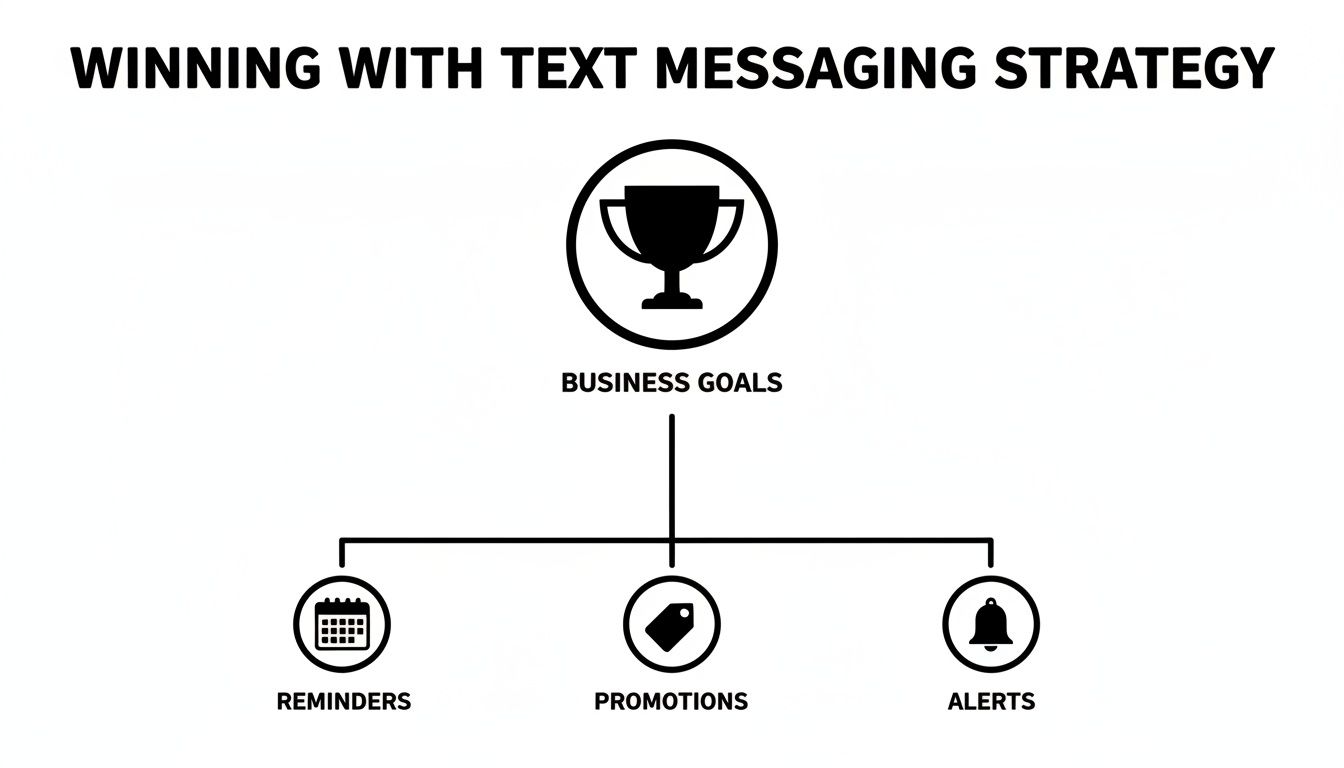
The image makes it clear how fundamental business objectives are directly supported by specific texting tactics like reminders, promotions, and alerts.
Your time is precious. Manually sending every single message just isn't going to work as you grow. This is where automation becomes your best friend, working for you around the clock.
Message scheduling is the simplest form of this. It lets you write your campaigns ahead of time and set them to go out at the perfect moment—whether that's during a morning commute or right before the big game starts.
Automation turns your texting platform from a manual chore into a self-sufficient communication engine. It builds customer relationships and drives action, even when you’re not actively working.
Drip campaigns are where the real magic happens. These are pre-built sequences of messages that automatically fire off when a new contact subscribes or takes a specific action. For example, a new subscriber could get:
This automated sequence nurtures the relationship over time, guiding customers on their journey without you lifting a finger. To get a better sense of how to build these, you can explore the various messaging features a powerful platform offers.
In the world of business texting, compliance isn't just a good idea—it's the law. Regulations like the Telephone Consumer Protection Act (TCPA) come with hefty fines for violations. It's critical that your platform has compliance baked into its very DNA.
Look for a service that gives you the tools to stay protected. Text-to-Join keywords are a compliant and easy way to grow your list because they require people to actively opt in. The system must also handle opt-out requests automatically. When someone replies with "STOP," "END," or "UNSUBSCRIBE," the platform should immediately remove them from all future messages. No manual work required.
Finally, a crucial feature that's often overlooked is link tracking and analytics. Your service should automatically shorten long URLs and track how many people click them. This data is gold. It helps you measure the ROI of your campaigns and understand what your audience actually cares about, so you can keep making your strategy better and better.
To help you connect the dots, here's a quick look at the most important features and why they matter for your business.
Ultimately, a platform with these features isn't just a tool for sending texts; it's a complete system for building relationships, driving revenue, and growing your business efficiently.
Picking the right mass texting service is a bigger decision than you might think. It's not just about comparing a list of features. You're really looking for a partner that can grow with you, protect your reputation, and make your team's life easier.
The right platform shouldn't feel like another complicated tool to learn. It should feel like a natural extension of how you already talk to your customers. With so many options out there, let's cut through the noise and focus on what really matters.
First things first, let's talk about money. How these services charge can be confusing, but it usually boils down to two main approaches: paying as you go or a monthly plan.
Pay-Per-Message: This is exactly what it sounds like. You buy a bundle of text credits and use them whenever you need to. It's a great fit for businesses with unpredictable or seasonal needs, like an event planner who only sends out blasts a few times a year. You only pay for what you actually use. Simple.
Monthly Subscriptions: With this model, you get a certain number of messages or contacts each month for one flat fee. This is perfect for businesses that communicate regularly, like a retail store sending out weekly deals or a clinic sending daily appointment reminders. Subscriptions usually give you a better price per message and make your budget nice and predictable.
But don't just look at the headline price. Dig a little deeper. Ask about what happens if you go over your limit, if your unused credits roll over to the next month, and if picture messages (MMS) cost more than plain text (SMS). A plan that looks cheap at first can get expensive fast if it doesn't match how you'll actually use it.
A mass texting platform that doesn't talk to your other software is like a phone that can't make calls. Its real power comes alive when it connects seamlessly with the tools you already rely on every single day. This is why integrations are so important.
Imagine connecting your texting service to your CRM. When a new lead gets added to your CRM, an integration could automatically fire off a welcome text and add them to a follow-up sequence. No more manual work. No more data entry errors.
A platform with strong integrations creates one unified view of your customer and a smooth workflow for your team. It gets rid of tedious tasks and makes sure your texts are always based on the latest information.
Look for a service that plays well with your e-commerce platform, marketing automation software, or scheduling tools. A solid integration ecosystem, often powered by tools like Zapier, can connect your texting platform to thousands of other apps, essentially building you a fully automated communication machine.
Let's be blunt: a perfectly written text is worthless if it never gets delivered. Deliverability should be one of your top concerns. Ask any potential provider about their relationships with mobile carriers, their uptime guarantees, and what kind of phone numbers they offer (like standard 10-digit numbers, toll-free numbers, or dedicated short codes).
Just as critical is the platform’s commitment to compliance. Your business has to follow the rules (like the TCPA), and a good service will have compliance tools baked right in. We're talking about features that manage opt-ins, handle opt-out requests automatically, and give you clear guidance on the right way to message people. Don't risk huge fines by going with a service that treats compliance like an afterthought. You can see how top-tier services handle this by checking out some of the best sms marketing platforms that make it a priority.
Finally, never overlook how easy the platform is to use and how good their support is. The most feature-packed service on the planet is useless if your team dreads logging into it.
Most services offer a free trial—use it! Get a real feel for how it works. Is it intuitive? Can you upload contacts and schedule a campaign without pulling your hair out? And if you do get stuck, how quickly can you get a real human to help you? A platform with fast, friendly support can save you a world of frustration and ensure you're getting every penny's worth out of your investment. Your team should feel empowered, not intimidated.
Okay, you've got the strategy down and the tools ready to go. Now for the fun part: launching your first campaign. This is where all that planning pays off, creating a direct line to your customers in an instant. Let's walk through the steps to make sure that first text message lands perfectly.
The absolute bedrock of any good campaign is an ethically built contact list. And I don't mean a list you buy—I mean a list you earn. You need express written consent from every single person before you hit send on a marketing message. Simple things like Text-to-Join keywords on your website or a sign by the register are great, compliant ways to build your audience from the ground up.
With your list ready, it’s time to write a message that actually works. You need to be clear, concise, and offer something of real value to the person reading it.
Keep these simple things in mind:
Your message also needs a strong call-to-action (CTA). Something weak like "check out our website" is just asking to be ignored. Get specific and make it compelling: "Click here to get 25% off now" or "Reply YES to claim your spot." Want to really grab their attention? Use MMS to drop in an image or GIF that makes your offer impossible to miss.
Whatever you do, don't blast a campaign to your entire list without testing it first. It’s so simple but so often overlooked. Send a test message to yourself and a couple of teammates to hunt for typos, broken links, or weird formatting. This one small step can save you from a majorly embarrassing and ineffective send.
Once the test looks good, it's go-time. A professional mass texting service for business lets you schedule your campaign for the perfect moment, making sure it shows up when your audience is most likely to be paying attention.
A well-planned launch isn't just about hitting "send." It's about delivering a valuable, timely, and compelling experience that respects your customer's attention and drives a real result.
Finally, remember the campaign isn't over just because the message is sent. Now you need to measure what happened. Track your key metrics—click-through rates, reply rates, and conversion rates. Digging into this data gives you priceless insight into what your audience actually cares about, helping you make your next campaign even better.
For a more detailed walkthrough, you can learn more about how to send a mass text message and really nail down your process.
Even with a solid plan, a few questions are bound to pop up when you're diving into mass texting for your business. Let's tackle some of the most common ones so you can move forward with confidence.
Absolutely, as long as you play by the rules. The big one you need to know is the Telephone Consumer Protection Act (TCPA). At its core, it says you must get express written consent from people before you send them marketing texts. No exceptions.
This is where a professional platform is non-negotiable. They build compliance right into the system with features like double opt-in forms and automatic opt-out handling. When someone texts 'STOP,' the system takes care of it instantly, keeping you on the right side of the law without you having to lift a finger.
Great question. Both deliver an audio message, but they get there in completely different ways.
Think of a ringless voicemail as a stealthy drop-off. It sends your pre-recorded message directly to someone's voicemail server without ever making their phone ring. It’s a subtle, non-intrusive way to leave a message that feels personal and doesn't interrupt their day.
A voice broadcast, on the other hand, is a direct phone call. The system dials the number, and if the person picks up, your message plays right then and there. If they don't answer, it's left as a regular voicemail. It’s a much more direct approach compared to the subtlety of a ringless drop.
In a word: no. You should never use your personal phone for any kind of mass business texting.
Mobile carriers have sophisticated systems to detect high-volume sending from personal numbers. It doesn't take long for them to flag your number as spam and block it entirely. Once that happens, your deliverability is shot, and so is your reputation.
Professional services use dedicated business numbers (like short codes or 10-digit local numbers) that are designed for sending messages at scale. More importantly, they give you all the tools for compliance, automation, and tracking that your personal phone just can't touch.
Ready to see how you can connect with your customers instantly and effectively? Call Loop provides the powerful SMS, ringless voicemail, and voice broadcasting tools you need to automate your outreach and grow your business. See how it works at https://www.callloop.com.
Chris Brisson
Chris is the co-founder and CEO at Call Loop. He is focused on marketing automation, growth hacker strategies, and creating duplicatable systems for growing a remote and bootstrapped company. Chat with him on X at @chrisbrisson


Trusted by over 45,000 people, organizations, and businesses like


