
See a Demo
You're just one step away from seeing Call Loop in action.
Enter your information below to watch a demo right now.

You're just one step away from seeing Call Loop in action.
Enter your information below to watch a demo right now.

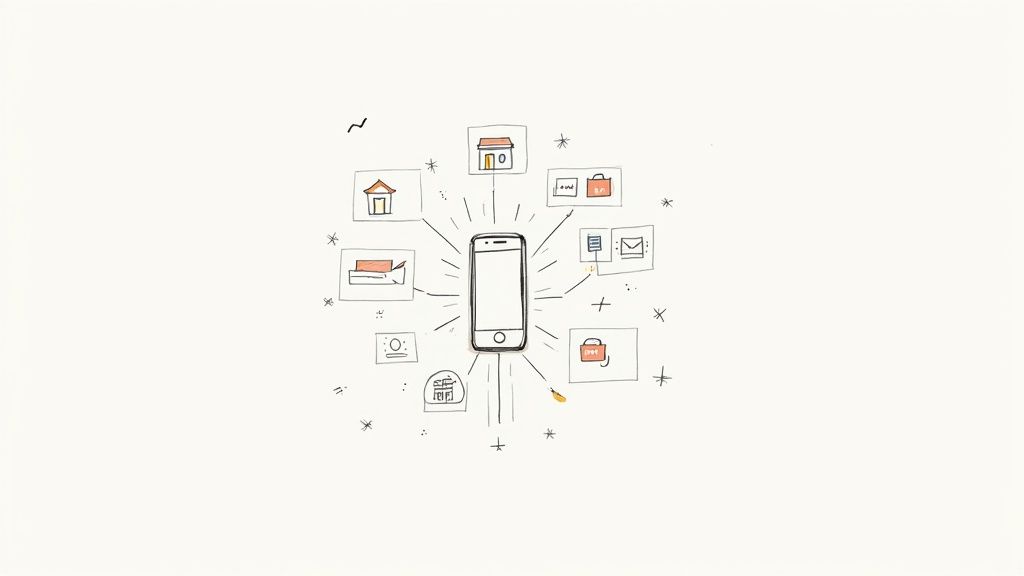
To really send text messages en masse, you can't just use your personal phone. You need a dedicated platform that's built for the job—something that lets you upload a contact list, write a message, and blast it out to hundreds or even thousands of people in one go.
Crucially, these services are designed to keep you on the right side of the law by automatically managing opt-ins and opt-outs, something your standard phone's messaging app just can't do.
Think about it: what's the one device your customers check dozens of times a day? Their phone. Mass texting gives you a direct line to them, cutting straight through the noise of a crowded email inbox or a chaotic social media feed.
This isn't just another marketing channel. It’s an immediate, personal way to communicate that's essential for building customer loyalty and growing a modern business.
The numbers don't lie. By 2025, it's expected that nearly 5.9 billion people worldwide will be sending and receiving texts. That's about 65% of the planet's population.
Here in the U.S., the figures are even more telling. Roughly 80% of Americans, or about 292 million people, are active texters. If you want to dive deeper, you can read the full research about these SMS marketing statistics.
Emails can sit unread for days. Social media posts get buried by algorithms. Text messages, on the other hand, demand attention right away.
The data is pretty staggering: SMS messages boast a 98% open rate, and most are read within just three minutes of being delivered.
This creates some incredible opportunities for businesses. Let’s look at a few real-world examples:
In every one of these scenarios, mass texting is the common thread. It provides a direct, reliable, and lightning-fast way to deliver information that gets people to act immediately.
While a standard 160-character SMS is incredibly effective, smart strategies often mix in other messaging channels for a more dynamic approach. This is where you can get creative without being intrusive.
A great example of this is ringless voicemail. This technology lets you drop a pre-recorded audio message straight into someone's voicemail box without their phone ever ringing. It's an effective way to leave a direct voicemail message.
It's the perfect solution for when you have a more personal or detailed message to share. A business owner, for instance, could leave a personal "thank you" for new customers or provide a detailed update about a service change.
By pairing the urgency of a mass text with the personal touch of a ringless voicemail drop, you can build a communication strategy that truly grabs attention and fosters stronger relationships with your customers.
Before you even think about hitting "send" on a mass text, you need an audience. But not just any audience—you need a list of high-quality, engaged contacts who have explicitly given you permission to text them.
This isn't just a suggestion; it's the law. A solid, consent-based contact list is the absolute foundation of any SMS campaign that works. It’s what separates a welcome message from spam. Rushing this step is the fastest way to get hit with massive fines and do lasting damage to your brand.

The big regulation you need to know in the U.S. is the Telephone Consumer Protection Act (TCPA). This law is crystal clear: businesses must get "express written consent" from people before sending them automated marketing texts.
Now, "written" doesn't mean they need to mail you a signed piece of paper. It can be entirely digital. Think of a customer checking a box on your website form, texting a specific keyword to your number, or signing up on a tablet in your store.
The key here is that the language you use has to be completely unambiguous. The person needs to know exactly what they’re signing up for—promotional text messages from you. Something vague like "we'll keep in touch" just won't cut it and leaves you exposed.
Growing your list the right way is all about a fair exchange: you provide real value, and in return, you get a phone number and consent. People guard their phone numbers, so you need to make your offer compelling.
Here are a few of the most effective ways I've seen work time and time again:
Key Takeaway: The goal isn't just to collect numbers. It's to build a real community of subscribers who are excited to hear from you. Always be upfront about what they'll get and how often you'll text them. Trust starts right at the sign-up.
If you're looking for more creative ways to get people on board, our guide on 5 ways to grow your SMS marketing list starting today has a few more strategies you can put into action right away.
The specific words you use at the point of sign-up are your number one legal shield. It has to be airtight.
Your opt-in disclosure must cover these key elements:
Here’s an example of solid, compliant language you could use on a website form:
"By entering your phone number and clicking 'Submit', you agree to receive recurring automated marketing messages from [Your Business Name] at the number provided. Consent is not a condition of purchase. Reply HELP for help and STOP to cancel. Msg frequency varies. Msg & data rates may apply."
This level of detail leaves no room for confusion and gives you a clear record of consent. And remember, this isn't a one-and-done deal. Every single mass text you send must also include clear opt-out instructions, like "Reply STOP to unsubscribe," to stay compliant.
You’ve got about three seconds to get your point across in a text message. Seriously, that’s it.
In that blink-of-an-eye window, your message has to land, make sense, and get someone to actually do something. If you're used to writing copy for email or social media, you need to toss that playbook out. SMS is a whole different ballgame where being direct and punchy is everything.
The raw power of texting is hard to overstate. Emails can get lost in a crowded inbox, but a text message cuts right through the static. We're talking about an insane 98% open rate, and 90% of those messages get read within just three minutes. When you stack that up against the average email open rate hovering around 20-25%, it's obvious why figuring out how to send mass text messages well is a complete game-changer. For a closer look at these numbers, you can discover more insights about SMS marketing statistics on truedialog.com.
The fastest way to get ignored? Sending a generic, one-size-fits-all text blast. Nobody wants to feel like just another number on a list. Your goal should be to make a message sent to thousands feel like it was written for one person.
Personalization is your secret weapon here. Just using a customer's first name is a simple, yet incredibly effective, first step. A text starting with "Hey Jessica," will always outperform "Dear customer."
But you can, and should, go deeper. Use the data you have to make the message hyper-relevant:
This isn't just about sending a text; it's about delivering a helpful, relevant piece of information. It proves you know your customer, and that builds the kind of trust that gets people to take action.
Every single text message needs a point. What, exactly, do you want the person to do? Your call to action (CTA) needs to be crystal clear. Vague requests like "check out our website" just don't cut it. You have to be specific and give them a reason to act now.
A strong CTA is direct and often has a deadline attached:
Each example tells the user precisely what to do and why they should do it immediately. This clarity is what turns a glance into a click or a sale. To pack the most punch into your character count, consider using a tool like shortgenius for concise message crafting to keep your copy tight and intelligent.
Sometimes, 160 characters of plain text just won't do the trick. That’s when you bring in the heavy hitter: MMS (Multimedia Messaging Service). With MMS, you can send images, GIFs, and short videos, which can make your message impossible to ignore.
Pull out MMS for situations where you need to:
That visual pop can stop someone mid-scroll and make your offer stick. Just be mindful that MMS messages usually cost a bit more to send, so use them when they'll have the most impact.
There are times when even the best text message lacks a certain human touch. That's where ringless voicemail comes in. It lets you drop a pre-recorded audio message straight into someone’s voicemail box—their phone never even rings.
Think about it. A customer gets a text about a special offer. A few hours later, a voicemail from your company's founder shows up, personally thanking them for being a customer and explaining the offer. This one-two punch combines the speed of SMS with the warmth of a human voice, creating a seriously compelling experience. Ringless voicemail drops are a great way to make a personal connection without being intrusive.
Alright, you've done the hard work of building a compliant list and mapping out your messaging. Now it’s time for the fun part: putting it all into motion. This is where your strategy turns into real conversations and, ultimately, real results. Launching your first campaign to send mass text messages might seem like a big step, but today's tools make it surprisingly simple.
First things first, you need to get your contacts into the system. Most professional SMS software lets you upload a list with a simple CSV file. A good platform will even do some of the clean-up for you, automatically removing duplicates and flagging wonky numbers. This simple step helps boost your deliverability right out of the gate.
Once your list is uploaded, you might be tempted to just hit "send to all." Don't do it. That’s one of the fastest ways to get a wave of opt-outs. The real magic is in segmentation—breaking your audience into smaller, more relevant groups based on what you know about them.
Think of it as the difference between shouting into a stadium and having a one-on-one chat. Which one do you think gets a better response? For example, you could slice your list into segments like:
When you get this specific, your messages feel less like marketing and more like helpful advice. People are way more likely to act on a text that feels like it was written just for them.
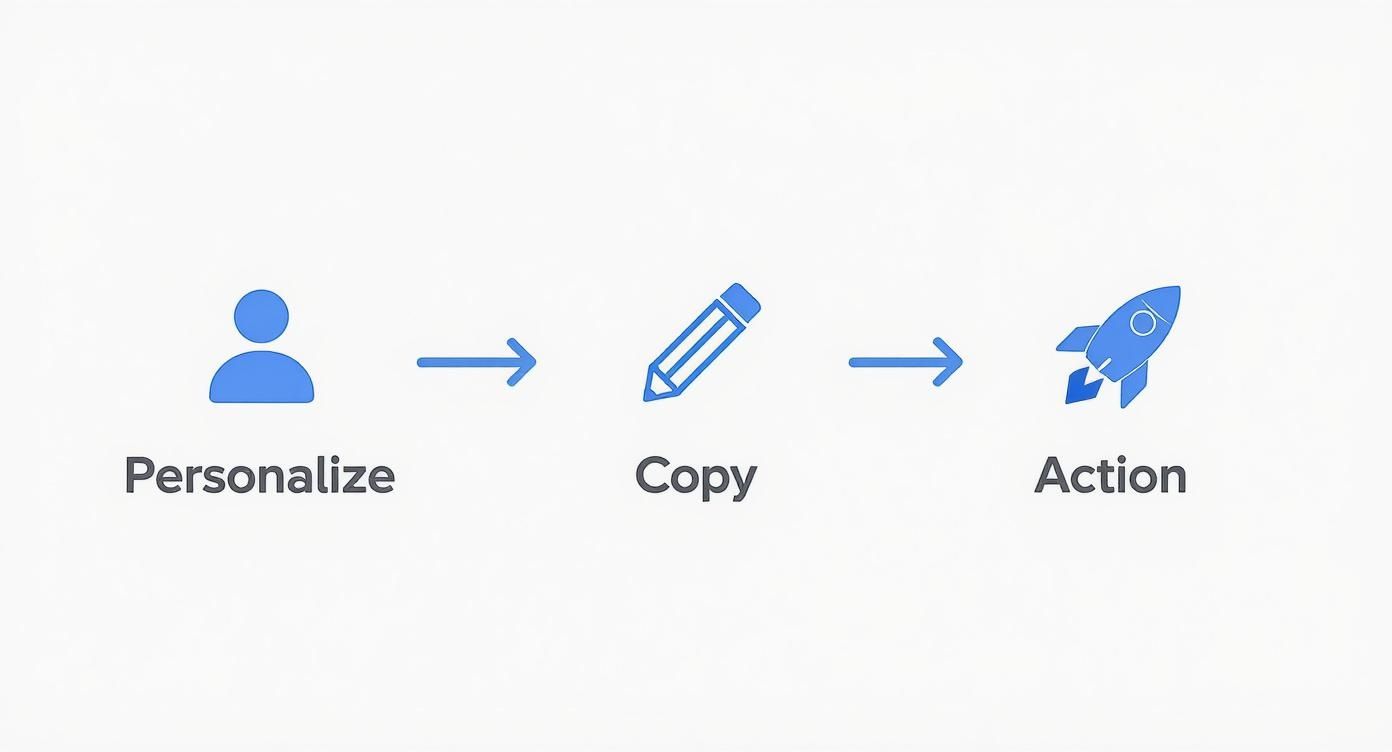
This simple workflow shows how it's done: you start with personalization, craft compelling copy, and drive them toward a clear action.
As you can see, a great mass text isn't just about the words. It’s a strategic journey designed to take someone from "Oh, that's interesting" to "I need to check this out."
Sending a brilliant message at the wrong time is like telling a great joke to an empty room. Timing is everything. Blasting a text at 2 AM is a guaranteed way to get an angry reply (or just an immediate opt-out).
The best time really depends on your audience, but a good rule of thumb is to send during normal business hours. We’ve seen great results with mid-morning or mid-afternoon sends during the week.
Try to avoid Monday mornings—everyone's just trying to catch up. Late Friday afternoons are also a dead zone, as people are already mentally checking out for the weekend. The goal is to land in their inbox when they’re most likely to see your message and act on it. Most platforms let you schedule your SMS broadcasts ahead of time, which is a lifesaver. You can set everything up and let it run at the perfect moment.
Don’t just think in terms of one-off blasts. Consider setting up automated sequences. A welcome series for new subscribers, for instance, could send a few helpful messages over their first week. It’s a fantastic way to build a relationship from day one and keep your brand top-of-mind.
While SMS is incredibly powerful, it's not the only tool in the shed. Sometimes, you need the visual punch of an image, or the personal touch of a voice message. Deciding between SMS, MMS, and Ringless Voicemail really comes down to your campaign's goal and what will resonate most with your audience.
Here’s a quick breakdown to help you decide which channel is the right fit for your message.
Each tool has its place. For urgent, simple messages, SMS is king. When you need to show, not just tell, MMS is your go-to. And for those moments when you want to make a deeper, more personal connection without being intrusive, Ringless Voicemail is incredibly effective.
Combining these tools can be a game-changer. For example, imagine sending a mass text about a limited-time sale. A day later, you could follow up with a ringless voicemail from your company’s founder, adding a human touch and reinforcing the urgency. This multi-channel approach helps you cut through the noise and creates a much richer experience for your customers.
Okay, you've got the basics down. You know how to craft a message, load up a list, and hit send. But the real magic happens when you move beyond simple promotional blasts and start building a smart communication engine.
The goal is to shift from just marketing to creating a genuinely helpful, ongoing conversation with your customers. It's about making your messages feel personal and timely, not like they're coming from a robot.
This is where you start layering in different channels and setting up automated sequences that engage people at just the right moment. Instead of just pushing information out, you're building systems that react to customer behavior, anticipate what they need, and build real loyalty. This is what separates the good campaigns from the truly great ones.
Texting is awesome for its speed and directness, but sometimes a message just needs a more personal, human touch. That’s where Ringless Voicemail Drops come in handy.
This tech lets you deliver a pre-recorded audio message straight to someone's voicemail box without their phone ever ringing. It’s a fantastic, non-intrusive way to add a human element to your outreach.
Think about using it for more complex announcements, a heartfelt thank-you from your company's founder, or a detailed follow-up that would be way too clunky for a standard text message.
One powerful play is to send a mass text for the initial heads-up and then follow up with a ringless voicemail to add more context and personality. For example, a text might announce a major new feature, while the voicemail could be a team member enthusiastically explaining how it works.
Automation is your best friend when it comes to scaling personalized communication without burning out your team. It’s all about creating a series of messages that are automatically triggered by specific customer actions or timelines. These workflows ensure every single person gets a consistent and relevant experience.
Here are a few real-world examples of automated workflows:
The real power of automation is delivering the perfect message at the perfect time. It makes your communication feel incredibly timely and helpful, allowing you to build complex, multi-step conversations that run on their own.
If you’re ready to dive deeper into this, our guide on how to send automated texts gives you a more detailed walkthrough for setting up these powerful sequences.
Finally, don't forget that texting isn't just a broadcast channel—it's meant to be a conversation. The best strategies embrace two-way messaging, actively encouraging replies and using them to handle customer service questions, clear up confusion, and build actual relationships at scale.
Many platforms let you manage these incoming messages in a shared inbox, so your team can jump in and respond quickly. When you invite that dialogue, you transform your SMS program from a simple marketing tool into a vital channel for customer support and engagement. That creates a much richer and more valuable experience for everyone on your list.
Jumping into the world of mass texting can feel a bit overwhelming at first. There are rules, costs, and new tech to figure out. I get it. This section is here to clear up the most common questions we hear, so you can feel confident sending texts that are both effective and responsible.
We'll cover the big ones: Is this even legal? What's it going to cost? What metrics actually matter? Think of this as your go-to guide for making smarter decisions with your text campaigns.
Yes, but you absolutely have to do it by the book. It's only legal if you have prior express written consent from every single person on your list before you send them any marketing texts. No exceptions.
Regulations like the Telephone Consumer Protection Act (TCPA) in the US are incredibly strict on this point. Your opt-in has to be crystal clear that they're signing up for promotional texts from you. You also must give them an easy and obvious way to opt out, like replying "STOP" to any message. Sending texts without permission can lead to some seriously crippling fines, so compliance isn't just a suggestion—it's a must.
The cost can swing a bit depending on your provider, how many texts you're sending, and whether you're using SMS or MMS. Most services will either use a credit system or offer monthly subscription plans.
A single SMS message (a standard text) can run you anywhere from $0.01 to $0.05. If you want to include images or GIFs (MMS messages), expect to pay a bit more since they use more data. Many platforms offer tiered pricing, meaning the more you send, the less you pay per message. The trick is to find a plan that lines up with your sending volume to get the best bang for your buck.
Pro Tip: Watch out for hidden fees. A provider with transparent pricing means you know exactly what you're paying for, whether you're sending a hundred texts or a hundred thousand. No surprises.
Ringless voicemail is a pretty slick piece of technology. It lets you drop a pre-recorded audio message straight into someone's voicemail box without their phone ever ringing. It's a fantastic tool to use alongside a mass texting strategy to hit your audience on multiple channels. This technique is often called a direct voicemail drop.
For example, you could send a mass text about a flash sale. A few hours later, follow up with a more personal, detailed ringless voicemail from your company's founder. Because it’s less intrusive than a cold call, it's a great way to share more complex info or just add a human touch that makes your brand stick.
If you're not tracking your metrics, you're flying blind. These numbers tell you the real story of how your campaigns are performing and point you directly to what you can improve.
Here are the essentials you should always be watching:
Tracking these numbers isn't just about getting a report card. It's about gathering real insights so you can tweak your messaging, segment your audience better, and nail your timing for even better results next time.
Ready to create high-impact, compliant outreach campaigns that get results? With Call Loop, you can automate, personalize, and scale your customer communications across SMS, voice, and ringless voicemail. Join over 45,000 users and see how simple and reliable your outreach can be.
Chris Brisson
Chris is the co-founder and CEO at Call Loop. He is focused on marketing automation, growth hacker strategies, and creating duplicatable systems for growing a remote and bootstrapped company. Chat with him on X at @chrisbrisson


Trusted by over 45,000 people, organizations, and businesses like


