
See a Demo
You're just one step away from seeing Call Loop in action.
Enter your information below to watch a demo right now.

You're just one step away from seeing Call Loop in action.
Enter your information below to watch a demo right now.

Let's cut through the jargon. At its core, A2P (Application-to-Person) messaging is simply when a piece of software sends an automated text message to a real person. It's the magic behind the flight status updates, appointment reminders, and flash sale alerts that pop up on your phone every day.
Think of A2P as a one-way announcement from a business to its audience. A concert promoter texting thousands of ticket holders about a last-minute time change? That's a perfect example of A2P in action.
It's a system built from the ground up for scale and reliability. This is completely different from the casual, back-and-forth texts you exchange with a friend, which is known as P2P (Person-to-Person). The distinction might seem small, but it's crucial—mobile carriers treat these two types of messages very, very differently.
To really see the difference, let's break it down side-by-side. While both use SMS, their purpose, technology, and rules are worlds apart.
FeatureA2P (Application-to-Person)P2P (Person-to-Person)Primary UseAutomated, one-to-many communication (alerts, marketing)Conversational, one-to-one communication (friends, family)SenderSoftware application or platformHuman via a mobile deviceVolumeHigh-volume, mass messagingLow-volume, individual messagesPhone NumbersShort codes, toll-free numbers, 10DLCStandard 10-digit mobile numbersCarrier ApprovalRequires carrier registration and vettingNo special registration requiredSpeedHigh throughput (hundreds of messages per second)Low throughput (one message per second)
Understanding this table is the first step to getting A2P right. P2P is for personal chats, while A2P is the professional tool for business communication.
This method has become the backbone of modern customer engagement, allowing businesses to connect instantly and reliably with massive audiences. It's a powerful tool not just for standard SMS but also for related technologies like ringless voicemail, where a pre-recorded message lands directly in someone's voicemail box without their phone ever ringing.
The importance of A2P messaging isn't just anecdotal; the numbers tell the story. The global market value hit approximately USD 72.2 billion in 2024 alone, proving just how essential this channel has become for businesses all over the world.
To tap into this power, companies use specialized platforms that handle all the tricky parts of sending messages at scale. These systems are designed to manage everything from compliance to deliverability, making sure your communications actually reach the people they're meant for.
When you set it up right, a solid SMS text messaging platform can automate your outreach, make your team more efficient, and drive real results. This guide will walk you through everything you need to know to get started.
Ever wonder what actually happens after you hit 'send' on a mass text campaign? An A2P message doesn't just poof into existence on someone's phone. It takes a lightning-fast, highly specialized journey through an infrastructure built for speed and reliability.
This system is completely different from the simple path your personal texts take. Think of it like a dedicated postal service for businesses. When you send a message, you're not just dropping it in a regular mailbox. You're handing it off to a high-volume sorting facility designed to process thousands of messages a minute.
The journey starts the moment a business uses a platform to send a message. This kicks off an API call—basically a technical request that bundles up the message and shoots it off to the next stop.
From the platform, the message zips over to a messaging aggregator. These companies are the main traffic controllers of the A2P world. They have direct pipelines into mobile carriers and their entire job is to sort and route massive volumes of texts from thousands of businesses.
The aggregator then passes the message to the right mobile carrier network, like T-Mobile, Verizon, or AT&T. The carrier does a final compliance check and then delivers it straight to the recipient's device. This whole dance happens in seconds, which is how you get near-instant communication on a huge scale.
The image below really nails the fundamental difference between the two communication paths.

As you can see, A2P is all about one-to-many broadcasting, while P2P is built for those classic one-to-one chats.
Businesses can't just use a personal cell number for A2P messaging. You have to use specific, carrier-approved numbers, and picking the right one is a crucial first step.
Key Takeaway: The entire A2P system—from the API call to the aggregator and carrier network—is purpose-built to handle business traffic securely and efficiently. This specialized route is what separates legitimate business communication from spam.
Getting this right is the key to making sure your messages actually land in the inbox. When businesses use an approved number type and a compliant platform, they maintain high message deliverability rates.
Understanding what gets a message delivered is a topic all its own, which is why we've put together a guide on how to improve your A2P SMS deliverability. It’s essential for making sure your important communications, from marketing promos to ringless voicemail notifications, connect with your audience every time.
If you want to get into A2P messaging, you have to play by the rules. Mobile carriers have put strict requirements in place for a good reason: to protect all of us from the flood of spam texts and build a communication channel people can actually trust. For any business, understanding these compliance rules isn't just a good idea—it's the single most important factor in actually getting your messages delivered.

It wasn't always this organized. In the past, some businesses would try to game the system by using unregistered numbers for their mass messaging. This forced carriers to create a formal system to tell the good guys from the bad guys. Now, when a customer gets a text from your business, that system ensures it's a message they asked for and can rely on.
At the center of A2P compliance in the United States, you'll find The Campaign Registry (TCR). TCR is the main authority that works directly with mobile carriers to register A2P campaigns using standard 10-digit long code (10DLC) numbers.
Think of it as getting a business license for your text messaging.
The process is pretty straightforward and breaks down into two main steps:
This simple process builds a ton of trust with the carriers. When their systems see a message coming from a registered brand and a well-defined campaign, they are far less likely to mistake it for spam. Getting registered is the bedrock of any solid A2P strategy.
Following the rules has a direct, immediate impact on how well your messaging performs. There are two key concepts you need to get familiar with: throughput and filtering.
By completing the registration process, you are essentially telling carriers, "We are a legitimate business sending messages that our customers want." This simple act unlocks higher sending speeds and ensures your communications reliably reach your audience.
At the end of the day, compliance isn't about jumping through hoops to avoid penalties; it’s about making your messaging work. Platforms and services are also held to these same strict standards, so it's always smart to review a provider's policies. You can get a deeper sense of what this looks like by reading Call Loop's comprehensive anti-spam policy to see how a compliant framework protects both businesses and their customers. By embracing registration, you make sure all your A2P efforts succeed.
Alright, we’ve covered the technical side of things. Now let’s get to the fun part: seeing how A2P messaging actually helps businesses make more money and keep customers happy. This isn't just some background tech; it's a powerful tool that companies, from local shops to massive enterprises, use every single day.
The real magic of A2P is its direct line to your customer's pocket. It delivers important, timely info straight to the one device they never ignore: their phone.
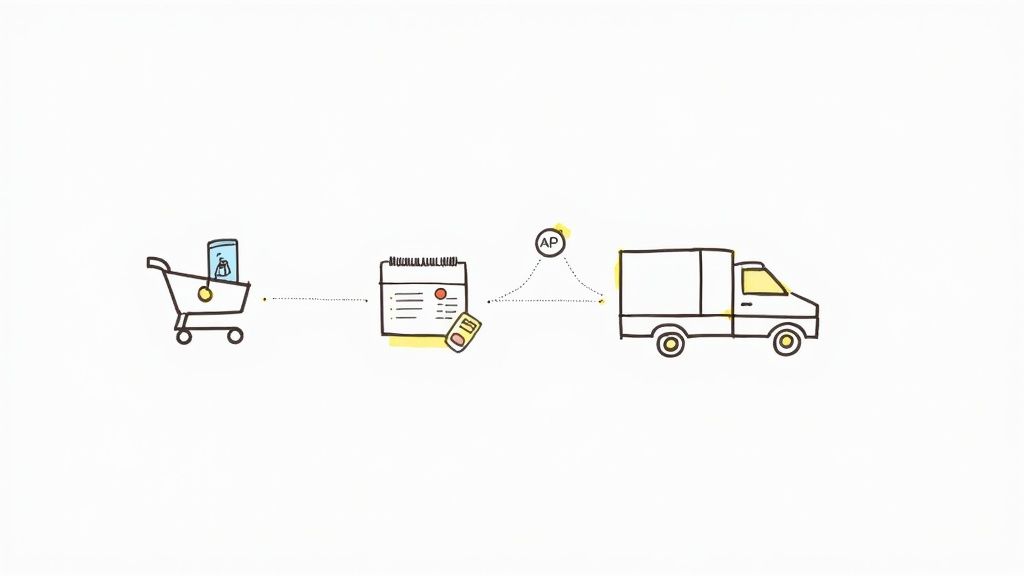
Think about it. This lets you slice right through the noise of a jam-packed email inbox or a chaotic social media feed. Your most critical messages get seen, period. In fact, A2P is the engine behind many of the essential business automations companies can't live without.
The ways businesses use A2P are incredibly varied. Retailers blast out flash sale alerts and send reminders about abandoned shopping carts. Healthcare providers automatically send appointment confirmations, which drastically cuts down on no-shows. The impact is huge, no matter the industry.
Here are just a few real-world examples of A2P in action:
The numbers back this up. The banking and finance sector (BFSI) is a huge player, responsible for nearly 30% of the A2P market share in 2023 because of its heavy reliance on secure alerts. Likewise, retail and ecommerce lean on A2P for everything from marketing to logistics, with promotional messaging alone expected to become a USD 7.5 billion market.
One of the smartest strategies we see is pairing A2P SMS with other channels. Imagine a customer gets a text about an important payment due soon. A couple of days later, you could follow up with a non-intrusive ringless voicemail that gives them a bit more detail or a friendly reminder—all without their phone ever actually ringing. This type of communication is often called a voicemail drop.
This multi-channel approach makes your communication strategy far more robust. You can layer your messages, using the instant hit of an SMS for urgent stuff and the personal feel of a voice message for more detailed follow-ups.
By combining tools like SMS and ringless voicemail, businesses can create a cohesive communication experience that respects the customer's time while ensuring the message is received.
This approach lets you connect with your audience on their own terms, which naturally boosts response rates and builds a much stronger relationship. At the end of the day, A2P is the engine that drives these kinds of automated, multi-step campaigns, making them scalable and incredibly effective for any business.
Okay, you get what A2P is and how the magic happens behind the scenes. The next logical question is: which platform do you trust to handle it for you? This is a bigger decision than it seems.
Not all messaging platforms are built the same. Far from it. The partner you choose will make or break your SMS campaigns, directly impacting whether your messages get delivered, if you stay on the right side of carrier rules, and what kind of return you see for your efforts.
It's tempting to get wooed by flashy features and slick sales demos, but success comes from focusing on the fundamentals. You're looking for a true partner, someone who handles the messy technical stuff so you can get back to what you do best—talking to your customers.
When you start comparing options, it's easy to get lost in feature lists that are a mile long. Let's cut through that noise. A handful of core elements really separate the great platforms from the merely good ones. Think of these as the non-negotiables.
Here's what should be at the top of your checklist:
Beyond the tech specs, two "hidden" factors will determine your long-term success: the platform's dedication to compliance and the quality of their support. Get these wrong, and you're in for a world of hurt.
Here's a little inside baseball: A provider's relationships with the mobile carriers are their secret weapon. A platform with deep carrier connections can get deliverability problems sorted out way faster and go to bat for you when issues pop up. That's the difference between a message sent and a message received.
This is why you have to find a platform that takes compliance seriously. That means giving you the tools to manage opt-outs automatically and holding your hand through the entire 10DLC registration process. A provider who helps you navigate the red tape is worth their weight in gold.
And finally, test their support before you commit. Send them a question. See how quickly they respond and how helpful they are. When you're in a pinch, having a responsive, knowledgeable human to help you is priceless. It shows they're actually invested in your success.
Don't think of A2P messaging as just some local trend—it’s the global standard for how businesses talk to people, and it has exploded across every continent. While the idea is the same everywhere, how it's used and how fast it's growing can look wildly different from one place to another.
The Asia-Pacific region is the undisputed heavyweight champion of the A2P world. In 2024, it was responsible for a massive 44.5% of the global A2P SMS market. What's driving this? A perfect storm of rapid digital growth, a boom in mobile banking, and sky-high smartphone ownership in countries like China and India. If you want to dive deeper, you can check out the full A2P SMS market research for a complete breakdown.
But while Asia-Pacific brings the volume, North America brings a different kind of value. It's a mature market, heavily focused on innovation and playing by the rules. The U.S. market alone is on track to hit a staggering USD 12 billion by 2034, proving just how stable and important it is in the long run.
It's not just about the established leaders, either. We're seeing huge growth in Africa and the Middle East as their digital infrastructure comes online, turning A2P into a truly global tool, not just something for developed nations.
Here's one of the most interesting shifts: small and medium-sized businesses (SMBs) are now the fastest-growing group of A2P users. This is a big deal. It shows that powerful communication tools, which used to be locked away for huge corporations, are now open for businesses of all sizes.
This worldwide adoption is a strong signal that building an A2P strategy is a smart, long-term move. Whether you're sending out a marketing text blast, a critical alert, or a gentle follow-up with a ringless voicemail, you’re using a channel that people trust and understand no matter where they are. It's a reliable bet for any business looking to connect.
Even after you get the basics down, a few questions always pop up when businesses start thinking about actually using A2P messaging. Let’s clear the air and tackle some of the most common ones so you can move forward with confidence.
Absolutely not. Legitimate A2P messaging is consent-based communication, not spam. The entire framework is built around one core idea: customers must give you permission to text them. They have to opt-in first.
Think of it this way: the whole 10DLC registration process was created specifically to weed out spammers and verify legitimate businesses. Spam is junk mail you never asked for. A2P is a regulated channel for sending messages your customers actually want. That’s what makes it so powerful.
10DLC is short for "10-Digit Long Code." In simple terms, it’s a standard, local-looking phone number that the mobile carriers have officially approved for business messaging. It was created to give businesses a reliable and affordable way to send texts at a higher volume than a personal phone ever could.
Getting your brand and campaigns registered for 10DLC is non-negotiable in the US now. This process is how you prove to carriers that you're a legitimate sender. In return, they boost your message deliverability, increase your sending speed, and stop your texts from getting flagged as spam.
Please don't. Using your personal cell for mass business texting is a huge mistake and a direct violation of carrier policies. The mobile networks are incredibly smart and actively hunt for A2P-style traffic coming from regular P2P (person-to-person) numbers.
If you try it, your messages will fail, and you’ll likely get your number blocked—sometimes permanently. For any kind of reliable business texting, you have to use a dedicated A2P platform with an approved number, like a 10DLC or a text-enabled toll-free number.
Ready to start sending messages your customers actually want to receive? With Call Loop, you can easily manage SMS campaigns, send ringless voicemail drops, and automate your outreach while staying fully compliant. See how Call Loop can help you connect with your audience today.
Chris Brisson
Chris is the co-founder and CEO at Call Loop. He is focused on marketing automation, growth hacker strategies, and creating duplicatable systems for growing a remote and bootstrapped company. Chat with him on X at @chrisbrisson


Trusted by over 45,000 people, organizations, and businesses like


