
See a Demo
You're just one step away from seeing Call Loop in action.
Enter your information below to watch a demo right now.

You're just one step away from seeing Call Loop in action.
Enter your information below to watch a demo right now.

So, can you actually send a text message from your email?
The short answer is yes, absolutely. It's a surprisingly old-school trick that still works, bridging the gap between two of the most dominant ways we communicate. For years, this has been a reliable way to get a message from an email inbox straight to someone's phone.
You've got two main ways to pull this off, each with its own quirks.
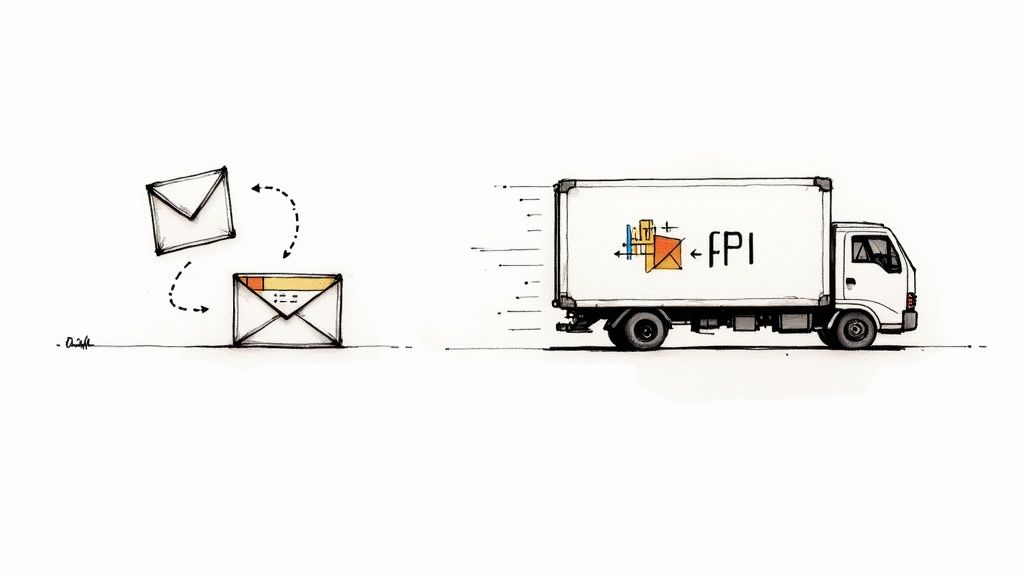
This whole idea of email-to-SMS isn't new; it's been around since the early 2000s. The magic happens when you send an email to a special address called an SMS gateway. This gateway takes your email, strips it down, and reformats it into a text message that pops up on a mobile device.
This process gives you two very different options for getting your message out there. Let's break down what they are and why you might choose one over the other.
As you can see, while both get a message from point A to point B, how they do it is worlds apart. Your choice has a real impact on everything from whether your message even arrives to how professional your business looks.
The first route is using a free SMS gateway that mobile carriers provide. Think of this like the public postal service—it’s functional for sending a single letter, but it's not built for speed, tracking, or a professional look. It gets the job done in a pinch, but it can feel clunky and unreliable.
Your second, much more powerful option is to use a professional business messaging platform. This is like hiring a dedicated courier service. You get speed, reliability, and a whole suite of tools designed to make sure your messages are delivered efficiently and professionally, every single time.
While both methods can send a text from your email, they are fundamentally different tools. Choosing between a free gateway and a dedicated platform will shape your deliverability, branding, compliance, and the overall customer experience.
Here’s a quick rundown of the key differences:
Getting a handle on these differences is the first real step. It helps you decide whether you just need a quick, one-off solution or a serious tool for your business communication strategy.
So, how does this whole "free text from your email" thing even work?
Think of every major mobile carrier—like Verizon, AT&T, or T-Mobile—as having its own special digital mailroom. This mailroom is technically an email to SMS gateway, and its only job is to catch specially addressed emails, tear them open, and turn them into text messages.
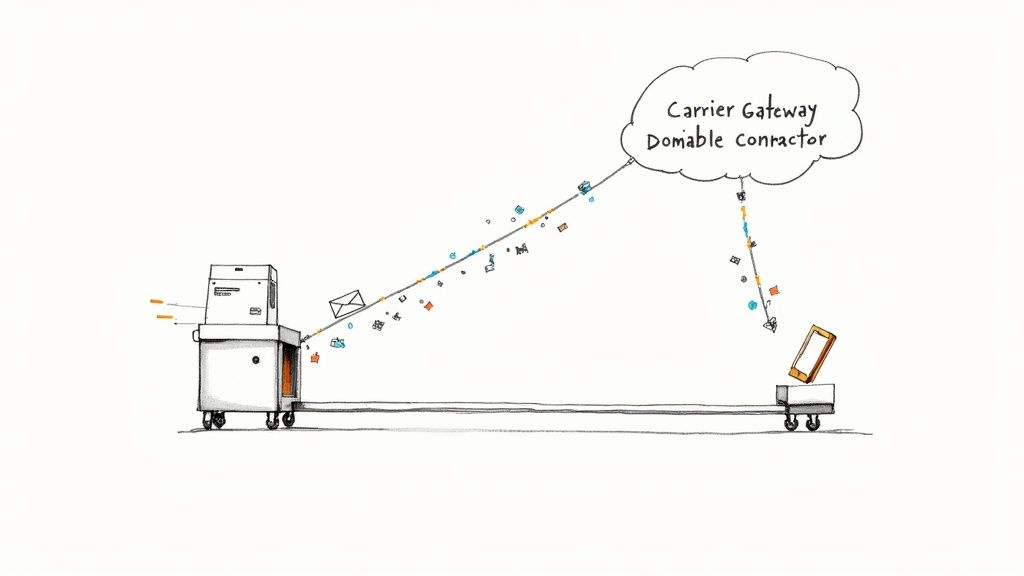
When you want to send a text message from your email, you aren't actually sending it straight to a phone. You’re sending it to one of these gateways, which acts like a translator between two completely different systems.
The process itself is surprisingly simple, though it does need a bit of manual legwork. You’re basically tricking the mobile network into treating your email like a text message by formatting the "To" address in a very specific way.
Here’s the breakdown:
@vtext.com for Verizon or @txt.att.net for AT&T).1234567890@vtext.com.The gateway receives your email, strips away the subject line, your signature, and any fancy formatting. It then forwards only the plain text body as an SMS to the destination phone number. For a complete list of carrier domains, you can check out our detailed guide on how to find the right email to SMS gateway address.
While sending a quick text from your email for free sounds great on the surface, this method is riddled with limitations that make it a terrible choice for almost any business use. It’s like using a walkie-talkie for a conference call—it might get a short message across, but it’s nowhere near reliable or professional enough.
One of the biggest headaches is the strict 160-character limit. Go over that, and the gateway will often chop your message into multiple texts that arrive out of order, leaving your recipient completely confused.
Using a free gateway means you get what you pay for. There are no delivery confirmations, so you’ll never actually know if your message was received. That lack of feedback is a massive risk for anything time-sensitive or important.
Even worse, when someone replies, their message lands back in your email inbox as a jumbled mess from a cryptic-looking address. Trying to manage a real conversation this way is nearly impossible and looks incredibly unprofessional.
For any business that needs organized, two-way chats and professional features like scheduling or even ringless voicemail drops, this free method just doesn't cut it. It’s a neat trick for a personal, one-off message but falls flat for any serious, scalable communication.
While tinkering with free carrier gateways is a neat trick, it's a dead end for any serious business. When you need your messages to actually land, scale up your efforts, and look professional, you need a dedicated business messaging platform. These services aren't just another way to send texts from email; they are complete communication hubs built for getting results.
Instead of gambling on those unpredictable carrier gateways, these platforms use powerful application programming interfaces (APIs) to plug directly into mobile networks. Think of it like this: the free method is like sending a message in a bottle and hoping it arrives. Using a platform is like hiring a professional courier with real-time tracking. You get a direct line that ensures your messages are delivered quickly and reliably, every single time.
Professional platforms turn text messaging from a simple alert system into a powerhouse for your marketing and customer communication. You get a central dashboard to manage contacts, see conversations, and analyze what's working—all in one place. This is absolutely essential for any business that wants to build real, lasting relationships with its customers.
Here's what you can typically expect:
These tools let you go way beyond one-off texts. You can build smart, automated communication flows that actually drive your business forward.
The best platforms don't just stop at SMS. They pull in other communication tools to help you create a multi-channel strategy. One of the most powerful additions is ringless voicemail. This cool tech lets you drop a pre-recorded audio message directly into someone's voicemail box without their phone ever ringing. A ringless voicemail drop is a super personal, high-impact way to deliver a message without interrupting someone's day.
This technology is incredibly powerful. When you pair a ringless voicemail message with a follow-up text, you create a one-two punch that grabs attention and gets a response.
This combo allows you to connect with customers on multiple fronts, respecting their time while making sure your message gets through. For things like appointment reminders, special offers, or important updates, this integrated approach is a game-changer. The first step to building more effective campaigns like this is exploring a dedicated SMS messaging service.
The numbers back this up, big time. While email open rates hang around 20-28%, SMS campaigns have an incredible open rate of about 98%. The gap in engagement is just as massive. SMS click-through rates hit 18-36% compared to email's average of 1.5-5%. It's clear that getting your message into a customer's text inbox is one of the most effective things you can do to make sure it's seen and acted on.
So, you're deciding between a free carrier gateway and a professional messaging platform. It really boils down to your goals. For a quick, one-off text to a friend, the free route is probably fine.
But for any business that depends on communication to grow, this isn't just a technical choice—it's a strategic one. Getting it wrong can have real consequences.
To make the right call, you need to see a direct, head-to-head comparison. Let's break down how these two methods really stack up across the criteria that matter for your business, from cost and reliability to the crucial stuff like compliance and branding.
On the surface, "free" always sounds better. But when you dig into what each method actually delivers (or fails to deliver), the picture gets a lot clearer. This table lays out the pros and cons to help you see the full story.
This comparison highlights a critical point: while one option costs money and the other doesn't upfront, the value and security they offer are worlds apart. A dedicated platform is an investment in doing things right.
That table gives you a snapshot, but the real difference is what happens day-to-day. Take compliance, for instance. Trying to manually track who has opted out of your messages on a spreadsheet is a recipe for disaster. A single mistake can lead to massive TCPA fines. Professional platforms like Call Loop automate this, giving you an essential safety net.
Reliability is another huge deal. With a free gateway, you’re basically sending a message into a black hole—you have no idea if it ever arrived. For a time-sensitive alert or a flash sale, that’s just not acceptable. A paid service gives you the solid infrastructure needed to make sure your messages get there on time, every time. This is how you can truly send text messages from email with confidence.
Business messaging platforms give you the tools to automate, schedule, and analyze your campaigns for maximum impact.

This shows how a dedicated platform turns simple messaging into a smart, data-driven operation.
Ultimately, the "free" method often costs you more in the long run through lost customers, wasted time, and legal risks. Investing in a dedicated platform is a strategic move that pays for itself in efficiency, professionalism, and peace of mind.
For any serious business looking to grow, the choice is clear. The limitations of carrier gateways create bottlenecks and risks. A professional platform, on the other hand, provides the power, reliability, and advanced features you need to build a real communication strategy. It’s the difference between a temporary workaround and a permanent, scalable solution.
When you decide to send text messages from email for your business, you're officially stepping into a regulated arena. This isn't like firing off a quick text to a buddy; business messaging is governed by some pretty strict laws, especially the Telephone Consumer Protection Act (TCPA) in the U.S.
Ignoring these rules isn't just a slap on the wrist—it can lead to some seriously staggering fines.

The number one, single most important rule is getting express written consent before you send a single marketing message. This is not a suggestion. It's the law, plain and simple. Without it, you’re putting your whole operation at risk.
Staying on the right side of the law means more than just getting permission upfront. You need a disciplined, thoughtful approach to every message you send out. Trying to juggle all these rules manually with a free email-to-SMS gateway is a disaster waiting to happen, because all the responsibility lands squarely on your shoulders.
Here’s a quick checklist of must-follow practices:
The big problem with free gateways is they offer zero tools to manage these critical compliance tasks. Professional platforms, on the other hand, are built from the ground up to automate these processes, protecting your business from costly human error.
Imagine trying to manage opt-outs and consent records manually across a bunch of spreadsheets. It’s incredibly risky. One tiny mistake—like sending a message to someone who already opted out—can trigger a TCPA violation. A real business messaging platform handles all of this automatically.
Done right, texting is a huge opportunity. SMS response rates are around 45%, blowing email's 6% out of the water. Plus, over 48% of consumers actually prefer getting business communications by text. The demand is there, you just have to meet it correctly.
Platforms automatically process opt-out requests, maintain compliant consent records, and give you the infrastructure to operate safely as you grow. They also help you stick to a solid anti-spam policy, which is vital for keeping your sender reputation clean.
This built-in safety net is probably the biggest advantage over any free method. It turns a high-risk activity into a secure, reliable, and incredibly effective way to connect with your customers.
As you start figuring out how to send texts from your email, a few questions always seem to pop up. Answering these is key to understanding the huge difference between a quick-and-dirty workaround and a real business strategy. Let's dig into what most people ask.
Technically, yes. Using a carrier's email-to-SMS gateway doesn't cost any money to hit 'send.' But that's where the "free" part ends. This method has a ton of hidden costs, mostly in your time, the lack of reliability, and how unprofessional it can look. You really get what you pay for—which is zero insight into whether your message even arrived and a clunky experience for both you and your recipient.
Professional business messaging platforms, on the other hand, do have a subscription fee. But that investment pays for itself with sky-high deliverability, detailed analytics, automated compliance tools, and features that actually drive business results.
This is the big one. For the free gateway method to work, you absolutely have to know the recipient's mobile carrier to get the email address right (like 1234567890@vtext.com for Verizon). There are some lookup tools online, but they're often out-of-date and add yet another frustrating manual step to the whole process.
This single requirement is what makes the free method a non-starter for any serious business use. Dedicated business platforms completely get rid of this headache. You just provide the phone number, and the platform handles all the carrier routing on the backend. No guesswork needed.
The fact that you have to manually hunt for carrier information is the clearest sign that free gateways were never built for efficient, scalable communication. A professional platform just makes this friction disappear.
Yes, people can reply to texts sent either way, but the experience is night and day. When someone replies to a text sent through a free gateway, that message just dumps back into your email inbox. It usually comes from a bizarre, auto-generated address, making it a nightmare to track conversations or manage any kind of follow-up.
With a business platform, replies are neatly organized into clean conversation threads inside a central dashboard. It turns a messy email chain into a manageable, two-way communication channel that feels like a professional sales or support interaction.
Beyond just sending texts, many business platforms offer other powerful tools to round out your communication. Ringless voicemail is a perfect example—it's a technology that lets you drop a pre-recorded audio message directly into someone's voicemail box without their phone ever ringing.
It’s a super effective, non-intrusive way to deliver a personal message. Think about it: you could send a ringless voicemail drop with a special offer and immediately follow it up with a text that has a link to your website. This kind of multi-channel approach, combining SMS and a ringless voicemail message, is a massive advantage you only get with a dedicated communication platform.
Ready to stop messing with workarounds and build a real, multi-channel messaging strategy that actually works? Call Loop gives you the tools to automate SMS, voice, and ringless voicemail campaigns that drive results. Start your free trial with Call Loop today and see the difference for yourself.
Chris Brisson
Chris is the co-founder and CEO at Call Loop. He is focused on marketing automation, growth hacker strategies, and creating duplicatable systems for growing a remote and bootstrapped company. Chat with him on X at @chrisbrisson


Trusted by over 45,000 people, organizations, and businesses like


