
See a Demo
You're just one step away from seeing Call Loop in action.
Enter your information below to watch a demo right now.

You're just one step away from seeing Call Loop in action.
Enter your information below to watch a demo right now.

Yes, you absolutely can text a landline. It sounds a bit like magic, but it's a real and surprisingly common practice. While an old-school rotary phone isn't suddenly going to display your emojis, modern tech has found a clever way to bridge the gap.
Your text message doesn't just vanish into the ether—it gets converted into a voice message for the person on the other end to hear. It's a simple and effective way to reach anyone, even if they're still rocking a phone with a curly cord.
So, you send a text to a landline number. What happens next? It’s a fair question. Most people assume the message just disappears, lost in some digital black hole. But that’s not the case at all.
Thanks to specialized messaging gateways, that text gets intercepted and translated into a format the landline can actually use.
Think of it like having a universal translator on standby. When your SMS leaves your phone, the network recognizes its destination is a voice-only line. Instead of giving up, it reroutes the message to one of these smart gateways to handle the conversion.
The most common method behind this trick is Text-to-Speech (TTS) technology. A computer's voice literally reads your text out loud.
The gateway's software takes your written message, synthesizes it into an automated voice, and then places a good old-fashioned phone call to the landline. When the person answers, they hear the robotic voice reading your message. If no one picks up, it often gets left as a voicemail. Either way, your message gets through.
Key Takeaway: The whole process is automatic. Your text message simply triggers an automated phone call that reads your message aloud, connecting two very different pieces of technology seamlessly.
Now, things get even more interesting for businesses. Many companies now "text-enable" their existing landline numbers. This doesn't use the text-to-speech trick. Instead, it links their trusted business phone number to a software application, allowing them to send and receive actual text messages from a computer or app. This turns their main number into a two-way texting channel without changing the number their customers already know and trust.
Sending a text to a landline seems impossible, right? Like trying to send an email to a fax machine. But it actually works, all thanks to a clever bit of tech called a messaging gateway.
Think of this gateway as a universal translator. It stands between the mobile world and the old-school landline network, intercepting a text message and converting it into a language the landline can understand. Without this digital middleman, your text would just hit a dead end.
The whole thing is automatic. When you text a landline number, your mobile carrier's network is smart enough to recognize it's not a cell phone. Instead of trying to deliver a standard SMS, it reroutes the message to a specialized text-to-landline gateway. This ensures your message doesn't just vanish into thin air.
Here’s a simple visual of how it all connects:
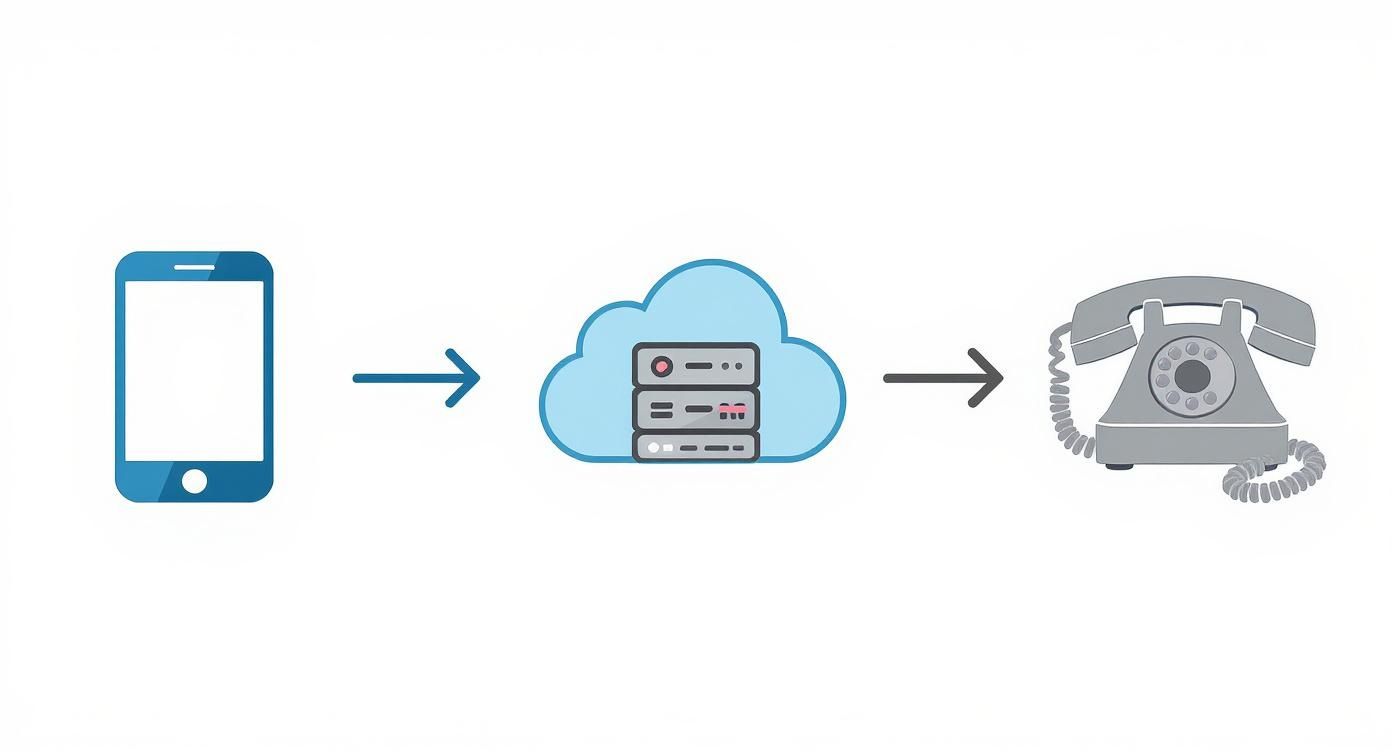
As you can see, the gateway is the crucial bridge connecting two very different communication technologies.
The most common trick up the gateway's sleeve is Text-to-Speech (TTS). This technology takes the words you typed out and turns them into an automated voice message. It's the same kind of tech you hear giving you directions from your GPS or on an automated customer service line.
Here’s a quick play-by-play:
This whole process happens in seconds, so your message gets there almost instantly. If you're curious about how gateways work for other things, our guide on the https://www.callloop.com/blog/email-to-sms-gateway dives into a similar kind of communication bridge.
While TTS is fine for a quick personal note, businesses need something more functional—something that allows for back-and-forth conversations. That's where text-enablement comes in. Companies can "text-enable" their existing business landline or VoIP numbers, essentially hooking them up to a software platform.
This process transforms a traditional, voice-only business number into a powerful, two-way texting tool without changing the number customers already know and trust.
Instead of turning texts into a voice call, the software routes incoming SMS messages to a shared inbox. From a computer or mobile app, your team can read and reply to texts just like they would with emails. For a closer look at what's possible, you can see how companies are using VoIP text messaging for modern business. This approach lets businesses manage customer chats, send out appointment reminders, and offer support through a channel people already use and love.
Knowing how you can text a landline is one thing, but the real story is in why so many businesses are jumping on board. This isn't just a cool tech trick; it's a strategic move to meet customers right where they are.
When a company text-enables its existing landline, it's breathing new life into a trusted asset. Think about it: this is the number customers already have saved in their phones, the one they see on company trucks, the one they've recognized for years. Adding texting to that familiar number makes a business instantly more accessible without having to build a new identity from scratch. You're simply adding a powerful new layer of communication to a foundation of trust.
This simple shift changes the entire dynamic of customer interactions for the better. Communication becomes faster, more efficient, and way more convenient for everyone. The days of endless phone tag and overflowing voicemail boxes are on their way out, replaced by quick, direct conversations.
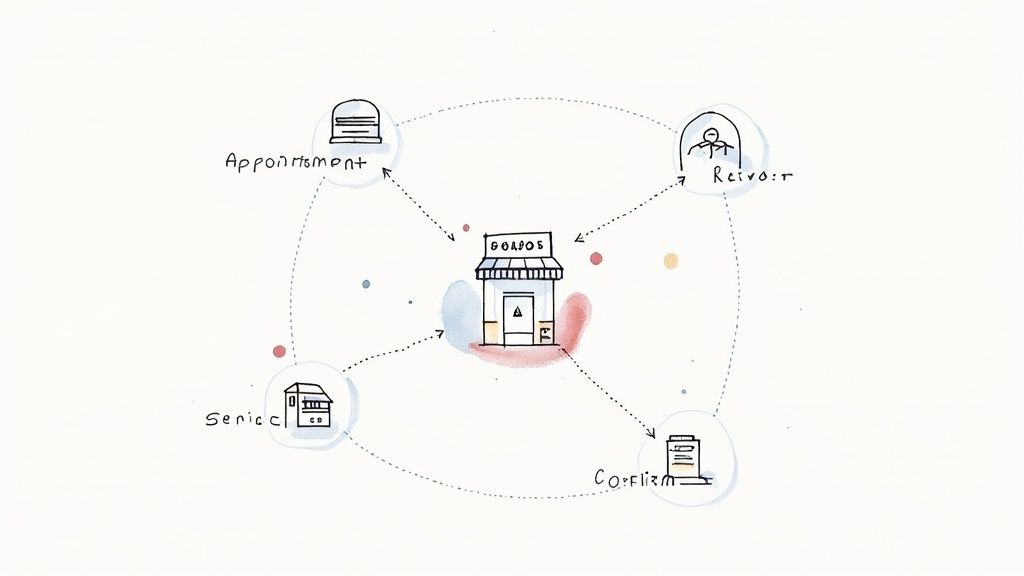
In the real world, landline texting is an absolute game-changer for daily operations. Imagine a dental office sending automated appointment reminders via text and watching no-shows plummet. Or picture a local shop texting a customer the second their special order is ready for pickup, delivering that instant gratification that builds loyalty.
These aren't just hypotheticals; this is what's happening every day. Businesses are turning their conventional phone numbers into versatile communication hubs. Auto repair shops, for example, text repair estimates and get approvals in minutes, which keeps the workflow moving and cash flowing. One small e-commerce store even cut its inbound support calls by 50% just by texting shipping and pickup updates.
The core benefit is simple: it allows businesses to communicate in a way that is less intrusive than a phone call but more immediate than an email. This balance respects the customer's time while ensuring important information is received and read promptly.
The use cases for a text-enabled landline pop up in nearly every industry, which just shows how incredibly useful it is. The goal is always the same: make communication better, save time, and build stronger relationships with customers.
Here are just a few examples of how different businesses are putting it to work:
For businesses looking to get the most out of this, the key is integrating landline texting with a solid CRM system. This allows for maximum efficiency and personalized outreach. Digging into best practices for CRM setup and management can show you how these systems work hand-in-hand. Ultimately, adding texting to a familiar number isn't just a technical upgrade; it’s a customer-focused evolution that makes doing business easier for everyone.
While you can technically text a landline to get a voice message across, there’s a much cleaner, more direct way to achieve a similar goal: ringless voicemail. It's a subtle but incredibly powerful alternative for reaching people without the awkwardness of a text-to-speech robot call.
Picture this: you want to leave someone a voicemail, but you don't want to interrupt their dinner or a meeting by making their phone ring. That's exactly what ringless voicemail was built for. It completely bypasses the live phone network and drops your pre-recorded audio message straight into their voicemail inbox.
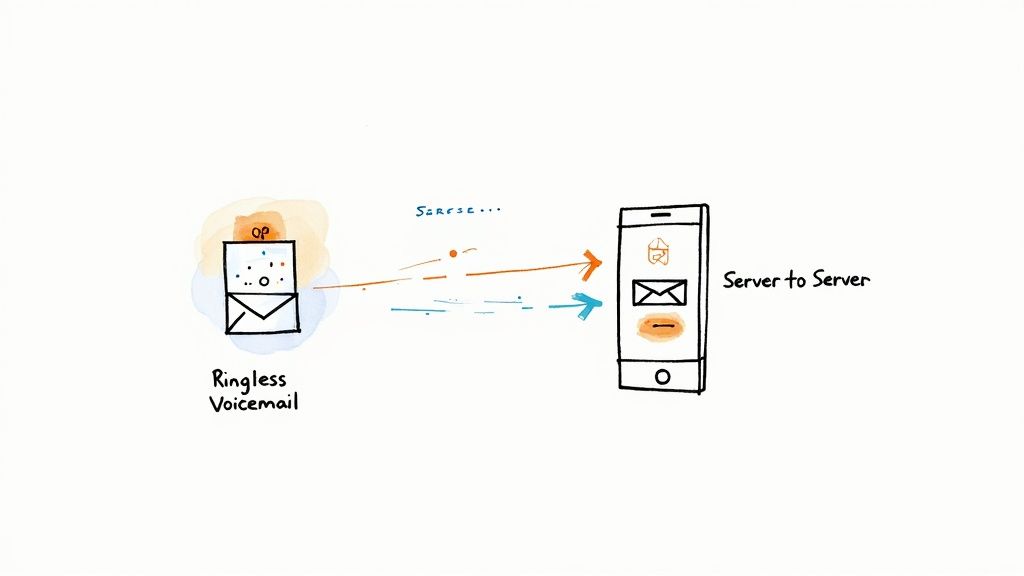
It’s a unique way to deliver information that’s less intrusive than a live call but far more personal than a plain text message.
The magic behind ringless voicemail is best described as a "server-to-server" drop. Instead of dialing through the public phone network (which is what triggers a ring), the platform talks directly to the voicemail server of your contact's carrier.
Think of it like a mail carrier who has a special key to your community's mailbox cluster. They can slide letters right into your box without ever knocking on your front door. This direct deposit ensures the message is delivered silently, waiting for the recipient to check it on their own time. Platforms like Call Loop have this delivery method down to a science, making it a reliable tool for business outreach.
The real advantage here is its non-disruptive nature. Your message arrives without causing an interruption, making it ideal for information that doesn’t need an immediate, back-and-forth conversation. It’s a communication strategy built on respecting your contact's time and attention.
This makes it a perfect fit for all sorts of business needs where the goal is to inform, not necessarily to start a live chat right that second. This method is often called voicemail drop or direct-to-voicemail messaging.
Because it's so unobtrusive, ringless voicemail has become the go-to tool for specific communications where a text or a live call just doesn't feel right. It lets you reach both mobile and landline numbers with a personal, pre-recorded audio message.
Here are a few common and highly effective ways businesses are using it:
By understanding what makes Call Loop’s ringless voicemail different, you can add a sophisticated and respectful channel to your outreach toolkit, right alongside your ability to text a landline.
Whether you're looking to text a landline, drop a ringless voicemail, or message a standard mobile number, you have to play by the rules. These aren't just polite suggestions—they're legal requirements designed to keep consumers from being bombarded with unwanted messages. Skip them, and you could be looking at some seriously hefty fines.
The big one you need to know is the Telephone Consumer Protection Act (TCPA). This is the federal law that dictates how businesses can use automated dialers, pre-recorded voice messages, and texts to talk to their customers. Its whole purpose is to clamp down on spam and protect people's privacy.
Under the TCPA, the single most important thing you need before sending any kind of promotional or marketing message is express written consent. This isn't a gray area; it's a specific, non-negotiable legal standard.
Getting permission isn't just a best practice; it's the law. This consent must be clear, conspicuous, and unambiguous, proving that the consumer knowingly agreed to receive marketing texts from your business.
This permission needs to be documented in writing. That can mean an electronic form, like a checkbox on your website's signup form, a keyword someone texts to your shortcode, or even a physically signed piece of paper. The point is, you need a verifiable record proving that person gave you the green light. Just having their phone number doesn't count.
The TCPA draws a clear line between two different kinds of messages, and the rules are different for each.
Every single text messaging campaign needs to give people a dead-simple, obvious way to opt out. The industry standard is having them reply with words like "STOP," "END," or "UNSUBSCRIBE."
Your system has to be set up to recognize these keywords and immediately add that number to a do-not-contact list. This has to be automatic and happen instantly.
Getting a handle on compliance means understanding how your provider applies these rules. You can see our approach by checking out Call Loop's comprehensive anti-spam policy for a real-world example. Sticking to these guidelines doesn't just keep you on the right side of the law—it builds trust with your audience.
So, you've got a landline number and want to connect with your audience. Should you text it? Drop a voicemail? It can feel a little confusing, but the choice boils down to a single question:
What are you trying to accomplish?
Think of it like picking the right tool for the job—you wouldn't use a hammer to turn a screw. A simple way to decide is to ask yourself, "Do I need a conversation, or do I just need to get information out there?" Your answer will point you straight to the right technology.
If you're looking for real-time engagement, two-way texting is your best friend. This is for situations that demand a back-and-forth exchange or need an immediate response from your contact. It essentially turns your business number into a live channel for conversation, which is fantastic for building stronger customer relationships.
Consider two-way texting for things like:
On the flip side, ringless voicemail is perfect for one-way, non-urgent announcements. Its magic lies in delivering a personal, audio message directly to someone's voicemail without ever making their phone ring. It’s a completely non-intrusive way to get important information across professionally.
Use ringless voicemail for:
The most powerful strategies often use both. A business might drop a ringless voicemail to announce a big promotion and then use two-way texting to field questions from all the interested customers. It's a perfect one-two punch.
The idea of texting landlines has really taken off, merging old-school trust with modern convenience. With text message open rates hitting an incredible 98%, it's no surprise businesses are scrambling to text-enable their landline numbers.
And while it's true that 73% of American adults now live in homes without a traditional landline, these numbers are still incredibly relevant for businesses, offering a familiar and trusted point of contact. You can dig into more texting statistics to see just how effective this channel has become.
Jumping into the world of landline texting can feel a bit like learning a new language. You've probably got a few questions buzzing around. Let's clear things up with some straight-to-the-point answers to the most common things people ask.
Not quite. While you can hit 'send' on a text to pretty much any landline number, what happens next is a roll of the dice based on the carrier. If their provider is set up for text-to-landline, your message will likely get turned into an automated voice call. But if they're not, your message might just disappear into the void without you ever knowing it failed.
For you, the sender, it's business as usual. Texting a landline is treated just like texting a mobile number by your carrier. It'll just count as one of your standard SMS messages, whether that's from a monthly allotment or your unlimited plan. The person on the receiving end doesn't pay a dime for the text-to-speech call.
This is a really important one. Think of it like this: landline texting (the text-to-speech kind) actually makes their phone ring to deliver a robotic voice version of your text. It’s an active interruption.
Ringless voicemail, on the other hand, is a much slicker, quieter approach. It completely sidesteps the live phone network, dropping a pre-recorded audio message directly into their voicemail inbox. Their phone never makes a sound.
The Bottom Line: Ringless voicemail is a direct-to-voicemail delivery method that doesn't disrupt your contact's day. Standard landline texting converts your typed words into an automated phone call that they have to answer.
A regular, old-school landline phone can't send a text message back. It's a one-way street. However, when a business uses a platform to "text-enable" their main office number, everything changes. They can then send and receive texts from a computer or an app, turning their familiar, trusted number into a full-blown, two-way messaging powerhouse.
Ready to connect with your entire audience, no matter what phone they use? Call Loop gives you the compliant tools you need for powerful SMS, voice, and ringless voicemail campaigns that actually work. See how our platform can transform your outreach strategy.
Chris Brisson
Chris is the co-founder and CEO at Call Loop. He is focused on marketing automation, growth hacker strategies, and creating duplicatable systems for growing a remote and bootstrapped company. Chat with him on X at @chrisbrisson


Trusted by over 45,000 people, organizations, and businesses like


