
See a Demo
You're just one step away from seeing Call Loop in action.
Enter your information below to watch a demo right now.

You're just one step away from seeing Call Loop in action.
Enter your information below to watch a demo right now.


On the surface, the difference between SMS and MMS seems simple. SMS (Short Message Service) is your classic, plain-text message. MMS (Multimedia Messaging Service) is what you use to send pictures, videos, and GIFs.
Think of it this way: SMS is like sending a quick, reliable note that’s capped at 160 characters. MMS is more like a digital postcard—it lets you include vibrant visuals and much longer text.
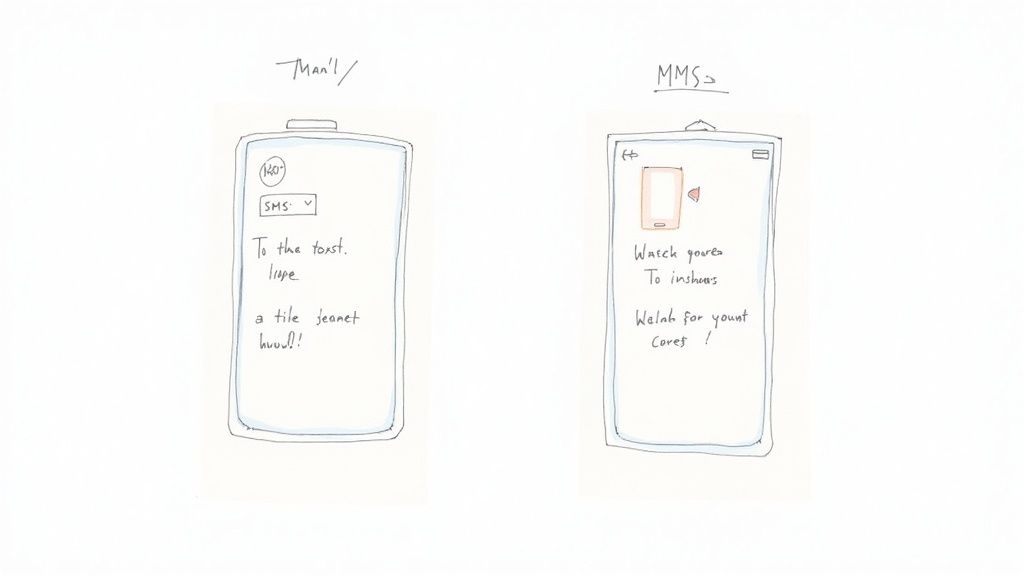
Even though both message types land in the same inbox on your phone, they’re built on completely different technologies from different mobile eras. SMS first appeared back in the 1980s, designed as a super-efficient way to send short text snippets over cellular networks.
MMS is the newer kid on the block, showing up in the early 2000s specifically to handle all that rich media content we love today. If you want to dive deeper into the specifics, you can get a full overview of the different kinds of SMS text messaging.
This age gap is really what creates the core distinctions. SMS is universally compatible and works on pretty much every mobile phone ever made—which is why it’s still the go-to for critical alerts. MMS, on the other hand, needs a smartphone and a data connection to send and receive those media files.
Grasping these fundamental differences is the first step. It helps you decide when a short, punchy message will do the trick and when you need to go for something more visually engaging.
For a quick, scannable reference, here’s a breakdown of how these two messaging types compare side-by-side.
As you can see, it’s not really a question of which one is "better." It's about picking the right tool for the job you need to do. A smart business messaging plan knows how and when to use both.
Beyond just the flashy features and character counts, the real gap between SMS and MMS is under the hood. It all comes down to the technology that gets your message from point A to point B. How they work reveals exactly why one is the undisputed king of reliability and the other is your go-to for making a visual splash.
The secret to SMS’s rock-solid delivery is that it travels over the network's control channel. This is the same special pathway your phone uses for critical background tasks, like pinging cell towers and handling calls. Because this channel is always on, SMS messages get through with incredible consistency, even when you’re dealing with a terrible signal or have no data connection.
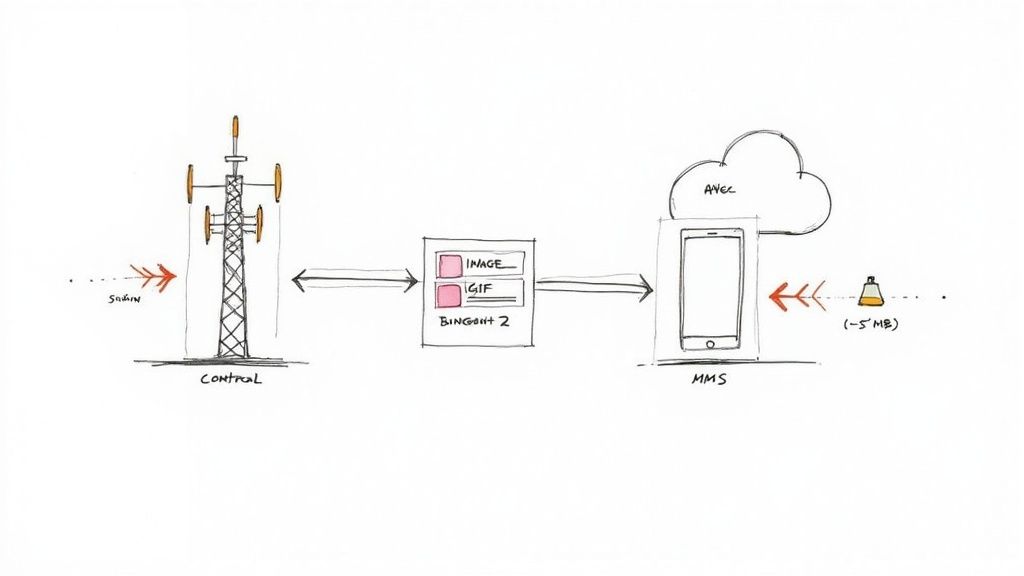
This is precisely why SMS is the backbone for things you can’t afford to miss, like two-factor authentication codes and emergency alerts. Its delivery is practically a sure thing. If you write a message longer than 160 characters, the network simply breaks it into smaller chunks using a process called concatenation, then stitches them back together perfectly on the other end.
MMS plays by a completely different set of rules. To send anything visual—images, GIFs, short videos, or audio files—it needs a cellular data connection (like 4G or 5G). Think of it as packaging up your media and text into a little bundle and sending it over the internet.
This total reliance on data brings a few key factors into play:
The bottom line is this: The bulletproof reliability of SMS comes from its simplicity and its use of the control channel. The visual power of MMS, on the other hand, comes with a trade-off—it needs a stable data connection and careful attention to file sizes.
Once you get a feel for these technical differences, you can start building a much smarter outreach strategy. While SMS and MMS are your primary tools, other technologies like ringless voicemail offer a completely different way to connect. A ringless voicemail drop sends a pre-recorded audio file straight to someone's voicemail box without their phone ever making a peep.
This can be a fantastic way to supplement a text campaign. Imagine sending an eye-catching MMS with a great product shot, then following up a day later with a ringless voicemail that adds a personal, detailed touch. By combining these different tools, each with its own unique delivery method, you create a communication flow that’s far more robust and effective.
When you start digging into your budget and campaign logistics, the differences between SMS and MMS suddenly become crystal clear. Your choice here isn't just about features; it has a direct impact on your wallet and how smoothly your campaigns run, mostly because of how mobile carriers treat each message type. It's a game of cost versus complexity with every message you send.
Let's get one thing straight: MMS messages always cost more than SMS messages. This isn't some arbitrary price hike. Sending a plain text SMS is a featherlight task for a carrier, using almost no data. An MMS with an image or video? That’s a whole different story. It chews up way more data and processing power, and you can bet the carriers pass that cost right on to you. If you’re sending messages at scale, this price difference becomes a massive factor in your planning.
Beyond the price tag, deliverability is a huge point of separation. SMS has an almost unbeatable reach—pretty much every mobile phone on the planet can get a standard text. This makes it the go-to channel for critical, time-sensitive info when you absolutely, positively need to know the message got there.
MMS, on the other hand, comes with a few more strings attached that can mess with delivery:
The universal reliability of SMS is its greatest strength. MMS offers higher engagement potential but comes with more delivery hurdles that require careful management to ensure your message actually reaches your audience.
Both SMS and MMS marketing are playing in a heavily regulated sandbox, with rules like the Telephone Consumer Protection Act (TCPA) watching your every move. If you don't get proper consent from your contacts, you're looking at some seriously painful financial penalties, no matter which message type you use. But here's the kicker: the higher cost of MMS means every undelivered or non-compliant message stings your budget that much more.
This is where you have to get smart and start integrating other tools. For example, a ringless voicemail drop can slide a detailed audio message right into someone’s inbox without their phone ever ringing. It’s a great way to follow up an SMS or MMS campaign with something richer and more personal, and it completely sidesteps the carrier filtering headaches that come with multimedia files. It adds another solid, reliable layer to your communication strategy.
Knowing the technical specs and costs of SMS versus MMS is just the starting point. The real magic happens when you know exactly which one to pull out of your toolbox for a specific business goal. It’s never about which one is better overall, but which is the perfect tool for the task right in front of you.
SMS is all about speed, simplicity, and its almost unbeatable delivery rate. That makes it the undisputed champ for any message that’s urgent, functional, or transactional. Its directness just cuts through all the noise, making sure your message gets seen almost instantly.
MMS, on the other hand, is your go-to for making a lasting impression. When the goal is to captivate, persuade, or build up some serious brand love, the visual power of multimedia is a game-changer. It turns a simple notification into a compelling brand experience.
The power of SMS is in its concise, action-oriented nature. You’ll want to choose SMS when the message's value is in its speed and clarity, not its creative flair.
Ideal scenarios for SMS include:
The core idea behind using SMS is utility. If the message serves a direct function and needs to be seen immediately, SMS is almost always the right call. Its reliability and simplicity are its greatest strengths.
MMS is the clear winner any time visual context is what will drive engagement and action. While SMS already has an incredible 90-98% open rate globally, MMS takes engagement to a whole new level.
Research shows that MMS can significantly boost key metrics compared to standard SMS. This includes higher click-through rates, fewer opt-outs, and a greater likelihood of being shared. And considering that 93% of consumers say visuals are a major factor in their purchasing decisions, MMS can have a massive impact on your campaign's bottom line.
This visual guide can help you decide if your campaign budget is better spent on low-cost reach or high-impact visuals.
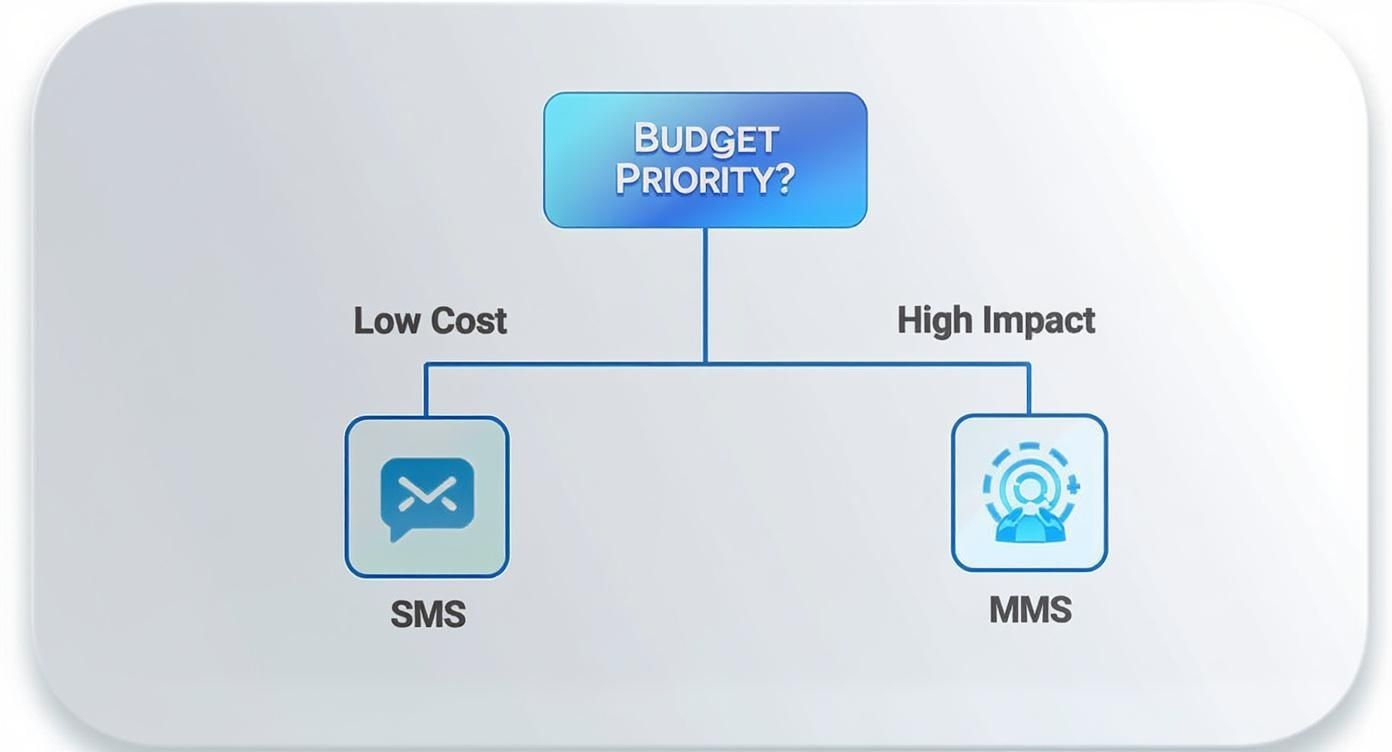
As the flowchart shows, one of the first things to consider is budget versus impact. This helps guide you toward SMS for cost-effective outreach and MMS when making a stronger visual impression is the main priority.
Here are some powerful use cases for MMS:
When you match the message type to your specific goal, you build a much more effective and efficient communication strategy. Just remember to follow our guide on SMS marketing best practices to make sure your campaigns are both compliant and impactful.
To make this even clearer, here's a quick reference table to help you decide which channel to use based on your communication goals.
Choosing between SMS and MMS isn't a one-time decision; it's a strategic choice you make for every campaign. By understanding the unique strengths of each, you can ensure your message not only gets delivered but also achieves its intended goal, whether that's driving immediate action or building long-term brand loyalty.
An effective outreach strategy often goes beyond just the text in an inbox. You’ve got SMS and MMS down, but layering in other channels is what creates a richer, more engaging customer experience. One of the most powerful—and surprisingly non-intrusive—tools for this is ringless voicemail (RVM).
This isn't about cold calling. RVM technology delivers a pre-recorded audio message directly to a contact's voicemail server without ever making their phone ring. It’s a subtle yet highly personal way to connect. You get to avoid the interruption of a live call while still conveying the warmth and nuance of a human voice.
RVM really shines in specific scenarios where a text message might feel too impersonal or just isn't enough to get the point across. Think of it as the perfect complement to your existing SMS and MMS campaigns, adding a distinct touch that helps you stand out.
Consider using RVM for:
The real magic of ringless voicemail is its ability to deliver detailed, personal messages without being disruptive. It respects your contact's time by letting them listen and respond on their own schedule.
The real power emerges when you stop thinking about these channels in isolation and start combining them. Imagine sending an engaging MMS with a product video. A day later, you can follow up with a ringless voicemail that offers a special discount or answers common questions about that product.
This approach creates a cohesive narrative. You can even send a final, quick SMS to let them know a helpful message is waiting in their voicemail. This multi-layered approach ensures your message is heard and remembered, which can seriously boost your overall engagement and response rates.
If you want to dive deeper into the nuts and bolts, you can learn more about how to implement a ringless voicemail strategy that works hand-in-hand with your texting efforts. By integrating these tools, you move beyond simple messaging and start building a more dynamic and effective communication system.
Running a strategy that mixes SMS, MMS, and even ringless voicemail requires a solid, easy-to-use platform. The right tools help you go beyond just blasting out messages. They let you build automated, personalized campaigns that actually get results. When you're picking a platform, look for features that specifically solve the headaches of managing SMS and MMS together.
You'll want a system that gives you powerful audience segmentation so you can send the perfect message to the right people. Marketing automation is also a must-have. It's what lets you create drip campaigns that smartly combine SMS alerts, eye-catching MMS promotions, and personal follow-ups using ringless voicemail drops. This kind of coordinated effort makes your communication feel timely and relevant, not just random noise.
Any good messaging strategy is built on data. If you aren't tracking clear metrics, you're just flying blind. A quality platform will hand you detailed analytics to see what's working and prove the value of your campaigns.
Here are the Key Performance Indicators (KPIs) you should be watching:
One of the most critical features to look for is intelligent MMS fallback. This nifty function automatically converts an MMS to an SMS with a clickable link if the person's device can't handle it. It's a small detail, but it's vital for making sure your message always gets delivered, protecting your investment and maximizing your reach.
By focusing on these core features and tracking the right KPIs, you can manage your SMS and MMS campaigns like a pro. A data-first approach lets you tweak and improve your performance over time, proving just how valuable direct messaging is for your growth.
As you dig into the world of SMS and MMS, a few practical questions always pop up. Let's tackle the most common ones businesses run into when building out their messaging strategy.
This is a big one, but thankfully, modern platforms have a built-in safety net. If you send an MMS to a device that can't receive it (maybe because of carrier issues or an older phone), a feature called MMS fallback kicks in.
The system is smart enough to automatically convert the message into a standard SMS that includes a clickable link. Your customer just taps the link to see the picture or video in their web browser. This way, your content always gets through one way or another.
Not in the same way as SMS. While you're not stuck with the tight 160-character limit, MMS messages do have their own rules. The text portion can be pretty generous, sometimes up to 5,000 characters.
The real constraint is the media file size. Most carriers draw the line somewhere between 1-5 MB, so you'll want to make sure your images and videos are optimized before sending. If you have a longer audio message to share, you can always supplement your campaign with ringless voicemail to get around file size limits entirely.
Ready to see how powerful SMS, MMS, and ringless voicemail can be when they work together? Call Loop combines all three into one simple platform. Start your free trial today and see the difference for yourself.
Chris Brisson
Chris is the co-founder and CEO at Call Loop. He is focused on marketing automation, growth hacker strategies, and creating duplicatable systems for growing a remote and bootstrapped company. Chat with him on X at @chrisbrisson


Trusted by over 45,000 people, organizations, and businesses like


