
See a Demo
You're just one step away from seeing Call Loop in action.
Enter your information below to watch a demo right now.

You're just one step away from seeing Call Loop in action.
Enter your information below to watch a demo right now.


Before you can tackle appointment no-shows, you have to get real about what they’re actually costing you. It’s not just about an empty time slot on the calendar. The real damage goes much deeper, hitting your direct revenue, wasting your team's valuable time, and blocking other clients from getting the help they need.
An empty chair isn't just a minor hiccup in your day; it's a financial leak that’s quietly sinking your business. Every single no-show is a direct loss of revenue you can never get back for that block of time. When you start multiplying that one missed payment by all the no-shows you get in a week, a month, or a year, the numbers get scary, fast.
But the lost income is just the tip of the iceberg.
Your team still put in the work preparing for that appointment. Staff spent time pulling files, setting up rooms, or reviewing a client’s history. All of that is paid labor that generated zero return. It's wasted effort that tanks productivity and inflates your operating costs without a penny of revenue to show for it.
And the ripple effect doesn't stop there. A no-show ties up a valuable spot that another client could have taken—maybe someone on your waitlist or a person with an urgent need. This doesn't just delay care for others; it can make your practice seem unavailable, pushing people to look elsewhere.
Let's look at the hard numbers to really understand what's at stake. The financial toll of patient no-shows is a massive problem, especially in healthcare. In the U.S. alone, missed appointments drain the healthcare industry of an estimated $150 billion every single year.
For an individual physician's practice, that breaks down to about $150,000 per year in lost revenue. On average, that’s $200 down the drain for every missed appointment. You can dig into more of these stats in various reports covering no-show costs in the U.S. healthcare system.
When you stop thinking of it as a "missed appointment" and start seeing it as "$200 in lost revenue and 45 minutes of wasted staff time," the whole problem changes. It’s no longer an abstract annoyance—it’s a concrete business metric that you have to fix.
The cost isn't just about scheduled appointments, either. Every missed interaction, whether it's a no-show or an unanswered phone call, is a lost opportunity. To really get the full picture, it helps to think about the financial impact of any missed client contact. For instance, this piece on The Real Cost Of Missing 4 Calls Per Week shows how these small communication failures add up over time.
Calculating your own no-show rate is the first step toward plugging that leak. Once you know exactly what it's costing you, you'll have all the motivation you need to put the practical, modern strategies that follow into action.
Let's be honest, the number one reason for a no-show isn't malice or disrespect. It's simple forgetfulness. Life gets chaotic, and appointments booked weeks ago can easily fall off the radar. This is exactly why a passive approach—like making one reminder call and just hoping for the best—is a surefire way to end up with empty slots in your schedule.
If you're serious about cutting down on no-shows, you need to get proactive. This means building a communication system that reaches clients where they already are, using multiple channels to create a safety net.
Think about it: some people live in their email inbox, while others only glance at text message notifications. If you're only using one method, you're guaranteed to miss a huge chunk of your audience. A solid system combines automated texts, emails, and even voice calls to make sure your message gets through.
The ripple effect of just one no-show is bigger than you'd think. It's not just lost revenue; it's wasted staff time and longer waits for your other clients who did show up.

As you can see, a single missed appointment creates a domino effect that disrupts your entire operation.
SMS and email reminders are the bread and butter of any good system, but you can add another surprisingly powerful layer: ringless voicemail. This cool piece of tech sends a pre-recorded audio message straight to a person’s voicemail box without their phone ever ringing.
What's the big deal? It feels personal. Hearing a friendly voice is often way more compelling than reading a block of text. A well-crafted ringless voicemail drop can add a human touch and convey a sense of importance that text messages sometimes lack. With this voicemail marketing approach, you can deliver a message that feels direct and urgent without being intrusive.
Imagine a dental office leaving a warm, personal voicemail reminding a patient about their cleaning. It’s not a cold, robotic alert but a friendly check-in that reinforces the relationship and makes the appointment feel more significant.
Timing is everything. Bombard clients with too many reminders, and you become spam. Send too few, and you defeat the purpose. The sweet spot is a strategic sequence that gently guides them from the moment they book right up to their appointment time.
We've found that a multi-channel approach works best, hitting different platforms at key intervals.
This table breaks down a timeline that we've seen work wonders for minimizing no-shows.
By layering your communication like this, you create multiple touchpoints that make it almost impossible for someone to forget.
The most successful reminder systems are built on two-way communication. It's not enough to just send messages; you must make it incredibly easy for clients to respond, confirm, reschedule, or cancel with a single word or click.
Disconnected communication is a huge reason for missed appointments. In fact, some studies show that poor provider communication is behind as many as 31.5% of no-shows. That number alone shows how critical a smooth, interactive connection really is.
This is precisely why your reminder system can't be a one-way broadcast. When a client can simply reply to a text to confirm or ask a quick question, you eliminate friction and give them control. The same logic is used to successfully increase event attendance—make it simple and engaging for people to say "yes."
Your automated workflow should be smart, too. If a client texts back "C" to confirm, the system should automatically pull them out of the remaining reminder sequence. This little detail prevents you from annoying them with messages they don't need and keeps your whole process running smoothly. Using automated text message reminders is one of the most effective ways to reduce friction and improve confirmation rates.
A slick reminder system is great, but it can only do so much. If your actual scheduling process is a pain—forcing clients to call during a tiny 9-to-5 window, sit on hold, or play phone tag just to reschedule—you're practically begging for no-shows.
Think about it from their side. If it's a hassle to book or change an appointment, people are far more likely to just throw in the towel and not show up at all.
This is exactly why you need to move to a digital-first scheduling solution. The whole idea is to put your clients in the driver's seat. The easiest way to do that? An online self-scheduling portal.

When clients can book, check, and manage their appointments anytime, day or night, from their phone, it completely changes the game. Sure, it takes a load off your admin team, but the real win is giving clients control. That one shift makes a massive difference in your no-show rates.
Handing over the scheduling keys does more than just quiet your phone lines. It gives clients a real sense of ownership. When someone personally picks a time that fits their life and knows they can easily shift it if something comes up, they're far more invested in keeping that appointment.
The numbers don't lie. Online scheduling is a proven no-show killer, especially in healthcare. Studies have found the no-show rate for appointments booked online is just 1.8%. Compare that to the 5.9% rate for appointments booked the old-fashioned way. The reason is simple: online systems make it incredibly easy for people to reschedule or cancel instead of just ghosting you.
Not all scheduling tools are built the same. When you're shopping around, you need to look for features that directly solve the no-show problem.
One of the most valuable features you can find is an automated waitlist. It transforms your scheduling tool from a simple calendar into a revenue-saving machine. This is an absolute game-changer for filling those dreaded last-minute cancellations.
Last-minute cancellations are going to happen. It's a fact of life. But they don't have to kill your revenue for the day. An automated waitlist is your secret weapon here.
When a spot opens up, the system can automatically text everyone on the waitlist, offering them the newly available slot. First come, first served.
Suddenly, a potential loss becomes a win-win. You fill an empty spot on your calendar, a happy client gets in sooner than they expected, and your front desk staff isn't stuck making a dozen frantic phone calls. It’s a smooth, efficient process that keeps your schedule packed and your income steady.
The best systems are the ones that integrate directly with your communication tools, making sure your SMS reminders and waitlist alerts work hand-in-hand. This integration creates a seamless workflow that manages everything from booking to arrival, dramatically cutting down the odds of an empty chair.
Strong communication and slick scheduling software are game-changers, but they won't stop every no-show. Without clear, consistent rules for your business, you're still leaving money on the table. Your appointment policies are the backbone of your strategy; they set expectations and create a culture of accountability for your team and your clients alike.
The point isn't to punish people. It's about building a fair system that respects everyone's time—especially yours. A solid policy protects your business from the chaos and lost revenue of a last-minute cancellation while treating your clients with respect. It's a balancing act between being firm and being fair.
Of course, a policy is only as good as its communication. Plaster it everywhere: on your website, in your confirmation emails, and have your team mention it during the booking process. When everyone knows the rules from the get-go, there are no awkward surprises later.
There's no single "best" appointment policy. What works for a high-end salon might feel completely wrong for a pediatric clinic. You've got to think about your specific client base, how much an empty slot costs you, and the overall vibe of your brand.
Here are a few of the most common and effective approaches I've seen work:
A fair policy is one that is communicated clearly, consistently, and upfront. Surprising a loyal client with a fee they never knew existed is a quick way to damage a relationship. Transparency is non-negotiable.
While penalties definitely work, don't forget about the flip side: rewarding good behavior. Sometimes, positive reinforcement can be an even stronger motivator for clients to be reliable, and it builds goodwill instead of creating friction. The whole idea is to thank clients for their commitment, not just penalize them for slip-ups.
Think about offering a small discount for clients who pre-pay for their service. Or maybe you give a little something extra to those who book their next appointment before they even leave the building. This not only locks in future revenue but makes your clients feel genuinely valued for their loyalty.
Picking the right policy means you've got to weigh the pros and cons for your business. What one owner sees as essential protection, another might view as too aggressive for their customers.
To help you figure out the best fit, I've broken down the most common strategies in this table.
Ultimately, the best policy is one that feels right for your brand, protects your bottom line, and is something your team can enforce consistently and fairly. Don't be afraid to start with one approach and tweak it as you learn what resonates with your clients.
Your scheduling software, reminder system, and client policies are all powerful pieces of the puzzle. But if they aren't talking to each other, you're still playing with a handicap. To really crush the no-show problem, your technology needs to communicate.
When systems are siloed, it creates a ton of manual work and opens the door for human error. A disconnected process is exactly where clients fall through the cracks and appointments get missed.
The real goal here is to build a cohesive, automated ecosystem where your tools work in harmony. Imagine a client confirming their appointment via text. In a connected system, that confirmation doesn't just sit in an inbox—it instantly updates your scheduling software and automatically pulls them out of any future reminder sequences. This keeps you from annoying your clients with pointless messages and frees your staff from having to manually track who has confirmed and who hasn't.
This level of integration transforms your operation from a series of disjointed tasks into a smooth, self-managing workflow. It ensures that from the second an appointment is booked until the moment that person walks through your door, the entire process is seamless.
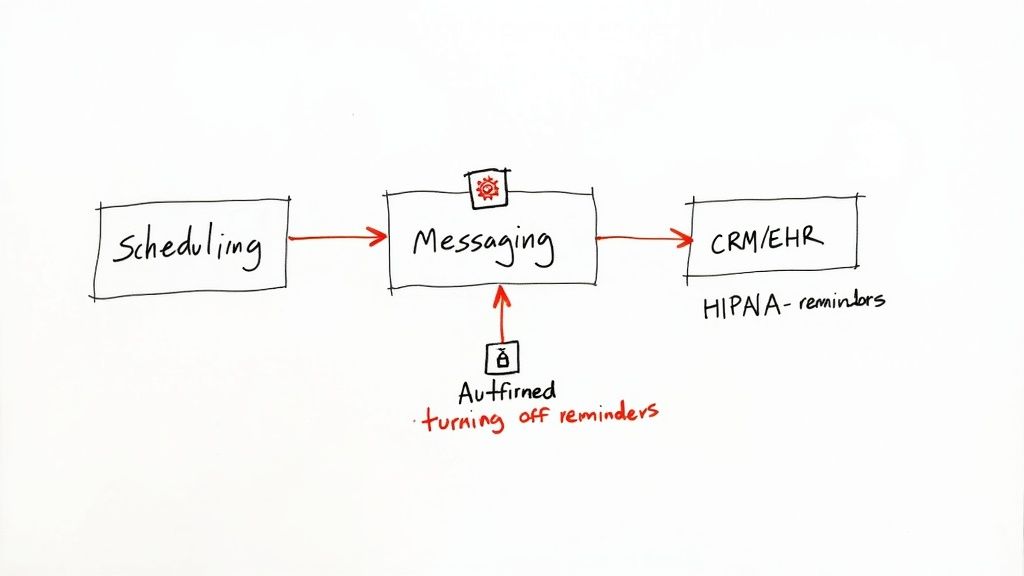
This is where the magic really happens. When your communication platform starts talking directly to your core business software—whether that’s a Customer Relationship Management (CRM) system or an Electronic Health Record (EHR)—you unlock true automation.
With these systems linked, client data flows freely. A new appointment logged in your EHR can automatically trigger a welcome text and enroll the client in a reminder campaign. No more manual data entry, which is not only a drag on your team's time but also a huge source of mistakes.
A solid integration lets you:
This creates a single source of truth for all client interactions, giving your team the full picture without having to jump between five different programs.
For anyone in healthcare, this integration comes with a big, non-negotiable requirement: HIPAA compliance. The Health Insurance Portability and Accountability Act has strict rules for protecting sensitive patient information. Any tech you use for patient communication has to meet these tough security and privacy standards.
This means you can't just grab any off-the-shelf SMS tool. You absolutely have to choose a platform built for healthcare that offers features like:
Using a non-compliant tool for patient communication is a massive risk. We're talking huge fines and serious damage to your reputation. Always, always verify that your communication vendor is fully HIPAA-compliant before you even think about connecting it to your EHR.
The key to automation is creating a system that intelligently handles the entire client journey. The goal is to free up your team from repetitive administrative tasks so they can focus on what they do best: providing excellent care and service.
Connecting different software might sound like a developer-level task, but it doesn't have to be. Platforms like Zapier act as a bridge between thousands of different apps, letting you create powerful automated workflows without writing a single line of code. You can learn more about how to connect your apps using Zapier to build the seamless system your business needs to cut down on no-shows for good.
Even with the best game plan, a few tricky situations always seem to pop up. When practice managers and business owners start tightening up their no-show process, the same handful of worries tends to surface.
Let's walk through the most common questions I hear and give you some clear, practical answers to get you over those final hurdles.
This is the big one, and it's a completely fair question. The secret here is all in the communication and framing. You aren't punishing people; you're protecting your schedule so you can serve everyone better, including your loyal clients.
First, give everyone a heads-up well in advance. Announce the new policy with an email, a post on your website, and even a small, tasteful sign at your front desk. Keep the language positive: "To make sure we can offer timely appointments to all our valued clients, we're updating our cancellation policy starting on [Date]."
For your regulars, the ones who have been with you for years, think about offering a one-time "grace" forgiveness for their first slip-up. It's a simple gesture that shows you value their business while still setting the new standard.
Most reasonable people get it when you explain that the policy helps you fill last-minute spots for others who might be in pain or need urgent help. It all comes down to mutual respect for everyone’s time.
Absolutely. While SMS is the undisputed king of quick confirmations, ringless voicemail plays a different, very valuable role. A text message is easy to ignore and can feel a bit robotic. A voice message, on the other hand, adds a personal touch that really cuts through the digital clutter.
Think about it: a ringless voicemail drop feels more like a personal check-in from your office. It’s way less intrusive than a live call but carries more weight than a simple text. For older clients who might not be glued to their texts, or for high-value appointments where that human element really matters, it can make a huge difference in attendance rates. The message goes straight to their voicemail without ever making their phone ring, making it a subtle but powerful direct to voicemail tool.
Dealing with the same person flaking on appointments time and again is maddening. This is where you need a direct but completely professional conversation. After the second or third no-show, it’s time to step in.
Have the owner or a manager make a personal call. A simple, non-accusatory script is your best bet: "Hi [Client Name], I noticed you've missed a few appointments, and I just wanted to personally check in and make sure everything is okay. Our schedule is in high demand, and when a spot goes unfilled, it means another client misses out on getting the care they need."
From there, you offer a path forward.
This tactic addresses the issue head-on while still being constructive. It shows you're serious without being confrontational. The goal isn't to shame them; it's to solve the problem for good.
Ready to stop losing revenue to no-shows? Call Loop gives you the tools to automate your entire communication workflow. From SMS reminders and two-way confirmations to personal-touch ringless voicemail and voice broadcasts, our platform ensures your message gets delivered. Create a cohesive, HIPAA-compliant system that cuts no-shows and keeps your schedule full.
Chris Brisson
Chris is the co-founder and CEO at Call Loop. He is focused on marketing automation, growth hacker strategies, and creating duplicatable systems for growing a remote and bootstrapped company. Chat with him on X at @chrisbrisson


Trusted by over 45,000 people, organizations, and businesses like


