
See a Demo
You're just one step away from seeing Call Loop in action.
Enter your information below to watch a demo right now.

You're just one step away from seeing Call Loop in action.
Enter your information below to watch a demo right now.

Getting a short code isn't a casual setup task. It’s a regulated business messaging project with real cost, carrier scrutiny, and a slower launch path than 10DLC or toll-free. In most cases, businesses should expect roughly 8 to 12 weeks from planning to activation, with carrier review driving most of that timeline, as noted in this short code leasing overview. That review exists for a reason: carriers want proof that your opt-in flow, sample messages, and customer disclosures are compliant before they approve high-volume sending.
The short code workflow follows the order a business experiences it: deciding whether a short code is justified, choosing between random and vanity numbers, checking availability through the registry/provider process, preparing the application package, and getting through carrier review and launch. Ongoing obligations that matter after approval include opt-in documentation, mandatory HELP/STOP handling, and policy alignment.
The decision criteria here are practical. A short code recommendation only makes sense when a team can tolerate an 8-12 week setup cycle, expects sustained message volume, has documented consent flows ready for review, and benefits from either high throughput or memorable branding. If a company needs to launch in days, expects mostly two-way conversations, or is still testing whether customers even want texts, I would not push them toward a short code first.
We also compare short codes against 10DLC and toll-free using five filters: message volume, timeline tolerance, compliance readiness, branding needs, and whether the program depends on conversational replies. That matters because the best messaging number for a retailer running national promotions is not automatically the best choice for a clinic sending appointment reminders or a support team handling one-to-one conversations.
Before you start the paperwork, decide whether a dedicated short code matches the stage and scale of your messaging program. A short code is a 5 or 6-digit number built for high-throughput application-to-person messaging. It is excellent when volume is predictable, speed matters, and the program already has a disciplined compliance process.
Where businesses get this wrong is assuming a short code is the "serious" option and everything else is a compromise. In practice, the right choice depends on volume, use case, and operational maturity.
A short code is usually the best fit when you have:
A business should usually start with 10DLC or toll-free instead when it has:
I would be especially cautious about leasing a short code for a company that has not yet nailed down its consent language. Paying for the number is the easy part; passing review and staying compliant is what determines whether the investment holds up.
Back in the day, some companies would try to save a buck by using "shared" short codes, where a bunch of different businesses all sent texts from the same number. Carriers put a stop to that. It was a mess for compliance and a spam nightmare.
Today, a dedicated short code is your only real option. This gives your brand exclusive use of that number, which is absolutely vital for building brand recognition and making sure some other company's bad behavior doesn't get your messages blocked. It is the industry standard.
So, a dedicated short code isn't the only way to text your customers. You've also got 10-Digit Long Codes (10DLC) and toll-free numbers. Each one has its place. Short codes are the undisputed champions of throughput, starting at 100 messages per second and going up from there. They're built for those massive, one-to-many broadcasts.
People often assume all business texting numbers are the same. They're not. Short codes are specifically vetted and approved by carriers for high-volume sending, which means better deliverability and fewer messages getting caught in spam filters.
On the other hand, 10DLC and toll-free numbers are much better for conversational, lower-volume texting. They’re cheaper and way faster to get set up, but they just don't have the horsepower for huge blasts. For businesses looking to mix SMS with other channels like ringless voicemail, getting these distinctions right is key to a smart strategy. If you're still on the fence, our deep dive on short codes for SMS can help clear things up.
To give you a clearer picture, let's break down how these options compare.
This table gives you a quick side-by-side look at the main players in business texting. It should help you see exactly where short codes fit into the ecosystem and why they're the premium choice for high-volume campaigns.
| Feature | Dedicated Short Code | 10-Digit Long Code (10DLC) | Toll-Free Number |
|---|---|---|---|
| Best For | High-volume marketing, alerts, mass blasts | Conversational, P2P-style messaging | Customer service, support, some marketing |
| Throughput (Speed) | 100+ MPS (Messages per second) | Varies by carrier vetting, typically lower | Higher than 10DLC, but less than short codes |
| Setup Time | 8-12 weeks | Days to a few weeks | Days |
| Cost | High (thousands per month) | Low (a few dollars per month) | Moderate (monthly fee) |
| Number Format | 5-6 digits (e.g., 38470) | 10 digits (local area code) | 10 digits (e.g., 800, 888, 877) |
| Voice Enabled | No (SMS/MMS only) | Yes | Yes |
| Brand Recognition | Excellent; easy to remember and market | Moderate; looks like a personal number | Good; established for business use |
The practical threshold is simple: if your program is mostly support, reminders, or sales conversations, short codes are often overkill. If you are running retail promotions across many locations, franchise notices, nonprofit or political outreach at scale, or authentication traffic that cannot bottleneck, the higher bar starts to make sense.
Retail is the clearest example. A brand sending flash-sale announcements to a large opted-in list can justify the speed and memorability. Franchises may need one centrally managed number for broad announcements. Political and nonprofit teams often value fast list-wide sends, though they still need rigorous consent controls. Authentication is more nuanced: if reliability and scale are essential, a short code can make sense, but many companies should compare it against verified toll-free or other approved routes first.
When should a business not lease one yet? Three situations come up constantly: low-volume senders, teams without documented opt-in flows, and brands still testing message-market fit. In those cases, I would start cheaper and faster, prove subscriber demand, and move up only when throughput or branding becomes the bottleneck.
The short code application process is easier to manage when you treat it like a staged approval workflow instead of a single form. In the U.S., the registry layer, the messaging provider layer, and the carrier review layer each do different jobs. The registry manages the short code inventory and leasing framework, your provider or aggregator coordinates submission and implementation, and each wireless carrier reviews the campaign for its own compliance standards before traffic goes live. That division of responsibilities is why the process feels slower than other messaging routes.
Start by pressure-testing the use case. A short code is meant for programs that need sustained throughput, clear branding, or broad one-to-many delivery. If the campaign is mostly customer support chats, local appointment reminders, or early-stage outreach, a 10DLC or toll-free program is often the better starting point.
The fastest way to derail an application is to force a marginal use case into a short code request. Carriers want a narrow, defensible explanation of what the program does, who receives messages, and how consent is gathered.
Next, decide whether you want a random code or a vanity code. Random codes are assigned from available inventory and are generally the more practical option when speed and cost matter most. Vanity codes are chosen for memorability and branding, but they only work if the specific number you want is available.
I usually think of vanity as a marketing decision, not a technical one. If customers are likely to remember, type, or see the number in ads, packaging, or live events, the premium can be justified. If the number mostly sits behind app flows or transactional traffic, random is often the smarter lease.
Businesses typically do not self-assign a number directly from a public pool. Availability is handled through the provider or aggregator working within the U.S. short code registry framework. The administrator for U.S. short codes is the US Short Code Registry, which handles leasing and number administration.
Availability matters most for vanity requests. A random code is usually easier to secure because any open number can work. A vanity request depends on that exact number being open, and if it is not, the team may need to revise campaign creative, keyword promotion, or offline materials before launch.
This is the part many teams underestimate. Carriers do not approve a short code because the brand is legitimate; they approve a clearly documented messaging program. Your application package should include:
Carrier and industry guidance consistently emphasize opt-in clarity, consumer disclosures, and support for HELP/STOP. The CTIA messaging principles and Twilio’s short code requirements are useful references for the type of documentation reviewers expect.
For most businesses, the provider is the operational quarterback. They collect the brief, flag weak spots, submit the program, and coordinate follow-up questions. They also handle the technical side of provisioning and testing after approvals come through.
Provider quality really matters. A strong partner will push back on vague message samples, missing privacy language, or unsupported use cases before carriers ever see them. In my experience, that early pushback saves far more time than it costs.
Each carrier can review the campaign independently, and revision requests are common. Carriers may ask for tighter opt-in wording, clearer frequency disclosures, updated terms, more realistic message samples, or proof that the consent language shown on the signup page matches the application.
This is usually where timelines slip. Not because the rules are mysterious, but because marketing, legal, and product teams often need to revise assets in parallel. Fast approvals tend to come from companies that can produce screenshots, legal links, and message examples quickly without debating fundamentals mid-review.
After approvals, the provider activates the code, configures required keyword responses, and runs launch testing. That testing should confirm at minimum that opt-out handling works, HELP replies route users to support, message templates match the approved use case, and traffic behaves correctly across participating carriers.
A launch is not the end of registration discipline. If you materially change the program later, such as adding promotional traffic to a code approved only for transactional alerts, you may need to re-review the campaign through your provider.
The easiest way to understand the process is to separate administration from approval. The U.S. short code administrator manages the registry and leasing framework. Providers or aggregators help businesses request a code, prepare materials, submit the campaign, and implement the messaging setup. Carriers then decide whether the campaign can operate on their networks based on compliance, consumer protection, and messaging use-case standards. For carrier-facing requirements, teams commonly rely on provider documentation such as Sinch short code guidance, while the underlying registry function remains with the official short code administration system.
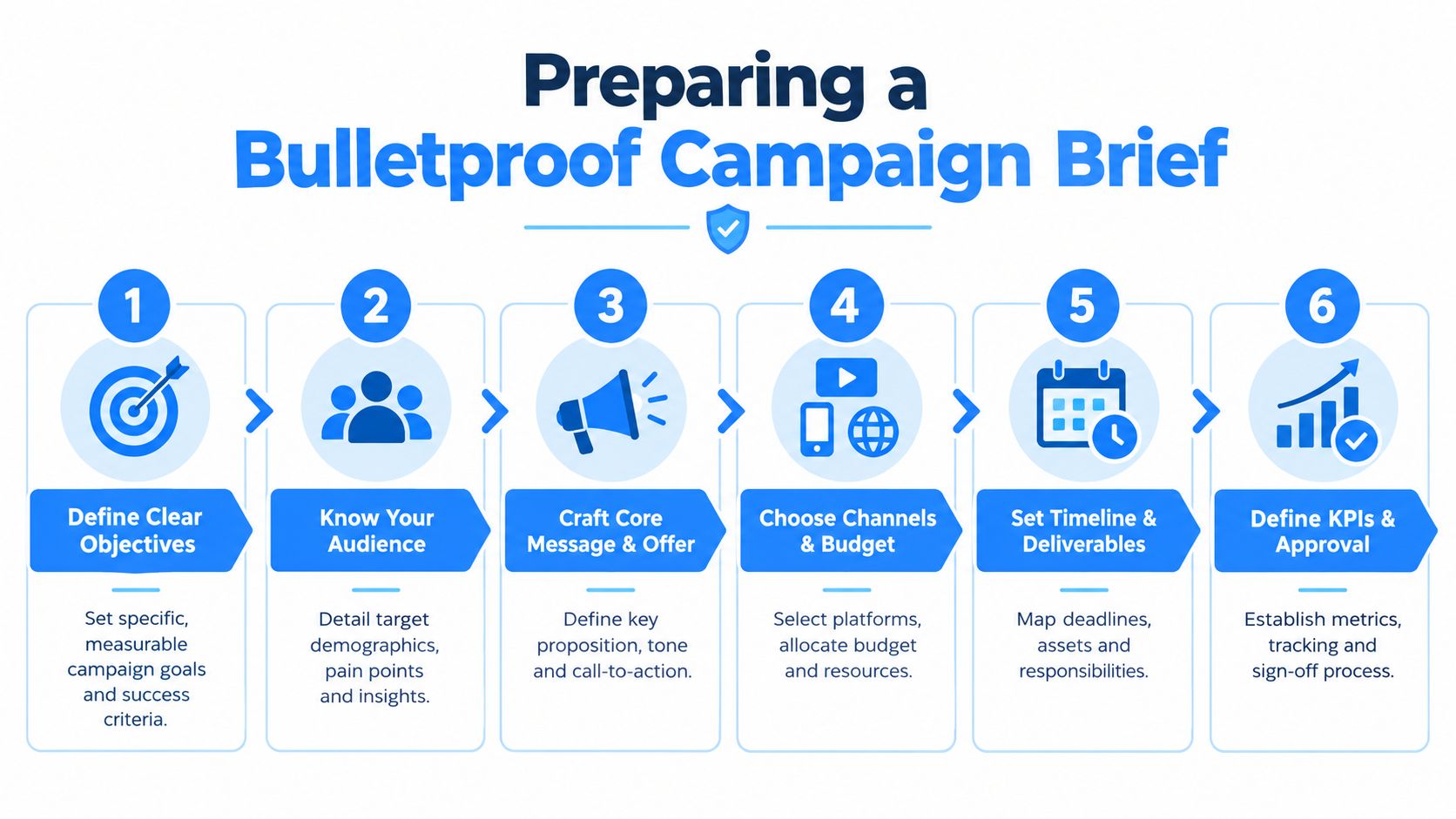
It really simplifies the choice, showing that after you've confirmed your need for high-volume messaging and weighed the options, a short code is the logical next step.
Short code economics make more sense once you think in terms of leasing, not ownership. Businesses do not buy a short code outright. They lease exclusive use of the number for a recurring fee, and they keep that right only while the lease remains active and the program stays compliant. That structure is one reason short codes are best reserved for mature messaging programs rather than experimental campaigns.
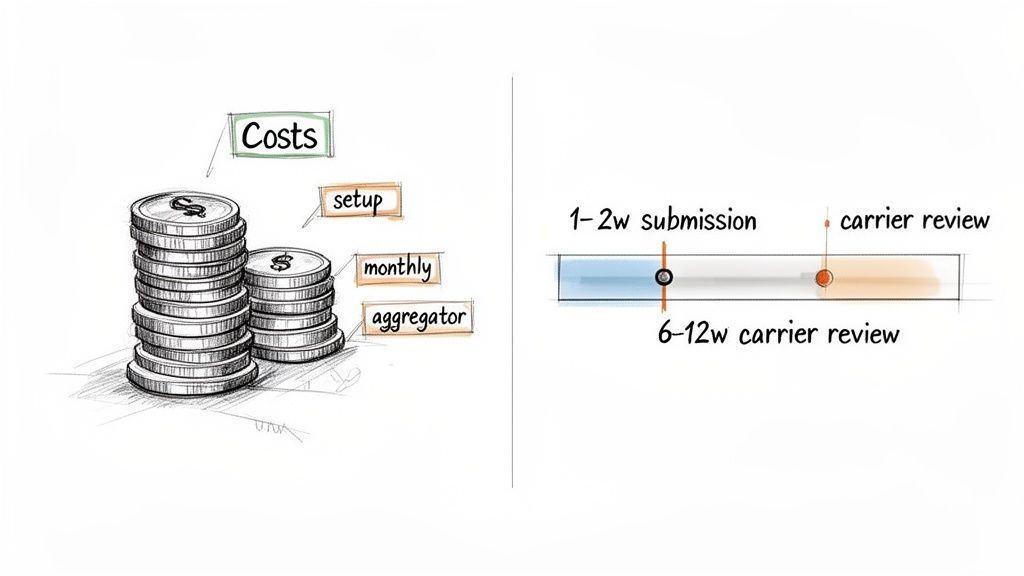
Leasing gives your business exclusive use of a 5- or 6-digit code for the term of the agreement, but it does not create permanent ownership rights. Published industry pricing commonly puts registry-level leasing at about $500 per month for a random code and $1,000 per month for a vanity code, often billed quarterly, as summarized in this short code cost breakdown. Some providers package additional management and support into higher monthly pricing, which is why quotes can land above the base lease.
That difference matters. A long code or toll-free number may cost only a few dollars per month, while a short code carries a much higher fixed commitment because it is designed for throughput, exclusivity, and large-scale brand messaging.
The lease fee is only the first line item. A practical budget should separate at least five categories:
Businesses often underbudget. The published lease may be straightforward, but the total cost depends on how much support the provider gives and how clean your application is on the first pass.
A business using a random code should generally expect at least the base lease of about $500 per month, plus provider and platform costs. In practice, a working budget often lands in the low four figures per month once support and messaging software are included, especially if the provider handles submission management. For a vanity code, the base lease commonly starts around $1,000 per month, and provider-managed programs can climb higher depending on support scope and traffic needs. Twilio’s public messaging pricing and industry lease guides illustrate how provider charges can sit above raw number access alone; see Twilio SMS pricing for an example of provider-side pricing context.
If I were budgeting from scratch, I would not present a short code internally as a $500/month decision. I would frame it as an ongoing messaging program with lease, platform, compliance, and launch-management costs attached.
Availability changes both branding flexibility and the approval schedule. Random codes are usually simpler because any open number can satisfy the request. Vanity codes are constrained by inventory. If the preferred number is unavailable, you either choose a new number or rethink how the campaign will be marketed.
That sounds minor, but it can delay launch if the code appears on packaging, signage, paid ads, or franchise materials already in production. I have seen teams spend more time debating a memorable vanity number than fixing the actual application package. Unless recall is central to the campaign, the random route is often the faster business decision.
The standard expectation is still about 8 to 12 weeks end to end, with carrier review often taking the biggest share of that window. Industry guidance commonly notes that carrier-by-carrier approval can take 4 to 12 weeks depending on revisions, use case complexity, and how quickly documentation issues are resolved; see this leasing timeline explainer.
A practical timeline usually looks like this:
The shortest projects are usually the simplest ones: a clear use case, one clean opt-in path, polished legal links, and message samples that match the campaign. The slowest projects are usually not slowed by the registry itself but by revision cycles after carriers spot inconsistencies.
People often ask if one U.S. short code can cover multiple countries. It cannot. Short codes are generally country-specific, so international expansion usually means separate registrations, separate approvals, and separate costs by market. For a deeper look at managing an SMS short code, it's worth reviewing the core features and requirements.
Getting a short code is a huge step, but it’s only half the job. The challenge, and where the long-term success of your high-volume messaging lives or dies, is building a campaign that carriers trust and your subscribers want to be part of. If you cut corners on compliance, that expensive short code you fought for could get suspended in a heartbeat, making it totally useless.
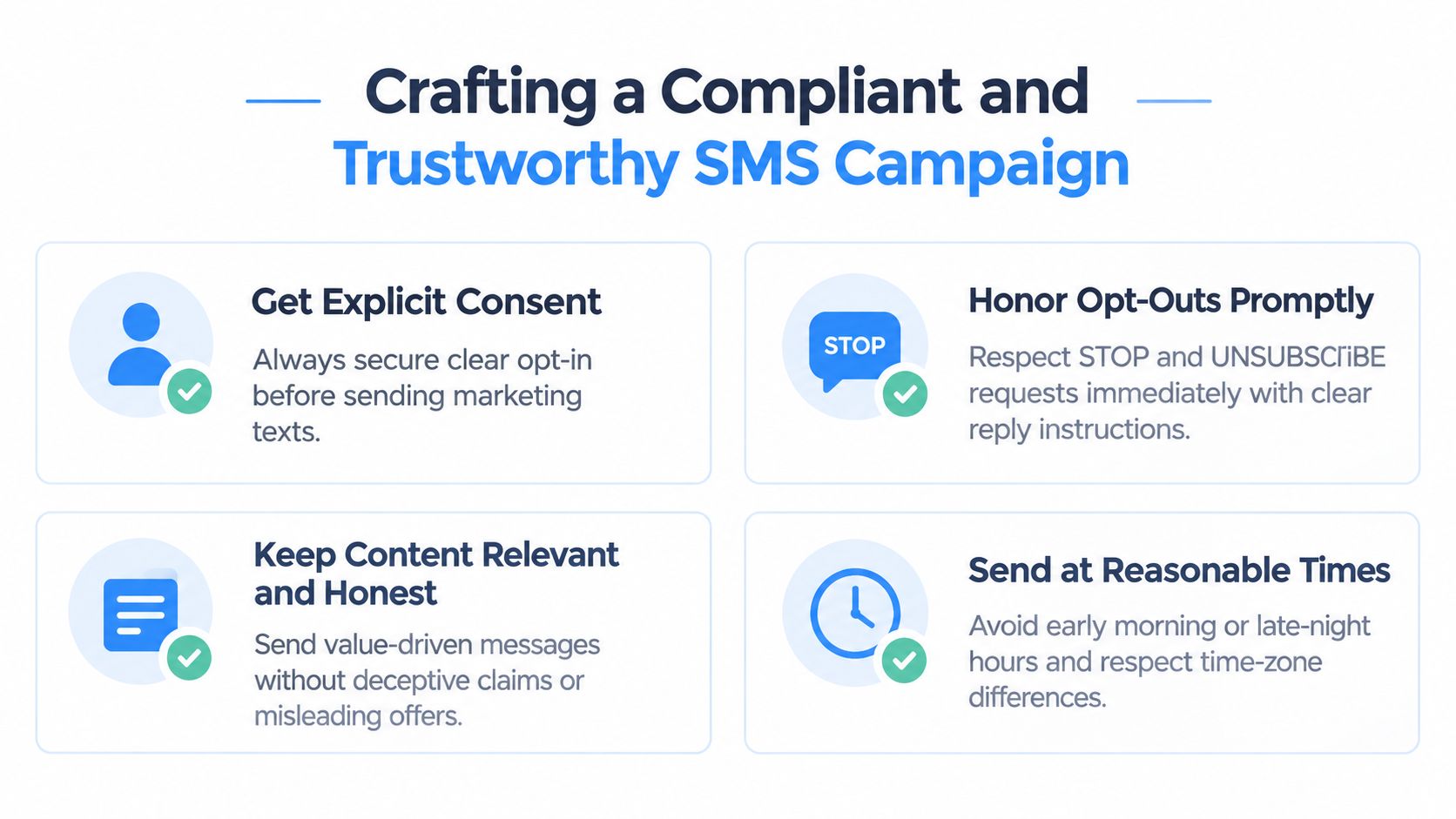
The nuts and bolts of creating a campaign that not only works but is built to last include the absolute non-negotiables that keep your messages flowing and your audience consistently engaged.
Everything—and I mean everything—in a compliant SMS program comes back to consent. You need explicit, provable permission from every single person you text. No exceptions. Carriers are strict here, and a wishy-washy opt-in process is the number one reason I see applications get rejected during the short code registration process.
Your opt-in method has to be crystal clear, whether it's a web form, a text-to-join keyword, or something else. People need to know exactly what they're signing up for.
Every opt-in call-to-action has to nail these points:
For instance, a solid web form CTA would read something like: "Enter your number to receive weekly deals from MyBrand. Up to 4 msgs/month. Msg & data rates may apply. Text HELP for help, STOP to cancel. View our Terms and Privacy Policy."
Every short code program is required by the carriers to support two critical keywords: HELP and STOP. These aren't suggestions; they are automated responses you must have configured before your campaign ever sees the light of day. Think of them as a key checkpoint for any carrier audit.
I always tell clients to think of HELP and STOP as their automated customer service reps. They empower the user and build trust, which is exactly what carriers want to see. A broken HELP or STOP response is a massive red flag and can get your campaign shut down almost instantly.
Your HELP message needs to give people a way to find more info, usually by pointing them to a support phone number or email. The STOP message must confirm they’ve been unsubscribed and won't get any more texts. Getting familiar with regulations like the Telephone Consumer Protection Act (TCPA) is a good idea to really understand the legal weight behind honoring these requests immediately.
Don't treat your Terms and Conditions (T&Cs) and Privacy Policy like boilerplate legal text you just copy and paste. Carriers read these documents during your application review, and they're looking for specific language about your SMS program.
Your Privacy Policy is especially important. It must state, in no uncertain terms, that you will not sell or share SMS opt-in data with any third parties for their marketing. Carriers view any data sharing as a deal-breaker. If your standard company policy allows data sharing, create a specific carve-out just for your SMS program.
A simple sentence can do the trick. Something like: "The above excludes text messaging originator opt-in data and consent; this information will not be shared with any non-affiliated third parties."
Compliance doesn't stop once you get the opt-in. You have to keep your subscriber list clean and healthy to ensure good deliverability over the long haul. That means you need a process for regularly removing inactive numbers and, of course, processing those STOP requests right away.
If carriers see high bounce rates or a sudden spike in STOP requests, it signals that your list might be stale or your content isn't hitting the mark. This can trigger an audit and tank your sender reputation. A well-maintained list gives your messages the best chance of getting delivered, protecting your investment and making every text count.
Look, while a dedicated short code is the undisputed king for blasting out massive campaigns, it's not always the right tool for the job. The short code registration process is a long and expensive headache. For a lot of businesses, more flexible options like 10-Digit Long Codes (10DLC) or Toll-Free numbers make way more sense.
The game has changed. It's not just about one-way marketing blasts anymore; it’s about having real, two-way conversations with your customers. 10DLC and Toll-Free numbers really pull ahead, offering a personal touch that a 5-digit short code just can't match.
A major development in business texting has been 10-Digit Long Codes (10DLC). These are normal, local phone numbers that carriers have officially approved for business messaging (A2P). They balance the friendly feel of a local number with the compliance of a registered business line.
Think about it—people are just more comfortable getting a text from a recognizable local area code. It feels like a conversation with a real person, not a faceless corporation. This makes 10DLC perfect for things like:
Plus, getting a 10DLC number set up is ridiculously faster and cheaper than a short code. We're talking days instead of months. That speed and affordability have made it the go-to option for a huge number of businesses.
We all know Toll-Free numbers (like 888, 877, 866) from customer service calls, and that same trust carries over to texting. They're a rock-solid choice for support teams and some marketing efforts, giving you better sending speeds than 10DLC without the sky-high cost of a short code.
Just like 10DLC, Toll-Free numbers are text-enabled and built for two-way conversations. They're especially great for support queues where customers can text for help and get quick, reliable answers.
The market is clearly shifting away from a one-size-fits-all model. It's pretty telling that many businesses are now using 10DLC for their texting, while a smaller percentage are sticking with one-way short codes. This trend toward conversational SMS highlights a broader shift in customer engagement strategies.
Choosing the right number isn't just about picking the fastest one. You've got to weigh your specific needs, budget, and timeline. To make it easier, here’s a quick breakdown of how these options stack up against each other.
| Attribute | Short Code | 10DLC | Toll-Free |
|---|---|---|---|
| Throughput | Very High (100+ MPS) | Low to Medium (1-60 MPS) | Medium (~40 MPS) |
| Number Type | 5-6 digit number | 10-digit local number | 10-digit toll-free number |
| Use Case | High-volume marketing, alerts | 2-way conversations, support | Customer service, alerts |
| Cost | Very High ($500-$1500/mo) | Low ($1-$20/mo) | Low to Medium ($2-$30/mo) |
| Setup Time | Very Slow (8-12 weeks) | Fast (Days) | Fast (Days to a week) |
| Voice-Enabled? | No | Yes | Yes |
| MMS Support? | Yes | Yes | Yes |
This table gives you a bird's-eye view, but the best strategies often mix and match.
The smartest marketing teams I know don't put all their eggs in one basket. They build comprehensive outreach plans that blend different messaging types to get the best results. For example, a campaign might kick off with a friendly SMS from a 10DLC number. If there's no reply, it could be followed up with a personalized ringless voicemail drop.
This multi-channel approach lets you connect with customers where they're most comfortable. A ringless voicemail can drop a more personal, detailed message right into someone's inbox without their phone ever ringing, a powerful, non-intrusive follow-up that a short code can't do. By carefully considering the costs, setup times, and your specific goals, you can choose the right number or combination of numbers to win, without just defaulting to the most expensive option on the menu.
You lease it. Businesses do not purchase permanent ownership of a U.S. short code; they lease exclusive use of the number for a recurring fee and must maintain compliance to keep using it. Common published lease pricing is about $500 per month for a random code and $1,000 per month for a vanity code, often billed quarterly, according to this industry pricing guide.
Administration and approval are split across different parties. The official U.S. registry framework is handled through the US Short Code Registry, while your messaging provider or aggregator usually manages the submission workflow, documentation, and provisioning. Wireless carriers then review the campaign and decide whether it can operate on their networks.
In practice, businesses usually check availability through their messaging provider as part of the leasing process. Random codes are generally easier to secure because any open number can work. Vanity codes depend on whether that exact number is still available, so an unavailable choice can force a different number or a delayed launch if marketing materials depend on it.
A strong application includes the brand name, company details, exact use case, opt-in screenshots or mockups, sample mobile-terminated messages, sample HELP and STOP responses, terms and conditions link, privacy policy link, and evidence of the consent language shown to subscribers. Carriers want to see that the actual signup flow matches what the application claims.
Most businesses should plan for about 8 to 12 weeks from preparation to launch. A meaningful share of that time sits in carrier review, and the timeline can stretch if the campaign brief, opt-in disclosures, or message samples need revisions. This short code timeline overview is consistent with what providers commonly quote.
No. A short code is usually worth the higher lease when a business has high message volume, a clear and compliant opt-in flow, patience for a slower launch, and a use case that benefits from high throughput or memorable branding. It is usually the wrong starting point for low-volume teams, companies still testing SMS, or support-heavy programs that would work better on 10DLC or toll-free.
Not reliably. Assignment and campaign usage can change over time, and a single message is not enough to confirm current control of a number. If you need to verify a code, check through the official registry or work with a provider rather than guessing from one inbound message.
Ready to simplify your outreach? Call Loop provides the tools you need to manage SMS, voice, and ringless voicemail campaigns seamlessly. Start your free trial today and see how easy high-impact messaging can be.
Chris Brisson
Chris is the co-founder and CEO at Call Loop. He is focused on marketing automation, growth hacker strategies, and creating duplicatable systems for growing a remote and bootstrapped company. Chat with him on X at @chrisbrisson


Trusted by over 45,000 people, organizations, and businesses like


