
See a Demo
You're just one step away from seeing Call Loop in action.
Enter your information below to watch a demo right now.

You're just one step away from seeing Call Loop in action.
Enter your information below to watch a demo right now.

An SMS short code is a special 5-6 digit phone number built specifically for high-volume text messaging. Think of it as a VIP number for your business—it's short, incredibly easy to remember, and engineered for mass communication.
Imagine if your business mailing address wasn't a long, complicated street name but a simple, iconic one like "123 Main St." Customers would remember it instantly. That's exactly what a short code does for your text message campaigns; it's a custom, high-traffic address that makes connecting with your audience effortless.
These specialized numbers are the engine behind professional Application-to-Person (A2P) messaging. They let businesses send thousands of texts at once without getting flagged as spam by mobile carriers—a critical advantage for time-sensitive promotions, alerts, and customer service updates.
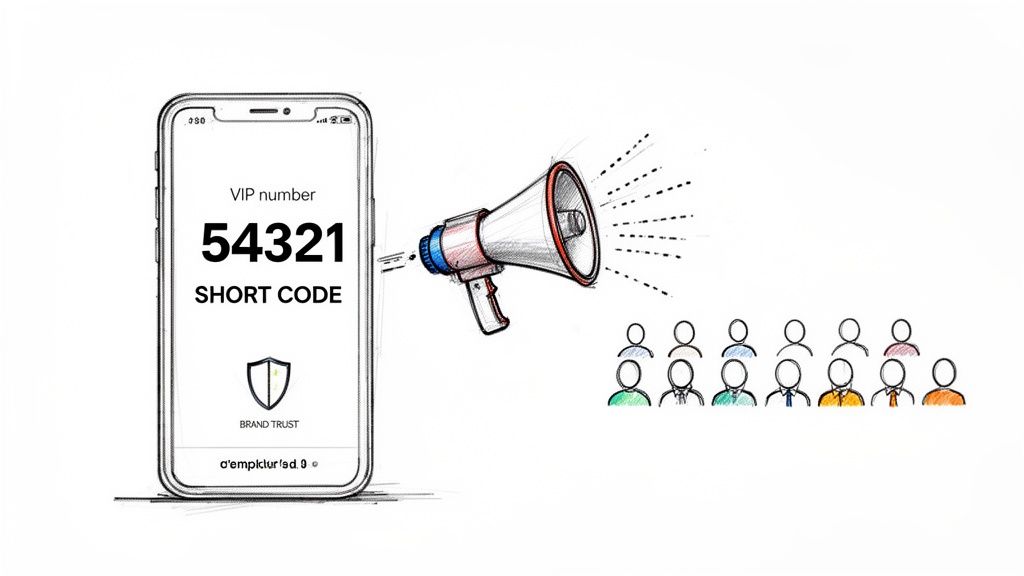
When a customer gets a text from a 5-digit number, it instantly signals that it's from a professional, established brand. Unlike standard 10-digit phone numbers, short codes are pre-vetted and approved by the carriers, which builds immediate trust and dramatically improves deliverability. This verification process ensures your messages land right in the inbox, ready to be seen.
Since they first appeared, short codes for SMS have become a total game-changer for business communication. They consistently pull in staggering 98% open rates, absolutely dwarfing email's typical 20-30%. Even better, 90% of those messages are read within just three minutes.
At its core, a short code is a tool for scale. It’s built from the ground up to handle a massive volume of messages, making it the perfect choice for:
Short codes bring a unique combination of speed, reliability, and brand recognition to your communication strategy. Let's break down exactly how these benefits translate into tangible business results.
These advantages make short codes a powerful asset for any business serious about connecting with its audience through text.
A short code isn't just a number; it's a direct line to your audience that’s built for speed, reliability, and brand recognition. It ensures your most important communications are delivered instantly and professionally every time.
These powerful numbers come in two main flavors—dedicated and shared—each offering different benefits depending on your business goals. Understanding the difference is the first step toward building more effective outreach strategies that drive real results.
Picking between a dedicated or a shared short code is one of those crucial first steps. It's a decision that shapes your branding, your budget, and what you can ultimately do with your SMS campaigns. There's no single "right" answer—it all comes down to your specific goals, from how many messages you plan to send to how much control you want over your brand's mobile identity.
Think of a dedicated short code like owning your own storefront on a bustling main street. That 5-6 digit number is yours and yours alone. You get to control everything: the branding, every single keyword, and all the messaging that goes out. No one else can use it.
A shared short code, on the other hand, is more like renting a booth in a crowded, popular market. You're sharing the same number with other businesses, which makes it a fantastic, low-cost way to get started quickly. But, just like in a real market, sharing the space means you have to follow a few extra rules.
A dedicated short code is the go-to for businesses that are serious about building a powerful brand identity through SMS. Since you’re the only one using the number, every text your customers receive is instantly recognizable as coming from you. This is a game-changer for high-volume senders who need maximum delivery speed and the freedom to use any keyword they dream up.
That exclusivity also protects your data and your sender reputation. You're not sharing your digital real estate, so another company's mistakes can't hurt your deliverability or get the number flagged by carriers. It's the ultimate setup for anyone who needs total control and the ability to scale without limits.
With a dedicated code, your brand is the star. Every keyword, every message, and every customer interaction is tied directly to you, creating a seamless and trustworthy communication channel.
For businesses just dipping their toes into SMS marketing or working with a tighter budget, a shared code is the perfect entry point. The biggest win here is the cost—it's significantly lower because you're splitting the leasing fees with other users. Plus, setup is way faster since the number is already approved and active with the mobile carriers.
The main trade-off is keyword management. Because multiple businesses are using the same number, every keyword has to be unique. If another company on your shared code has already claimed the keyword "SALE," you'll have to get creative and pick something else. It requires a bit more thought during campaign setup, but it makes powerful SMS marketing accessible to just about anyone.
You can also pair a shared short code with other services like ringless voicemail, which drops a message right into someone's voicemail box without their phone ever ringing. Combining these tools lets you build a surprisingly sophisticated outreach strategy, even on a lean budget.
To make the choice crystal clear, let's break down the key differences. This table will help you weigh the features of each against your own business needs, budget, and campaign goals.
Ultimately, dedicated codes offer unparalleled control and branding for established, high-volume campaigns. Shared codes provide an affordable and quick-to-launch alternative that opens the door to SMS for businesses of all sizes.
Getting your hands on a dedicated short code isn't like just buying a phone number off the shelf. Think of it more like commissioning a custom piece of equipment for your business. It’s a carefully managed process that involves you, your messaging provider (like us here at Call Loop), the U.S. Short Code Registry, and every major mobile carrier. Knowing the roadmap upfront is the key to setting the right expectations.
The journey starts after you decide between a random number and a more memorable vanity code. From there, we’ll work with you to put together a detailed application and campaign brief. This document is everything—it spells out exactly how you plan to use the short code, covering your opt-in methods, sample messages, and how you'll handle customer support.
This flowchart breaks down that initial choice, helping you weigh your budget, campaign size, and branding goals.
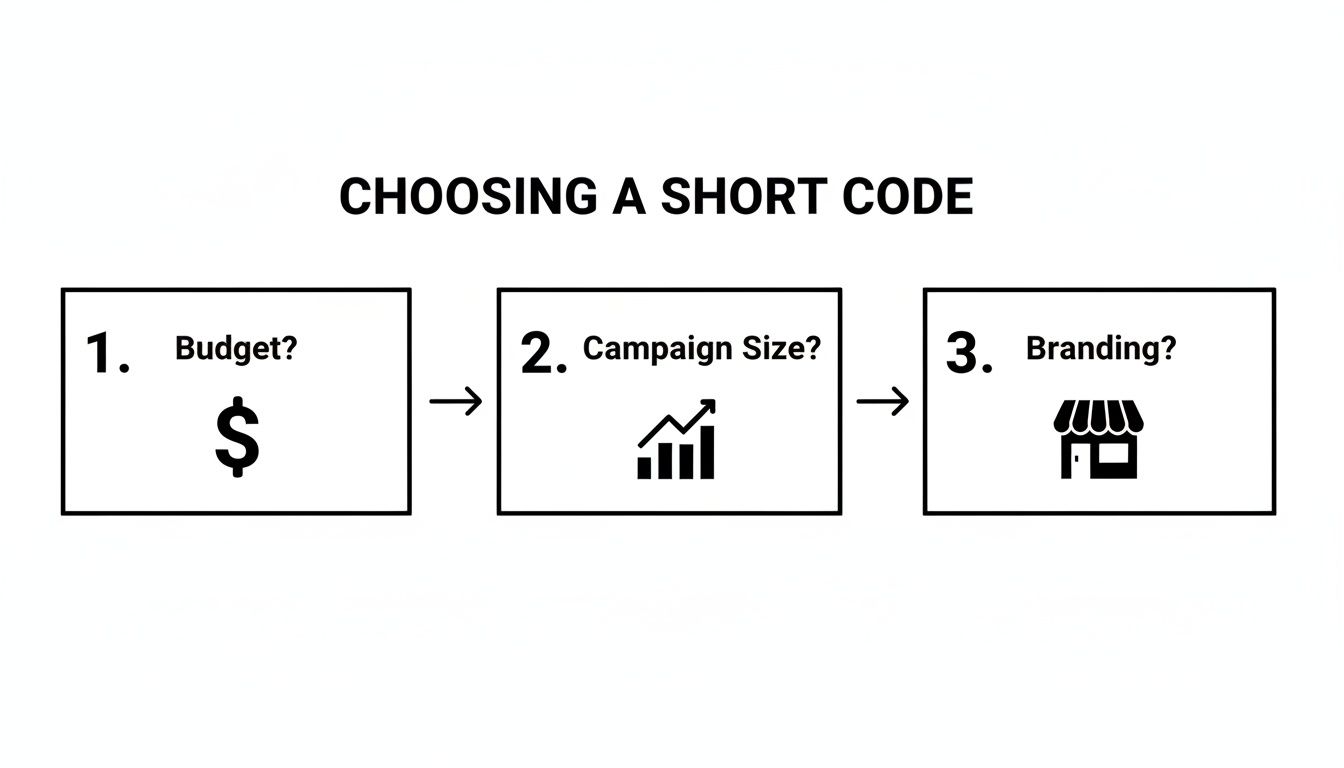
It’s a simple way to prioritize what truly matters, whether that’s keeping costs low, preparing to reach a massive audience, or cementing your brand identity in a few memorable digits.
Once your application is in, the waiting game begins. This is the provisioning phase, where each mobile carrier—think Verizon, AT&T, and T-Mobile—individually reviews and green-lights your campaign. They comb through every detail to make sure you’re playing by the rules and providing a good experience for their customers.
Plan for a 6 to 12-week timeline from the day you submit your application to the day your short code goes live. This isn't a timeline that can be negotiated or rushed, as it involves coordinated testing across all the major carrier networks.
This is why you have to plan ahead. If you’ve got a big product launch or a holiday campaign on the calendar, you need to start the short code process months in advance. The last thing you want is for your number to still be stuck in approvals when you need it most.
The investment for a dedicated short code really comes down to two things: leasing fees and setup costs. You don’t actually own the number; you lease it from the Short Code Registry.
These fees are billed quarterly and paid in advance. On top of that, there's usually a one-time setup fee to cover all the paperwork and provisioning work.
This investment reflects just how valuable this channel has become. The global SMS marketing market is on track to hit $9.96 billion by 2025, and much of that growth is fueled by the raw power and throughput of short codes. For more on the market's explosive growth, you can find great insights on Emarsys.com. It’s a serious investment for serious marketing efforts, ensuring your messages land reliably every single time.
Using a short code for SMS is like having a direct hotline to your customers, but with great power comes great responsibility. In the world of text marketing, compliance isn't just a box to check—it’s the entire foundation of a legal and sustainable strategy. Get it wrong, and you're looking at massive fines and a complete loss of the customer trust you worked so hard to build.
The big one you absolutely need to know is the Telephone Consumer Protection Act (TCPA). This is the federal law that sets the ground rules for telemarketing, and yes, that includes text messages. Its core idea is simple: you must have explicit, provable consent before you send anyone a promotional text.
Before a single message goes out, you need express written consent. Now, this doesn't mean you need a pen and paper signature. It can be an electronic agreement, like when a customer texts a keyword to your short code or ticks a clearly-labeled box on a web form.
The consent has to be crystal clear. Your customers must know exactly what they're signing up for—what kind of messages they'll get and who they're from. Burying this in the fine print is a huge no-no and puts your entire operation at risk.
Staying on top of the ever-changing rules can be a challenge. For ongoing updates and detailed advice, it’s always smart to keep up with industry experts. You can read more on SMS compliance to stay current with the best practices.
To stay on the right side of the law and keep the mobile carriers happy, every single SMS campaign needs a few non-negotiable elements. Think of these as safeguards that protect both you and your subscribers.
Here’s what’s absolutely essential:
This is where a solid platform becomes your best friend. Services like Call Loop are built to automate many of these critical safeguards, from handling opt-out keywords to making sure the right disclosures are always included. These systems help you run powerful A2P (Application-to-Person) campaigns that are both incredibly effective and legally sound. To get the full picture, it's worth learning more about what is a2p texting and why it's so important for compliance.
Theory is great, but what really matters is what works in the trenches. The true power of SMS short codes comes to life when you see how businesses use them to solve real-world problems. These little numbers become the engine for campaigns that boost sales, cut down on operational headaches, and forge stronger connections with customers.
Companies from massive retailers to your local dentist are using short codes to slice through the marketing noise. Instead of sending an email and just hoping it gets opened, they send a text that's seen almost instantly. It's a direct line for getting time-sensitive info in front of people right when they need it.
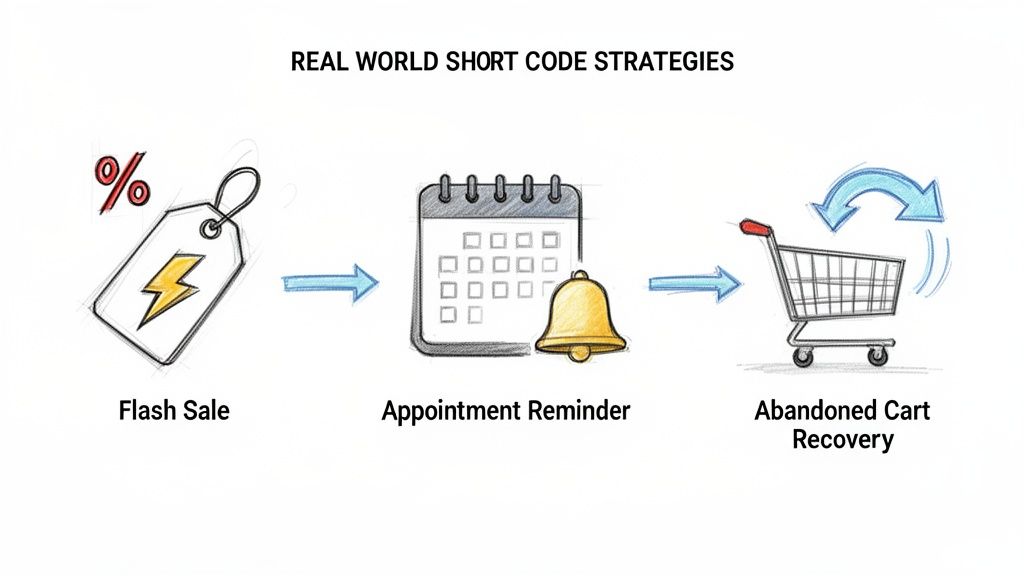
So, what does this actually look like day-to-day? The beauty of short codes is their flexibility. Businesses in just about any industry can use them to hit specific, measurable goals.
Here are a few winning strategies we see all the time:
As powerful as short codes are on their own, they become absolute game-changers when you layer them with other communication channels. Think about a sequence where a customer gets a text, and if they don't respond, a ringless voicemail lands in their inbox the next day. This creates a follow-up system that's persistent without being annoying. This technique, sometimes called a voicemail drop, ensures your message is heard without disrupting your contact's day.
By combining SMS with tools like ringless voicemail, you build a dynamic communication strategy that engages customers at multiple touchpoints, significantly increasing the likelihood of a response.
The best short code strategies are often powered by smart business tools working together in the background. Understanding the trends in integrated systems, like those in CRM and automation development, can help you get the most out of every text you send. When your tools are in sync, a simple text message becomes a serious engine for growth.
For more ideas on building out your strategy, check out our guide on SMS marketing best practices for some extra insights.
While SMS short codes are the heavyweight champs of high-volume texting, they aren't the only players in the game. To get the most out of business texting, you need to understand the whole landscape. Choosing between a short code, a 10DLC number, or a Toll-Free number really boils down to your specific needs for speed, volume, cost, and the kind of brand identity you want to project.
Think of it like picking a vehicle for a job. A short code is your Formula 1 race car—it’s built for incredible speed and massive audiences, but it comes with a premium price tag and takes longer to get on the track. It's the go-to for those huge national marketing campaigns where brand recognition and high throughput are absolutely non-negotiable.
10-Digit Long Codes (10DLC) are essentially standard local phone numbers that have been approved for business messaging. They are the perfect tool for more conversational, lower-volume interactions that need a personal touch.
Because a 10DLC number looks just like a regular phone number, it feels more personal and less corporate. This makes it ideal for things like appointment reminders, one-on-one customer service chats, and targeted follow-ups. Their biggest advantage? They’re cheap and incredibly fast to set up. While they can't match a short code's raw sending power, 10DLC numbers are a reliable and affordable starting point for any business focused on building relationships, not just broadcasting messages.
Toll-Free numbers, like the familiar 800-series numbers, strike a fantastic balance between the power of short codes and the simplicity of 10DLC. They offer solid message throughput—much higher than 10DLC, though not quite at short code levels—and they carry an immediate sense of trust and legitimacy that customers instantly recognize.
Plus, they support both texting and voice calls, making them a versatile, all-in-one contact solution. For businesses that need to send more messages than 10DLC can handle but aren’t quite ready for the investment of a dedicated short code, Toll-Free texting is an excellent middle-of-the-road option that blends reliability with brand credibility.
Even with the best strategy, you're bound to have a few questions when you're ready to pull the trigger on a new messaging solution. Getting straight answers helps you take those final steps with confidence. Let’s tackle the most common questions we hear from businesses about using short codes.
When you get a dedicated short code, you're looking at two main costs: a one-time setup fee and a recurring lease. For a random, non-custom 5-6 digit number, the lease typically runs about $500 per month.
Want something more memorable? A "vanity" short code that’s easy to recall and ties into your brand (think texting "SALE" to 24242) will cost you more. Expect the lease to jump to $1,000 or more per month. These fees go directly to the Short Code Registry and the carriers themselves, separate from whatever you pay for your messaging platform subscription.
Getting a short code isn't something you can do overnight, so you definitely need to plan ahead. Once you submit your application and a detailed campaign brief explaining exactly how you'll use it, you should budget for a 6 to 12-week approval period.
During this time, every major mobile carrier reviews your application and provisions the code for their network. The timeline really depends on how clear your application is and the complexity of your campaign. Bottom line: start the process well before you need it for any big marketing push.
That 6 to 12-week window is the industry standard. It gives carriers the time they need for thorough compliance checks and technical testing to make sure everything works smoothly for their customers.
Nope. SMS short codes are strictly country-specific. A short code approved for the United States won't work in Canada, the UK, or anywhere else. Every country has its own set of rules, carrier networks, and approval hoops to jump through.
If you’re planning to run SMS campaigns internationally, you’ll have to apply for and lease a separate short code for each country you want to reach. It’s the only way to stay compliant with local laws and carrier rules, ensuring your messages actually get delivered.
Ready to build powerful, multi-channel outreach campaigns with SMS, ringless voicemail, and voice broadcasts? Call Loop provides the tools and compliance features you need to connect with your audience at scale. Start your free trial today and see the difference for yourself!
Chris Brisson
Chris is the co-founder and CEO at Call Loop. He is focused on marketing automation, growth hacker strategies, and creating duplicatable systems for growing a remote and bootstrapped company. Chat with him on X at @chrisbrisson


Trusted by over 45,000 people, organizations, and businesses like


