
See a Demo
You're just one step away from seeing Call Loop in action.
Enter your information below to watch a demo right now.

You're just one step away from seeing Call Loop in action.
Enter your information below to watch a demo right now.


You know the feeling. It’s Tuesday at 6:10 p.m., the line is set, the dining room looks ready, and half your tables are still empty. You can post to Instagram, but you’re at the mercy of the feed. You can send an email, but that message may sit unopened until tomorrow.
That’s why sms marketing for restaurants matters so much. It lets you reach people when they’re deciding where to eat, whether they should order takeout, or whether tonight is the night to use that loyalty reward. Used well, text messaging isn’t just another marketing channel. It’s an operational lever you can pull when you need to fill seats, move inventory, push catering, recover lapsed regulars, or remind guests that your place exists before they open a delivery app.
The restaurants that get the most from SMS don’t treat it like a coupon cannon. They build a compliant list, segment it, send fewer and better messages, and pair SMS with channels like ringless voicemail when they need a bigger announcement to land. That’s how you turn a contact list into repeat traffic.
A slow night doesn’t wait for your email campaign to warm up. If you need to boost dinner covers, move a limited batch dessert, or push online ordering before the kitchen goes quiet, you need a channel people see fast.

SMS gives you that speed. Open rates reach 98%, and 90% of messages are read within minutes. For restaurants, that translates into conversion rates of 8-15% for orders and click-through rates up to 35%, according to restaurant SMS performance data from Peblla.
That matters in real operating situations:
Practical rule: If the message loses value by tomorrow, it probably belongs in SMS.
Social media builds awareness. Email supports longer-form retention. SMS drives immediate action. That’s why it works so well for restaurants. Hunger is time-sensitive, decisions are quick, and phones are always in reach.
The strongest operators use text messaging to solve practical problems, not just to “do marketing.” When your room is soft, your patio needs a push, or your online orders dip, SMS gives you a direct line to people who already said they want to hear from you.
Most restaurant owners want to jump straight to the fun part. The offer, the clever copy, the last-minute dinner push. That’s backwards. If your foundation is sloppy, your program will create headaches instead of revenue.
Compliance isn’t paperwork for its own sake. It protects deliverability, keeps your list cleaner, and reduces the chance that a profitable channel turns into a legal mess.
Promotional texts require clear consent. In practice, that means you should never upload a pile of old customer numbers and start blasting offers. A guest needs to knowingly opt in.
The cleanest setup is double opt-in. Someone signs up through a keyword, form, QR code, or checkout flow, then confirms they want messages. That extra step filters out bad numbers, catches typos, and documents intent.
A compliant opt-in process should do four things:
State what they’re signing up for
Make it obvious they’re joining your restaurant text list for offers, updates, or reminders.
Identify your restaurant
Don’t make subscribers guess which business is texting them.
Capture consent clearly
Hidden boxes and vague wording create risk.
Keep records
You need a trail showing when and how the person opted in.
SMS is short-form communication. That affects both performance and compliance. According to technical restaurant SMS guidance on deliverability and compliance, you should limit messages to 160 characters per segment, use double opt-in, keep frequency to 2-4 messages per month per segment, include clear opt-out language such as “STOP to end,” and follow these protocols to support 99% deliverability. The same guidance notes that over-messaging can trigger a 50% spike in opt-outs, and TCPA fines can reach up to $1,500 per message.
That’s the part owners tend to underestimate. One bad habit compounds fast. If you send too often, write too long, or ignore opt-outs, the damage doesn’t stay in one campaign.
Don’t think of compliance as a legal tax. Think of it as list hygiene with financial consequences.
Your phone number setup affects trust and delivery. For restaurants, the practical decision usually comes down to a 10DLC number or a toll-free number. The right choice depends on your volume, campaign type, and how you plan to scale.
If you’re running recurring promotions, reminders, and segmented offers, use a business texting setup that supports registration, throughput management, and suppression handling. If you haven’t sorted out number registration yet, review 10DLC compliance requirements for business texting before you launch.
A few setup choices matter right away:
Restaurants often over-message when sales dip. That’s when unsubscribes jump. Set your cadence while you’re calm, not when Friday lunch underperforms.
A practical approach is to define message categories first:
| Message Category | How to Use It | Risk if Overused |
|---|---|---|
| Promotional offers | Slow nights, specials, events | Fatigue and opt-outs |
| Operational updates | Reservation reminders, order updates | Usually low if expected |
| Loyalty messages | Reward notices, member perks | Feels stale if every text is a coupon |
| Re-engagement | Lapsed guest follow-up | Can feel intrusive if mistimed |
The point is control. A reservation reminder is different from a “2-for-1 appetizers tonight” blast. Don’t shove every message into one bucket.
Every message should instantly answer three questions:
That means your restaurant name belongs in the text, your offer or update should be clear, and your opt-out language should be present when required. Short messages work better anyway. They’re easier to scan, less likely to fragment, and less likely to confuse guests.
If your business overlaps with healthcare, hospital catering, medically customized meals, or patient meal communications, general restaurant marketing practices may not be enough. In that case, you need a platform and workflow that can support stricter privacy controls.
This matters more than many operators realize. A standard promo setup may work fine for taco specials and loyalty reminders, but it may be the wrong fit for a hospital meal program or a wellness-focused catering line tied to protected data.
Get the foundation right first. Once consent, suppression, number setup, and message rules are locked down, everything else gets easier.
You don’t build a profitable SMS program by adding a tiny signup link to your footer and hoping people find it. Restaurant lists grow when you ask at the right moments, in the right places, with a reason that feels worth it.
The best list-building tactics are visible, simple, and tied to the guest experience.
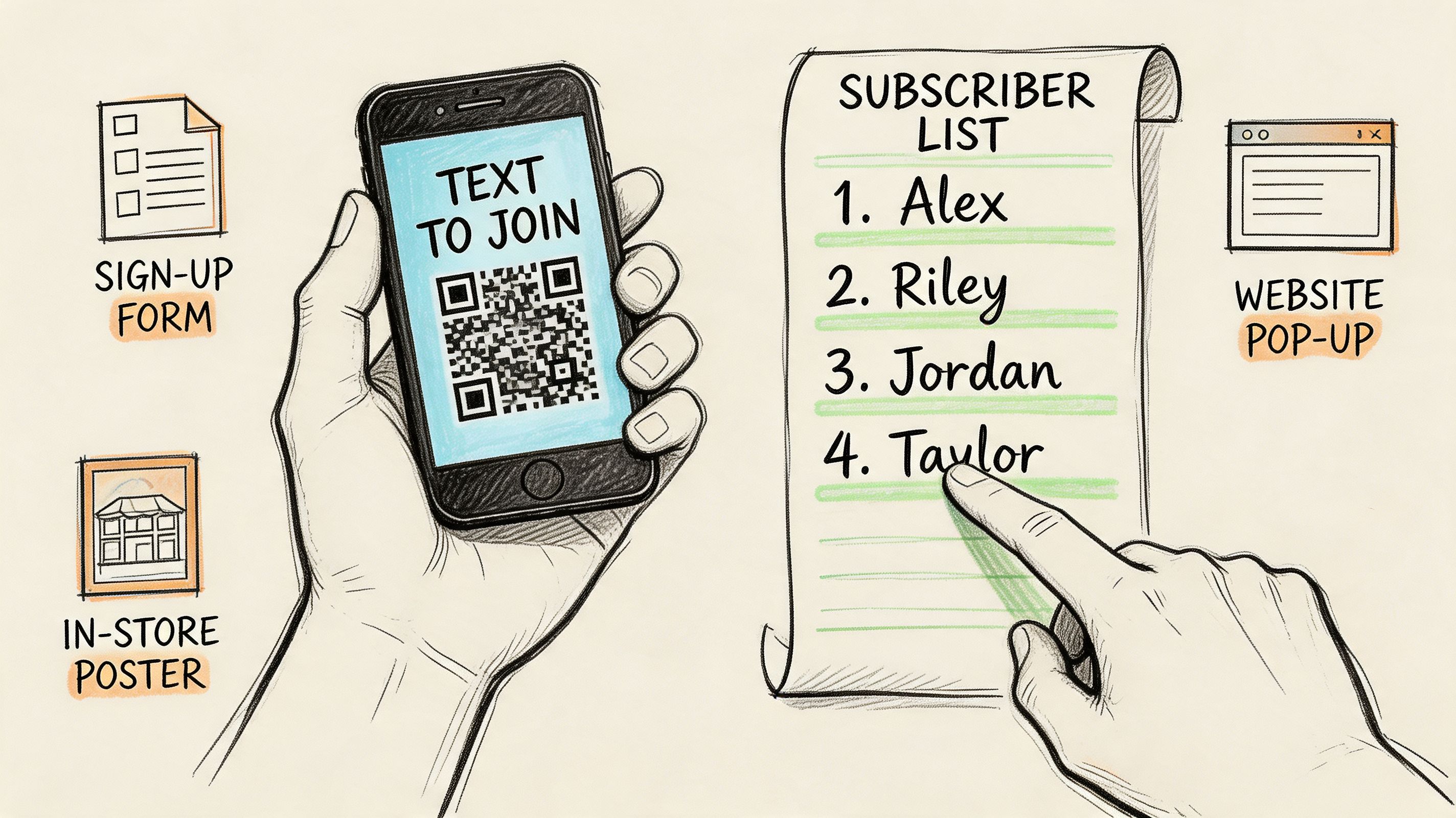
Take a neighborhood bistro trying to increase repeat visits without leaning entirely on paid ads. The owner puts a text-to-join sign at the host stand, adds a QR code to takeout bags, and trains cashiers to mention the VIP text list at checkout. Not with a hard sell. Just a short line: join for specials, event alerts, and early access.
That works because the ask fits the moment. The guest is already engaged with the brand, already holding food, and already making a decision about whether to come back.
Some placement points outperform others because people stop there long enough to notice them.
Use these first:
If you want more local acquisition ideas outside SMS, this roundup of simple strategies for local leads is useful because it mirrors how brick-and-mortar businesses turn in-person attention into contactable demand.
“Join our text list” is weak. People need a clear benefit. That benefit doesn’t always have to be a discount.
Offers that tend to work well for restaurants include:
The strongest hook is often access, not price. Guests who care about your food also care about being first.
A lot of restaurants miss list growth because they leave it entirely to signage. Staff can help, but only if the script is short and low-pressure.
Good:
Bad:
The ask should feel like hospitality, not telemarketing.
A solid list-building setup usually includes text-to-join keywords, QR codes, confirmation texts, and tagging by location or offer source. If you’re building from scratch, these ways to grow your SMS marketing list give you practical mechanics for turning in-store traffic into subscribers.
One operational note matters here. Tag subscribers by source from day one. If someone joins from a happy hour table tent, a catering page, or a lunch special QR code, that context helps later when you segment messages.
| Mistake | What happens |
|---|---|
| No clear incentive | Guests ignore the signup prompt |
| One generic list for everyone | Later campaigns feel irrelevant |
| Staff never mentions it | Growth depends only on passive traffic |
| Hidden compliance language | Risk goes up and trust goes down |
A bigger list isn’t always a better list. A cleaner list with clear consent and useful source tags will outperform a larger pile of random contacts every time.
Once your list is live, your campaign strategy decides whether SMS becomes a revenue channel or just another thing to manage. The restaurants that get real traction don’t send random blasts. They match message type to business problem.
That means one text for a same-day seat-filling push, another for reservation reminders, another for lapsed guest reactivation, and a different voice altogether for an event announcement.
Segmentation changes everything. According to restaurant SMS segmentation and A/B testing guidance from Librorez, restaurants can achieve 21-30% conversion rates by segmenting audiences and testing offers. The process starts with guest data from your POS, then grouping people into cohorts such as frequent diners or lapsed customers instead of sending generic blasts.
If you need a broader primer on organizing customer groups, this guide to customer segmentation for businesses gives a useful way to think about behavior, value, and timing before you write a single message.
Here’s the practical difference:
Not every restaurant text should try to sell the same way. Some messages drive immediate traffic. Others reduce no-shows or increase repeat visits.
Here’s a simple working model.
| Campaign Type | Primary Goal | Example Message/Use Case |
|---|---|---|
| Slow-night promotion | Fill seats fast | “Tables open tonight. Come in before 8 for a chef special.” |
| Happy hour push | Increase same-day traffic | “Happy hour starts at 5. Bring a friend and grab your usual.” |
| Reservation reminder | Reduce no-shows | Confirmation and reminder before booked tables |
| Takeout prompt | Drive online orders | “Short wait times tonight. Order pickup before the rush.” |
| Event announcement | Build attendance | Tasting night, trivia, live music, chef popup |
| Lapsed guest reactivation | Win back dormant customers | “Haven’t seen you in a while. We saved something good for this week.” |
| Loyalty update | Increase repeat visits | Reward ready, bonus item unlocked, members-only access |
| Ringless voicemail follow-up | Add personality to big announcements | Chef or owner message for a menu launch or special event |
The best-performing restaurant messages feel immediate, specific, and easy to act on. They don’t sound like a chain-store blast unless you are one.
A few examples of stronger direction:
Weak messages usually fail for one of three reasons. They’re too broad, too long, or too vague about what the guest should do next.
Send one message with one job. If the text tries to promote brunch, catering, happy hour, and live music at once, it won’t move any of them well.
Ringless voicemail is useful when you need more texture than SMS allows. A text is perfect for speed. A voicemail adds tone, personality, and a little more story.
Restaurants can use ringless voicemail for:
A practical sequence looks like this: send an SMS to your event segment with the core offer and booking link, then follow with a ringless voicemail from the owner or chef a day or two later to add warmth and urgency. That combination often works better than repeating the same text twice.
Voice broadcasting can also support larger operational pushes, especially when you need broader awareness for closures, major events, or time-sensitive changes. The trade-off is attention. Voice takes more commitment from the listener, so reserve it for messages worth hearing.
Target local dinner guests and lapsed regulars, not the entire list. Keep the offer narrow. You’re trying to change tonight, not the whole month.
A useful structure:
This demonstrates the effectiveness of layered messaging. SMS can announce the release and booking link. Ringless voicemail can deliver a more personal note from the chef to your top guests.
Operational texts often get overlooked in marketing conversations, but they matter. Reservation confirmations, reminders, and waitlist updates create a smoother guest experience. They also train subscribers to see your texts as useful, not just promotional.
That trust pays off later when you send an actual offer.
A profitable restaurant SMS program stops feeling like a series of campaigns and starts acting like part of daily operations. If Tuesday dinner is soft, if catering leads keep going cold, or if regulars disappear for six weeks without a word, automation gives you a way to respond on time instead of after the opportunity passes.

Start with triggers you can set up quickly and measure clearly. A welcome sequence is usually first because every new opt-in should get an immediate response, a short introduction, and one clear next step. For a full-service restaurant, that might be a reservation link. For a fast-casual brand, it might be an online ordering offer tied to a first purchase.
After that, add automations tied to moments that affect revenue or retention:
Timing matters more than volume.
A reservation reminder sent a few hours before service reduces no-shows. A reactivation text sent after a guest drops off can bring back business that would have disappeared. A catering follow-up sent while the inquiry is still fresh often does more work than another generic weekly promo.
Basic list splits are easy to build and usually too broad to produce strong margins. A better setup groups people by how they buy.
Useful segments often include:
Discount strategies determine whether many restaurants either protect margin or give it away. If you send the same discount to loyal regulars and to people who have not visited in months, you train your best guests to wait for an offer they never needed. Send the discount only to the at-risk segment, and keep value-based messaging for regulars. That one change usually improves revenue quality even before total volume rises.
One simple rule works well. If a guest already buys full price, do not teach them to expect a coupon.
Some messages need more than a short text. Catering follow-ups, private dining outreach, event reminders, and high-value guest reactivation often perform better when SMS is paired with ringless voicemail. The text drives the click. The voicemail adds tone, credibility, and urgency.
A practical example: send a text to catering prospects with a tasting offer or booking link. If they do not respond, send a ringless voicemail from the owner the next day with a brief, personal note. That sequence usually feels more considered than sending the same reminder text again.
Voice broadcasting also has a place for broader announcements like weather closures, holiday hours, or major event updates. Use it selectively. Asking someone to listen takes more commitment than asking them to read a text.
Your POS, reservation platform, loyalty system, and CRM should inform who gets messaged and who gets excluded. Without those connections, automation becomes scheduled blasting with better branding.
Once your systems are connected, you can:
If you want a practical model for setting up these workflows, automated text messaging sequences for business outreach shows how timed sends and trigger-based campaigns are typically structured. Call Loop also supports SMS, voice broadcasting, ringless voicemail, segmentation, and integrations through tools like ActiveCampaign, HubSpot, and Zapier, which can reduce the operational mess of stitching together separate systems.
Restaurants serving specialized niches need one more filter. If you handle healthcare catering, medically specific meal programs, or hospital food service communications, your automation rules should reflect privacy requirements from the start. That means choosing platforms and workflows with HIPAA support where protected health information could be involved, and keeping sensitive details out of standard promotional texts.
A/B testing does not need a complicated setup. Test one variable at a time and tie the result to revenue, bookings, or repeat orders.
| What to Test | Version A | Version B |
|---|---|---|
| Offer type | Limited item | Discount |
| Send time | Late morning | Late afternoon |
| CTA | Book now | Order now |
| Tone | Friendly casual | Direct urgency |
Run the test long enough to get a clean read, then make a decision. If Tuesday dinner is your weak spot, test the Tuesday offer first. If catering is the bigger opportunity, test inquiry follow-up speed and message format before tweaking promotional copy.
For local operators trying to connect performance back to actual business outcomes, this piece on understanding marketing performance in Prescott is a good reminder that channels should be judged by attributed revenue and repeat behavior, not just clicks.
Open rates look nice in reports. They do not tell you whether the campaign made money.
Track results that change decisions:
Review performance every week. Cut weak automations quickly. Keep the flows that fill slow shifts, recover lapsed guests, and move higher-value business like events or catering. That is how SMS becomes more than a messaging tool. It becomes a predictable revenue channel.
A restaurant SMS program gets more profitable when it starts reacting to guest behavior instead of sending the same promotion to everyone on the list. The practical shift is integration. Connect SMS with your POS, reservation system, loyalty data, and catering pipeline so the message matches what the guest did.
That changes how you use the channel on a real Tuesday night.
If reservations are soft at 4 p.m., you can message local guests who usually book same-day. If a catering prospect asked for a quote and then went quiet, you can send a short follow-up text, then use ringless voicemail for a more personal nudge from the owner or events manager. SMS handles speed. Ringless voicemail adds context and voice, which is useful for higher-value bookings, private dining, holiday packages, and VIP events where a plain text can feel too transactional.
Promotional SMS is still useful, but advanced programs separate low-friction offers from messages that need more explanation.
Use SMS for:
Use ringless voicemail when the message benefits from tone and personality:
The trade-off is simple. SMS is faster and easier to act on. Ringless voicemail takes more planning, but it can improve response rates for offers with higher ticket value or more decision friction.
Some restaurant operators serve markets where standard promo-text habits are not enough. Hospital catering, medically customized meal programs, senior care food service, and patient meal coordination all require tighter message controls. In those cases, choose a platform that supports HIPAA workflows and keep protected health information out of any message unless your process and vendor are set up for it.
This matters in healthcare catering because the risk is not theoretical. A casual text about a meal plan, allergy protocol, or patient delivery can create a compliance problem if it includes protected details. Keep these programs segmented, limit who can send messages, document consent clearly, and review templates with legal or compliance oversight before launch.
A mature program is measured by business outcomes, not message volume.
Watch these metrics closely:
One warning here. List growth can look healthy while profit gets worse. If new subscribers only respond to discounts, your list is growing but your pricing power is slipping. The fix is to monitor revenue quality, not just opt-in volume.
If you cannot identify which messages fill empty tables, recover lapsed guests, or generate profitable catering conversations, your reporting is still too shallow.
The questions below address the decisions that usually come up after a restaurant has the basics in place. These are the issues that affect scale, compliance, and profit.
| Question | Answer |
|---|---|
| How often should a restaurant send marketing texts? | Set cadence by guest behavior, not by a fixed calendar. A guest who opted in for late-night offers may tolerate more messages than a weekend brunch customer. Start lighter than you think, watch opt-outs after each campaign type, and increase only when the extra sends produce profitable reservations or orders. |
| How do I handle SMS for a multi-location restaurant group? | Run one program with location-level segmentation, separate opt-in language where needed, and clear sender naming in every message. A guest near your downtown store should not get a patio promo for the suburban location. Centralize reporting, but let each location control hours, offers, and blackout dates so local managers can fill slow shifts without creating brand inconsistency. |
| What are the compliance rules for alcohol-related promotions by text? | Check state rules, carrier policies, and your own age-verification process before sending any alcohol offer. Keep these campaigns limited to adults who have given proper consent, avoid messaging that could appeal to minors, and make redemption controls clear at the point of sale. If your team cannot verify audience age with confidence, skip alcohol promotion by SMS and use a different offer. |
| Are discounts required for SMS to work? | No. Discounting is only one tool, and it is often the least durable one. Priority reservations, a limited chef special, first access to holiday bookings, or a same-day reminder that you still have tables at 7:30 can produce stronger margins than a percentage-off coupon. |
| Where does ringless voicemail fit best in a restaurant program? | Use SMS for fast actions and ringless voicemail for higher-consideration outreach. A short text works well for tonight's empty tables. Ringless voicemail is better for private dining, holiday catering, wine dinners, or reactivating a corporate catering contact who has gone quiet, because voice carries more context and a more personal tone without requiring a live call. |
| How should I use SMS if my restaurant also serves healthcare catering or patient-related meal programs? | Treat that as a separate communication stream with tighter controls. Use a platform that supports HIPAA-capable workflows, keep protected health information out of routine marketing texts, restrict sender access, and review templates with compliance oversight before launch. The operational risk is much higher than a standard restaurant promo, so the process has to be tighter too. |
| What should I do when SMS response drops even though my list keeps growing? | Check message relevance before you blame the channel. Response usually falls because the offer is too broad, the timing is off, or newer subscribers joined for a one-time incentive and never developed buying habits. Break performance out by source, segment, and campaign objective, then cut the low-quality acquisition sources first. |
If you want to build a restaurant outreach program that combines SMS, voice broadcasting, and ringless voicemail in one place, Call Loop is worth a look. It supports text-to-join keywords, segmentation, automated campaigns, tracking, and HIPAA-capable workflows, which makes it a practical fit for restaurants that want both everyday promotions and more specialized communication flows.
Chris Brisson
Chris is the co-founder and CEO at Call Loop. He is focused on marketing automation, growth hacker strategies, and creating duplicatable systems for growing a remote and bootstrapped company. Chat with him on X at @chrisbrisson


Trusted by over 45,000 people, organizations, and businesses like


