
See a Demo
You're just one step away from seeing Call Loop in action.
Enter your information below to watch a demo right now.

You're just one step away from seeing Call Loop in action.
Enter your information below to watch a demo right now.

Getting 10DLC compliance right is no longer optional—it's the ticket to the game for anyone using local 10-digit numbers for business texting. It simply means you've registered your business and your messaging campaigns with the mobile carriers.
This process is the new standard for all Application-to-Person (A2P) SMS. When you comply, carriers see your messages as legitimate, which is absolutely critical for deliverability and avoiding some pretty nasty fines.
Think of 10DLC as the new rulebook for business texting, created by mobile carriers like T-Mobile and AT&T. They were getting hammered by spam and needed a way to separate the good guys from the bad. Before 10DLC, businesses sending texts from regular 10-digit numbers would often get flagged as spam because the networks had no way to verify who was sending what.
Now, with 10DLC, you formally register your brand and your specific messaging use cases (called "campaigns") through a central organization, The Campaign Registry (TCR). This process proves you are who you say you are, telling carriers that your messages are wanted and expected by your audience.
Getting registered isn't just about dodging trouble; it's a smart business move. Once you're in the system, carriers give your messages preferential treatment, and the advantages are huge.
Here's what you gain:
To really get the full picture, it helps to know a bit about the numbers you're using. Understanding what a virtual phone number is provides great context for how this all fits together in the modern messaging world.
To help you keep track of everything, here’s a quick checklist of the core components you'll need to address.
Getting these pieces in place is the foundation of a solid, long-term SMS strategy.
Let's be blunt: ignoring 10DLC is a direct threat to your ability to text your customers. The grace periods are over, and carriers are now aggressively filtering all unregistered A2P traffic on 10-digit numbers.
You simply cannot afford to ignore 10DLC registration. Carriers will heavily filter or block your messages entirely. On top of that, they'll hit you with significant non-compliance fines for every single text sent from an unregistered number.
For businesses that mix SMS with other channels like ringless voicemail and voice broadcasts, staying compliant is non-negotiable. While 10DLC is specific to texting, the core principles of consent and transparency are best practices that protect your entire outreach strategy. For more details on what A2P texting means, check out our comprehensive guides.
At the end of the day, 10DLC compliance is the first and most important step to making sure your text marketing, alerts, and customer support are reliable and effective. Without it, you're putting your most direct connection to your customers at serious risk.
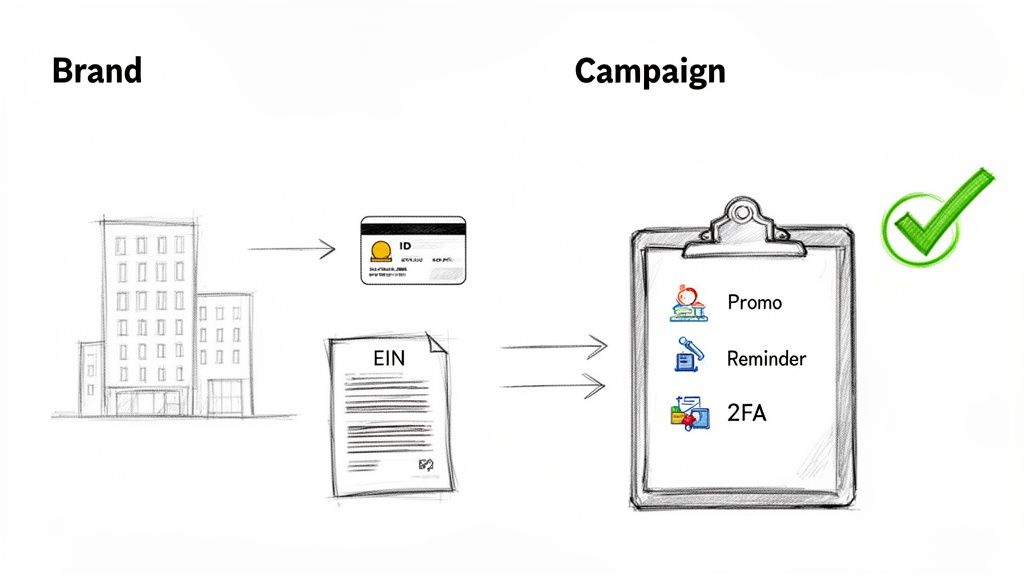
Getting squared away with 10DLC compliance really comes down to two main things: Brand Registration and Campaign Registration. I like to think of it like this: first, you get your business license to prove you're a legit company, and then you get permits for the specific things you want to do.
You'll prove your business is real, and then you'll detail exactly how you plan to use text messaging.
This whole setup is managed by The Campaign Registry (TCR), the central group that works with mobile carriers to vet everyone. Your messaging partner, like us here at Call Loop, will handle the actual submissions for you, but it’s on you to provide all the correct info. Trust me, getting this right the first time is the secret to getting approved quickly and without headaches.
Once you’re compliant, your messages flow through the system smoothly, like this:

This shows why registration is so important. When carriers see your messages are coming from a registered source, they know you're legitimate and prioritize getting them delivered.
First up is registering your brand. This is where you establish your business's identity with TCR, and it's the foundation for everything else. The goal is to prove you're a real, verifiable entity, which helps TCR give you a Trust Score that impacts your messaging throughput.
You’ve got to be precise with your company details. There’s no room for “close enough” here.
Key Info for Brand Registration:
The number one reason we see brand registrations fail is a mismatch between the legal name and the EIN. Seriously, pull out your tax paperwork and double-check it. Even a tiny difference like "Inc" versus "Incorporated" will get you rejected.
After your brand gets the green light, it’s time to register your messaging "campaigns." A campaign isn't just one marketing blast; it’s a specific use case that defines the purpose of your messages. Are you sending appointment reminders? Special offers? Account alerts? The carriers want to know.
Every campaign you register is tied back to your approved brand, creating a clear chain of accountability. This is where you lay out the what and how of your entire texting strategy.
Picking the right campaign type from the get-go is critical for getting approved.
Common Campaign Use Cases:
The idea is similar to what's been done for years with high-volume short codes, but 10DLC opens this up for standard 10-digit local numbers. If you're weighing your options, you can learn more about short code registration in our guide.
When you register a campaign, you have to write a crystal-clear description and provide a few sample messages. Vague descriptions are a fast-track to rejection. You need to be specific about who you're texting and why.
For instance, a weak description like, "Sending marketing messages to my customers," is almost guaranteed to fail.
A strong, compliant description looks more like this: "This campaign sends promotional offers and new product alerts to customers who have opted in on our website. Customers receive messages about weekly sales and exclusive discounts. We also send ringless voicemail drops for major announcements."
Your sample messages have to match that description and include all the required compliance language.
Example Compliant Message Template:
"Hi [FirstName]! This is The Local Gym. Our Black Friday sale starts now! Get 50% off your first 3 months. Show this text to redeem. Reply STOP to unsubscribe."
This sample works because it does three things right:
By being meticulous with your brand and campaign details upfront, you're building a solid foundation. This doesn’t just make sure your texts get delivered; it also builds trust with carriers and your customers right from the start.
Okay, so you've navigated the brand and campaign registration process. That's a huge step, but the real work starts now. Successful 10DLC compliance isn't a one-and-done task; it’s about what you send—and who you send it to—every single day.
This is where the rubber meets the road. Carriers scrutinize message content just as closely as they do your registration details. Think of every text as a direct reflection of your brand's trustworthiness. Your goal is to consistently prove you're a legitimate business sending valuable, solicited information.
To get past carrier filters and build trust with your subscribers, certain elements simply have to be in your messages. These aren't suggestions; they're the absolute fundamentals of A2P messaging.
Making these a consistent part of your messaging dramatically cuts the risk of being flagged as spam.
Your Core Content Checklist:
And these rules aren't just for SMS. They're solid best practices for any kind of outbound communication, including ringless voicemail and voice broadcasts. This creates a consistent, respectful customer experience no matter how you reach them.
Just as important as what you include is what you leave out. Carriers have absolutely zero tolerance for certain types of content. Sending messages about these topics will get you blocked—fast and hard.
This is a red line you can't cross. Doing so can permanently torpedo your sender reputation.
The industry has a handy acronym for the big no-nos: SHAFT. It stands for Sex, Hate, Alcohol, Firearms, and Tobacco. Any content that promotes or even relates to these topics is strictly forbidden in A2P messaging and will trigger aggressive filtering by all major carriers.
Beyond SHAFT, other categories are also heavily restricted. This includes things like high-risk financial services (think payday loans), gambling, and any kind of deceptive marketing. Your best defense is to stick to your approved campaign use case and never stray into these prohibited areas.
The absolute foundation of all compliant messaging is express written consent. You need to have clear, documented proof that every single user explicitly agreed to get text messages from you. If you don't have it, any message you send is a violation.
This isn't just a 10DLC thing; it's a legal mandate under the Telephone Consumer Protection Act (TCPA). Getting consent right protects you from massive fines and keeps your contact list healthy.
Here are the approved ways to get and document consent:
Managing these consent records is non-negotiable. To make sure your methods are airtight, you can check out our deep-dive on best practices for express written consent.
Respecting opt-outs is every bit as important as securing opt-ins. When a user replies "STOP," your system must automatically add them to a "Do Not Call" (DNC) list for that campaign and immediately stop all future messages.
But it doesn't stop with individual opt-outs. Your business also has to respect the National Do Not Call (DNC) Registry. This is especially critical if your strategy involves voice broadcasts or ringless voicemail, where TCPA rules are incredibly strict.
The stakes are high. The National DNC Registry has over 258 million active numbers, and with the FTC collecting almost $400 million in penalties, the financial risk is enormous. Some states even have their own separate DNC lists to complicate things further.
Using a platform with built-in DNC scrubbing is essential for any modern business. These systems automatically check your lists against national and state registries before sending anything, helping you avoid crippling fines that can exceed $43,000 per violation. This isn't an optional step; it's a critical part of running a compliant outreach program.
Getting your content and consent right is only half the battle. To really nail your deliverability, you have to get the technical side of sending right, too. Once The Campaign Registry (TCR) gives your brand and campaigns the green light, you need to play by the carriers' rules.
Mastering these technical details is what separates the pros from the spammers. It's how you make sure your messages actually land in the inbox, not in a carrier's filter. Think of it as tuning your engine after building the car—it’s the final step that guarantees a smooth ride.
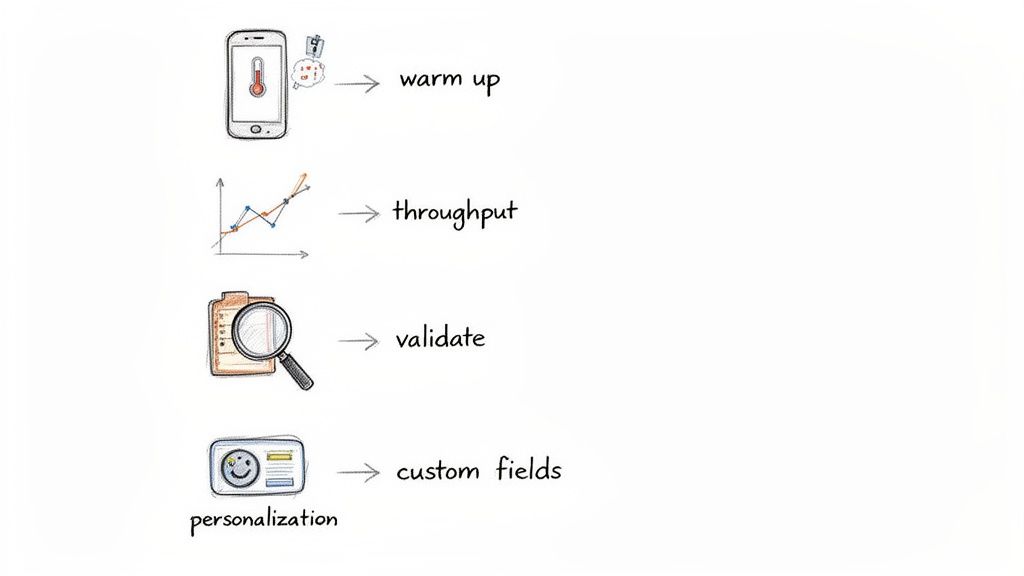
When your brand gets registered, it's assigned a Trust Score. This score is a huge deal. It’s based on how you vetted your brand and your sending history, and it directly controls your throughput—the speed at which you can send messages.
Throughput is measured in messages per second (MPS) or messages per minute (MPM). A high Trust Score means you get to send faster, which is critical for large, time-sensitive campaigns. This is exactly why it pays to get your brand registration perfect from day one. A low score will throttle your sending speed and create frustrating bottlenecks.
Nothing screams "spam!" to a carrier like a brand-new phone number suddenly blasting out thousands of texts. That kind of activity will get you flagged almost immediately. The secret is to be smart and deliberate.
Always "warm up" a new 10DLC number. Start by sending a small batch of messages, then slowly ramp up your volume over a few days or weeks. This shows the carriers you're a legitimate sender and helps build a positive reputation for that number.
When you're ready to send a big campaign, don't just dump the entire list into the queue at once. Spacing out your sends is much safer. Sending 10,000 messages over an hour looks way better to carriers than trying to fire them all off in five minutes.
Sending texts to bad numbers is like throwing money away. Worse, it tanks your sender reputation. Every time a carrier gets a delivery error because a number is a landline or disconnected, it's a strike against you. Too many of those, and your messages will start getting filtered.
Before you even think about hitting "send," you need to clean your list with a number validation service.
Taking this one step can have a massive impact on your 10DLC compliance and the ROI of your campaigns. You're making sure you only pay to send messages that can actually be delivered.
Personalization is more than just a nice touch; it's a deliverability tool. Using custom fields to include a subscriber's name or other relevant info makes your texts feel less like a generic blast. This boosts engagement and makes it less likely someone will report you as spam.
Link shorteners are also a must for tracking clicks and saving characters. But be careful here. Always use a reputable service that offers branded or dedicated short domains. The free, public shorteners are often abused by spammers and can get your messages flagged. A custom branded link not only looks more professional to your customers but is also seen as more trustworthy by the carriers.
It's happened to the best of us. You’ve put in the work, filled out all the forms, and hit "submit" on your 10DLC registration, only to get a rejection notice. It’s frustrating, but it’s rarely a dead end.
Think of it less as a final verdict and more as the start of a conversation with the carriers. They’re not trying to shut you down; they just need more clarity. Understanding why they reject submissions is the key to getting a quick approval on your second try.
When a campaign gets rejected, you’ll get a reason code. Instead of guessing, let’s break down what the most common ones really mean and exactly how to fix them.
By directly addressing the reason for the rejection and resubmitting, you're showing the carriers you’re responsive and serious about playing by the rules.
Getting your 10 dlc compliance approved isn't a one-time setup; it’s an ongoing process. Your sender reputation isn't set in stone—it's a living thing that changes based on your daily messaging habits. And you can bet the carriers are always watching for signals that might indicate a problem.
I like to think of it like maintaining a car. You don't just buy it and assume it will run forever. You have to get regular oil changes and check the tire pressure. Proactively monitoring your messaging analytics is the "preventative maintenance" for your sender reputation.
High opt-out rates or a sudden spike in delivery error codes are the early warning signs of a compliance issue. Ignoring them is the fastest way to get your messages filtered or completely blocked. Proactive management is the only way to ensure long-term deliverability.
Staying compliant means keeping a close eye on your performance and being ready to adapt. This active management is what protects your ability to connect with customers through SMS, ringless voicemail, and other channels.
Here's what you should be doing regularly:
This ongoing diligence is what ensures your text and voice outreach remains a reliable and effective tool for your business. It protects your investment and, most importantly, maintains the trust you've built with your customers.
Let's clear up some of the most common questions we get about 10DLC. Even with all the guides out there, a few things can still feel a bit fuzzy when you're in the weeds.
This is a great question. The short answer is no, not directly. 10DLC rules are specifically for A2P (application-to-person) SMS and MMS traffic.
However, that doesn't mean you're in the clear. The principles behind 10DLC—consent and transparency—are universal. Regulations like the TCPA and the National Do Not Call Registry absolutely cover voice calls, and by extension, ringless voicemail. So, you still need to be diligent about maintaining a clean, opt-in list and scrubbing it against the DNC. It's just smart practice for any outreach channel.
Think of it in terms of volume, cost, and what you're trying to do.
A Standard Campaign is built for a single, focused purpose, like "Account Notifications" or "Marketing." These typically come with much higher message limits, which is perfect if you're sending to a large list.
A Low-Volume Mixed-Use Campaign is your flexible, budget-friendly option. It's designed for businesses sending a lower number of messages—usually under a few thousand a day. The big win here is you can bundle different use cases (like marketing and customer service) into one campaign, which is a fantastic starting point for most small businesses.
This is a two-part answer. Getting your brand registered is usually the fast part. If all your business info is accurate and lines up with your official records, you can see approval in just a few minutes.
Campaign registration is where you need to plan ahead. This can take anywhere from a few days to several weeks, depending entirely on how backed up the mobile carriers are with their reviews.
I can't stress this enough: get this done before you plan to send any messages. Firing off texts from an unregistered number is a quick way to get your messages filtered, blocked, and hit with some hefty non-compliance fees.
Yes, you can. It's perfectly fine to link a single 10DLC number to more than one of your registered campaigns. For instance, you could use the same number for your "Customer Care" campaign and your "Appointment Reminders" campaign.
That said, the best practice we've seen is to keep your use cases neatly separated by campaign. It shows carriers you're being transparent about your traffic, which helps ensure good deliverability and is crucial for building a solid sender reputation over time.
Ready to simplify your outreach and ensure your messaging is always compliant? Call Loop provides a powerful, multi-channel platform for SMS, voice broadcasting, and ringless voicemail, with all the tools you need to manage 10DLC compliance effortlessly. Start connecting with your customers today.
Chris Brisson
Chris is the co-founder and CEO at Call Loop. He is focused on marketing automation, growth hacker strategies, and creating duplicatable systems for growing a remote and bootstrapped company. Chat with him on X at @chrisbrisson


Trusted by over 45,000 people, organizations, and businesses like


