
See a Demo
You're just one step away from seeing Call Loop in action.
Enter your information below to watch a demo right now.

You're just one step away from seeing Call Loop in action.
Enter your information below to watch a demo right now.

Ever feel like your emails and text messages are just getting lost in the noise? You're not alone. In a world where everyone is shouting for attention online, the simple sound of a human voice can make all the difference.
This is where voice broadcast software comes in. Think of it as an email blast, but for your phone. Instead of sending a wall of text to an inbox, you’re delivering a personal, pre-recorded audio message directly to thousands of people at once.
At its core, voice broadcast software automates the process of calling a huge list of contacts to play a recorded message. It’s a way to scale a personal touch, making a direct connection that’s hard to ignore. This technology also includes tools like ringless voicemail, which allows you to send a message directly to someone's voicemail inbox without their phone ringing.
This isn't about replacing your team; it's about making them ridiculously efficient. Instead of your agents spending hours dialing one number after another, a single campaign can reach thousands of people in just a few minutes. Best of all, every single person hears the exact same message, with the perfect tone and clarity you intended.
Let's be real: efficiency is the name of the game. Imagine you need to get an urgent alert, a new sales offer, or an appointment reminder out to 5,000 customers. Doing that manually would be a logistical nightmare, tying up your team for days.
With voice broadcast software, you record your message once, upload your contact list, and hit "send." It's that simple. This frees up your people to handle the important stuff, like talking to the genuinely interested leads who call back after hearing your message.
The real magic is in the consistency. By automating that first touchpoint, you ensure your brand's voice and message are perfectly aligned for your entire audience—something that’s nearly impossible when you have different people making manual calls.
In many ways, voice broadcast software is a specialized type of automatic phone dialer, fine-tuned for launching and managing massive outbound campaigns with total control.
The proof is in the numbers. The global market for broadcast automation software is sitting at around $2.13 billion in 2024 and is expected to jump to $5.12 billion by 2029. That kind of growth happens when businesses see a real, tangible return. Companies are ditching manual, piecemeal efforts for centralized, automated systems that just work. You can dig into more market insights over at researchandmarkets.com.
But this isn't just a one-way street. Good voice broadcast software is built to start conversations, not just spit out messages. Most platforms come packed with interactive features that let people take action right away.
That last one, ringless voicemail, is a game-changer for non-urgent updates or marketing follow-ups. It lets people listen on their own time, making it feel less intrusive. By mixing automated reach with these interactive options, voice broadcasting becomes a surprisingly effective way to communicate at scale. A solid ringless voicemail drop strategy ensures your message is delivered without interrupting your contact's day.
So, how does this actually stack up against the old ways of doing things? Let's break it down.
While manual calls offer deep personalization and emails are cheap, voice broadcasting hits that sweet spot of scalability, personal touch, and cost-effectiveness. It gives you the best of both worlds.
To really get what makes voice broadcast software tick, you have to look under the hood at the tools making the magic happen. These aren’t just dumb dialers blasting out calls. They're smart platforms built to fine-tune your outreach and make sure your message actually gets heard.
The whole game is about getting the right message to the right person at the right time. Modern software pulls this off with a handful of key features that work together to get people to listen and act.
One of the slickest tricks in the book is live vs. answering machine detection (AMD). Think about it: you’ve got a killer message designed for a live conversation, but it gets cut short by a voicemail greeting. What a waste. AMD is the fix, instantly figuring out if a real person or a machine picked up the phone.
Once it knows who (or what) is on the line, the system can pivot:
This simple feature makes a huge difference, ensuring your best stuff is delivered to people, not machines.
Let's be real, recording custom audio for every single campaign is a massive time sink. That’s where Text-to-Speech (TTS) comes in. You just type out your message, and an AI voice whips up a solid audio file in seconds.
But the real power move is personalization. With TTS, you can drop contact-specific info—like names, appointment times, or account numbers—right into the audio. A bland message like, "Your appointment is confirmed," instantly becomes, "Hi Sarah, just a reminder your appointment with Dr. Smith is at 2 PM tomorrow."
That little touch makes your automated calls feel way more personal and relevant. And this tech is only getting better. The market for AI voice generators was already at $4.9 billion in 2024 and is expected to explode to $54.54 billion by 2033. That growth tells you everything you need to know about the demand for natural-sounding synthetic voices.
So, what happens when someone on the line is actually interested? This is where a Press-1 transfer (or call transfer) closes the deal. It bridges the gap between just listening and taking action.
During your broadcast, you can drop in a prompt like, "To speak with a sales representative now, please press 1." The moment they hit that key, the system seamlessly transfers them to a live agent. Just like that, your broadcast goes from a simple announcement to a lead-gen machine. It's worth noting that other outbound tools, like predictive dialing technology, offer different ways to automate calls and boost agent productivity, showing the variety of options available in modern communication systems.
Sometimes you need to get a message across without blowing up someone's phone and interrupting their day. For that, ringless voicemail is perfect. This tech lets you slide a pre-recorded message directly into someone's voicemail box without their phone ever making a peep.
Ringless voicemail is the ultimate "I respect your time" tool. It lets people listen to your message on their own terms, making it a fantastic choice for sales follow-ups, gentle reminders, and other updates that aren't urgent.
This approach feels less like a cold call and more like a personal note left just for them, which can seriously improve the chances they'll listen to the whole thing. From direct calls to subtle voicemail drops, these features are all about making an impact.
Theory is great, but results are what matter. Voice broadcast software isn't just a clever piece of technology; it's a practical tool that delivers measurable wins across a huge range of industries. From boosting sales to ensuring public safety, its applications are as diverse as the businesses that use it.
The secret to its success is simple: it cuts through the noise. Instead of fighting for attention in a crowded inbox, a voice message creates a direct, personal connection that demands a moment of focus. This is how organizations deliver critical information quickly and effectively, turning communication into real action.
For sales and marketing teams, voice broadcasting is a powerful engine for growth. It’s perfect for waking up cold leads that have gone silent or for following up with prospects who downloaded a resource but never booked that demo.
Imagine a sales team sitting on a list of 1,000 old leads. Calling them manually would take weeks of tedious work. With voice broadcasting, they can send a targeted, non-intrusive ringless voicemail to every single one in minutes. The message could be a simple, friendly check-in offering a new guide or an exclusive discount, prompting anyone interested to call back.
This one move warms up cold lists and drives fresh inbound calls, leading to a measurable lift in lead conversion and a much healthier sales pipeline.
Missed appointments are a massive drain on resources for healthcare providers, costing the U.S. healthcare system an estimated $150 billion every year. Voice broadcast software offers a simple, effective fix by automating appointment reminders.
A clinic can set up a campaign to automatically call patients two days before their scheduled visit with a friendly, pre-recorded message.
"Hi [Patient Name], this is a reminder of your appointment with Dr. Evans on [Date] at [Time]. To confirm, please press 1. If you need to reschedule, please press 2 to speak with our staff."
This small interaction has a huge impact. Healthcare providers using this method often see a significant drop in no-show rates, sometimes by as much as 30%. It’s a simple automation that keeps schedules full and improves the continuity of patient care.
In the fast-paced world of political campaigns, getting your message out quickly and mobilizing supporters is everything. Voice broadcasting is an essential tool for get-out-the-vote (GOTV) efforts, event promotion, and volunteer coordination.
Campaigns can send targeted messages to registered voters in specific districts, reminding them of polling locations and hours on election day. They can also use it to quickly rally volunteers for last-minute events or phone banking sessions, ensuring high turnout when it matters most.
This mass communication capability lets campaigns reach thousands of people with a consistent, compelling message straight from the candidate, driving both voter engagement and action. The broadcast industry as a whole is focused on these kinds of efficiencies. As U.S. broadcast station ad revenue was forecast to be about $32.97 billion in 2025, down 9.4% from prior years, platforms that offer automated, targeted message distribution are becoming essential for defending margins. You can find more details in the full broadcasting solutions market report.
When a crisis hits, speed is critical. Schools, universities, and municipalities rely on voice broadcasting to send out emergency alerts and time-sensitive notifications to their communities.
Whether it’s a campus lockdown, a weather-related school closure, or a public safety warning, a voice broadcast can deliver the message to thousands of phones instantly. Unlike text messages or emails that might go unnoticed for hours, an incoming phone call commands immediate attention. This makes it the most reliable method for truly urgent communications.
This capability ensures that everyone receives the information they need to stay safe, demonstrating the software’s vital role far beyond just marketing and sales.
Using voice broadcast software is powerful, but you've got to use it responsibly. As much as this tech can amplify your message, it comes with a clear set of rules designed to protect people from unwanted calls. Ignoring them isn't just a bad look—it can land you in some serious legal and financial hot water.
Think of compliance as the foundation for any successful campaign. Without it, even the most brilliant message is built on shaky ground. The trick is to see these regulations not as hurdles, but as a roadmap for building trust and making sure your audience actually welcomes your calls.
The big one you absolutely have to know is the Telephone Consumer Protection Act (TCPA). This federal law lays out the ground rules for how businesses can contact consumers by phone, and it all boils down to one word: consent. You must have clear permission from someone before you send them automated marketing messages.
And that’s not a suggestion; it’s the law. For any marketing-related voice broadcasts, you need prior express written consent. This means the person has clearly agreed, in writing, to get marketing calls from you at that specific number.
The golden rule of the TCPA is simple: Don't call people who haven't asked you to. Fines for violations can run from $500 to $1,500 per call. For a large campaign, that can add up to a truly devastating number, fast.
On top of getting individual consent, you also have to respect the National Do Not Call (DNC) Registry. This is simply a list of people who have raised their hands and said they don't want to receive telemarketing calls. Before you even think about launching a campaign, you have to "scrub" your contact list against this registry.
Scrubbing just means removing any phone numbers from your list that appear on the DNC list. Most reputable voice broadcast providers have built-in DNC scrubbing tools to make this pretty painless. Skipping this step can lead to its own set of hefty fines, completely separate from TCPA violations. This is also a critical step for other outreach methods; we cover this in more detail in our guide on how to ethically use a ringless voicemail for business.
Staying on the right side of the law is one part of the equation. The other is making sure your messages actually get through. Phone carriers are getting smarter and more aggressive about blocking calls they think are spam.
To keep your calls from getting flagged and blocked, follow these simple best practices:
Picking the right voice broadcast software is the first big step. Get this right, and you're well on your way to running effective, scalable outreach campaigns. This decision shapes everything from your day-to-day workflow to your long-term ROI, so it’s important to find a partner that really gets what you need.
Think of it like choosing the right engine for your business. You need something that not only works well today but has the power to grow with you down the road. It doesn't have to be complicated, but a few key factors like cost, ease of use, and support will make all the difference.
Before you sign on the dotted line, take a minute to run through this checklist. Each of these points hits on a critical piece of the puzzle that will directly impact how successful your campaigns are.
Once you’ve picked your software, it’s time for the fun part: bringing your first campaign to life. Following these steps will make sure you’ve covered all your bases for a smooth launch.
This simple process—choosing, testing, and refining—is the secret sauce for launching broadcasts that actually get results.
Following the rules isn't optional, and this flowchart breaks down the must-do compliance steps for any voice broadcast campaign.
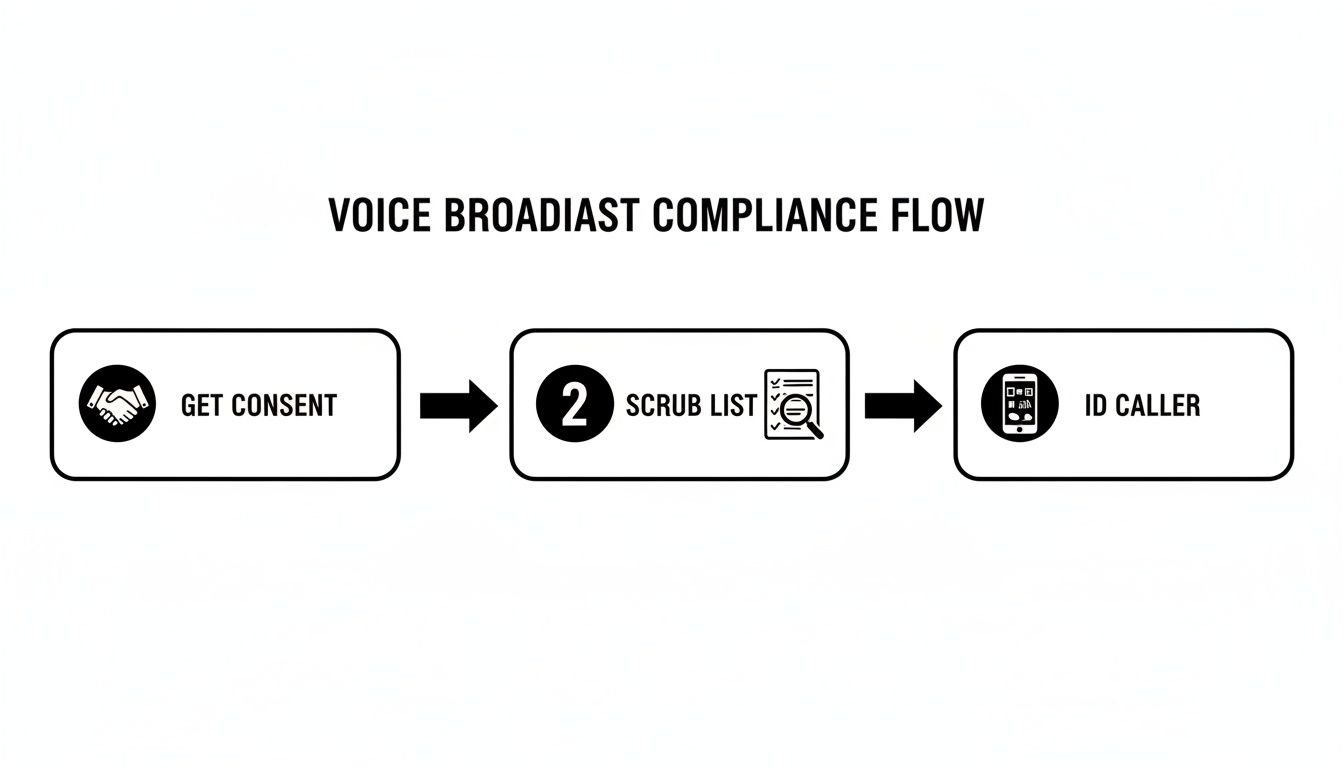
It’s a clear visual reminder that staying compliant is a multi-step process you have to nail down before every single campaign you send.
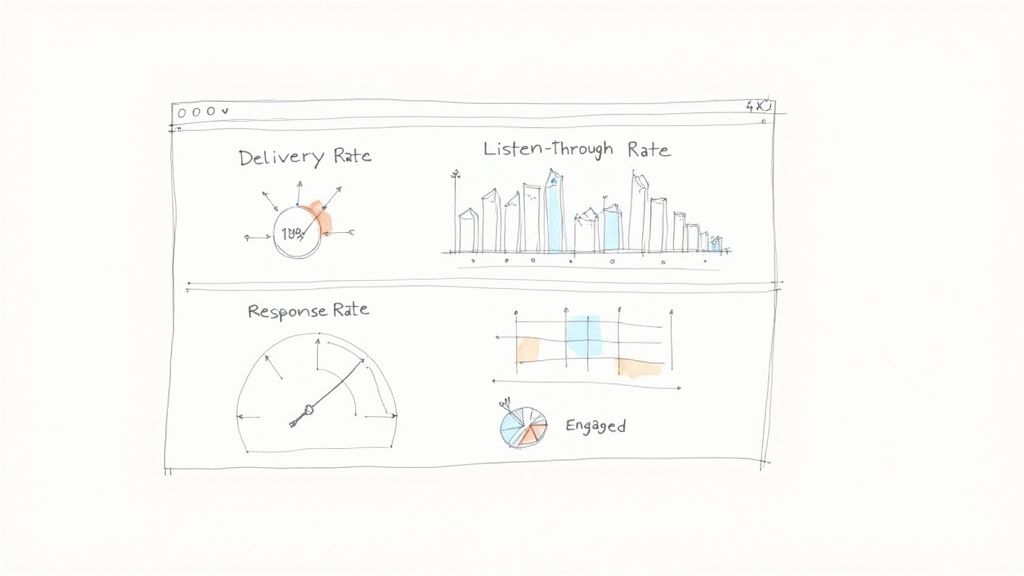
Hitting "send" on a campaign is just the start. The real magic happens when you dig into what happened next. If you aren't measuring your results, you're basically flying blind. You can't prove your ROI, and you definitely can't make your next campaign any better.
Good voice broadcast software gives you a dashboard full of the key numbers—the KPIs—that tell the whole story. These aren't just vanity metrics for a fancy report. They're real, actionable insights that show you exactly where your strategy is hitting the mark and where it's falling flat. By tracking these numbers, you turn a simple broadcast into a smart, data-driven communication machine.
To get a clear picture of what's working, you only need to focus on a handful of essential metrics. Think of them as the vital signs of your campaign's health.
Data is useless unless you know what to do with it. Once you have these metrics in hand, you can start making smart tweaks to crush your next broadcast. It’s all about a systematic approach.
Think of your analytics dashboard as a feedback loop. It tells you exactly what your audience is responding to, allowing you to fine-tune your messaging, timing, and calls to action for maximum impact.
Let's say you see a great delivery rate but a poor answer rate. That’s a signal to experiment with sending your broadcasts at different times of the day.
What if your answer rate is solid, but the listen-through rate stinks? Time to go back to the drawing board and rewrite the first five seconds of your script to make it more compelling. And if you have a low response rate on a press-1 campaign, it’s a clear sign your offer or call to action just isn't cutting it.
This cycle of measuring, analyzing, and optimizing is what separates a good campaign from a truly great one.
Jumping into the world of automated voice messages can bring up a few questions, especially around the rules and what actually works. Getting straight answers is the best way to move forward with confidence. We've tackled some of the most common queries we hear about using voice broadcast software the right way.
This isn't about finding loopholes. It's about understanding how to build trust with your audience while still hitting your communication goals. Let's clear up the important details.
The real difference comes down to two simple things: permission and purpose.
A legal voice broadcast is a message you send to people who have explicitly given you consent to contact them. Think of things like appointment reminders, school closure alerts, or marketing messages a customer actually signed up for. They're expecting to hear from you.
An illegal "robocall," on the other hand, is that annoying, unsolicited call you get during dinner. It's often deceptive, sometimes fraudulent, and sent to people who never asked for it. That's why reputable voice broadcast software providers build compliance tools right into their platforms—to help you stay on the right side of the law.
Absolutely, but you have to play by the rules. The Telephone Consumer Protection Act (TCPA) is the big one here, and you need to follow it to the letter. This means getting prior express written consent from every single contact before you send them a promotional message.
For informational messages, like a shipping notification or an appointment confirmation, the rules are often a bit less strict. But the line can get blurry. When in doubt, always get that explicit opt-in. It’s the safest way to protect your business.
The Caller ID you use makes a huge difference in whether people pick up or just ignore the call. You've got a few main options:
Your best bet is to choose a properly registered local or toll-free number. This helps you avoid the spam filters and ensures your message actually gets through.
Ready to connect with your audience on a massive scale? With Call Loop, you can launch powerful voice broadcast and ringless voicemail campaigns in just minutes. Start your free trial today and see how easy it is to get your message heard.
Chris Brisson
Chris is the co-founder and CEO at Call Loop. He is focused on marketing automation, growth hacker strategies, and creating duplicatable systems for growing a remote and bootstrapped company. Chat with him on X at @chrisbrisson


Trusted by over 45,000 people, organizations, and businesses like


