
See a Demo
You're just one step away from seeing Call Loop in action.
Enter your information below to watch a demo right now.

You're just one step away from seeing Call Loop in action.
Enter your information below to watch a demo right now.

Ever heard of ringless voicemail? It's a clever way to send a pre-recorded audio message straight to someone's voicemail inbox—without their phone ever making a peep. This lets you share information without interrupting someone's day with an unexpected call. This technology is a powerful tool for businesses looking for non-intrusive communication methods.
Think of it like this: you're sending a letter directly into someone's mailbox without ever knocking on their door. The mail gets delivered, and they can check it whenever they want. That's exactly what ringless voicemail does. It skips the whole song and dance of a traditional phone call and goes straight to the destination: the voicemail server.
This approach completely changes the game for direct communication. A normal phone call barges into someone's day, hoping you catch them at a good time. Ringless voicemail, often called a voicemail drop, works on a totally different, more respectful principle.
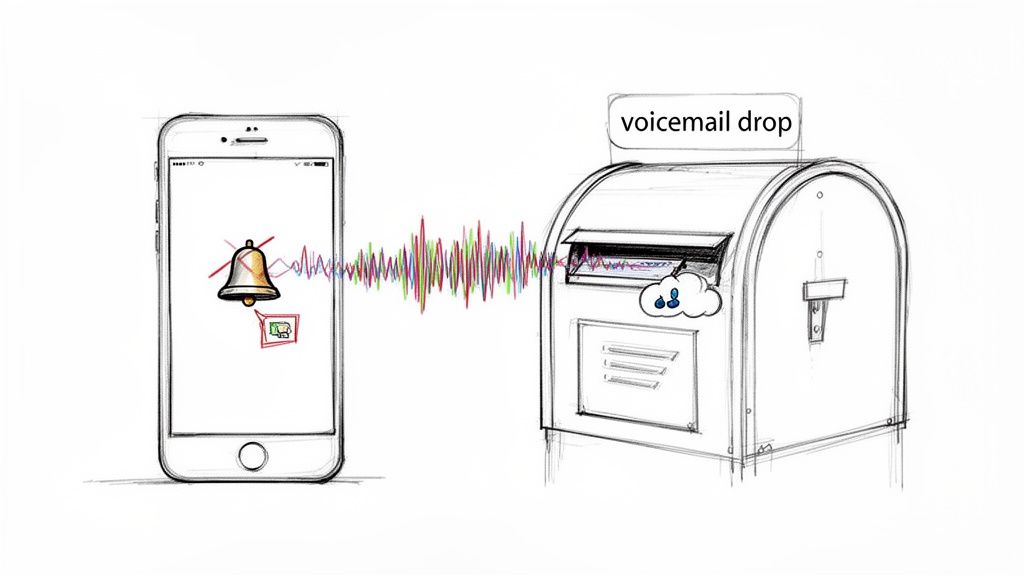
So, how does it pull this off? The secret is in the server-to-server communication. Instead of dialing a number through the live phone network (which is what makes a phone ring), a ringless voicemail platform connects directly with the mobile carrier's voicemail server. It then just deposits your audio file right into the user's inbox.
The person on the other end simply sees a new voicemail notification, just like any other, but there's no missed call in their log. This creates a much better experience. People can listen when they have a moment, which often means they're more likely to hear your whole message instead of just deleting a missed call from a number they don't recognize. If you want to dive deeper into the nuts and bolts, you can learn more about how Call Loop's ringless voicemail feature works.
The real beauty of ringless voicemail is its ability to connect with your audience without being disruptive. This non-intrusive approach respects people's time and makes them far more likely to actually engage with your message.
To really get it, let's break down the key differences between a voicemail drop and a standard call.
As you can see, the two methods operate on completely different playing fields, each with its own place in a communication strategy.
So, what really sets this method apart? It comes down to a few core traits that make it a go-to tool for so many businesses.
At the end of the day, this technology gives you a powerful way to communicate at scale while still feeling personal and respectful. It delivers your voice and your message, without demanding anyone's immediate attention.
So, how does a pre-recorded message just show up in someone's voicemail without their phone ever making a peep? It feels a little like magic, but it's really just a clever, direct path that completely sidesteps the regular phone network.
Think about a standard phone call. When you dial a number, your call hops onto the Public Switched Telephone Network (PSTN). This is the massive global web of phone lines, cables, and satellites that connects all of us. The PSTN's whole job is to create a live, real-time link between you and the person you're calling, which is what makes their phone ring.
Ringless voicemail technology throws that playbook out the window. Instead of using the PSTN to make a live call, it creates a direct, server-to-server connection with the mobile carrier's voicemail system. It’s like having a backstage pass that lets you slip a note into someone's mailbox without ever knocking on the front door.
The journey starts the second you upload your audio file to a platform like Call Loop. Once you’ve picked your contact list and hit "send," the system kicks off a perfectly timed sequence behind the scenes.
Here’s a quick breakdown of how it works:
Because this whole dance happens between servers, the recipient's phone never gets a signal to ring. It's completely oblivious to the transaction, which is why there's no missed call notification left behind.
The secret sauce of ringless voicemail technology is its ability to talk directly to the carrier's infrastructure, cutting the end-user's device out of the loop entirely. This server-to-server chat is what makes non-intrusive, direct-to-voicemail delivery possible.
This unique technical route is what makes voicemail drops so incredibly efficient. A single platform can handle thousands of these server-to-server connections at the same time—something that would be flat-out impossible with traditional dialing. The system isn't sitting around waiting for someone to answer or for a call to finally roll over to voicemail; it’s just depositing files.
This is also fundamentally different from jury-rigged solutions like "call forwarding." This is purpose-built tech designed for one thing: getting an audio message into a voicemail box quietly and reliably. This direct path doesn't just create a better experience for the recipient; it also gives you a much more dependable way to deliver your message, sidestepping all the usual headaches of live calling campaigns like network congestion or unanswered rings.
Let's face it: nobody likes getting a cold call in the middle of a busy day. It's disruptive, often unwelcome, and usually ends with a quick hang-up. Businesses are constantly looking for better ways to connect with people without being that annoying interruption. This is where ringless voicemail drops come in.
Instead of forcing a live conversation, this approach lets you slide a personal message directly into someone's voicemail inbox. It's a game-changer because it respects their time. They can listen and respond when it's convenient for them, turning a potential annoyance into a welcome touchpoint.
Imagine you have a list of a thousand leads to contact. How long would that take to call manually? Days? A week? You'd be stuck dialing, waiting for someone to pick up, and leaving message after message. With a ringless voicemail platform, you can reach that entire list in just a few minutes.
This kind of efficiency is huge for businesses of all sizes. It means you can scale up your outreach without needing to hire a massive team or pour endless hours into manual dialing. A real estate agent can announce a new listing to hundreds of potential buyers instantly. A marketing team can promote an upcoming webinar to their entire contact list with a few clicks.
The process itself is ridiculously simple. You're basically just three steps away from launching a campaign.
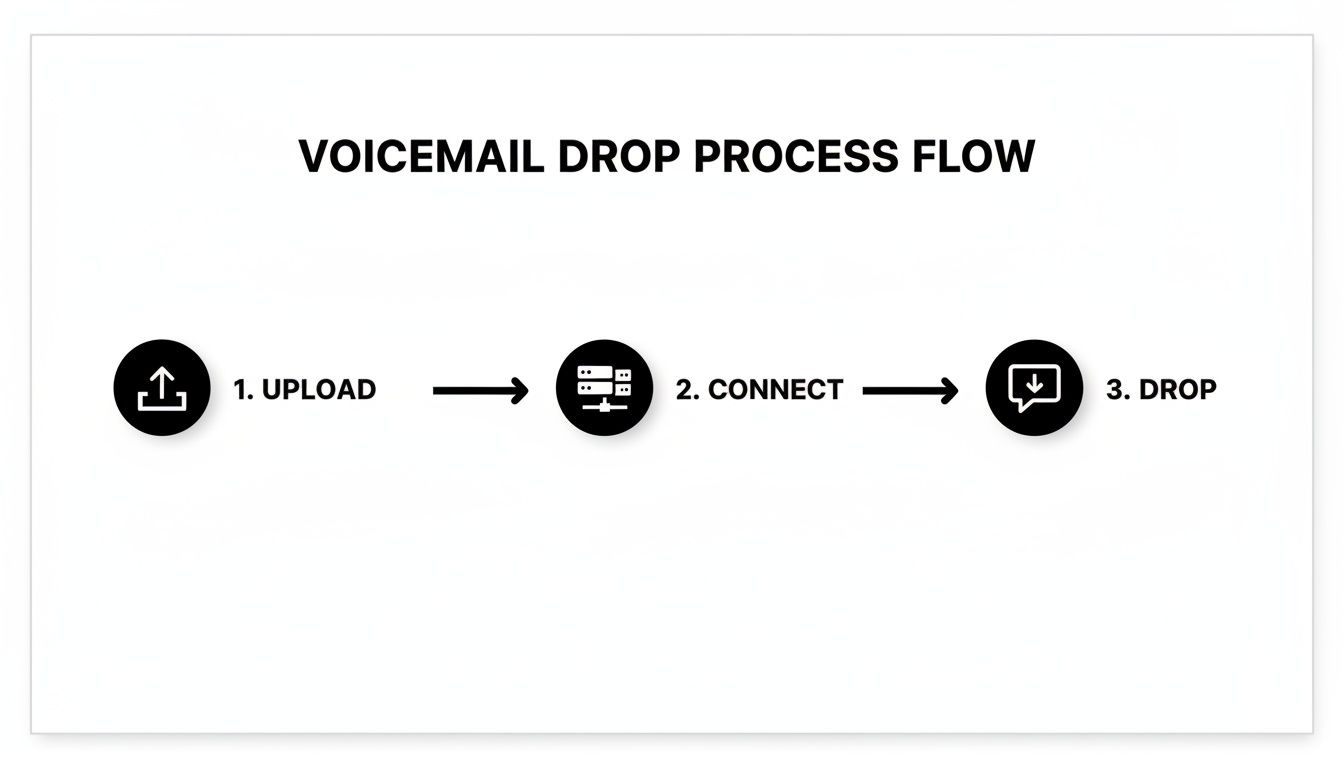
This simple "upload, connect, and drop" flow is what makes it possible to send thousands of personalized messages almost instantly.
Because voicemail drops don't interrupt people, they naturally get much higher engagement. Think about it: you're far more likely to listen to a message on your own time than to answer an unexpected call from a number you don't recognize. This leads to fantastic listen-through rates, which means your actual message gets heard.
The numbers back this up in a big way. Ringless voicemail boasts a 92% open rate and a 96% listen-to rate. Compare that to cold email campaigns, which might see a 6% reply rate on a good day. It's not even a fair fight. With over 90% inbox delivery, it's one of the most reliable channels out there. You can dig into more insights about these engagement metrics to see just how powerful it is.
The real magic of a voicemail drop is that it starts a conversation on the recipient's terms. When you give them that control, you're far more likely to get a positive response and build a real connection.
On top of being efficient, ringless voicemail is also incredibly budget-friendly. With traditional call campaigns, you're paying for every minute your team spends dialing, waiting for an answer, or talking. With a voicemail drop, you only pay for the messages that are successfully delivered.
This pay-for-performance model makes it easy to predict and manage your marketing spend. You stop wasting money on calls that go unanswered or on numbers that don't even have voicemail set up. It delivers a much stronger return on investment, putting it within reach for small businesses and large enterprises alike.
Here’s a quick rundown of the key benefits driving businesses to adopt this strategy:
Ringless voicemail gives you a pretty powerful way to get in front of your audience, but that power comes with some serious responsibility. Getting a handle on the legal and ethical side of things isn't just a good idea; it's absolutely essential if you want to build trust and succeed in the long run. Mess up the rules, and you could be looking at hefty penalties and a damaged brand reputation.
The big one you need to know is the Telephone Consumer Protection Act (TCPA). This is the federal law designed to keep consumers from getting hammered with unwanted telemarketing calls. Even though ringless voicemail works in a unique way, the heart of the TCPA—getting permission first—is still the foundation of any compliant campaign.
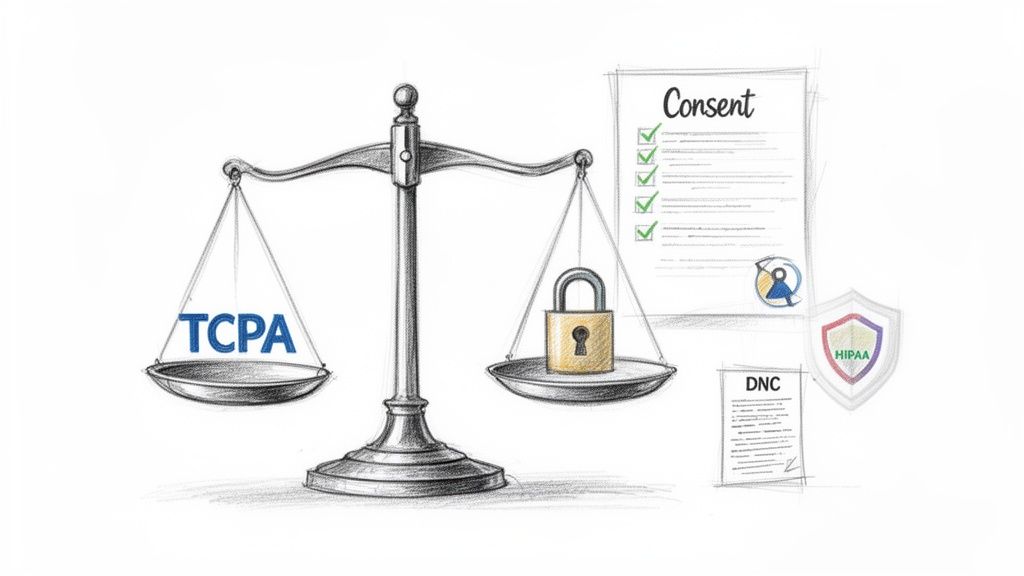
A huge legal question boils down to something simple: does dropping a voicemail count as a "call" under the TCPA? Some argue that since the phone never actually rings, it’s not a traditional call and shouldn't be governed by the same rules. The problem is, regulators and courts haven't settled on a single answer.
This legal gray area is exactly why you should always play it safe. The whole landscape for ringless voicemail has gotten a lot tighter. Carriers are filtering unsolicited audio drops like never before, especially when there's no proof of consent. This has forced businesses to get much stricter with their compliance. It’s a direct response to consumers being more aware of their rights and being quicker to report messages they don't want.
Trying to skate by on a technicality is a risky, short-term game. The gold standard for keeping your campaigns legal, effective, and out of trouble is getting prior express consent from every single person you contact.
To run a compliant ringless voicemail campaign, you have to look past the legal arguments and focus on ethical, permission-based communication. This doesn't just protect you from fines; it actually makes your campaigns work a whole lot better.
Here are the pillars of a responsible strategy:
For some fields, the compliance rules go even deeper. Take healthcare, for instance. The Health Insurance Portability and Accountability Act (HIPAA) has strict regulations for protecting sensitive patient data. If you’re a clinic using ringless voicemail for appointment reminders, you must use a platform built for HIPAA compliance.
This means any Protected Health Information (PHI) has to be handled securely, and your messages can't accidentally give away private details. Using a secure, HIPAA-compliant platform like Call Loop isn't a "nice-to-have"—it's a legal must to protect both your patients and your practice. When you make consent your top priority and stick to these guidelines, you can use ringless voicemail both responsibly and effectively.
Theory is one thing, but the true power of ringless voicemail really clicks when you see how it solves real problems for actual businesses. This isn't just some clever tech—it's a practical tool helping people connect in a way that’s both personal and incredibly efficient. From real estate agents juggling a dozen clients to doctors' offices managing appointments, its non-intrusive style makes it a perfect fit for all sorts of situations.
Think about it: dropping a warm, personal voice message straight into someone’s inbox cuts through the clutter of endless emails and texts. It creates a genuine connection and usually gets a much faster response, all without ever making their phone ring and interrupting their day.
Nowhere is the impact of voicemail drops more obvious than in the breakneck world of real estate. Agents are constantly spinning plates—new leads, open houses, client follow-ups. Time is their most precious commodity. Ringless voicemail lets them multiply their outreach without being chained to the phone for hours on end.
The real estate industry has latched onto this technology in a big way. Research shows that among top-producing agents who sell 25 or more homes a year, a whopping 65-75% use ringless voicemail in their workflow. For real estate teams of five or more, that number jumps to 70-80%. It's clear that for high-volume pros, this isn't a niche gadget anymore; it’s standard practice for staying ahead of the game. You can discover more insights on realtor adoption rates to see just how common it's become.
Agents are using it for all kinds of things, like:
While real estate is a great example, the use cases for ringless voicemail are incredibly broad. Different industries have found their own creative ways to leverage its direct, personal approach.
Healthcare providers, for example, lean on it for sending HIPAA-compliant appointment reminders. A friendly voice message feels more personal than a sterile text and does a better job of reducing no-shows. It's a secure way to communicate without spilling any sensitive patient information.
Marketing agencies also love adding voicemail drops to their campaigns. A well-timed voice message can give an email or SMS sequence a serious boost, nudging a prospect to check their inbox for that special offer you sent.
And in the world of retail and ecommerce, businesses are using it to share exclusive promotions or alert customers to flash sales. Hearing a voice can create a sense of urgency and excitement that a simple text just can't replicate.
The common thread here is the ability to deliver a timely, relevant, and personal message at scale. It turns a one-to-many broadcast into something that feels like a one-to-one conversation.
Of course, the technology is only half the battle. Crafting the right message is what makes it work. Your script will always change depending on your industry and goal, but here’s a solid framework to get you started.
For Lead Follow-Up (Real Estate):
"Hi [First Name], this is [Your Name] from [Brokerage]. I noticed you were interested in the property over on [Street Name]. Just wanted to leave you a quick message and see if you had any questions. My number is [Your Number]. Talk soon!"
For Appointment Reminders (Healthcare):
"Hello, this is a friendly reminder from [Clinic Name] about your appointment with Dr. [Doctor's Name] on [Date] at [Time]. If you need to reschedule, please give our office a call back at [Phone Number]. We look forward to seeing you then."
For a Special Promotion (Retail):
"Hey [First Name]! This is [Your Name] from [Store Name]. As one of our best customers, I wanted to personally let you know about our private 24-hour flash sale happening tomorrow. Check your email for an exclusive discount code. Hope you find something you love!"
Knowing how ringless voicemail works is one thing. Actually turning that knowledge into a practical, money-making strategy requires the right toolkit. You need a platform that makes it dead simple to get campaigns out the door, see what’s working, and plug right into the tools you already use. With a solution like Call Loop, you can go from idea to launch in minutes.
The whole process starts with an interface built for speed. You can easily upload your pre-recorded audio files, sort your contact lists, and use the scheduling options to make sure your message lands at the perfect time for maximum impact. This kind of control means you can line up your outreach with your audience's daily routine, boosting the odds they’ll listen and call you back.
A single voicemail drop can definitely get a response, but the real magic happens when you weave it into a multi-channel drip campaign. This lets you build a natural communication sequence that creates a real connection over time, instead of just being a one-off message.
For example, you could kick things off with a ringless voicemail, follow up with an SMS message a day later, and then maybe send an email if they click a link in your text. This layered approach keeps your brand on their radar without being annoying. Call Loop’s drip campaigns make orchestrating these sequences a breeze, letting you combine RVM with other channels for a complete outreach plan.
A winning strategy isn't about just sending one message; it's about starting a conversation. When you combine ringless voicemail with texts and emails in a drip campaign, you create multiple chances for people to engage and guide them toward taking that next step.
Let's be honest, for any tool to be useful, it has to play nice with the software you rely on every single day. Call Loop integrates directly with essential platforms like HubSpot, ActiveCampaign, and Keap. And with Zapier, you can connect to over 4,000 other apps, automating your workflows and keeping your data flowing smoothly. No more manual data entry or out-of-sync CRMs.
On top of that, a good strategy is built on solid, easy-to-understand data. You have to know what's hitting the mark and what's falling flat. Call Loop gives you powerful analytics that show you exactly how your campaigns are performing.
Here are the key metrics you’ll want to watch:
With our transparent, pay-per-drop pricing, you only pay for voicemails that are successfully delivered. This makes it incredibly easy to manage your budget and calculate a clear return on your investment.
If you're exploring more ways to level up your outreach, take a look at our guide on the best voice broadcast software to see how other tools can complement your goals. By pairing a simple-to-use platform with robust analytics and integrations, you can build a ringless voicemail strategy that brings in consistent, measurable results.
As you start to imagine what ringless voicemail could do for you, a few questions always pop up. It's totally normal. Getting these sorted out first helps you build a smart strategy that's not just effective, but also compliant from the get-go.
Let’s dive into some of the most common questions we hear.
The big one is always about the rules. We’ve touched on it, but the key piece of regulation to know is the Telephone Consumer Protection Act (TCPA). The absolute best way to stay on the right side of the law is to get prior express consent before sending anything. It’s a simple step that protects your business and, just as importantly, builds trust.
Another great question is about the tech itself—specifically, why this works for mobile phones but not for old-school landlines. The secret is in how the message gets delivered.
Ringless voicemail technology talks directly to a mobile carrier’s server to drop the audio file right into the voicemail box. It's a server-to-server conversation.
Landline systems are built differently. They just don't have that kind of centralized, server-based voicemail setup. Since the whole process depends on that server handshake, it’s simply not compatible with traditional phone lines.
Okay, so you've sent your messages. How do you know if they're actually working? While your specific goals will vary, there are a few core numbers you should always be watching to see how effective your ringless voicemail drops really are. Looking at the right data helps you tweak your approach and get the best possible return.
Tracking the right metrics is about more than just seeing if a message was sent; it's about understanding how your audience responds and what truly drives business growth.
To really get a handle on your success, keep a close eye on these key performance indicators:
Ready to see how a non-intrusive, scalable communication channel can transform your outreach? Call Loop provides the tools to launch compliant, high-impact ringless voicemail campaigns that get results. Explore our features and start your journey today.
Chris Brisson
Chris is the co-founder and CEO at Call Loop. He is focused on marketing automation, growth hacker strategies, and creating duplicatable systems for growing a remote and bootstrapped company. Chat with him on X at @chrisbrisson


Trusted by over 45,000 people, organizations, and businesses like


