
See a Demo
You're just one step away from seeing Call Loop in action.
Enter your information below to watch a demo right now.

You're just one step away from seeing Call Loop in action.
Enter your information below to watch a demo right now.

Think of marketing automation workflows as your own personal orchestra conductor for customer conversations. Instead of having to manually tap every musician on the shoulder to play their part, you create a beautiful, pre-written score that runs on its own. It uses specific cues (triggers) to kick off a series of perfectly timed actions, ensuring the right message hits the right person at exactly the right moment.
At its core, workflow marketing automation is a system that runs on simple "if this, then that" logic to manage conversations across all your channels. It's like a digital assembly line for your communications. When a new contact—your raw material—comes in, the system automatically guides them through a series of stations, with each stop being a specific, planned-out action.
This completely takes repetitive, manual tasks off your team's plate. No more sticky notes reminding someone to follow up with a new lead; the workflow handles it instantly. This frees up your team to stop chasing mundane tasks and start focusing on the bigger picture—strategy and creative work that actually moves the needle.
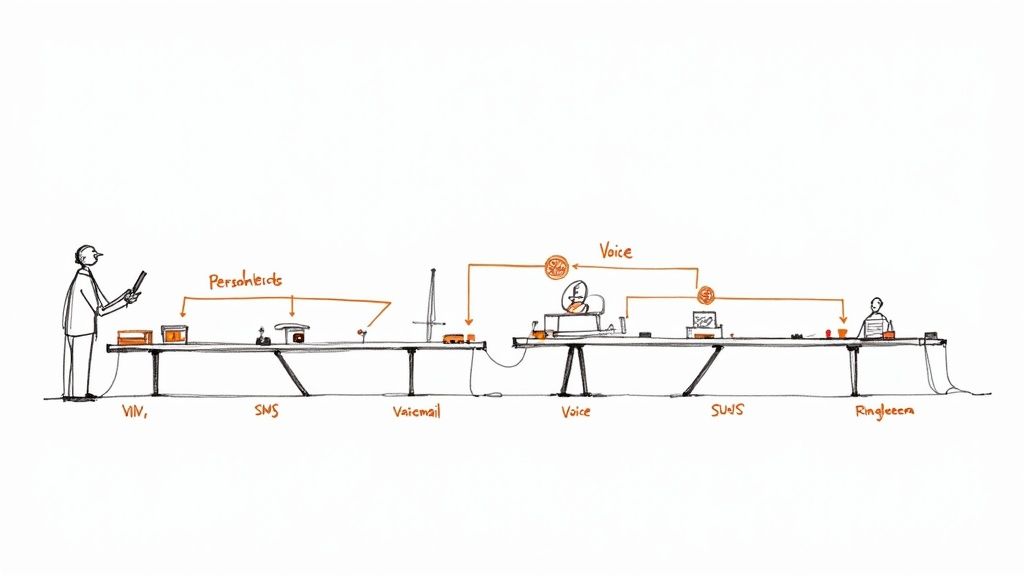
The real magic happens when a specific "trigger" event takes place. A trigger is just the starting pistol that fires off the workflow. A new customer signing up on your website, for example, is a classic trigger.
Once that gun goes off, the workflow starts running through a sequence of "actions." These are the actual messages you want to send out. A solid, practical workflow might look something like this:
This hands-off, multi-channel approach guarantees consistent and timely follow-up without anyone lifting a finger. It creates a smooth, professional experience for your customer and makes your marketing machine incredibly efficient.
Today's workflow automation isn't just about email anymore. To really connect with people where they actually live—on their phones—you have to bring in more direct and immediate channels. Powerful marketing automation solutions weave multiple communication methods into one seamless strategy.
This lets you build smart sequences that layer different kinds of outreach. You can kick things off with an SMS for a quick heads-up, follow up with a non-intrusive ringless voicemail drop, and then use a direct voice broadcast for the really important stuff. This layering makes sure your message gets heard, giving your marketing more punch and driving much better results.
Every powerful automated workflow, no matter how complex, is built from the same handful of core components. Think of it like building with LEGOs; you have a few different types of bricks that, when snapped together the right way, can create just about anything you can dream up.
Getting a handle on these pieces is the first real step toward designing marketing automation that actually gets results. It's how you move beyond blasting the same message to everyone and start having real, one-on-one conversations that respond to what people are doing.
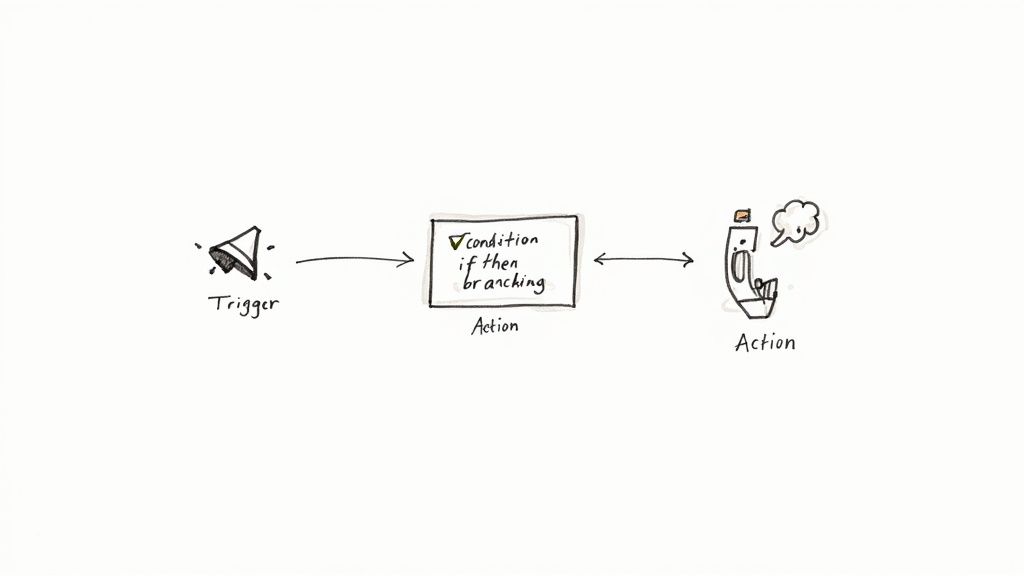
A trigger is just what it sounds like: the specific event that kicks off your entire workflow. It’s the starting pistol that sets everything else in motion. Without a trigger, your beautifully designed workflow just sits there, waiting for its cue.
These triggers are almost always based on customer behavior or changes in their data, which is what makes your marketing feel so responsive and timely. A trigger could be anything from a customer ditching their online shopping cart to them clicking a specific link in an email you sent.
A few common triggers include:
Basically, any customer interaction you can track can be used as a starting point. For example, you can use an SMS trigger to start a sequence the moment someone texts a keyword to your number. This lets you engage them immediately while their interest is at its peak.
Once a trigger fires, the workflow gets to work by executing actions. These are the specific, automated tasks your system carries out. Actions are the "work" in "workflow"—they handle all the communication and data management you’d otherwise be stuck doing by hand.
An action might be a direct message, like sending a personalized SMS, or it could be an internal housekeeping task. You can also string multiple actions together to create a multi-step campaign that unfolds over hours, days, or even weeks.
Think of actions as the individual steps in your marketing recipe. A welcome workflow might start by sending an initial SMS, followed by a ringless voicemail drop a day later, and then wrap up with an email offering a special discount.
Some of the most powerful actions you can automate are:
Finally, conditions are what make your workflow smart. They use simple "if this, then that" logic to send contacts down different paths based on their data or what they do next. This is where automation graduates from a simple sequence to an intelligent, adaptive system.
Conditions check if a certain rule is met and then route the contact down the appropriate branch. For example, if a customer clicks the link in your SMS, then send them a follow-up with a special offer. If they don't click, send a gentle reminder two days later.
This ensures every single communication is highly relevant to that person's unique journey, which makes it dramatically more effective.
Let’s be honest, setting up workflow marketing automation isn't just about saving a few minutes here and there. It’s about building a machine that consistently engages your customers and delivers real, measurable results for your business. When you stop sending one-off messages and start building smart, automated sequences, you create a reliable system that works for you around the clock.
This is a game-changer for lead nurturing. Instead of watching fresh leads go cold, a workflow can step in immediately, sending a perfectly timed series of messages that guide them through your sales funnel. No more letting people fall through the cracks. It’s all handled for you.
What’s the most valuable thing your team has? Time. And repetitive tasks are the biggest time thieves. Think about all the hours spent sending follow-up messages, segmenting contacts, or pinging people with appointment reminders. It adds up fast.
Automation takes all of that off your team's plate. It handles the monotonous jobs instantly and without errors, 24/7. This frees up your people to focus on what actually moves the needle: high-level strategy, creative campaigns, and building real relationships with customers. They can finally stop managing tasks and start driving growth.
It's like giving everyone on your team a digital assistant. The assistant handles the grunt work, allowing your people to operate at their best. The result? A team that's more productive, more strategic, and way more motivated.
In a world full of noise, generic marketing is just static. People tune it out. Automation is your secret weapon to cut through that noise by delivering personalized experiences at a scale you could never dream of doing manually.
Using triggers and simple rules, you can send messages tailored to what a customer actually does. Imagine a workflow that automatically sends a targeted ringless voicemail with a special offer after someone visits a specific product page three times. That’s not robotic; it’s relevant and helpful. That kind of personalization is what grabs attention and drives conversions.
And the numbers don't lie. Workflow automation is proven to seriously boost lead generation. Some reports show it can increase the number of leads you get by 80% and—get this—crank up qualified leads by an insane 451%.
The financial return is just as impressive. On average, businesses see a return of $5.44 for every dollar spent on automation. That’s a massive ROI. If you're curious, you can discover more workflow automation statistics to see the full impact.
Theory is great, but let's get our hands dirty and see how workflow marketing automation actually works. You can start building powerful sequences right now using a simple mix of SMS, voice calls, and ringless voicemail to connect with customers when it matters most.
The idea is to create a blueprint that drives a specific outcome—whether that’s winning back a lost sale or just making a great first impression.
The real beauty of these workflows is how they deliver tangible results every step of the way. They start by nurturing a brand new lead, then make your team more productive, and ultimately drive a real return on your investment.
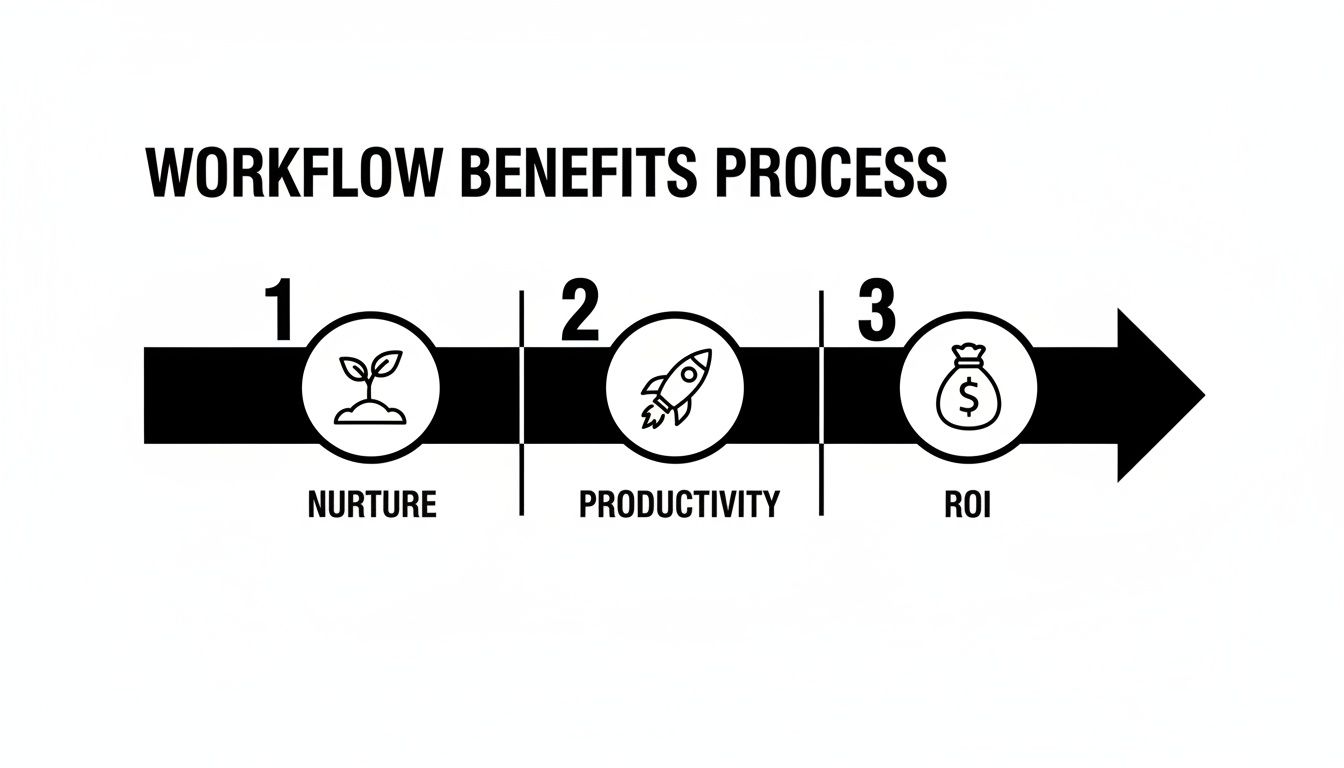
This process isn't just a concept; it’s a direct line from initial engagement to measurable financial returns. Here are three practical examples you can borrow and adapt for your own business.
You never get a second chance to make a first impression. A welcome series is your opportunity to immediately engage new subscribers, making them feel seen and valued from the second they join your list.
Here’s a simple way to set one up:
Let's be honest, every abandoned cart is lost money sitting on the table. This multi-channel workflow uses timely, automated nudges to bring customers back to complete their purchase. It's a remarkably effective strategy.
And the numbers don't lie. Abandoned cart workflows often generate the highest returns, with some earning nearly $29 per recipient. On average, companies see an ROI of 544% on their marketing automation—that's $5.44 back for every $1 spent.
Here’s a proven sequence:
Social proof is one of the most powerful sales tools you have. This workflow automates the process of collecting reviews from happy customers, helping you build trust and credibility for your brand on autopilot.
An auto SMS reply system is also a fantastic tool for handling incoming texts for other campaigns. You can learn more about setting up an auto SMS reply in our dedicated guide.
Here’s how to get more reviews:
The best workflows feel less like marketing and more like helpful, timely communication. As we've just seen, the right trigger at the right moment can kick off a powerful sequence of events.
Let's take a closer look at some common triggers and the automated actions they can set in motion.
These are just starting points, of course. The real power comes when you start combining these triggers and actions to create a custom-tailored experience that guides your customers seamlessly through their journey with you.
Building a workflow marketing automation strategy that actually works is so much more than just plugging triggers into actions. You need a thoughtful, strategic game plan. The best workflows aren't just built on cool tech; they're built on a real understanding of your customer's journey.
Every single workflow should start with one, crystal-clear goal. Are you trying to welcome a new lead? Win back a lost sale? Get some customer feedback? Pinpointing your objective upfront makes sure every message, from an SMS to a ringless voicemail, has a real purpose. Without that focus, your automation can feel clunky and disconnected.
Before you even think about building a workflow, take a step back and map out the entire customer experience. Put yourself in their shoes. What do they need? What questions do they have? Where might they get stuck? Your automated messages should feel like a helpful friend guiding them along, not a pushy salesperson.
This means you have to get ahead of what a customer needs next and deliver it before they even ask. For instance, a brand-new subscriber doesn't want a hard sales pitch; they need a warm welcome that builds a little trust. A customer who just got their product might be willing to leave a review, but you have to give them a few days to actually use it first.
When you line up your automation with the natural flow of the customer relationship, your messages always feel relevant and valuable. This one simple shift is what separates marketing that gets ignored from marketing that actually gets results.
Once you have your journey mapped out, it's time to nail the content of your messages. With channels like SMS and ringless voicemail, you have to be brief. Every single word counts.
A/B testing is your best friend here. Play around with different message copy, send times, and even the channels you use. You might discover that a ringless voicemail drop works way better than an SMS for certain follow-ups. Let your data be your guide. For a deeper dive, exploring comprehensive marketing automation best practices is a must for anyone serious about scalable growth.
And finally, don't forget that compliance isn't optional. Make sure your communication respects user privacy and follows all the rules. The most effective workflow is one that's both powerful and responsible.
Hitting "launch" on your workflow isn't the finish line—it's the starting gun. The most successful workflow marketing automation isn't a "set it and forget it" tool. Think of it as a living system that needs to be measured, analyzed, and fine-tuned over time.
Walking away after setup is a huge missed opportunity. The real magic happens when you start digging into the performance data and use it to make smarter decisions. This is what separates a campaign that sizzles out from one that keeps delivering value month after month.
Before you can improve anything, you have to know what you’re measuring. Fuzzy goals will always lead to fuzzy results. You need to zero in on specific metrics that tell you exactly how your SMS and ringless voicemail messages are performing.
Here are the essential KPIs you should have on your dashboard:
When you track these numbers for every single step in your workflow, you can pinpoint exactly where you're winning and where people are dropping off.
Once you have your data, it’s time to roll up your sleeves and put it to work. Optimization is really just a simple, four-step loop: measure, analyze, hypothesize, and test. This process turns those raw numbers into insights you can actually use to improve your results.
Let's say you're looking at your numbers and notice the second SMS in your abandoned cart sequence has a crazy-high unsubscribe rate. That's a clear signal something's off. You can form a hypothesis: "Maybe the message sounds too pushy." The next step is to test a new version with a softer, more helpful tone and see if it does better.
Think of it as being a scientist for your own marketing. Every workflow is an experiment, and every piece of data is a clue that helps you refine your formula for success.
This disciplined approach lets you make small, incremental tweaks that stack up into massive gains in engagement, conversions, and your overall ROI. By constantly testing and refining, you turn your workflow marketing automation into an increasingly powerful engine for growing your business.
Ready to build, measure, and optimize your own multi-channel workflows? Call Loop provides all the tools you need to automate SMS, voice, and ringless voicemail campaigns with powerful analytics to track your success. Start your free trial today and see how easy it is to create automation that gets results.
Chris Brisson
Chris is the co-founder and CEO at Call Loop. He is focused on marketing automation, growth hacker strategies, and creating duplicatable systems for growing a remote and bootstrapped company. Chat with him on X at @chrisbrisson


Trusted by over 45,000 people, organizations, and businesses like


