
See a Demo
You're just one step away from seeing Call Loop in action.
Enter your information below to watch a demo right now.

You're just one step away from seeing Call Loop in action.
Enter your information below to watch a demo right now.

At its core, express written consent is a clear, documented "yes" from a customer agreeing to get marketing messages from you. Think of it as the gold standard for communicating through SMS, voice calls, and even ringless voicemail. It's what keeps your outreach legal, welcomed, and effective.
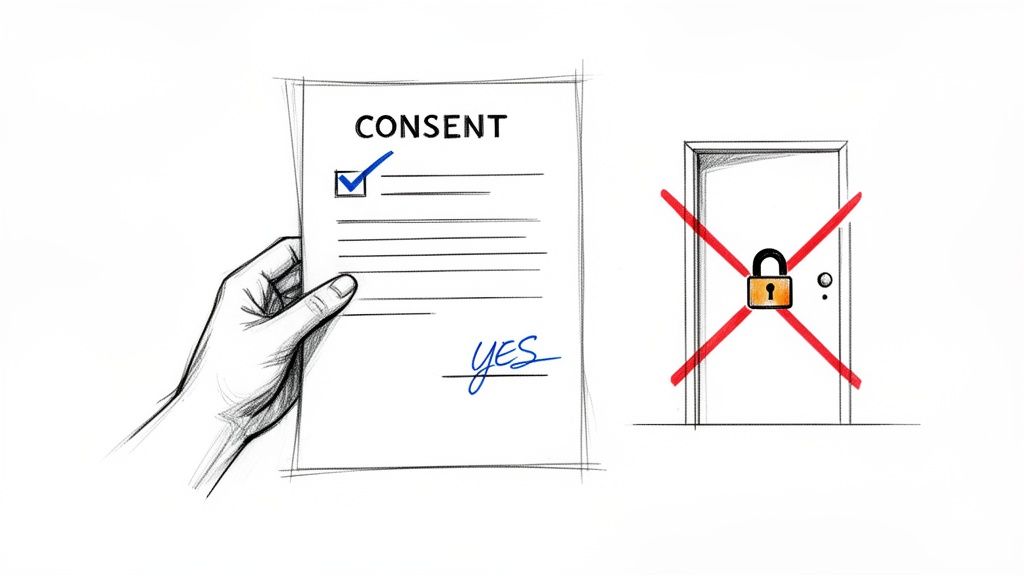
Imagine you're at a friend's house. Just because the door is unlocked doesn't mean you can just walk right in. You wait for them to give you an enthusiastic, "Come on in!" That's the perfect way to think about express written consent—it’s the huge difference between assuming you have permission and getting an explicit, unambiguous welcome.
In the world of business communication, this isn't just a nice-to-have; it's a legal cornerstone, especially under the Telephone Consumer Protection Act (TCPA). It represents a direct agreement where a consumer gives you the green light to contact them with promotional messages. Without that clear permission, your marketing campaign could easily be flagged as spam, landing you in some serious legal hot water.
But this goes beyond just ticking a regulatory box. It’s about building trust. When someone gives you their consent, they are inviting you into their most personal space—their phone. If you honor that trust, your messages are seen as valuable updates, not intrusive junk.
To make sure your consent is legally sound, you need to break it down. It's not as complicated as it sounds, but getting each piece right is non-negotiable for compliance.
Here's a quick table that lays out what's required for consent to be considered valid for your marketing communications.
Getting these three components right is the foundation of a compliant and successful messaging strategy.
The entire industry is shifting toward more stringent consent documentation. The global consent management market, which includes platforms designed to help businesses get this permission, grew from $318.3 million in 2020 and is on track to hit a massive $2,271.1 million by 2030. That explosion in growth tells you just how critical it is for businesses to get a clear 'yes' before hitting send. You can read the full research about consent management market growth for more details.
By securing express written consent, you aren't just following the law—you're building a higher-quality audience of engaged subscribers who genuinely want to hear from you. This leads to better campaign performance and stronger customer relationships.
The big reason "express written consent" has become such a critical part of doing business is a federal law called the Telephone Consumer Protection Act, or TCPA. Think of it as a shield for consumers, designed to stop the endless stream of unwanted robocalls and automated texts that hijack our phones.
But if you're a business, the TCPA isn't just some friendly guideline. It's a book of strict rules with some seriously painful financial penalties if you ignore them. Getting your head around this isn't optional—it's a core piece of modern marketing that directly protects your bank account.
The TCPA is brutally clear: you absolutely must get express written consent before you send any marketing messages using an automatic telephone dialing system (ATDS). That’s just a fancy term for an autodialer, and its definition is broad enough to cover most of the platforms we use for SMS marketing, automated calls, and even ringless voicemail drops.
The penalties for breaking these rules are no joke. They're designed to hurt.
These massive penalties have created a cottage industry of class-action lawsuits targeting companies that mess up their consent documentation. There are literally professional plaintiffs and law firms that hunt for businesses with sloppy practices, making TCPA violations a huge legal and financial risk.
The bottom line is simple: under the TCPA, consent isn't just about good manners. It's a legal requirement that acts as your main line of defense against crippling fines and lawsuits.
The financial dangers tied to the TCPA have spawned a massive industry just for managing consent. The consent management market is expected to hit $1.07 billion in 2026 and then explode to $2.34 billion by 2031. North America is leading the charge, largely because of the TCPA and a growing mess of state-level privacy laws.
This boom is a direct reaction to TCPA violations, which lead to over $200 million in FCC fines every single year from companies that failed to get clear consent. You can discover more insights about the consent management market on mordorintelligence.com.
At the end of the day, treating express written consent as a non-negotiable part of your process is the only safe way to operate. It protects your business, it shows respect for your customers, and it ensures your marketing builds valuable relationships instead of dangerous legal liabilities.
Alright, let's move from theory to action. Getting express written consent is all about making the sign-up process crystal clear, totally transparent, and dead simple for your customers. There are a handful of proven ways to capture this permission, and every single one hinges on explicit language and bulletproof documentation.
The most popular methods are probably ones you've seen before: web forms, text-to-join keywords, and maybe even a sign-up sheet at a point-of-sale. For a web form, you need a checkbox that someone has to actively click. The words next to it can't be wishy-washy. Think something direct like, "I agree to receive recurring automated marketing messages from [Your Brand] at the number provided. Consent is not a condition of purchase. Reply STOP to cancel."
Here’s the thing: just getting someone to say "yes" isn't enough. You have to be able to prove they said yes. Meticulous record-keeping is your single best defense if you ever face a TCPA complaint. If a customer challenges your right to contact them, the burden of proof falls squarely on your shoulders to produce a clear, undeniable trail of their consent.
Think of it as keeping a receipt for every permission slip you get. For every single person on your list, your records have to show:
This flowchart breaks down the simple but costly process of what happens when you text without getting that consent first.
As you can see, skipping that first step puts your business directly in the path of some serious financial penalties under the TCPA.
Trying to track all these details by hand is a recipe for disaster. It's nearly impossible and just asking for human error. This is why using a platform that automates the whole documentation process is so critical. When someone opts in, the system should instantly log all those crucial data points, creating a secure, reliable record for every subscriber. For a deeper dive, check out our guide on effective opt-in strategies for text marketing.
A robust system doesn't just ask for permission—it archives the proof. This automated trail is your evidence, demonstrating that you respected consumer rights and followed the law from the very beginning.
This level of detail is non-negotiable, whether you're sending SMS, making calls, or dropping ringless voicemail messages. For businesses that need comprehensive record-keeping, investing in good document management software can be a lifesaver for organizing and storing these vital consent records securely.
At the end of the day, a proactive and organized approach to documenting express written consent is the only way to shield your business while building a list of people who are genuinely excited to hear from you.
Voice communications can sometimes feel like the Wild West compared to SMS, but when you look at the actual rules, the lines are drawn pretty clearly. A lot of marketers fall into a dangerous trap: they figure since a ringless voicemail doesn't actually make a phone ring, it's less intrusive. From there, they assume it must be exempt from the tough consent rules.
That assumption could cost you dearly.
Legal rulings and regulators have been consistent on this point: a ringless voicemail is treated as a "call" under the TCPA. So, for any promotional message you drop straight into someone’s voicemail, you need the exact same level of express written consent required for automated texts and calls. The delivery method doesn't give you a free pass.
That same non-negotiable requirement for express written consent applies to your automated voice broadcasts, too. Before your pre-recorded message ever hits a contact’s phone, you need a clear, documented record showing they agreed to get those calls from you.
Without that proof, every single call you send is a potential TCPA violation, putting you at serious financial risk.
To keep your campaigns compliant and build trust with your audience, there are a few best practices you need to bake into your strategy. These aren't just helpful tips; they're the bedrock of a lawful and effective voice campaign.
The big takeaway here is that even though the technology is designed to bypass a direct ring, regulators don't care about the how. They care about the what—an unsolicited marketing message ending up on a consumer's device, which they see as the same thing as a call.
Platforms like Call Loop are built from the ground up with these rules in mind, giving you the tools to manage consent and run compliant campaigns right from the start. For instance, our system makes it easy to upload or record your audio messages and ensure they include the necessary identification and opt-out instructions.
You can learn more about getting this all set up in our guide on automatic voice messaging.
When it comes down to it, whether you’re sending a ringless drop or a voice broadcast, the core principle is the same: permission is everything. Getting express written consent isn't some roadblock to your marketing. It’s the foundation that makes your strategy sustainable, legal, and way more effective in the long run.
Theory is one thing, but putting it into practice is where the rubber meets the road. For anyone using Call Loop, managing express written consent isn't some extra chore—it’s baked right into the platform. This is your playbook for using our tools to build a compliant, effective, and trustworthy communication strategy from the get-go.
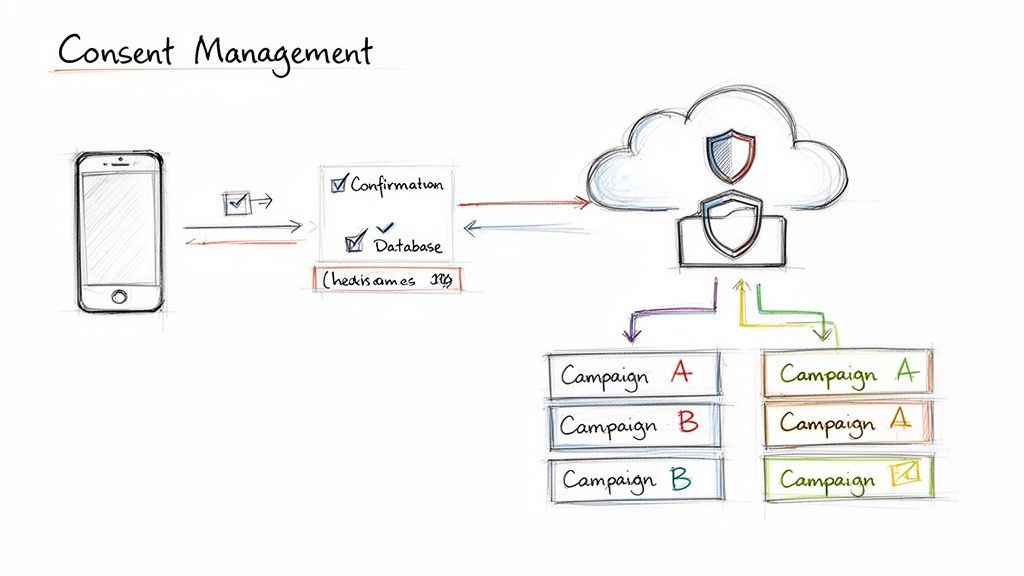
There’s a reason the market for consent management tools is exploding. Valued at $665.71 million, it’s projected to hit $3,592.63 million by 2033, which tells you one thing: smart businesses are investing heavily in getting compliance right. Brands that nail down express consent see open rates soar 40-50% higher than those using weaker permissions.
With features like double opt-in, Call Loop’s 45,000+ users are already ahead of the curve. This is especially true in sensitive fields like healthcare, where HIPAA-aligned consent is a must to dodge penalties that average a staggering $1.5 million per violation. To dig deeper into this trend, you can learn about the latest consent management findings.
The single most powerful tool you have for documenting consent is the double opt-in. Think of it as a two-step handshake to confirm permission. First, a user signs up on your form. Then, they have to reply "YES" to a confirmation text message. Simple as that.
This process creates a clear, undeniable, timestamped record of their intent. It wipes out any gray areas and gives you the strongest possible proof that a subscriber knowingly and willingly wanted to hear from you. The best part? Call Loop automates this whole sequence, locking in that ironclad proof for every single contact.
Let's be real: not all consent is the same. A customer might be perfectly fine getting appointment reminders but have zero interest in promotional offers for your ringless voicemail campaigns. Sending the wrong message to the right person at the wrong time isn't just annoying; it's a compliance risk.
This is where contact segmentation becomes your best friend. Call Loop makes it easy to create separate groups based on the specific type of consent each contact gave you.
By segmenting your audience, you make sure every message you send is relevant and, more importantly, lines up perfectly with the permission you were given.
Using segmentation isn't just a marketing "best practice"—it's a core part of responsible consent management. It turns your contact list from a simple database into a detailed map of who wants to hear what.
The final piece of the compliance puzzle is respecting someone's right to change their mind. The TCPA is crystal clear: you have to honor opt-out requests immediately. When a subscriber texts "STOP," they need to be removed from your list instantly, with no delays or manual steps.
Call Loop’s platform handles this on autopilot. The second an opt-out keyword like "STOP" comes in, the contact is flagged in the system, and no more messages will be sent to them. This automated process saves you from accidental violations, keeps your contact lists clean, and shows respect for your subscribers' choices—which is the ultimate key to a healthy and engaged audience.
Even after you've got a handle on the rules, certain situations can still feel a bit fuzzy. Getting clear on the gray areas of express written consent is what separates a confident, compliant outreach strategy from a risky one. Let's walk through some of the most common questions we see.
Let's clear this one up right away, because it's one of the most common and dangerous mistakes a business can make. The answer is an absolute, unequivocal no.
Buying a list of phone numbers never, ever grants you express written consent under the TCPA. Consent has to be given directly from the individual to your specific business, for a purpose you’ve clearly spelled out.
Using purchased or rented lists to send automated SMS, voice calls, or ringless voicemail campaigns is a fast-track to consumer complaints and potentially crippling class-action lawsuits. The only safe way forward is to build your contact list organically through direct, documented opt-ins.
Think of it this way: consent is non-transferable. Just because someone gave their permission to Company A doesn't mean it can be sold or handed off to you. Your business has to earn its own "yes" from every single person on your list.
This distinction is at the very core of TCPA compliance. Implied consent is what you might get when a customer gives you their number while doing business with you, like when they're placing an order. This generally gives you the green light for non-marketing, transactional messages—think shipping updates or appointment reminders.
Express written consent is the much higher bar you have to clear for any message that could be considered promotional or marketing. It requires a clear, positive action from the consumer, like checking a specific box or texting a keyword, where they explicitly agree to get marketing messages from you. If your message is designed to encourage a purchase, this is the level of consent you need.
The TCPA doesn't actually put an expiration date on express written consent. From a purely legal standpoint, it's valid until the person revokes it. But that definitely doesn't mean you can just set it and forget it.
As a best practice, you must always give people a simple and obvious way to opt-out, like replying "STOP" to a text. Even more importantly, you have to honor those requests immediately and automatically. A robust system that handles opt-outs is non-negotiable for staying on the right side of the law.
It’s also a smart move to periodically re-engage your list to make sure they still want to hear from you. This helps keep your database clean, your engagement high, and your compliance solid. For a deeper look at the best way to get that initial, provable permission, you can learn more about what double opt-in is and why it matters.
Chris Brisson
Chris is the co-founder and CEO at Call Loop. He is focused on marketing automation, growth hacker strategies, and creating duplicatable systems for growing a remote and bootstrapped company. Chat with him on X at @chrisbrisson


Trusted by over 45,000 people, organizations, and businesses like


