
See a Demo
You're just one step away from seeing Call Loop in action.
Enter your information below to watch a demo right now.

You're just one step away from seeing Call Loop in action.
Enter your information below to watch a demo right now.


70.19% of online shopping carts are abandoned on average, which means roughly 7 out of 10 shoppers leave before purchase completion, according to Baymard's cross-study benchmark summarized by Contentsquare's cart abandonment stats guide. That's not a small leak. It's a structural revenue problem, and it's why abandoned cart recovery works best when email, SMS, voice, and ringless voicemail are coordinated instead of treated as separate tactics.
A lot of stores still run a single reminder, maybe two, and call it recovery. That usually leaves money on the table, because the practical benchmark for single-email flows sits around 5% to 10%, while stronger multi-step sequences do better, and SMS plus segmentation can push higher still, according to Recapture's abandoned-cart recovery benchmark. The key job isn't writing one clever email. It's deciding which channel should speak, when it should speak, and whether the shopper needs a nudge, a reminder, or a carefully timed incentive.
Most abandoned cart recovery programs are built around convenience, not shopper behavior. Email is easy to automate, easy to report on, and easy to defend in a dashboard, so teams default to it. Shoppers abandon for different reasons, though, and one reminder rarely matches that range of intent.
Baymard's benchmark, reused across major industry summaries, puts global cart abandonment at 70.19% to 70.22% across 48 to 50 studies in the research base summarized by Contentsquare and Envive. That consistency matters. It shows cart abandonment is not a temporary checkout bug, it is a recurring mix of price sensitivity, comparison shopping, distraction, and friction that needs staged follow-up.
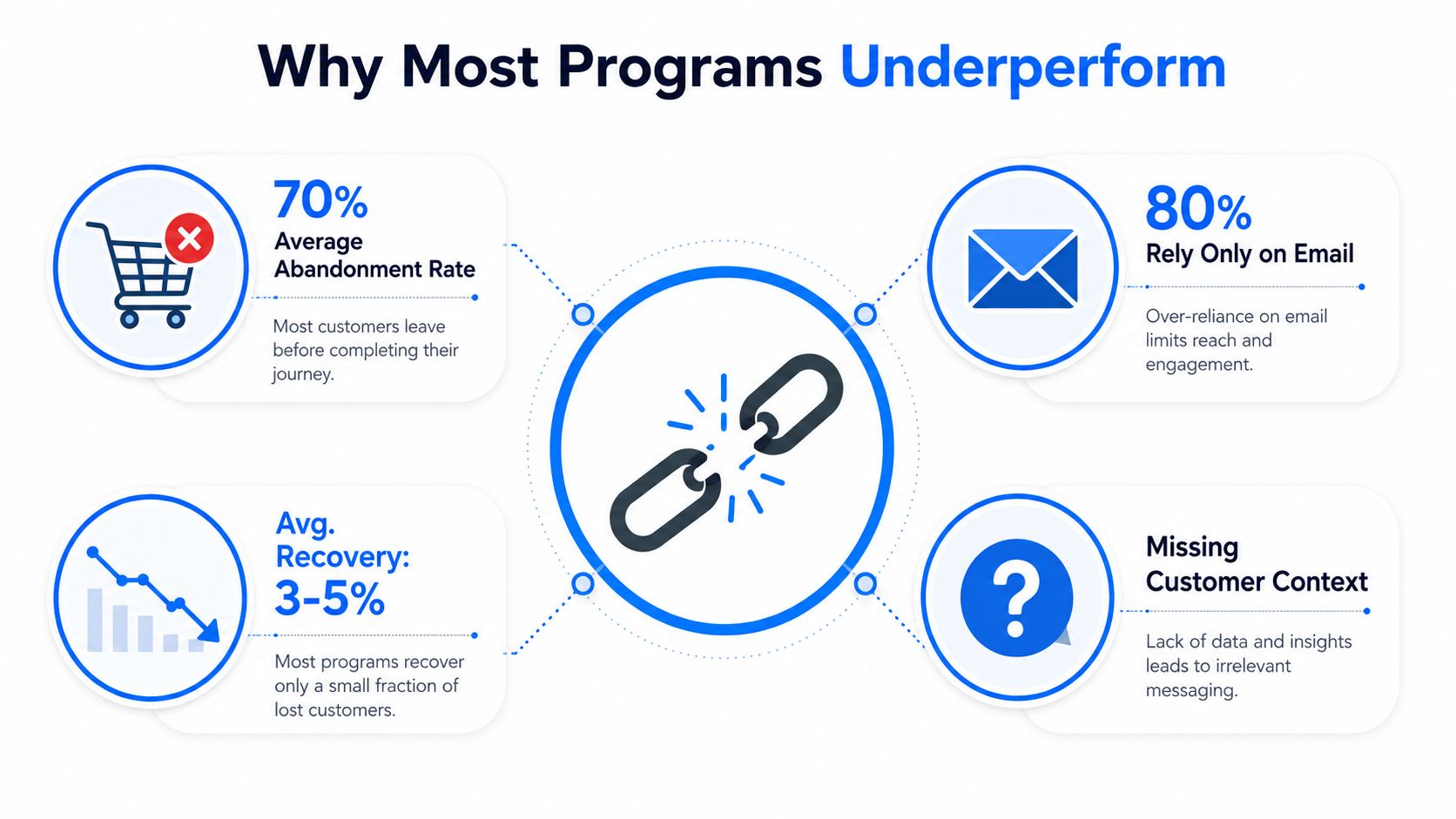
Typical abandoned-cart recovery rates are often only 3% to 5%, while stronger programs can reach 10% to 14%, according to Mailmend's recovery statistics. That spread explains why copy alone does not rescue weak programs. Timing, segmentation, and channel mix matter just as much as the message itself.
A single reminder also misses the shopper's context. Someone who left because they got distracted after adding a low-ticket item behaves differently from someone who hesitated on a high-value cart and started comparing prices. If your flow treats both shoppers the same, you are optimizing for operational simplicity, not revenue.
Practical rule: do not start with a discount just because you can. The first touch should usually recover intent, not buy the sale back with margin you may not need to give away.
One of the most expensive mistakes is offering incentives too early. Recent playbooks recommend starting without an offer, then reserving discounts for later touches or for higher-value carts where margin allows it, as discussed in Digital Applied's 2026 playbook on AI sequences. That matters because broad discounting teaches shoppers to wait for a deal.
The other common mistake is relying on the same channel at every step. Email is useful, but it is not the only place shoppers respond. SMS can create urgency, voice can add a human touch, and ringless voicemail can reach buyers without forcing a live call. Recovery gets better when each channel has a different role in the sequence.
Most programs underperform because they ignore customer context. Stores send the same reminder to every abandoner, at the same time, with the same offer logic, then wonder why results plateau. The fix is not more volume. It is better sequencing, better triggers, and better judgment about when to stop nudging and start escalating.
For segmentation ideas that translate cleanly into ecommerce recovery, see Call Loop's customer segmentation examples. If you want a broader framework for find customer segmentation strategies, start with cart value, product type, and customer history, then decide which channel should speak first, which one should follow, and whether the cart deserves a reminder, a stronger push, or no incentive at all.
Recovery flows fail before the first message goes out if the underlying event data is messy. The platform has to know when a cart was abandoned, which customer left it, what they left behind, and whether the event fired correctly. If that foundation is shaky, every later message is built on bad attribution.
The first task is simple in concept and often messy in execution. Confirm that your ecommerce platform is firing the abandonment event when someone leaves checkout or the cart without completing purchase. Then test it end to end. If the trigger never fires, or fires twice, or misses mobile sessions, your automations will underperform no matter how polished the copy looks.
Once the event is clean, segment by cart value, product type, and customer history. High-value carts deserve different treatment because the economics are different. A shopper leaving a large cart may justify more touches, more personalization, or a later incentive, while a low-value cart usually needs a lighter-touch recovery path.
For useful segmentation ideas, the structure in Call Loop's customer segmentation examples is worth adapting to ecommerce recovery, especially where cart value and customer behavior drive different follow-up paths. If you want a broader strategy view, MarTech Do's customer segmentation strategies gives a useful context for building audiences that behave differently.
Use merge tags and custom fields to make each message feel tied to the cart the shopper left behind. Product name, cart contents, and last-step context are the basics. If your automation platform sits on top of customer data, the flow can also branch by repeat purchase history, product category, or prior engagement.
Operational caution: instrumentation errors are invisible until they've already cost you revenue. If abandonment events don't fire consistently, your recovery rate can look weak even when the real problem is tracking, not messaging.
If you already run your lifecycle tooling in something like ActiveCampaign or HubSpot, or through Zapier-connected apps, the goal is the same, keep the abandonment event and the segment logic in sync. That lets your recovery system plug into existing workflows without manual exports. If you're using a platform that supports outbound messaging, it should read the cart event once and then route the shopper into the right sequence automatically.
The practical decision rule is simple. Segment by value first, then by behavior, then by channel preference if you have it. If you skip that ordering, you end up with generic flows that send the same reminder to a bargain hunter and a high-AOV shopper, which is a waste in both cases.
A good recovery sequence isn't a single campaign, it's a timed conversation. Email opens the door, SMS creates immediacy, voice adds urgency for the right carts, and ringless voicemail gives you another way to sound personal without interrupting the shopper live.
The first reminder should go out within 30 to 60 minutes, which matches the recovery timing benchmark in Recapture's guidance and the same early-touch emphasis repeated in Mailadept's email automation playbook. The second touch belongs around 12 to 24 hours, and the final touch usually lands at 48 to 72 hours if there's still a business case for follow-up.
That timing aligns with what happens after abandonment. One dataset reports that recovery sent within 1 hour can reach a 56.2% success rate, while success drops to 12% after 48 hours, according to WorldMetrics. The takeaway is blunt. Delay kills intent.
Email should do the broadest work. It's where you recap the cart, restate the value, and make it easy to return. SMS should feel like a quick nudge with a direct path back to checkout, especially when the shopper has already opted in and given you a mobile number. For a broader SMS workflow view, Call Loop's ecommerce SMS marketing page fits neatly into the kind of staged sequencing that works here.
Ringless voicemail is different. It drops a recorded message straight into the voicemail inbox without ringing the phone, which makes it useful when you want a more personal follow-up without the friction of a live call. Voice broadcasting is stronger for high-value carts, especially when the call can support live answer detection or a press-1 transfer to sales support.
You can make the sequence feel coordinated by assigning one job to each touch. Email reminds, SMS reactivates, ringless voicemail adds human presence, and live voice helps when the order value justifies the extra effort. If every message asks for the same action with the same urgency, it starts to feel like pressure instead of service.
Compliance matters here too. Keep double opt-in, honor DNC rules, and don't use voice or text as a loophole around consent. The best flows are firm, but they're still respectful of the channel the shopper approved.
The messages that recover carts do one thing well, they sound like they were written for the cart the shopper left behind. A generic “you forgot something” reminder rarely earns attention. Specific, context-aware language does.
For email, a subject line can stay simple and direct. “Your cart is waiting” works because it doesn't overpromise. The body should bring back the product, mention the category if it helps, and make the return path obvious. If you use social proof, keep it short and relevant, not bloated with marketing copy.
SMS needs to be shorter and more urgent. A practical template looks like this:
Hi [First Name], your [Product Name] is still in your cart. If you're ready, you can finish checkout here: [link].
That's enough in many cases. The point is speed, not storytelling.
A ringless voicemail script should sound like a person, not an IVR. Keep it short, mention the cart context, and avoid sounding like a hard sell. A usable structure is: identify the brand, acknowledge the left-behind cart, point to a quick next step, and invite a callback if the shopper has questions.
Voice broadcasting works when the cart justifies more attention. The script should be even tighter than voicemail, because the goal is to trigger a press-1 transfer or route the shopper to a live rep only when the order value warrants it. If the shopper answers, the human conversation has to be competent immediately.
Discounts are not the starting point. They work best when you've already tried a no-offer reminder and the shopper still hasn't returned, or when the cart value is high enough to justify margin trade-offs. Recent guidance in Digital Applied's 2026 playbook points to that same sequence, start without an offer, then use urgency or a modest incentive later.
That logic protects margin and reduces training effects. If shoppers learn that every abandoned cart earns a coupon, they'll wait for one. A better approach is to reserve offers for specific conditions, like high-AOV carts or shoppers who've already ignored earlier reminders.
Simple standard: write the first message to recover intent, not to win a discount race.
A lot of testing in recovery flows is cosmetic. Teams change button color, rewrite one line of copy, and call it optimization. That usually produces clean-looking dashboards and very little operational value.
The biggest levers are timing, channel order, incentive thresholds, and audience splits. If you want a meaningful lift, test whether SMS works better before or after the second email, whether ringless voicemail helps high-value carts more than low-value ones, and whether the sequence should branch by cart value sooner. Those are material decisions, not design preferences.
That's the kind of work Stimulead's AI CRO audit strategies are useful for, because they push the team toward structural changes instead of surface tweaks. You want testing that changes who gets what, and when, not just the wording of a button.
If you change the subject line, the offer, and the send time in the same test, you won't know what moved the result. Keep the split clean. Use one control flow and one variation, then let the data show which touchpoint pulls recovery forward.
Sample size and test duration need patience. Recovery flows are event-driven, so the test has to run long enough to collect comparable abandoners in each branch. If you stop early, you'll overreact to noise and end up rebuilding flows every week.
High-value carts can justify a different test path. Instead of only measuring email opens, track whether a cart moves to sales support, whether the callback is answered, and whether the order closes after escalation. That kind of testing is closer to revenue management than marketing vanity.
The biggest mistake is declaring victory on a touchpoint that looks good in the report but doesn't change the final order rate. Good testing tells you where the recovery happened, not just that it happened.
Measurement matters when it shows which part of the sequence is failing. Overall recovery rate is useful, but touchpoint-level performance is more useful. If email is getting opens and clicks while SMS is closing the gap, that tells you the handoff is working. If ringless voicemail is producing no lift, that tells you the channel is not pulling its weight.
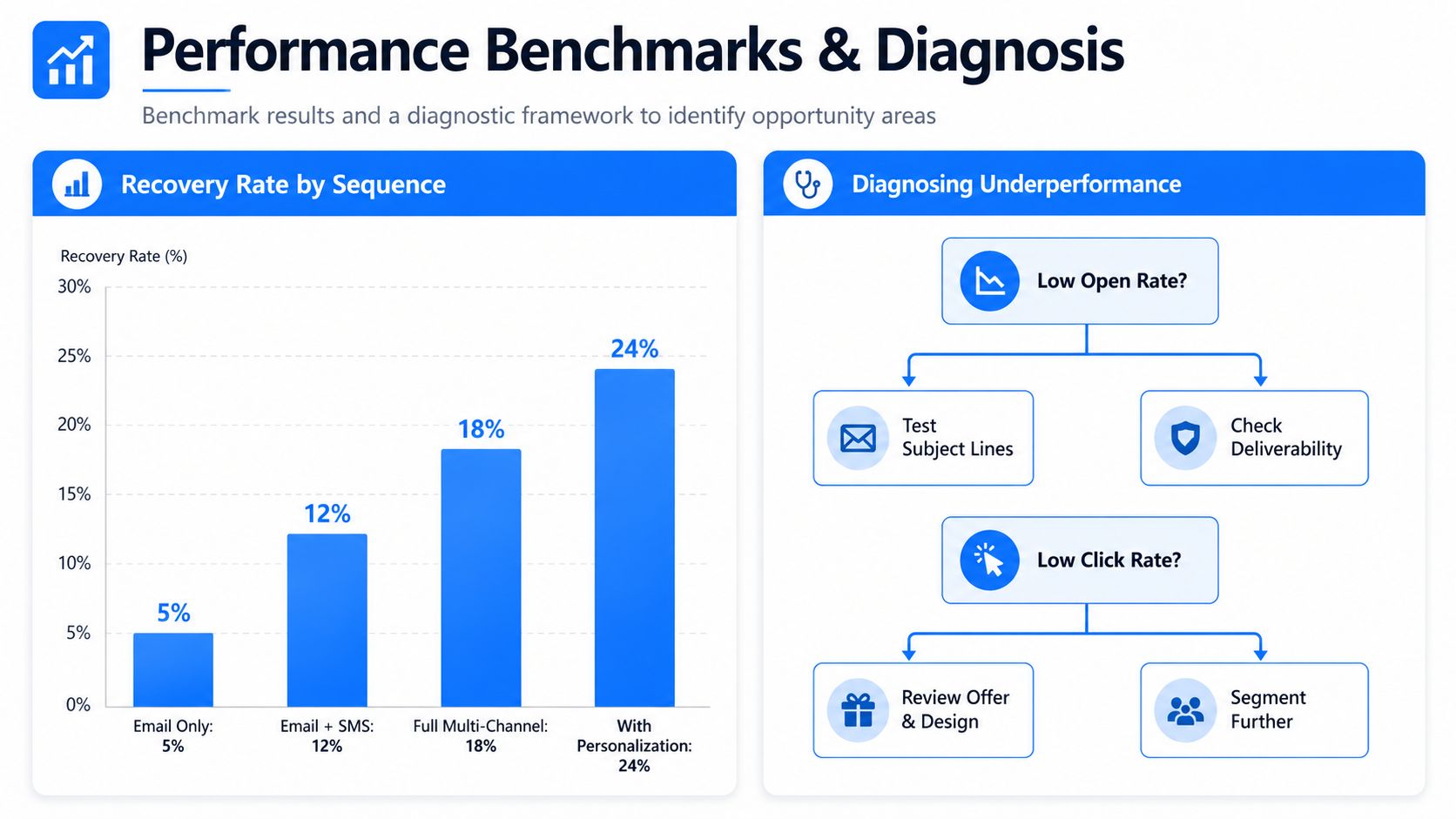
Typical abandoned-cart recovery sits around 3% to 5%, while stronger programs reach 10% to 14%, according to Mailmend. A practical recovery benchmark from Recapture puts single-email flows around 5% to 10%, optimized multi-step sequences around 10% to 15%, and stronger SMS-plus-segmentation implementations at 15% to 25%+. The exact number matters less than what it says about your sequence design.
If your rate is weak, don't guess. Diagnose by channel and cause. Price objections tend to cap recovery lower, while distraction or friction can support better performance when timing is tight, as noted in U.S. Tech Automations' 2026 playbook. For a practical framework on interpreting campaign performance, Call Loop's campaign performance analytics guide is a useful reference.
If open rates sag, the problem is usually the subject line, deliverability, or timing. If clicks are weak, the offer, design, or audience split is probably off. If people click but don't buy, the checkout path or incentive logic may be the issue.
Use a simple checklist:
A flow that recovers orders with heavy discounts may look good until you subtract the cost of the incentive. Measure net recovery, not just placed orders. If a discount raises conversion but hurts margin, it is not a win.
The strongest programs treat abandoned cart recovery as a measurement system first and a messaging system second. That is the point many overlook, and it is why the best flows keep getting simpler operationally while getting smarter about who gets contacted, when, and through which channel.
Chris Brisson
Chris is the co-founder and CEO at Call Loop. He is focused on marketing automation, growth hacker strategies, and creating duplicatable systems for growing a remote and bootstrapped company. Chat with him on X at @chrisbrisson


Trusted by over 45,000 people, organizations, and businesses like


