
See a Demo
You're just one step away from seeing Call Loop in action.
Enter your information below to watch a demo right now.

You're just one step away from seeing Call Loop in action.
Enter your information below to watch a demo right now.

You're probably already sending campaigns.
A weekend SMS promo goes out. A voice broadcast reminds people about an event. A ringless voicemail drop follows up with leads who didn't respond. By Monday, you have reports full of activity, but you still can't answer the one question that matters: did any of it produce revenue, appointments, callbacks, or real conversations?
That's where campaign performance analytics stops being a reporting exercise and becomes an operating discipline. Small businesses don't need more charts. They need a way to connect outbound activity to outcomes, especially in channels like SMS, voice, and ringless voicemail where the response often happens off the click path.
An SMS report can look healthy and still hide a bad campaign.
A local business sends a limited-time offer by text. The platform shows strong delivery. The owner assumes the campaign worked because the message got out. Then the week ends, phone traffic looks normal, bookings don't move much, and staff can't tell whether the text brought anyone in or instead reached people who were going to buy anyway.
That disconnect is common. A delivery report tells you the message arrived. It does not tell you whether the campaign changed behavior.
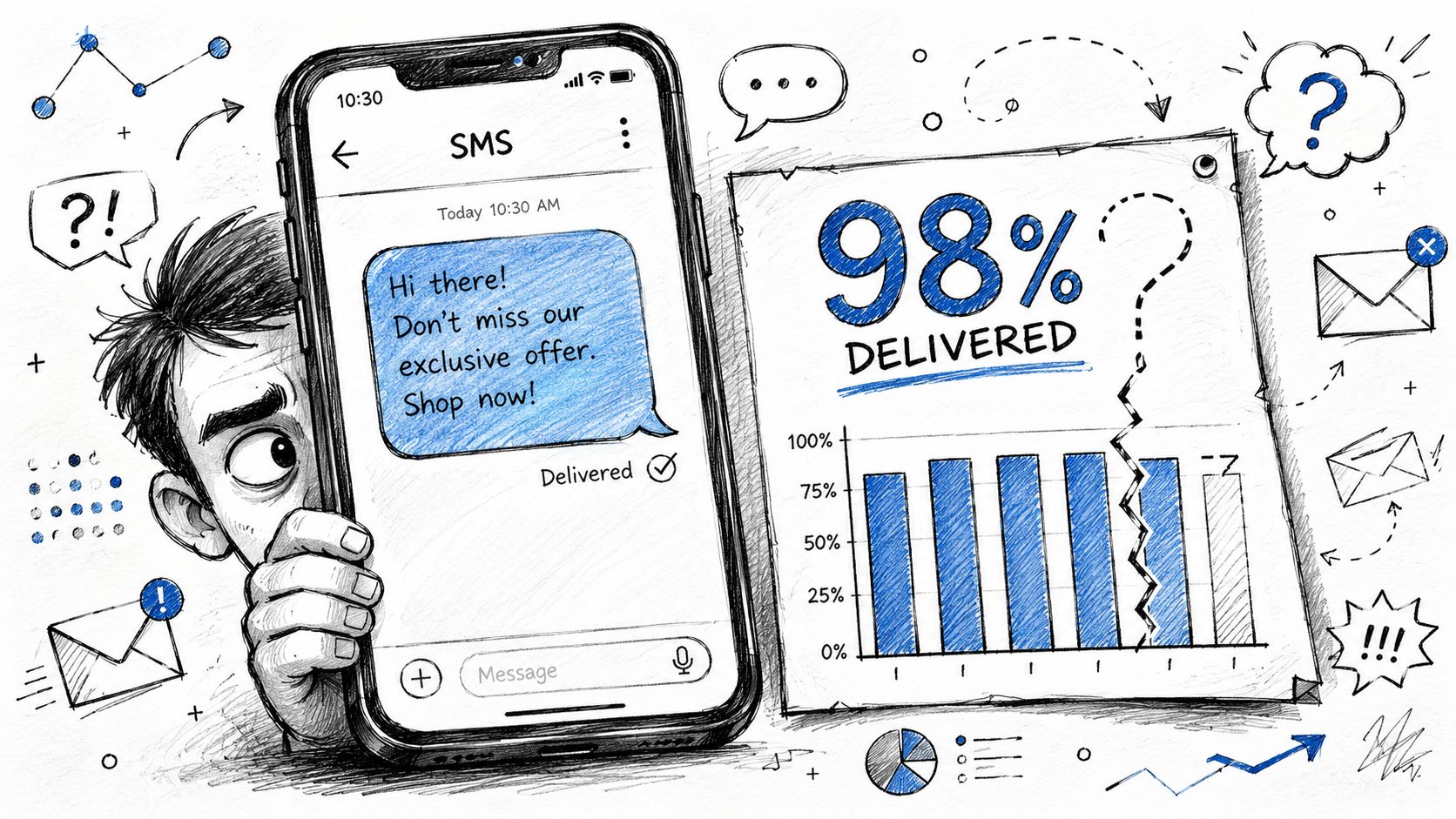
In outbound marketing, teams often stop at the easiest numbers to collect. Delivered messages. Sent messages. Maybe clicks. Those are operational metrics, not business metrics.
For SMS, voice, and ringless voicemail, the main action often happens later and somewhere else:
Existing content usually frames campaign performance analytics around clicks and web conversions, but it gives little practical guidance on how to measure outcomes when the campaign's real goal is a callback, a show-up, or a response to a voice drop. This gap is becoming more important as segmentation and cross-channel effects become central to modern marketing, as noted in Brandwatch's campaign analysis guide.
Stop asking whether a message was sent successfully. Ask whether it moved someone to take the next valuable action.
Good campaign performance analytics connects message activity to the next step in the customer journey.
That means you don't treat an SMS blast, a voice reminder, and a ringless voicemail drop as isolated channel events. You treat them as tracked touchpoints inside one business process. If the campaign was meant to create booked appointments, callback requests, purchases, or attendance, those are the outcomes your reporting should revolve around.
When business owners say their reporting feels fuzzy, this is usually why. They aren't short on data. They're short on measurement design.
The cleanest way to think about campaign performance analytics is to separate activity, engagement, and outcomes.
The discipline is built around a funnel of metrics: impressions and reach at the top, CTR and engagement in the middle, and conversion rate, ROAS, and CLV at the bottom. The point isn't just to see whether a campaign worked, but to understand why by comparing results against historical performance and benchmarks, according to Improvado's campaign analytics overview.
If you run SMS, voice, or ringless voicemail campaigns, don't start by asking which metric the platform makes easiest to view. Start by asking what the campaign was supposed to accomplish.
For example:
If the campaign objective is offline, your KPI should be offline too.
| Metric | SMS | Voice | Ringless Voicemail |
|---|---|---|---|
| Delivery status | Useful for list hygiene and sending quality | Useful for call completion context | Useful for successful drop validation |
| Click-through rate | Important when the message includes a tracked link | Less central unless paired with follow-up SMS | Rarely primary unless voicemail pushes to a tracked URL |
| Reply rate | Strong signal for two-way engagement | Not applicable in the same way | Can matter if voicemail prompts text reply |
| Callback rate | Useful when SMS prompts calls | Core metric for call-driven campaigns | Core metric for voicemail campaigns |
| Transfer rate | Usually not relevant | Important for press-1 or live transfer flows | Relevant if voicemail drives immediate call routing |
| Conversion rate | Tracks leads, purchases, bookings, or sign-ups | Tracks bookings, resolutions, or qualified conversations | Tracks booked calls, appointments, or sales after callback |
| Cost per acquisition | Helps judge efficiency by campaign or segment | Useful when a call center or sales team is involved | Useful when voicemail is used for lead reactivation |
| ROAS | Best for directly monetized campaigns | Works if revenue can be tied to campaign-driven calls | Works when callback outcomes are tied to sales |
| Customer lifetime value | Important when SMS drives repeat business | Useful for retention and reminder workflows | Useful for reactivation campaigns and long-cycle sales |
A lot of teams overvalue the top of the table because it's immediate.
That's a mistake.
If you sell online, a practical reference for tying text campaigns back to commerce outcomes is this Shopify SMS marketing playbook. It's useful because it frames SMS around actual buying behavior rather than just send metrics.
Practical rule: If a metric can't influence budget, targeting, or follow-up decisions, it belongs lower on your dashboard.
SMS usually gives you the cleanest engagement path because clicks and replies are easier to track. Voice and ringless voicemail are different. They often create assisted conversions, where the campaign starts the conversation but the sale closes later through a phone call, in person, or after a second touch.
That's why a “good” campaign report looks different by channel. The metric that matters most is the one closest to the business result you wanted in the first place.
Most bad reporting starts before launch.
Teams send the message first, then try to reconstruct what happened. By then, the campaign is already leaking attribution. The fix is simple in concept and tedious in practice: build measurement into the campaign setup.
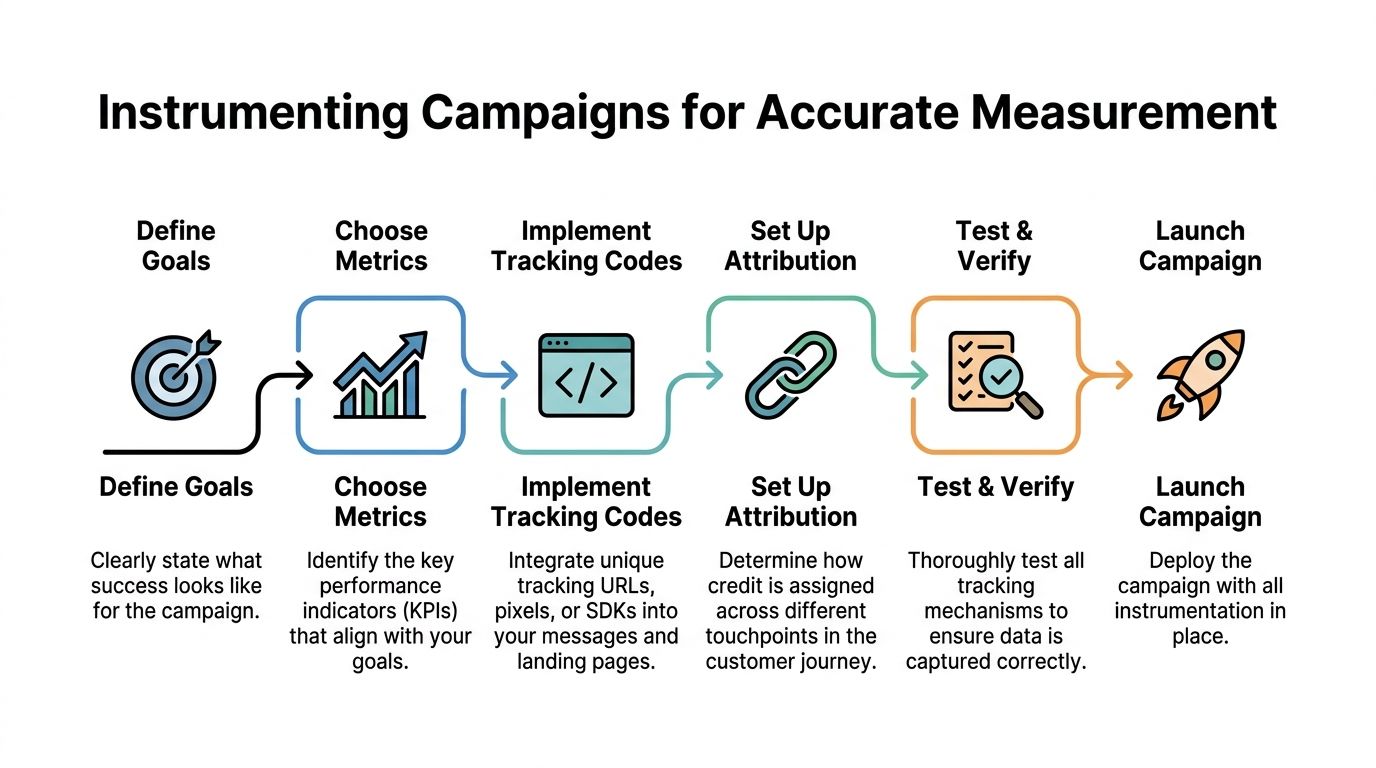
Every outbound campaign should have a traceable response path. If the message includes a link, use a tracked link. If the campaign expects inbound calls, use a dedicated number. If the campaign grows your list, use a distinct keyword.
That sounds basic, but small businesses often skip one of these and lose the ability to separate channel performance later.
A strong setup checklist looks like this:
If list quality is a recurring issue, build validation into the workflow before every major send. That's where a process like phone number validation for outbound messaging helps prevent bad data from polluting campaign results.
SMS gives you more instrumentation options than most businesses use.
A better setup usually includes:
Voice and ringless campaigns need different mechanics. There, the emphasis shifts to dedicated caller IDs, transfer paths, callback monitoring, and post-call status capture.
The campaign isn't measurable because you sent it through a platform. It's measurable because you designed every likely response path before launch.
One of the easiest ways to corrupt campaign performance analytics is to reuse the same tracking logic for completely different campaign goals.
A promo text to drive purchases should not share the same response path as an appointment reminder. A ringless voicemail for dormant lead reactivation should not feed the same bucket as a customer service callback line.
Keep these separated:
When these are mixed, dashboards look busy but become hard to trust. You'll still have data. You just won't have decision-ready data.
Ringless voicemail is where weak analytics gets exposed fast.
There's often no click. Sometimes there's no immediate reply. The action you care about is usually a callback, a transferred conversation, or a later conversion that starts with the voicemail but finishes elsewhere. If you don't plan for that, ringless voicemail gets labeled “hard to measure” when the actual issue is that nobody set up the trail.
A successful drop is only the first operational checkpoint.
For ringless voicemail and voice broadcasts, the more useful sequence is:
That means every campaign should have a distinct inbound route. A dedicated number or campaign-specific caller ID gives you a cleaner attribution signal than a shared main line.
If your team is building call-driven reporting, call tracking and analytics for marketing attribution is the operational layer that lets you connect callbacks and sales activity back to the original campaign.
Voice campaigns often generate value without creating a neat web event.
A reminder call may reduce no-shows. A voicemail may prompt someone to call back two hours later. A press-1 campaign may transfer a prospect to a live rep, where the actual qualification happens manually. Those are still campaign outcomes.
Use a simple capture model:
| Action type | What to record |
|---|---|
| Callback | Campaign source, date, outcome |
| Press-1 transfer | Source campaign, receiving rep, call status |
| Appointment booked | Original campaign, booked date, attendance result |
| Sales conversation | Campaign source, disposition, close status |
One practical way to close the reporting gap is to follow voice with SMS.
A voicemail can prompt a callback, but a follow-up text can capture intent more cleanly. If someone receives a ringless voicemail and then gets a short SMS asking them to confirm interest, reschedule, or request a callback, you suddenly have a trackable response event tied to the original outreach.
That combination works well in healthcare, home services, events, and any business where customers often respond by phone rather than by form fill.
Ringless voicemail rarely fails because the channel is unmeasurable. It fails because nobody decided in advance how callbacks and downstream outcomes would be logged.
A dashboard should answer decisions, not display every metric your tools can export.
When business owners tell me they're “watching the numbers,” I often find a spreadsheet full of sends, clicks, and dates but no structure that points to action. A useful campaign performance analytics dashboard has to make trade-offs visible. Which campaign drove responses. Which channel produced appointments. Which segment consumed budget without producing worthwhile outcomes.
Organizations often build dashboards around source systems. That creates one panel for SMS, one for calls, one for CRM activity. It's neat, but it fragments the story.
Build instead around business questions:
Your first panel should show campaign-by-campaign response indicators. For SMS, that might be clicks and replies. For voice and ringless voicemail, that might be callbacks and transfers.
Keep it comparative. The point is to identify which message and segment combinations are earning attention.
A second panel should move lower in the funnel. It tracks booked calls, appointments set, attendance, sales-qualified conversations, purchases, or renewals.
This panel matters more than the first one because it filters out campaigns that looked active but didn't move the business.
Your third view should compare efficiency across channels and campaign types. If one workflow consistently produces qualified conversations while another produces activity without progress, the dashboard should make that obvious.
Message platforms can tell you what happened inside the send. Your CRM, scheduler, ecommerce system, or call logs often hold the actual business result.
That's why the dashboard should combine communication metrics with operational outcomes. If you use multiple tools, pipe them into one reporting layer with consistent campaign naming. Some teams do this with spreadsheets. Others use a BI tool. Others rely on direct integrations and automation platforms.
One practical option in this category is Call Loop, which supports outbound SMS, voice broadcasting, ringless voicemail, tracked links, and analytics that can feed broader reporting workflows. The specific tool matters less than the rule: don't let messaging data live separately from sales and appointment data.
Use a structure like this:
If a dashboard can't tell your team what to pause, improve, or scale this week, it's a report archive, not a management tool.
A dashboard can still mislead you if you read it at face value.
Teams often see more conversions in the reporting window and assume the campaign caused them. Sometimes it did. Sometimes the campaign intercepted demand that already existed. That distinction matters because attribution answers who gets credit, while incrementality asks whether the campaign created additional results.
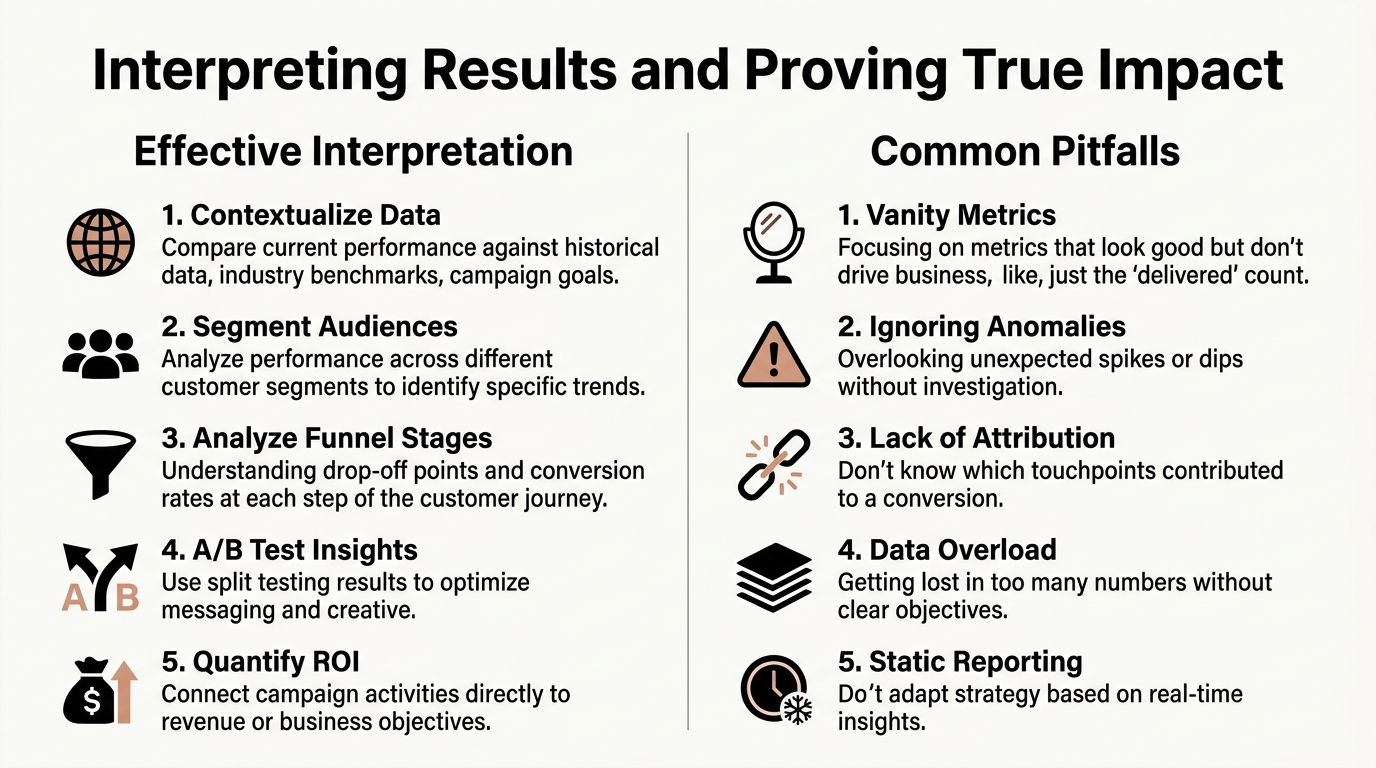
A response spike means very little on its own.
Interpret campaign performance against:
Many SMB reports break down because they report activity but ignore the surrounding conditions that explain it.
You don't need a complex attribution model to improve decision-making. Start with disciplined comparisons.
Try these:
Message test
Send two versions of copy to comparable segments and track which one leads to more meaningful downstream action, not just more clicks.
Timing test
Compare send windows for reminder messages, callback prompts, or promo texts.
Offer test
Hold the audience and channel steady while changing the incentive or CTA.
Sequence test
Compare SMS only against SMS plus voicemail, or voicemail followed by SMS, when your workflow includes multiple touches.
When you review the result, don't stop at the first visible metric. A version that gets more replies may still generate fewer qualified calls or lower-value customers.
One contrarian point for 2026 is that adding more attribution sophistication doesn't automatically improve decision quality. Guidance increasingly recommends checking discrepancies between platforms and using cohort and LTV analysis to separate brand-search and existing-demand effects from true incremental impact, as discussed in Saras Analytics on marketing campaign analytics.
That matters for outbound channels because platform-reported success can flatter a campaign that merely touched people who were already on the way to converting.
A practical interpretation framework is:
If you want a grounded process for measuring marketing campaign effectiveness across channels, focus on discrepancy checks and downstream value, not just platform credit.
Better attribution can create prettier reports. It doesn't always create better budget decisions.
Campaign performance analytics only matters if it changes what you do next.
The strongest teams use a tight operating loop. They diagnose what happened, form a hypothesis about why, test one meaningful change, and scale only after the result holds up in real business outcomes. That works better than constant tweaking because it forces each decision to connect back to a measurable objective.
Look for the point where the campaign underperformed. Did response stall at the message level. Did callbacks happen but staff fail to convert them. Did appointments get booked but attendance stay weak.
Don't rewrite the whole campaign. Pick one explanation. The offer was weak. The timing was wrong. The segment was too broad. The ringless voicemail prompted interest, but the callback path was unclear.
Change one thing that can plausibly affect the result. Better copy. Different send time. A dedicated callback number. A shorter voicemail script. A follow-up SMS after the drop.
If the change improves the business outcome you care about, roll it out more broadly. If it only improves top-line activity, keep testing.
A short final checklist helps keep teams honest:
The shift from vanity metrics to outcome measurement isn't complicated. It's disciplined. Once you build that discipline into SMS, voice, and ringless voicemail campaigns, your reporting stops being a vanity mirror and starts acting like a control panel.
If you want a practical way to run and measure outbound campaigns across SMS, voice, and ringless voicemail in one place, Call Loop gives teams the tools to automate outreach, track engagement, and connect campaign activity to real follow-up workflows.
Chris Brisson
Chris is the co-founder and CEO at Call Loop. He is focused on marketing automation, growth hacker strategies, and creating duplicatable systems for growing a remote and bootstrapped company. Chat with him on X at @chrisbrisson


Trusted by over 45,000 people, organizations, and businesses like


