
See a Demo
You're just one step away from seeing Call Loop in action.
Enter your information below to watch a demo right now.

You're just one step away from seeing Call Loop in action.
Enter your information below to watch a demo right now.

Text messaging sits at the center of ecommerce revenue now, but profitable programs rarely run on SMS alone.
Brands that treat SMS as a standalone promo channel usually plateau fast. They send discount blasts, collect a few quick wins, then watch opt-outs rise and response rates flatten. The better approach is to build a customer communication system where SMS handles speed, email carries detail, and ringless voicemail adds reach for high-value moments that deserve more than a short text.
That matters because customer intent changes by scenario. A cart reminder needs fast delivery. A back-in-stock alert needs immediacy and a clear call to action. A failed payment on a subscription order or a delayed shipment for a high-value customer may need a more personal touch. In those cases, ringless voicemail can add context and urgency without forcing a live call, which is why stronger ecommerce teams now use voice selectively instead of relying on text alone.
I see the same mistake across growing stores. They copy email strategy into SMS, send broad campaigns, and expect the channel to carry retention by itself. Profitable SMS programs are built differently. They start with clean consent, tight segmentation, behavior-based automation, and channel coordination so the customer gets the right message in the right format at the right time.
That is how SMS stops being just another campaign tool and starts acting like a revenue engine.
A shopper who abandons a cart at 2:07 p.m. is far more likely to respond to a text at 2:12 p.m. than to an email they notice that evening. That speed is why SMS produces outsized results in ecommerce. It reaches customers while buying intent is still active, not hours later after attention has shifted.
For operators, the advantage is simple. SMS closes the gap between interest and action.
Email still does important work. It handles richer product education, longer promos, and flows that need more context. SMS handles moments where timing changes the outcome. Cart recovery, low-stock alerts, delivery issues, subscription payment failures, and limited drops all fit that category. In each case, faster contact can protect revenue or reduce support friction.
Mobile shopping is not a side behavior anymore. Customers browse products on their phones, compare prices on their phones, and often complete the purchase after one timely reminder. SMS shows up in that same environment, with far less competition for attention than an inbox or social feed.
That changes what good campaign planning looks like:
Teams that only use SMS for discounts leave margin on the table and train customers to wait for the next code. The stronger model is to use SMS across the full customer lifecycle, then bring in email and ringless voicemail where each format fits best.
| Role | What it does | Why it matters |
|---|---|---|
| Revenue channel | Drives fast action on offers, replenishment, and recovery | Captures demand while intent is still high |
| Service channel | Sends shipping, delay, and account updates | Reduces anxiety and support load after purchase |
| Retention channel | Supports repeat orders, subscriptions, and loyalty moments | Increases customer lifetime value over time |
I usually frame it this way for brands setting budget. If a message needs to be seen quickly, SMS should be in the mix. If the moment carries higher value or needs more explanation, add another touchpoint instead of forcing everything through one channel. A failed recurring payment might start with a text, then follow with email, then a ringless voicemail for higher-value subscribers who still have not updated billing.
That is how top ecommerce teams build a communication engine instead of a text program.
One operational note matters early. SMS only works as a revenue channel if consent and message expectations are clear from day one. Before scaling campaigns, use an SMS compliance checklist for ecommerce and marketing teams to make sure the program is set up cleanly.
A profitable SMS program starts before the first campaign. If consent is sloppy, everything downstream gets worse. Deliverability slips, complaint risk rises, and the list fills with people who never wanted to hear from you in the first place.
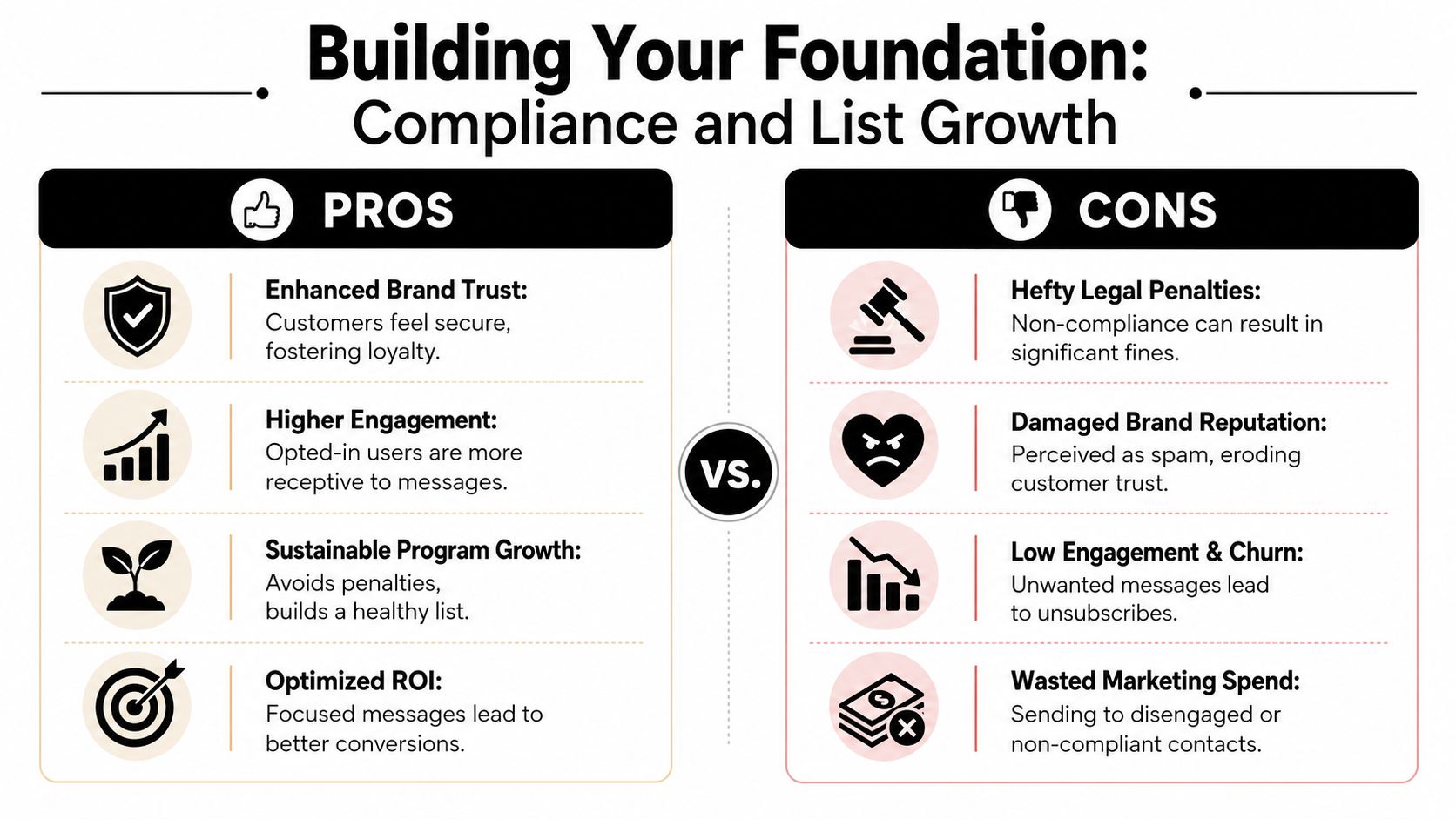
Most operators talk about compliance like it's a legal chore. In ecommerce SMS marketing, it's also a filtering mechanism. A clean opt-in means the customer understands what they're subscribing to, expects the messages, and is less likely to opt out the second you send a promotion.
Your baseline setup should include:
If you need a practical checklist for setup, use a structured SMS compliance checklist for marketing teams.
Big lists impress founders. High-intent lists make money.
The strongest subscriber sources usually come from moments where the shopper already wants an update, an offer, or easier access:
Practical rule: If the only value proposition is “get texts from us,” your opt-in rate will suffer and your unsubscribe rate will tell you why.
Some ecommerce teams operate close to health-related messaging without being healthcare providers. That creates a gray zone. While healthcare providers use SMS for patient reminders under HIPAA, 28% of SMB ecommerce brands in wellness, supplements, and beauty want to share post-purchase health insights via SMS but lack clear guidance on how to structure consent and avoid PII exposure without a dedicated HIPAA platform according to MessageFlow.
If you sell supplements, skincare, or wellness products, keep a bright line between helpful product communication and anything that exposes personal health information. Don't ask for sensitive details over text unless your systems and processes are built for it.
The fastest way to waste an SMS budget is sending the same message to everyone. Generic blasts feel cheap, train customers to ignore you, and usually force you to discount harder than necessary.
Segmentation fixes that. Personalization makes it convert.
The performance gap isn't subtle. Behavioral segmentation, such as targeting users who clicked but did not purchase, increases click-through rates by 47% compared to email sent to the same segment, while personalized SMS campaigns using recipient names or recent purchase history convert 35% better than generic sends based on MessageFlow benchmark data.
That tells you where the money is. Not in sending more texts. In sending fewer, better-timed ones.
A useful segmentation model for ecommerce usually starts with behavior, not demographics:
| Segment | Best message type | Common mistake |
|---|---|---|
| New subscriber | Welcome offer or brand intro | Sending a generic sale with no context |
| Product viewer | Browse reminder | Showing unrelated products |
| Cart abandoner | Recovery message with direct cart link | Waiting too long |
| First-time buyer | Post-purchase education | Jumping to another discount too fast |
| Repeat buyer | Cross-sell or replenishment | Treating them like a first-time visitor |
| VIP customer | Early access or concierge-style outreach | Sending the same promo everyone gets |
Using a first name alone isn't a strategy. It's formatting.
Useful personalization references something real:
Short messages usually perform better because they force clarity. The customer should understand the offer, the reason they received it, and the next step immediately.
Here's the difference in practice.
Weak generic send
“Big sale today. Shop now: [link]”
Stronger personalized send
“Still thinking about the black linen set? It's back in your size. Grab it here: [link]”
The second message respects intent. It doesn't ask the customer to start the journey over.
The shift from average to strong SMS performance often comes from subtraction:
Better ecommerce SMS marketing usually looks quieter from the brand side and more useful from the customer side.
If you only make one strategic change this quarter, make it this one.
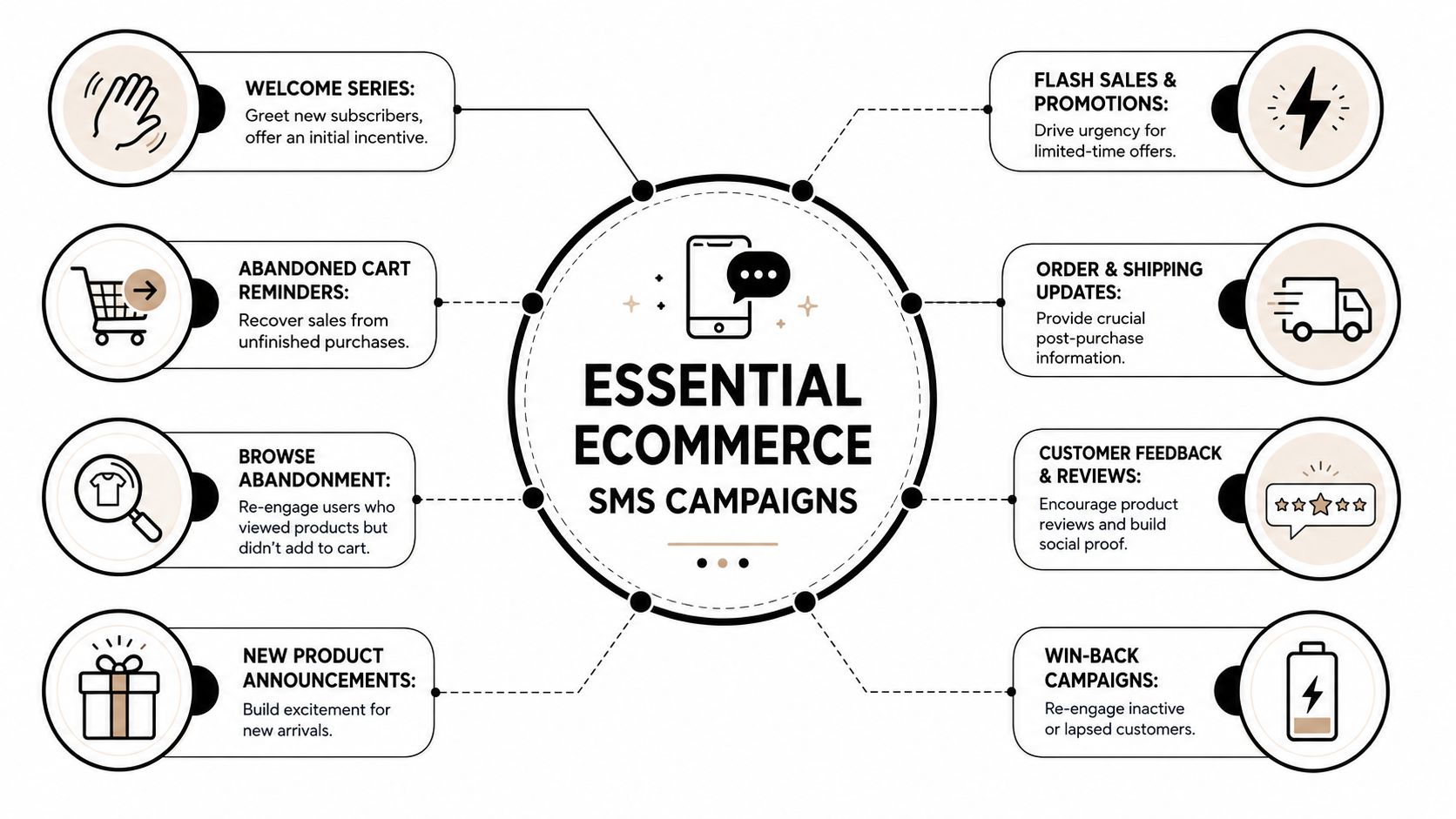
Every ecommerce store doesn't need dozens of SMS flows on day one. It needs a small set of campaigns that map to real customer decisions.
Those usually fall into two buckets: revenue recovery and customer reassurance.
Welcome series
The first text should confirm value fast. Don't over-explain the brand story. Give the subscriber a reason to click now or stay subscribed for later.
Template
“Welcome to [Brand]. You're in for early access, drops, and subscriber-only offers. Start here: [link]”
Abandoned cart reminder
Keep this direct. The shopper already knows what the cart is. Don't rewrite the whole sales page in a text.
Template
“You left something behind at [Brand]. Your cart is still saved: [link]”
Browse abandonment
This works when someone showed intent but never added to cart. Keep the message product-specific if possible.
Template
“Still looking at [Product]? It's waiting for you here: [link]”
Flash sale or limited-time promotion
Use this sparingly. The more often you declare urgency, the less urgency customers feel.
Template
“Today only: [Offer]. Shop before it ends: [link]”
Many brands obsess over acquisition and ignore the highest-trust moment in the lifecycle. After purchase, customers are paying attention. Use that well.
Template for shipping update
“Good news. Your order from [Brand] is on the way. Track it here: [link]”
Template for review request
“How's your [Product] working out? Leave a quick review here: [link]”
An average message sent at the right moment usually beats a polished message sent late. The most common failure pattern is overthinking creative while underthinking sequence.
Use this simple campaign map:
| Campaign | Trigger | Goal |
|---|---|---|
| Welcome | New opt-in | First click or first purchase |
| Cart recovery | Cart left behind | Recover purchase intent |
| Browse reminder | Product viewed | Re-engage mid-intent visitor |
| Shipping update | Fulfillment event | Improve experience and trust |
| Review request | Product received | Generate proof and feedback |
| Win-back | Customer goes quiet | Restart engagement |
When writing SMS copy, cut until only the useful part remains:
A text should move the customer one step forward. Not educate them on your entire campaign concept.
Revenue from SMS usually plateaus when a brand relies on one-off sends. It grows when messages are tied to customer behavior and the system keeps working after the campaign calendar is done.
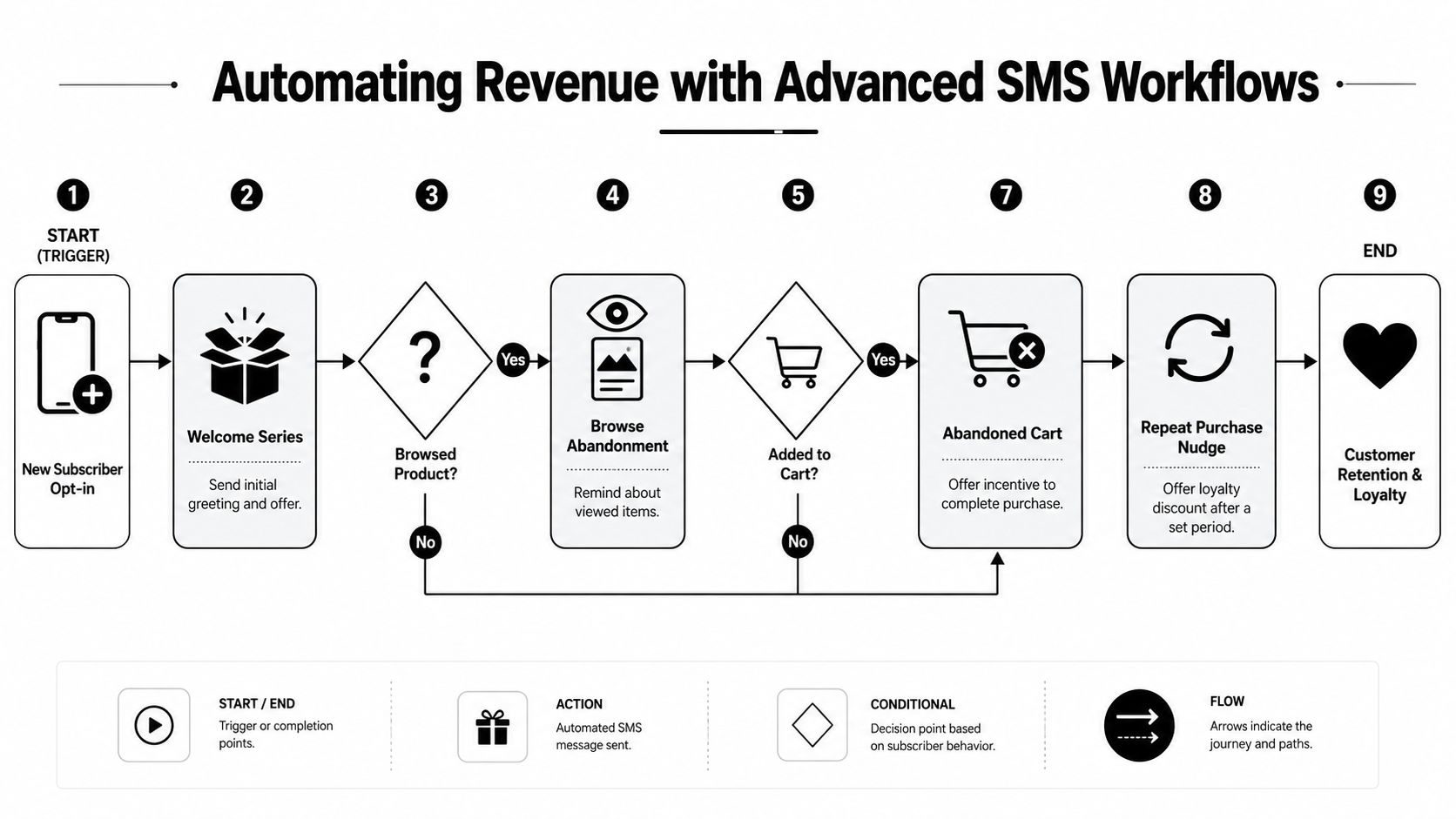
Manual campaigns still matter for launches, flash sales, and major promotions. Automated workflows do a different job. They capture intent while it is still warm, reduce reliance on constant campaign production, and turn SMS into a retention channel instead of a weekly reminder tool.
The practical shift is simple. Build flows around customer states, not internal marketing ideas.
A useful lifecycle looks like this:
That sequence gives you the base architecture for an SMS program that can scale. If you want a planning model, this marketing automation workflow guide for messaging campaigns shows how to map triggers, delays, and follow-up paths.
Here is a simple workflow structure:
| Trigger | Automated SMS action | Next branch |
|---|---|---|
| New opt-in | Welcome text | Clicked or ignored |
| Product viewed | Browse reminder | Added to cart or left |
| Cart abandoned | Recovery text | Purchased or dropped |
| Purchase completed | Confirmation and shipping updates | Delivered |
| Delivery confirmed | Review request | Responded or silent |
| No repeat purchase | Win-back nudge | Re-engaged or dormant |
The strongest programs add branching logic inside each flow. A customer who clicks but does not buy should not get the same follow-up as someone who ignored the message. A repeat buyer should not enter the same discount path as a first-time visitor. Those choices protect margin and improve the customer experience.
This is also where teams usually find wasted spend.
SMS underperforms when the post-click experience is weak. A text can do its job and still lose the sale if the landing page loads slowly, the link drops shoppers on a generic collection page, or the cart is not preserved on mobile. In practice, I see brands recover more revenue by fixing the handoff than by rewriting the copy for the fifth time.
Use a simple operating standard:
That last point matters. Top ecommerce teams do not treat SMS as a standalone channel. They use it as part of a communication engine. SMS handles urgency and speed. Email carries longer-form persuasion and offer detail. Retargeting keeps the product visible. In higher-value scenarios, a later ringless voicemail or voice touch can add pressure or reassurance without forcing every interaction into text.
Good automation feels timely, specific, and deserved. If a flow reads like a machine chasing revenue, conversion drops and opt-outs rise. If it reflects what the customer just did, SMS becomes one of the highest-margin parts of the retention program.
Most ecommerce brands stop at SMS. That's fine for broad campaigns. It's not enough for every high-value moment.
Some messages deserve a different level of attention. That's where ringless voicemail, voice broadcasts, and selective outbound voice touches fit.
A text is excellent for speed. A ringless voicemail is better when tone matters, when the purchase is higher consideration, or when you want the message to feel more personal without requiring a live call.
Good ecommerce use cases include:
A ringless voicemail can also reduce the “just another text” problem. If a customer has ignored multiple messages, a short voicemail often cuts through because it uses a different sensory format. For strategy examples, see this guide to ringless voicemail marketing for customer outreach.
Don't replace SMS with voice. Layer voice where the economics justify more effort.
A simple framework helps:
| Channel | Best for | Avoid when |
|---|---|---|
| SMS | Fast promos, reminders, updates | The message needs nuance |
| Ringless voicemail | High-value recovery, VIP touchpoints | The offer is low intent or routine |
| Voice broadcast | Time-sensitive broad announcements | The audience expects self-serve info |
Channel choice shapes customer perception. A cart reminder by SMS is normal. A personal-sounding voicemail about a premium item left behind can feel concierge-level if used sparingly. Used badly, it feels intrusive.
The strongest setup is usually coordinated, not duplicated.
For example:
That sequence does something a single channel can't. It escalates attention without immediately escalating pressure.
Use ringless voicemail to add weight, not volume.
That distinction matters. More messages don't automatically improve outcomes. Better channel matching does.
If you only track clicks, you'll miss the underlying problems. If you only track revenue, you'll diagnose issues too late.
A healthy ecommerce SMS marketing program needs performance metrics and infrastructure metrics side by side.
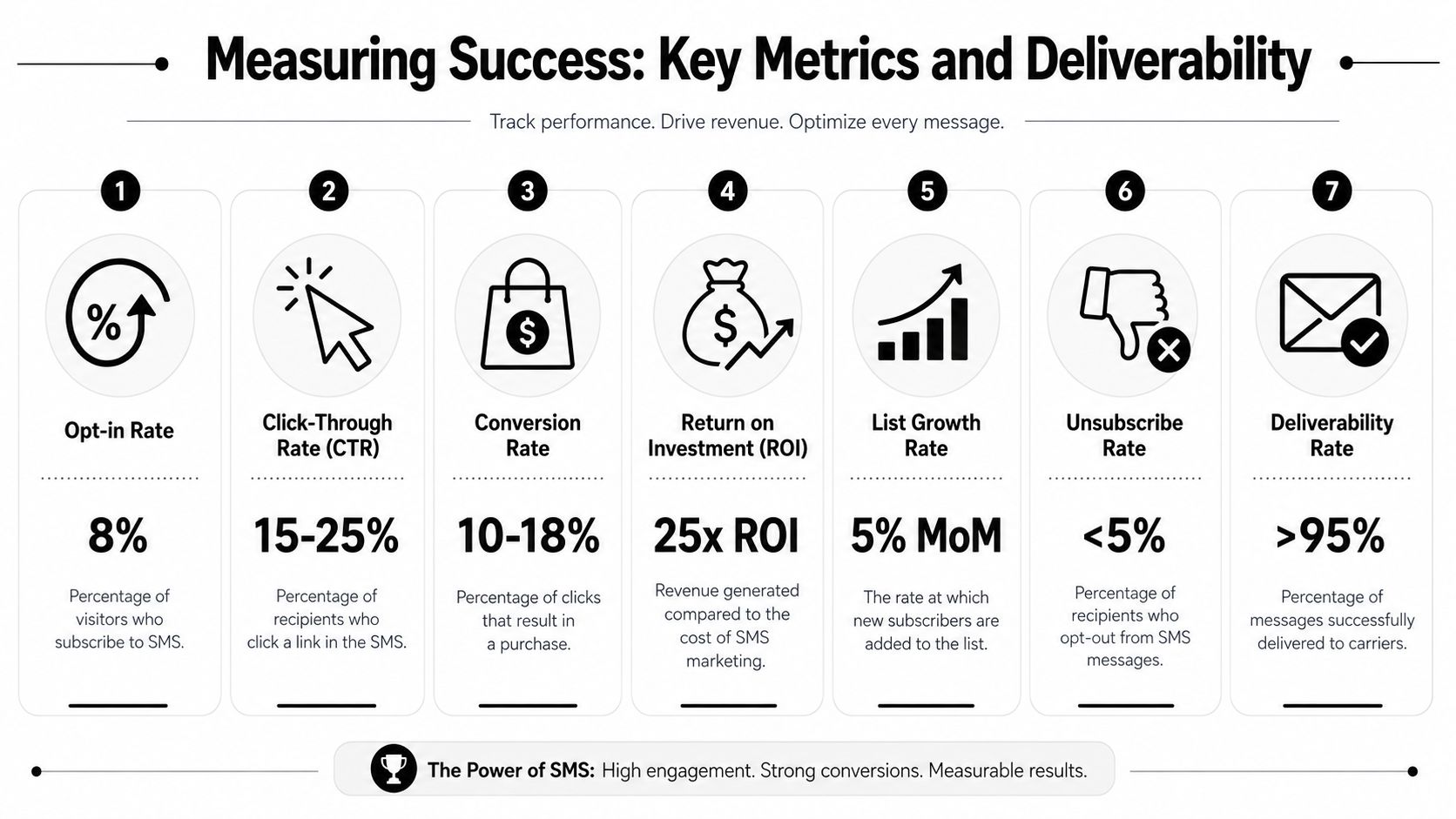
The headline benchmarks are strong. Ecommerce SMS conversion rates in 2024 to 2025 range between 11% and 20%, anchored by a 98% open rate and a 96.8% delivery rate in the US. SMS CTR is also 7x higher than email, with a global benchmark of 25.7% according to Infobip's SMS marketing benchmarks.
Those figures are useful, but the operational questions matter more:
| Metric | What it tells you | What a problem usually means |
|---|---|---|
| Opt-in quality | Whether acquisition sources are attracting the right subscribers | Weak value prop or poor consent framing |
| Deliverability | Whether carriers are accepting your traffic | Bad list hygiene, compliance issues, or sender setup problems |
| CTR | Whether the message and offer were compelling | Weak copy, weak timing, or bad segmentation |
| Conversion rate | Whether the landing experience completed the sale | Poor mobile UX or offer mismatch |
| Unsubscribes | Whether frequency or relevance is off | Over-messaging or low-value content |
| Revenue per send | Whether the campaign was commercially worthwhile | Good engagement but poor monetization path |
A lot of teams talk about deliverability like it's luck. It isn't. It's usually the result of setup, consent quality, cadence, and audience targeting.
If deliverability dips, check the basics first:
Strong programs don't chase vanity metrics. They watch for where friction enters the system, then fix that part of the chain.
Software doesn't create strategy, but the wrong stack absolutely blocks it.
If you're choosing tools for ecommerce SMS marketing, don't start with template libraries or coupon widgets. Start with the mechanics required to run a clean, segmented, multi-channel program.
Look for these capabilities first:
One option in this category is Call Loop, which supports bulk SMS, text-to-join keywords, segmentation, scheduling, drip campaigns, voice broadcasting, and ringless voicemail, plus integrations with tools like HubSpot, Keap, ActiveCampaign, and Zapier.
A lot of brands overbuy early. They license advanced functionality before they've built the operational habits to use it well.
Start with a smaller but disciplined launch:
That sequence is enough to prove channel fit before your team expands into more complex orchestration.
The strategic signal is clear. Businesses that actively text their customers are 5.89 times more likely to report digital marketing success than those that do not, and 67% of these businesses are actively increasing their SMS marketing budgets according to SimpleTexting's 2025 SMS marketing statistics.
You don't need a massive program to start. You need a compliant list, clear triggers, tight segmentation, and messages that help customers act quickly.
If you want to build an ecommerce communication engine that combines SMS, voice broadcasting, and ringless voicemail in one place, Call Loop gives you the tools to launch compliant opt-ins, automate follow-ups, segment audiences, and coordinate higher-impact outreach without stitching together multiple systems.
Chris Brisson
Chris is the co-founder and CEO at Call Loop. He is focused on marketing automation, growth hacker strategies, and creating duplicatable systems for growing a remote and bootstrapped company. Chat with him on X at @chrisbrisson


Trusted by over 45,000 people, organizations, and businesses like


