
See a Demo
You're just one step away from seeing Call Loop in action.
Enter your information below to watch a demo right now.

You're just one step away from seeing Call Loop in action.
Enter your information below to watch a demo right now.


You're probably looking at a draft right now and shaving characters wherever you can.
“Message” becomes “msg.”
“Messages” becomes “msgs.”
Maybe “text” becomes “txt” too.
That choice seems small, but in outbound communication it affects more than style. It affects space inside an SMS, how fast someone understands your point, whether a ringless voicemail script sounds natural when read aloud, and whether a customer thinks your business sounds efficient or sloppy. In healthcare or other sensitive workflows, it can also create avoidable ambiguity.
The abbreviation of message isn't a grammar puzzle. It's a channel decision.
Most small business owners abbreviate without a real rule. They shorten words when an SMS is getting crowded, when a reminder needs a link, or when a team member writes fast inside a CRM note or internal chat.
That's normal. It's also where inconsistency starts.
If one campaign says “Reply to this msg,” another says “Reply to this message,” and a ringless voicemail says “we sent you a msg with details,” your brand voice starts to wobble. Customers may not notice the exact wording, but they notice tone. Tight, clear language feels intentional. Random shorthand feels rushed.
A good rule is simple. Treat abbreviation as part of your messaging system, not as whatever the sender happens to type that day.
That matters most when multiple people touch outbound communication: the owner, office manager, marketer, receptionist, sales rep, or agency partner. If you already document your offers, positioning, and tone, add shorthand rules to that process. A comprehensive brand messaging framework is useful for that because it forces you to decide how your business should sound across channels instead of making those choices one send at a time.
Practical rule: If an abbreviation saves space but weakens trust, it's not saving anything.
Before you shorten “message” to “msg,” ask:
Those two answers usually tell you whether “msg” is efficient or whether the full word is the better choice.
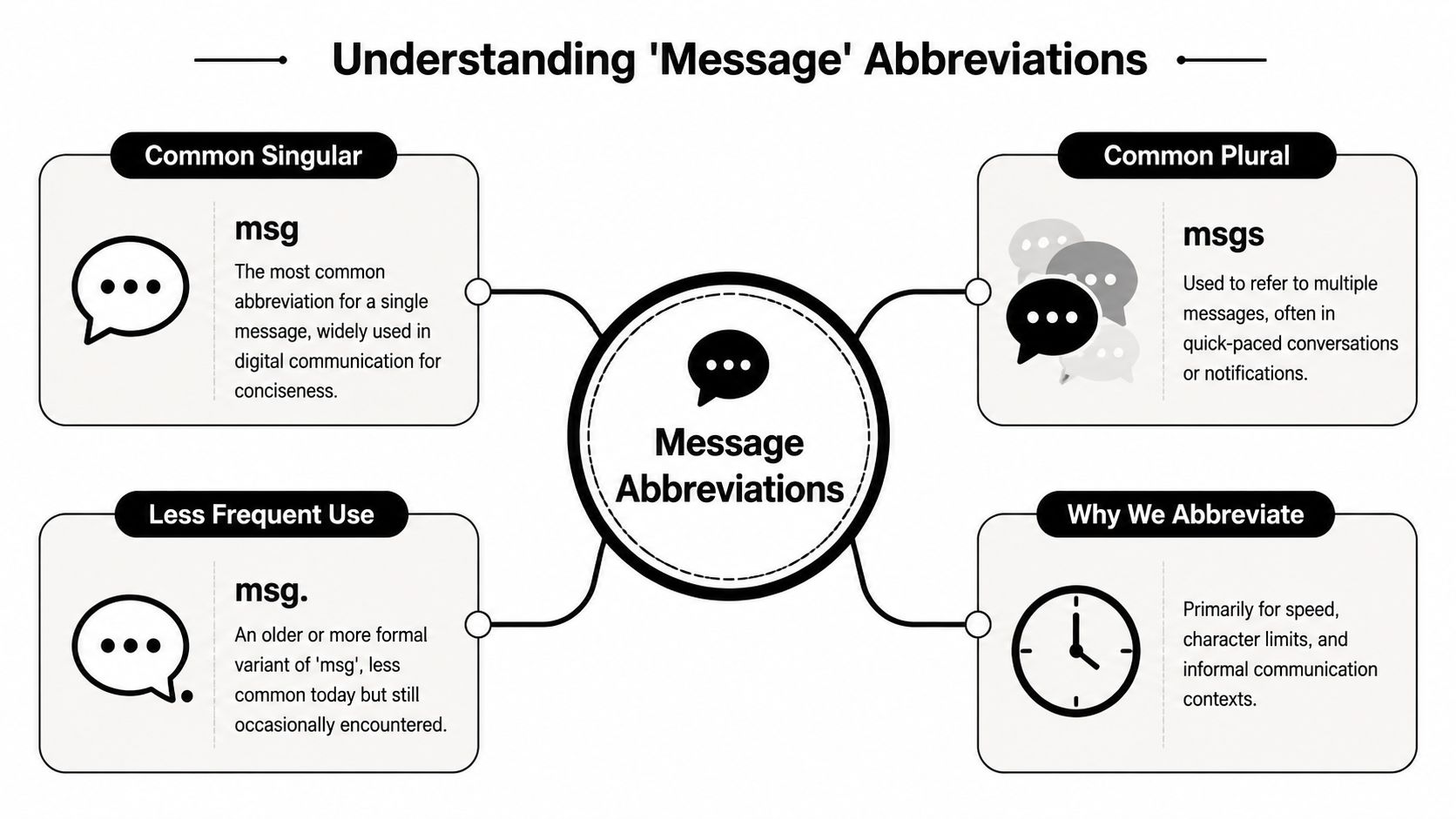
The most common abbreviation of message is msg. For the plural, msgs is commonly used. You'll also see msg. with a period, though that version feels older and less common in current digital writing.
In practical business use, the differences are straightforward:
This visual sums it up well:
Abbreviations didn't become popular by accident. A foundational reason they took over mobile messaging was the original 160-character SMS limit, and the early timeline matters here. The first SMS was sent on December 3, 1992 by Neil Papworth and read “Merry Christmas,” and by 1994 Nokia phones made SMS widely usable with T9 input. The character limit itself reportedly came from Friedham Hillebrand testing sentence length on a typewriter and concluding that 160 characters was a practical maximum, as described in this history of SMS milestones.
That technical ceiling shaped habits that still influence business messaging today. People learned to compress language because they had to.
Today, “msg” usually signals speed and familiarity, not laziness. It says, “I'm keeping this short.” In the right place, that's useful.
In the wrong place, it can look clipped.
If you're cleaning up shorthand in automated outreach, this guide on abbreviations for program communication is a helpful companion because it shows how short forms behave inside structured messaging, not just casual chat.
Abbreviation has been around for a long time, but digital communication changed how often people use it. A diachronic study summarized in the history of SMS language and textese found abbreviation usage increased by 155.55% from nineteenth-century to twentieth-century letters, then rose by a further 199.87% from twentieth-century corpora to twenty-first-century digital communication. That matches what most operators already know from experience. Abbreviations didn't start with texting, but texting made them routine.
That doesn't mean every channel should sound the same.
“Msg” works best where speed and space matter more than formality. Internal operations are the clearest example. Team chat, CRM notes, dispatch updates, and short SMS reminders can usually carry it without friction.
It also works in places where readers scan rather than study.
Customer-facing communication gets stricter fast. If a message asks for payment, contains instructions, addresses a complaint, or needs to sound polished, write out message. The same applies when your script might cross from text to voice.
A ringless voicemail is the easiest example. On a phone screen, “We sent a msg” may be acceptable. Spoken aloud, “We sent a message” sounds more natural and more professional.
Here's a practical scan table.
| Communication Channel | Appropriateness | Reason |
|---|---|---|
| Internal team chat | High | Speed matters, and the audience already understands the shorthand |
| CRM notes or tags | High | Space is useful, and these are operational rather than customer-facing |
| SMS reminders | Medium to High | Works when the message is short and the audience is broad enough to recognize it |
| Email subject lines | Medium | Can save space, but tone matters more than character savings |
| Customer support replies | Low to Medium | Clarity and warmth usually matter more than compression |
| Sales follow-up email | Low | Full wording sounds more polished and deliberate |
| Ringless voicemail script | Low | Spoken language needs clarity and natural rhythm |
| Legal, policy, or complaint handling | Low | Ambiguity creates unnecessary risk |
Use shorthand where people glance. Use full language where people decide.
If you're separating channel strategy more carefully, this explanation of the difference between texting and messaging is worth reviewing because many teams treat them as the same thing when they aren't.
Ask one simple question: would this abbreviation still work if the text were read aloud?
If the answer is no, don't use it in any campaign that might connect SMS, voice broadcasting, ringless voicemail, or email follow-up.
In outbound campaigns, abbreviation is less about style and more about message economics.
Business messaging guides consistently frame abbreviations as a way to save time and characters, but the more important operational point is this: every character you don't use on a nonessential word leaves room for something that may matter more. That could be a first-name merge field, compliance language, or a link. The practical effect is described well in this overview of text abbreviations in business SMS, which notes that abbreviation strategy should be treated as an optimization problem.

A small change like swapping message for msg can help when you're trying to keep a text concise without cutting the offer or the call to action.
That matters in workflows such as:
The mistake is assuming the same compressed copy should move unchanged across every channel.
An SMS might say, “Reply to this msg for details.” A ringless voicemail should not. Voice needs plain, spoken wording. “We sent you a message with the details” lands better in audio and reduces the chance that the script sounds robotic. The same goes for automated calls and voicemail drops that support sales, reminders, or reactivation.
If you use a multi-channel platform such as Call Loop for SMS, voice broadcasting, and ringless voicemail, build channel-specific copy instead of cloning the same shorthand everywhere. A short text can carry “msg.” Your voicemail script usually shouldn't.
Shorter copy helps only when the receiver understands it instantly.
Write the full version first. Then trim only the words that don't change meaning.
That usually produces better campaigns than starting with slang and trying to sound professional afterward.
Some messages shouldn't be abbreviated at all.
If the communication involves legal exposure, patient information, billing confusion, complaint handling, consent, or anything that may later be reviewed by a customer, manager, regulator, or court, shorthand stops being a convenience and starts being a liability. The problem isn't that “msg” is wrong. The problem is that high-stakes communication leaves no room for interpretation.

Guidance on business texting keeps landing on the same point. Abbreviations improve brevity, but they only help when clarity survives. SlickText advises keeping abbreviations simple and limiting them to roughly one well-placed shorthand per message so the text doesn't turn into a coded string that hurts readability, as explained in its guide to using text abbreviations clearly.
That advice matters even more in regulated communication.
Avoid the abbreviation of message in these situations:
In HIPAA-sensitive communication, the safest habit is simple: write for unambiguous understanding first, efficiency second. That doesn't mean every text has to sound formal. It means a patient should never have to decode what you meant.
If your team documents text records or worries about disputes, this article on whether text messages can hold up in court is a useful reminder that wording choices can matter well after the send.
The cleanest rule is this: if the receiver has to pause, write it out.
That's the ultimate test for the abbreviation of message. Not whether “msg” is technically acceptable. Not whether younger audiences recognize it. The only question that matters is whether your specific audience understands it immediately in that specific channel.
Use msg when all three conditions are true:
Use message when even one of those conditions fails.
Current reference material also makes another point that operators should take seriously. Texting acronyms change constantly, and any list is only a snapshot. That's why businesses still need stronger guidance on whether shorthand like “msg,” “txt,” or “DM” improves speed without adding ambiguity across SMS, voice follow-up, and multilingual audiences, as discussed in this review of how texting abbreviations keep evolving.
When in doubt, write it out.
If you're tightening written communication more broadly, this guide to professional email subject lines and CTAs is useful because it reinforces the same discipline: cut clutter, keep intent obvious, and make the next action easy.
Small wording choices shape customer perception. The businesses that handle them well usually sound clearer, more organized, and more trustworthy across every channel.
If you want one place to manage concise SMS, voice broadcasts, and ringless voicemail without treating every channel the same, Call Loop is built for that kind of outbound workflow. You can keep texts tight, use fuller language in voicemail scripts, automate follow-up sequences, and maintain clearer communication standards across campaigns.
Chris Brisson
Chris is the co-founder and CEO at Call Loop. He is focused on marketing automation, growth hacker strategies, and creating duplicatable systems for growing a remote and bootstrapped company. Chat with him on X at @chrisbrisson


Trusted by over 45,000 people, organizations, and businesses like


