
See a Demo
You're just one step away from seeing Call Loop in action.
Enter your information below to watch a demo right now.

You're just one step away from seeing Call Loop in action.
Enter your information below to watch a demo right now.

Let’s start by clearing the air. When we talk about an auto voice message, we're not talking about those annoying, illegal robocalls that everyone hates. Not even close.
Think of it instead as a powerful, permission-based tool for genuine business communication. It’s a way to send a pre-recorded or text-to-speech audio message to a list of phone numbers automatically, without anyone having to dial them one by one. It's perfect for things your customers actually want to hear, like appointment reminders, special promotions, or critical alerts.

At its core, this technology lets you connect with hundreds or even thousands of contacts at once with a perfectly consistent, crystal-clear message.
But modern systems are much smarter than a simple recording. They use some pretty sophisticated tech to figure out if a live person answered or if they hit an answering machine. This ensures the right message gets delivered in the right way, which makes for a much better experience for the person on the other end.
Choosing the right delivery method is crucial, and it really comes down to two main options: voice broadcasting and ringless voicemail. They might sound similar, but they serve very different purposes.
Voice Broadcasting: This is an active call. The system dials the number, and if a person picks up, they hear your message right then and there. If it goes to voicemail, the system waits for the beep and leaves the recording. This approach is fantastic for time-sensitive information or when you want interaction, like with "Press-1" campaigns.
Ringless Voicemail: This one is way more subtle. It bypasses the ringing altogether and drops your message directly into someone's voicemail inbox. It's the perfect, less intrusive option for non-urgent marketing updates or gentle follow-ups where you don't need to interrupt their day. This technology is often referred to as a ringless voicemail drop or direct-to-voicemail messaging.
The efficiency here is a game-changer. Imagine a dental office reminding 200 patients of their appointments in just a few minutes. Or a retail store announcing a flash sale to its entire loyalty list without a single staff member having to pick up the phone.
The technology behind these systems has come a long way. Automated voice messaging is now a key part of modern customer communication, riding the same wave of innovation that’s pushing speech and voice recognition forward globally.
This growth has a direct impact on the tools we use, leading to more accurate answering machine detection and text-to-speech voices that sound surprisingly natural and human. This is what makes modern outreach feel personal and effective, not robotic.
To see how these voice tools fit into a bigger picture of scaling your outreach, it's worth checking out a complete playbook for real estate marketing automation.
So, which one should you use? It really depends on your goal for the specific campaign. This table breaks down the key differences to help you decide.
Ultimately, voice broadcasting is your go-to for immediate, interactive communication, while ringless voicemail excels at delivering valuable information without being disruptive.
The success of any automated voice message campaign really boils down to one thing: the message itself. An authentic, clear, and compelling audio file can make a genuine connection, but a robotic or confusing one gets ignored every time.
Your first big decision is choosing between a pre-recorded human voice and a modern text-to-speech (TTS) engine.
A pre-recorded voice brings a level of warmth and personality that's tough to fake. If your brand is built on a personal touch, recording a message in your own voice—or a trusted team member's—can build instant rapport. This is a fantastic approach for messages that don’t change much, like a standard welcome or a special thank-you.
On the flip side, AI-powered text-to-speech offers incredible flexibility and scale. Today's TTS engines produce voices that are shockingly natural and can be personalized in real-time. You can automatically insert a customer's name, their specific appointment time, or a unique promo code into each message. This creates a highly relevant experience for every single person you call. To get a better feel for how this works, check out our guide on text-to-speech voice technology.
Decided to record your own audio? Great choice. You don't need a professional studio to get a solid, high-quality result. It’s all about controlling your environment.
A great recording is nothing without a great script. Every second on that call counts, so your message has to be tight and focused. The sweet spot for an auto voice message is between 30 and 45 seconds. That’s just enough time to get your point across without your listener tuning out.
Always, always start by immediately saying who you are. A simple, "Hi, this is [Your Name] from [Your Company]" builds trust and orients the listener right away. It stops them from hanging up on what they might think is just another spam call.
A winning script follows a simple, effective structure:
That CTA is the most critical part of your script. Be specific and make it easy. Instead of a vague "call us back," try something direct like, "Press 1 now to speak with our scheduling team" or "Visit our website before 5 PM to claim your offer." If you're looking to really nail the vocal quality, exploring leading AI voiceover tools can give you some powerful ideas for creating an engaging message.
A powerful message is just the beginning. The real magic happens in the setup, where you turn a simple audio clip into a smart, interactive campaign that actually gets results. This is where you dig into the technical details that separate a successful auto voice message from a generic, annoying robocall.
One of the first things you need to sort out is how your system will handle who (or what) picks up the phone. Configuring live vs. machine answer detection is a game-changer for both your budget and your customer’s experience. When a real person answers, you can play a direct, action-oriented message. If it hits voicemail, the system can wait for the beep and then leave a slightly different, more concise version.
It seems like a small tweak, but this prevents those awkward, clipped recordings and makes sure your full message gets heard. It also keeps costs in check, since most platforms only charge for successfully connected calls, and this feature helps define what a "successful" connection really is.
This is where voice broadcasting really shines. Adding a "Press-1" option transforms your message from a monologue into a conversation, giving interested listeners a way to engage on the spot. It’s way more than just a simple call transfer; it’s a killer tool for lead generation, customer support, and even collecting feedback.
Here are a few ways I’ve seen this work incredibly well:
This simple flowchart breaks down how every part of the message creation process should point toward that final action.
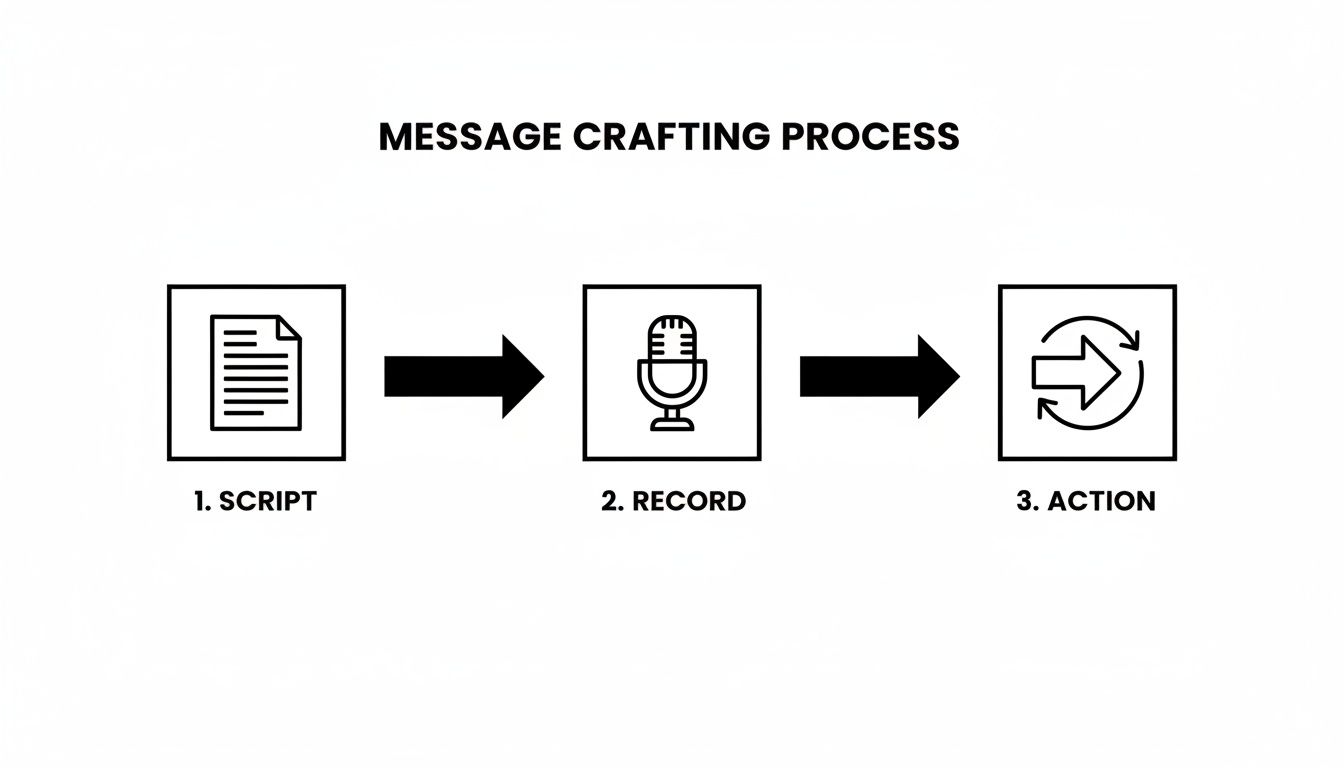
From the script you write to the way you record it, the goal is always to make it easy and compelling for the listener to take that next step.
When you send your message is just as important as what you say. Blasting out calls at 8 AM on a Monday is a surefire way to get ignored or hung up on.
Think about your audience's daily routine. The sweet spot is usually during times when people are less likely to be slammed with work—typically mid-mornings (10-11:30 AM) and mid-afternoons (2-4 PM) on Tuesdays, Wednesdays, and Thursdays.
Never underestimate the power of segmentation. A message that feels relevant gets a response. Instead of sending one generic broadcast, divide your contact list into smaller, more targeted groups based on their past behavior, location, or relationship with your business.
This is how you make an automated message feel personal. A local retailer, for instance, could send a special promotion to their VIP customers and a completely different "we miss you" offer to people who haven't stopped by in a while. The relevance skyrockets, and so do the response rates.
Honestly, this kind of interaction feels more natural to people than ever before. We've all been conditioned by voice assistants to talk to and listen to automated systems. With over 8.4 billion active voice assistants projected to be in use by 2024, the awkwardness of old-school robocalls is fading. People are just more comfortable with it, making your interactive campaigns more effective than they would have been even five years ago. You can learn more about the impact of voice technology on marketing to see just how big this shift is.
Sending an auto voice message comes with some legal responsibilities, but don't let that intimidate you. Getting a handle on the key rules is the first step to running your campaigns confidently and, more importantly, ethically.
The two biggest regulations you'll bump into are the Telephone Consumer Protection Act (TCPA) and the National Do Not Call (DNC) Registry. Simply put, the TCPA says you need clear, explicit consent from people before you send them automated marketing messages.
This is especially true for any broadcast that actually rings someone's phone. While a ringless voicemail is often seen as less intrusive, the legal lines can get a little blurry. The absolute best practice? Always work from a list of contacts who have specifically opted in to hear from you.
The good news is that modern messaging platforms are built with these rules in mind. They take a lot of the guesswork out of compliance by giving you tools to manage your lists and respect everyone's preferences.
You'll want to look for a couple of key features:
The core principle is simple: only message people who want to be messaged. Focusing on an engaged, opt-in audience not only keeps you compliant but also dramatically improves your campaign results.
If you're in healthcare, there's an extra layer to think about: the Health Insurance Portability and Accountability Act (HIPAA). This law is all about protecting the privacy and security of Protected Health Information (PHI).
You can absolutely use an auto voice message for things like appointment reminders, but the platform you use must be HIPAA-compliant. That means it needs to have safeguards like data encryption and secure access controls to keep patient data locked down. For a deeper dive, you can explore more about HIPAA compliant texting apps and the security features they require.
When crafting your healthcare messages, never include sensitive details like a diagnosis or test results. Just stick to the essentials—like the date, time, and location of an appointment. This protects patient privacy while still providing a valuable service.
Launching an auto voice message campaign is really just the starting line. The real wins come from digging into the results to understand what actually worked and what fell flat.
Without tracking the right numbers, you're flying blind. A campaign is only a success if you can prove it, and all that proof is sitting right there in your performance data. You just have to know where to look.
The first step is to get past the vanity metrics and zero in on the key performance indicators (KPIs) that tell you the real story about engagement.
Think of these numbers as clues that reveal how your audience is behaving and how your message is landing.
Don't just glance at these numbers individually. A high answer rate looks great, but if your Press-1 transfer rate is almost zero, it means your message isn't compelling enough to get people to act. The goal is to see how these metrics work together.
Once you have this data, you can start making smart, informed decisions to sharpen your future campaigns.
Let's say your listen-through rate on a ringless voicemail drop is disappointingly low. Time for an A/B test. Pit two different scripts against each other—maybe one with a more direct opening or a completely different call-to-action—and see which one performs better.
Likewise, if you notice calls made on a Tuesday afternoon have a much higher live answer rate than your Friday morning batch, you've just uncovered a critical insight about your audience. This data-driven approach lets you systematically improve your timing, messaging, and even how you segment your lists. For a deeper dive on this, check out our guide on measuring marketing campaign effectiveness.
The real magic happens when your voice messaging platform can talk to your other business tools. Integrating with your CRM using a tool like Zapier creates slick, automated workflows that save a ton of time and capture opportunities you might otherwise miss.
For instance, you could set up an automation that instantly triggers a personalized ringless voicemail to every new lead that fills out a form on your website. That immediate, personal touchpoint can dramatically boost engagement and conversion rates, turning a simple follow-up into a powerful piece of your sales funnel.
This kind of integration is quickly becoming the standard as auto voice messages get embedded into larger VoIP and unified communications systems. This tech stack makes it practical to send thousands of voice messages, track responses in real-time, and weave voice into your standard omnichannel campaigns. You can learn more about the growth of voice analytics technology in the VoIP market on skyquestt.com.
Jumping into automated voice messaging can bring up a few questions. It's a powerful tool, but like any tool, you want to make sure you're using it right. Let's tackle some of the most common questions we hear from folks just getting started.
This one comes up a lot, and it’s a crucial distinction. When people hear "robocall," they immediately think of those annoying, illegal spam calls everyone hates. That's not what we're talking about here.
A legitimate auto voice message is a communication tool built on permission. Businesses use it to send valuable updates to customers who have actually asked to receive them—think appointment reminders, delivery alerts, or special offers for VIP members. It's all about consent. Compliant platforms like Call Loop give you the tools to manage your DNC lists and consent, so you’re always on the right side of the law.
Keep it short and sweet. Seriously.
You’re aiming for the sweet spot of 30 to 45 seconds. This gives you just enough time to say who you are, get straight to the point, and give a clear call-to-action before your listener’s attention wanders.
Now, if you're sending a ringless voicemail, you might have a little more wiggle room since the person can listen to it later. Even then, being concise is almost always the winning strategy. Respect their time, and they'll be more likely to listen to what you have to say.
Absolutely. A standard voice broadcast works perfectly for both mobile numbers and old-school landlines. It will ring the phone just like a normal call and play your message, whether a person or an answering machine picks up.
The key thing to remember is that ringless voicemail is a different beast. That technology is built specifically to drop a voicemail directly onto a mobile phone's server without ringing the phone. If your contact list is a mix of mobile and landline numbers, a standard voice broadcast with good answering machine detection is your best bet for making sure everyone gets the message.
This is less about which is "better" and more about what fits your campaign and your brand. There’s a time and place for both.
A real, human voice—especially one recorded professionally—brings an authenticity and warmth that can be fantastic for building a personal connection. It helps build trust.
On the flip side, today’s AI-powered text-to-speech (TTS) voices are incredibly natural-sounding and offer amazing flexibility. If you need to personalize thousands of messages with unique names, appointment details, or order numbers, TTS is the way to go. It makes hyper-personalization at scale not just possible, but easy.
Ready to create voice campaigns that connect with your audience and drive results? Call Loop provides all the tools you need for compliant, effective outreach. Explore our features and start your free trial today.
Chris Brisson
Chris is the co-founder and CEO at Call Loop. He is focused on marketing automation, growth hacker strategies, and creating duplicatable systems for growing a remote and bootstrapped company. Chat with him on X at @chrisbrisson


Trusted by over 45,000 people, organizations, and businesses like


