
See a Demo
You're just one step away from seeing Call Loop in action.
Enter your information below to watch a demo right now.

You're just one step away from seeing Call Loop in action.
Enter your information below to watch a demo right now.

HIPAA-compliant texting apps are specialized communication tools built from the ground up with one goal in mind: protecting sensitive patient data. Unlike your standard messaging app, these platforms come loaded with advanced security safeguards like end-to-end encryption and detailed audit trails. They also require a Business Associate Agreement (BAA), a critical legal document that helps your practice steer clear of very costly violations.

We live in a world of instant gratification, and sending a quick text feels like the easiest way to communicate. But for healthcare providers, using standard apps like iMessage or WhatsApp is a high-stakes gamble—one that wagers patient privacy against your organization's financial health.
The heart of the problem is how these everyday apps handle Protected Health Information (PHI). Anything that can identify a patient when tied to their health data is considered PHI. We're talking about everything from names and appointment times to diagnoses and treatment plans.
Think of it this way: sending PHI through a standard text message is like mailing a patient's medical chart on a postcard. As that postcard travels from your phone to theirs, it passes through countless unsecured networks and servers. Anyone with the right access along that path could potentially intercept and read every last detail.
This glaring lack of security is a direct violation of HIPAA’s core requirements. Standard messaging apps just aren’t built to be the digital equivalent of a sealed, armored truck for sensitive data. They're missing the fundamental safeguards needed to keep that information from being exposed.
Standard texting services, including the native SMS on our phones, have several critical compliance gaps that put your practice in immediate danger:
The penalties for getting this wrong are severe, with fines that can reach up to $1.5 million per violation category each year. When you factor in the irreversible damage to patient trust, the risk of using non-compliant apps is just far too great.
This is exactly why specialized HIPAA-compliant texting apps aren’t just a "nice-to-have"—they're an absolute necessity. They provide the secure framework you need to communicate efficiently without ever compromising patient privacy, making sure every message is fully protected.
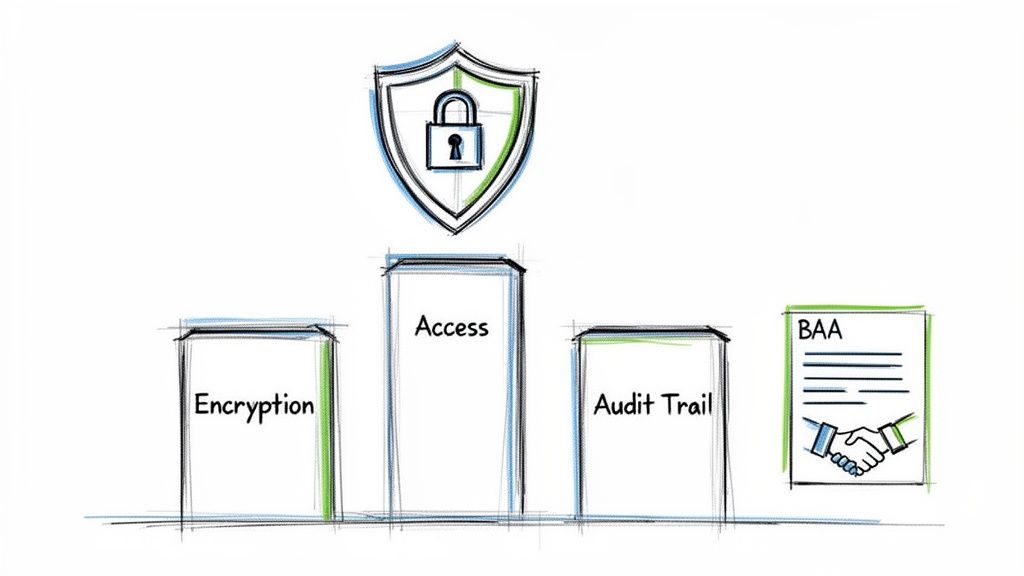
Trying to understand the technical side of HIPAA can feel like a maze, but it really comes down to a few clear, non-negotiable rules. These aren't just best practices; they're the pillars that hold up any truly secure platform and separate it from one that puts your practice at serious risk.
Think of these rules as the digital blueprints for building a fortress around your patient data. For a platform to be considered one of the best HIPAA compliant texting apps, it has to offer much more than just basic security. It needs a multi-layered defense that covers how data is sent, who gets to see it, and how every single interaction is logged.
Let's break down exactly what that looks like.
Any truly compliant texting solution is built on four core pillars. These technical and legal requirements work together to create a secure environment for handling Protected Health Information (PHI). Missing even one of these can expose your organization to significant risk.
These four elements are the absolute minimum. Now, let’s dig a little deeper into what each one means for your day-to-day operations.
The first and most important rule is end-to-end encryption. Think of it this way: a text message is like a secret note being passed in a crowded room. Without encryption, that note is written in plain English for anyone who intercepts it to read.
With encryption, the note is scrambled into an unreadable code the second it's sent and only gets unscrambled when it lands on the recipient's device. No one in the middle—not the app developer, the cell carrier, or a hacker—can figure out what it says. This is how PHI stays completely confidential, both in transit and when it's stored on a server.
Next up, a compliant app must have solid access controls. It’s not just about keeping outsiders out; you have to manage who can see what inside your organization. This is known as the "minimum necessary" standard, and it just means staff should only have access to the PHI they absolutely need to do their jobs.
A front-desk admin, for instance, might need to see appointment times, but they shouldn't be able to pull up a patient's detailed clinical notes. Secure apps make this easy with features like:
Ever wonder who accessed a patient's chart and when? That's where audit trails come in. An audit trail is basically a digital security camera that records every single interaction with PHI inside the app.
This log is an unchangeable record that captures who logged in, what messages they viewed or sent, and the exact time and date of the activity. If a potential breach occurs, this trail is your first and most vital tool for investigation, providing the transparency required by HIPAA.
These logs are crucial for accountability and are usually the first thing auditors ask to see. Without them, you have no way to prove you’re monitoring and protecting patient data. Failing here can be costly. HIPAA violations from insecure texting have resulted in fines hitting $1.5 million per incident, which is why so many providers are scrambling to find compliant solutions.
Finally, we have the legal foundation of it all: the Business Associate Agreement (BAA). This is a formal contract between your practice and the texting app vendor. The BAA legally requires the vendor to follow the same HIPAA rules you do, making them a partner in protecting PHI.
If a vendor won't sign a BAA, their app is not HIPAA compliant, no matter how great their security features are. It's that simple. This document is your official guarantee that your tech partner takes data protection as seriously as you do.
For providers doing things like a telehealth ADHD diagnosis, having tools backed by a signed BAA is non-negotiable. It's the only way to truly secure those sensitive digital conversations. You can learn more about how this fits into the bigger picture in our guide to SMS for healthcare.
Getting HIPAA compliance right is the table stakes—it's the absolute minimum. But the real magic happens when a texting app goes beyond just meeting legal requirements and actually becomes a powerhouse for your practice.
These are the features that transform a compliant app from a simple necessity into a strategic tool. They don't just secure data; they actively streamline your workflows, boost team efficiency, and make patient engagement feel effortless. A great HIPAA compliant texting app shouldn't feel like a restrictive legal tool. It should feel like a communication accelerator.
Think of these features as your scorecard when you're vetting different platforms. A truly robust solution will offer a whole suite of tools built for the fast-paced, demanding world of healthcare.
Here are the non-negotiables that separate a basic app from a truly effective communication hub:
But these core functions are just the starting point. The best platforms get creative, offering innovative tools that solve very specific communication headaches in healthcare.
Sometimes, a text just doesn't cut it. A voice message can convey a sense of urgency or a caring tone far more effectively, but a ringing phone can be disruptive. This is where specialized, compliant tools step in, giving you new ways to connect without compromising security.
One of the most interesting tools is ringless voicemail. This cool piece of tech lets you drop a pre-recorded audio message straight into someone's voicemail box without their phone ever ringing. It’s a completely non-intrusive way to deliver important info, like:
When you use a HIPAA-compliant platform, these voicemails are tracked with a full audit trail and the data is protected, just like a text message. It's an incredible addition to any patient outreach strategy. In a similar vein, secure voice broadcasting lets you send a single recorded message to a huge group all at once—perfect for public health alerts or practice-wide announcements.
Patients are actually asking for this. A staggering 90% of patients report being satisfied with receiving SMS messages from their healthcare providers. This isn't just about convenience; it leads to real results. Secure text reminders can increase show-up rates by up to 40%, helping clinics recover some of the billions lost to no-shows every single year.
As you start comparing different HIPAA compliant texting apps, don't just look for the security checkmarks. Your real goal is to find a partner that solves your clinic's unique communication problems. The boom in services like online weight loss programs with medication shows just how much modern healthcare relies on flexible, secure communication.
By creating a scorecard that weighs both compliance and operational features, you'll be in a much better position to make the right call. You can see how Call Loop’s platform provides a full suite of these tools in our guide on secure SMS features. Choosing the right platform isn't just about protecting your practice—it's about empowering your team to deliver better, more connected care.
Picking the right HIPAA-compliant texting app can feel like a chore. One look at all the vendors promising perfect security and flawless workflows is enough to make your head spin. It’s easy to get lost in the noise.
The secret is to look past the flashy marketing claims and stick to a clear, structured game plan. The focus should always be on what your practice actually needs.
A great app does more than just tick a compliance box; it should become a vital part of your daily operations. This means finding a solution that’s not just secure, but also dead simple for your team to use and ready to grow alongside your practice. Get this right, and you'll boost team efficiency and patient communication. Get it wrong, and you've just added another layer of complexity nobody asked for.
Before you even glance at a feature list, you need to confirm the vendor's commitment to compliance. This comes down to two critical items that are absolute deal-breakers.
Think of the BAA as the legal foundation and security certifications as the structural inspection. You simply can't build a compliant communication strategy without both firmly in place.
This process flow shows the core communication functions a modern healthcare team needs: secure messaging, the ability to recall messages, and automated reminders.
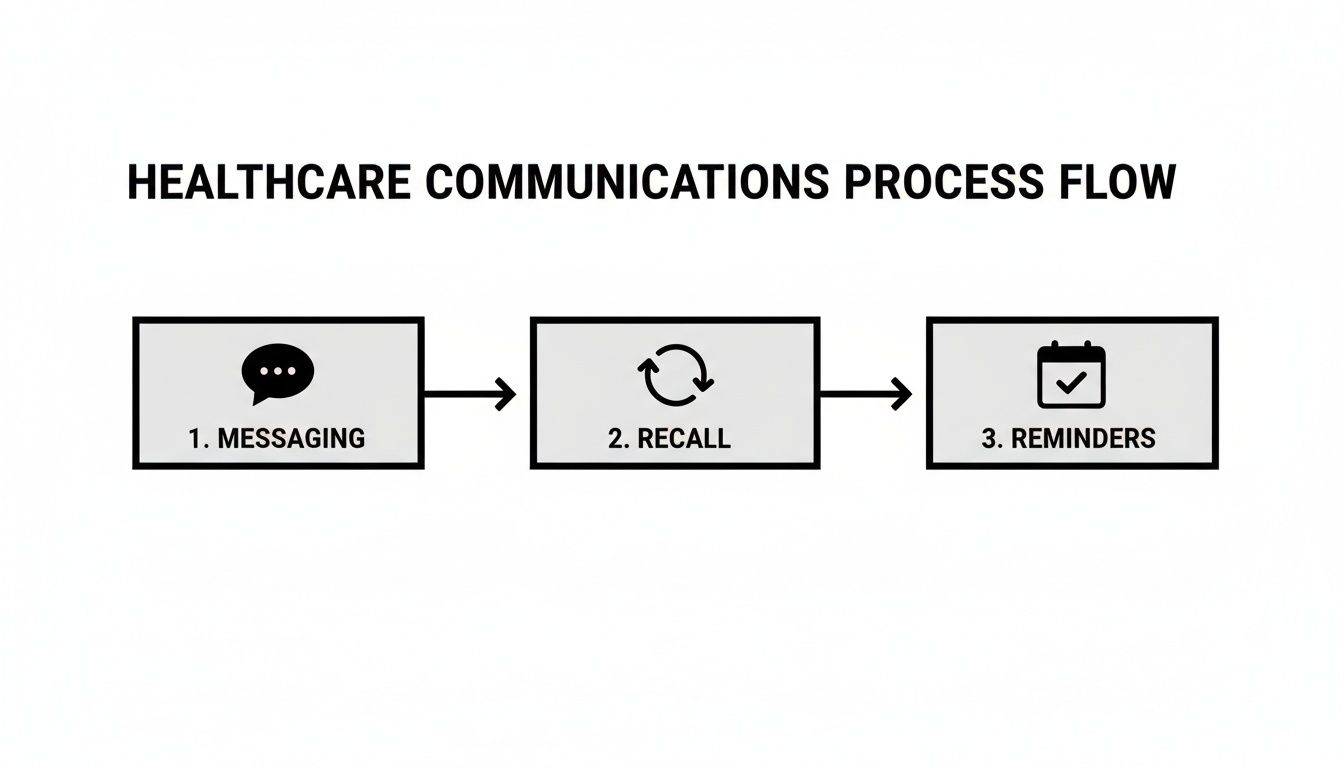
The image drives home an important point: a truly effective platform weaves daily tasks into a secure, compliant workflow, turning a regulatory headache into a real operational advantage.
Once you've confirmed a vendor’s compliance credentials, it’s time to shift focus to how the app will actually work in your office. A powerful app that nobody wants to use is completely useless.
Your team will only adopt the app if it’s easy to use. The interface needs to be clean, intuitive, and require almost no training. If your staff finds it clunky or confusing, they'll fall back on old, non-compliant habits. Always insist on a live demo or a free trial, and get a few team members to kick the tires.
Just as important are integrations. A standalone app creates data silos and forces your team to jump between different systems all day long.
Look for a platform that connects with your existing Electronic Health Record (EHR) system, practice management software, or other critical tools. Seamless integration means less manual data entry, fewer mistakes, and a much smoother workflow for everyone.
Finally, dig into the pricing structure to make sure it fits your budget now and in the future. Watch out for hidden costs. Ask direct questions about implementation fees, charges for extra users, data storage limits, and costs for premium support.
A transparent, predictable pricing model is what you're after. See if the vendor offers tiered plans that let you start with the essentials and add more features as your practice grows. Choosing a scalable partner means you won't have to go through this whole evaluation process again in a year or two. By asking these tough questions upfront, you can find a HIPAA-compliant texting app that becomes a true long-term asset.
Here's how we put all that theory into practice.
Knowing the ins and outs of HIPAA compliant texting apps is one thing, but actually using them to connect with patients is a whole different ballgame. This is where Call Loop steps in, turning what feels like a complex legal headache into a genuine advantage for your practice.
We built our platform from the ground up with one goal: to solve the real-world communication challenges healthcare practices like yours face every single day. We give you a single, secure place for all your patient outreach—not just SMS, but voice calls and our unique ringless voicemail drops, too.
We believe compliant communication shouldn’t be scattered across different apps and systems. It just creates confusion and risk. That’s why our tools are designed to work together, creating a smooth, secure experience for your patients from start to finish.
Imagine this: an automated, encrypted SMS appointment reminder goes out. The next day, a secure ringless voicemail with pre-op instructions lands on their phone. After the visit, a friendly check-in text follows up. That’s the kind of seamless journey we enable.
You can connect with patients using the right message at the right time, all from one platform where every single interaction is tracked and auditable. Here's what makes it possible:
The demand for secure healthcare messaging is exploding. The global market for HIPAA compliant messaging software was valued at a whopping USD 1.54 billion in 2024 and is on track to hit USD 2.80 billion by 2030.
Why the huge jump? Because practices everywhere are facing the exact challenges Call Loop was built to solve: the need for secure, efficient, and scalable ways to talk to patients. You can read more about this growing market over at Strategic Market Research.
At the end of the day, Call Loop offers more than just features; we deliver a complete communication solution. By bringing together SMS, voice, and secure ringless voicemail, we help you boost patient engagement, streamline your operations, and nail your HIPAA compliance without cutting any corners.
Our system transforms a legal requirement into a strategic tool. You can scale up your patient outreach with confidence, knowing every message, call, and voicemail is secure, documented, and fully compliant. This frees up your team to focus on what they do best—providing amazing care for your patients.
Diving into the world of secure healthcare messaging can feel like navigating a minefield. As more practices and organizations start using HIPAA compliant texting apps, it's totally normal to have questions about how all these rules work in the real world, day-to-day. Let's clear up some of the most common points of confusion.
Think of this section as tackling all the "what ifs" and "can I just..." scenarios that pop up. We'll get straight to the point and reinforce the core principles you need to know, from using everyday messaging apps to the nitty-gritty of a Business Associate Agreement.
Nope. This is one of the most common—and dangerous—misconceptions out there. Getting a patient's permission doesn't give you a free pass to ignore the technical security rules baked into HIPAA. At the end of the day, the responsibility to protect patient data lands squarely on the healthcare provider, not the patient.
Apps like WhatsApp and iMessage just aren't built for healthcare. They won't sign a Business Associate Agreement (BAA), they don't have the required server-level security, and they can't provide the detailed audit trails you need to track who's accessing PHI. Using them for patient communication is a compliance violation, plain and simple, consent or not.
A Business Associate Agreement (BAA) is a legally required contract between a healthcare provider (that's you, the "covered entity") and any third-party vendor that might see, touch, or store PHI on your behalf. This isn't just your texting app provider—it could be your cloud storage service, your billing company, or even your answering service.
Think of the BAA as a legal handshake that contractually forces your vendor to protect patient data with the same level of security and care that you do. Without a signed BAA from your software provider, you are not HIPAA compliant. It's a non-negotiable first step.
Yes, they almost always are. It might seem harmless, but an appointment reminder links a patient's name to a specific medical provider, a type of treatment, or a clinic location. That connection is all it takes to classify the message as Protected Health Information (PHI).
Because of this, all patient communications—even something as simple as a reminder—need to go through a fully HIPAA compliant platform. This ensures every single message is encrypted, access is logged, and you have a complete audit trail, heading off any potential compliance headaches before they start.
Ringless voicemail can be a fantastic, and fully compliant, tool for patient outreach, but only when it's delivered through a secure platform that signs a BAA. For it to be compliant, the system has to protect all the data involved—the patient's name, their phone number, and the message content itself—both when it's being sent and while it's being stored.
The platform also needs to have strict access controls in place and keep a detailed audit trail of every single message dropped. When done right, it's a super effective and non-intrusive way to send out post-visit instructions or public health updates while staying on the right side of HIPAA.
Ready to transform your patient outreach with a secure, multi-channel messaging platform? Call Loop provides the tools you need to automate SMS, voice, and ringless voicemail campaigns while maintaining full HIPAA compliance. Explore how Call Loop can help your practice today.
Chris Brisson
Chris is the co-founder and CEO at Call Loop. He is focused on marketing automation, growth hacker strategies, and creating duplicatable systems for growing a remote and bootstrapped company. Chat with him on X at @chrisbrisson


Trusted by over 45,000 people, organizations, and businesses like


