
See a Demo
You're just one step away from seeing Call Loop in action.
Enter your information below to watch a demo right now.

You're just one step away from seeing Call Loop in action.
Enter your information below to watch a demo right now.


To really know if your marketing is working, you have to look past the flashy numbers and focus on what actually grows the business. It’s all about tying every single marketing touch—from a link click in an SMS to a callback from a ringless voicemail—directly to your bottom line.
A solid measurement plan starts with clear goals and a deep understanding of foundational metrics like Customer Acquisition Cost (CAC) and Lifetime Value (LTV).
It's tempting to get caught up in likes, impressions, and open rates. Those numbers feel good and look great on a report, but they don't tell the full story. We call these "vanity metrics" because they're easy to chase but rarely correlate with actual revenue.
Think about it: a high open rate on an SMS campaign means nothing if nobody buys anything. Effective measurement means you stop chasing impressions and start tracking results. Your goal isn't just to be seen; it's to drive profitable action.
To truly prove your campaign’s worth, you need to speak the language of the C-suite: money. This requires a shift from tracking simple engagement to monitoring metrics that prove marketing is a revenue driver, not a cost center.
These are the core metrics that should form the foundation of any serious marketing program:
When you prioritize these KPIs, you can confidently answer the most important question of all: "Is this campaign actually making us money?"
To go deeper on connecting your marketing activities to real business growth, check out these proven strategies for measuring marketing campaign effectiveness.
The most dangerous marketing metrics aren't wrong... they're incomplete. They show activity without outcomes, effort without results, and tactics without a clear connection to strategy. True effectiveness is measured in pipeline contribution and revenue, not just clicks and views.
Before we dive deeper, here’s a quick-glance table to help you organize your thinking around key campaign metrics.
This table gives a quick overview of essential metrics, moving from surface-level engagement to deep business impact, helping you prioritize what to track.
By tracking metrics across these categories, you get a complete picture of performance, from initial contact to long-term customer value.
Every single interaction within your campaign needs a purpose. A click on an SMS link, a callback from a ringless voicemail, or an opt-in from a keyword—these aren't just data points. They are trackable steps on a customer's journey toward a larger business goal.
For example, a local plumbing company might send a ringless voicemail about a seasonal tune-up special. The real metric isn't how many voicemails were delivered; it's how many callbacks turned into a booked appointment.
Likewise, an e-commerce store running an SMS campaign shouldn't just celebrate a high click-through rate. The real win is the total sales generated from that specific, tracked link.
This is what separates guessing from knowing. When you draw a direct line between action and outcome, you can confidently defend your budget and double down on the channels that deliver real, profitable results.
Great data starts with a solid setup. If you don't have the right tracking in place from the get-go, even the most brilliant campaigns are just flying blind. Building a reliable measurement framework is the technical backbone that proves your marketing's worth.
This isn't just about collecting random data points; it’s about connecting the dots. This infrastructure ensures every single action—from an SMS link click to a callback from a ringless voicemail—is properly credited. It's how you finally move from guessing which channels work to knowing with certainty.
Accurate measurement begins long before you ever hit "send." For every channel you use, you absolutely need a distinct way to track the responses it generates. This is completely non-negotiable for measuring marketing campaign effectiveness.
Here’s how I recommend setting up your core outbound channels:
Following this process ensures every lead and every sale can be traced back to its origin. What you're left with is a clean, reliable dataset you can actually trust for your analysis.
This simple flow shows how your campaign goals should directly translate into measurable actions and, ultimately, real business impact.
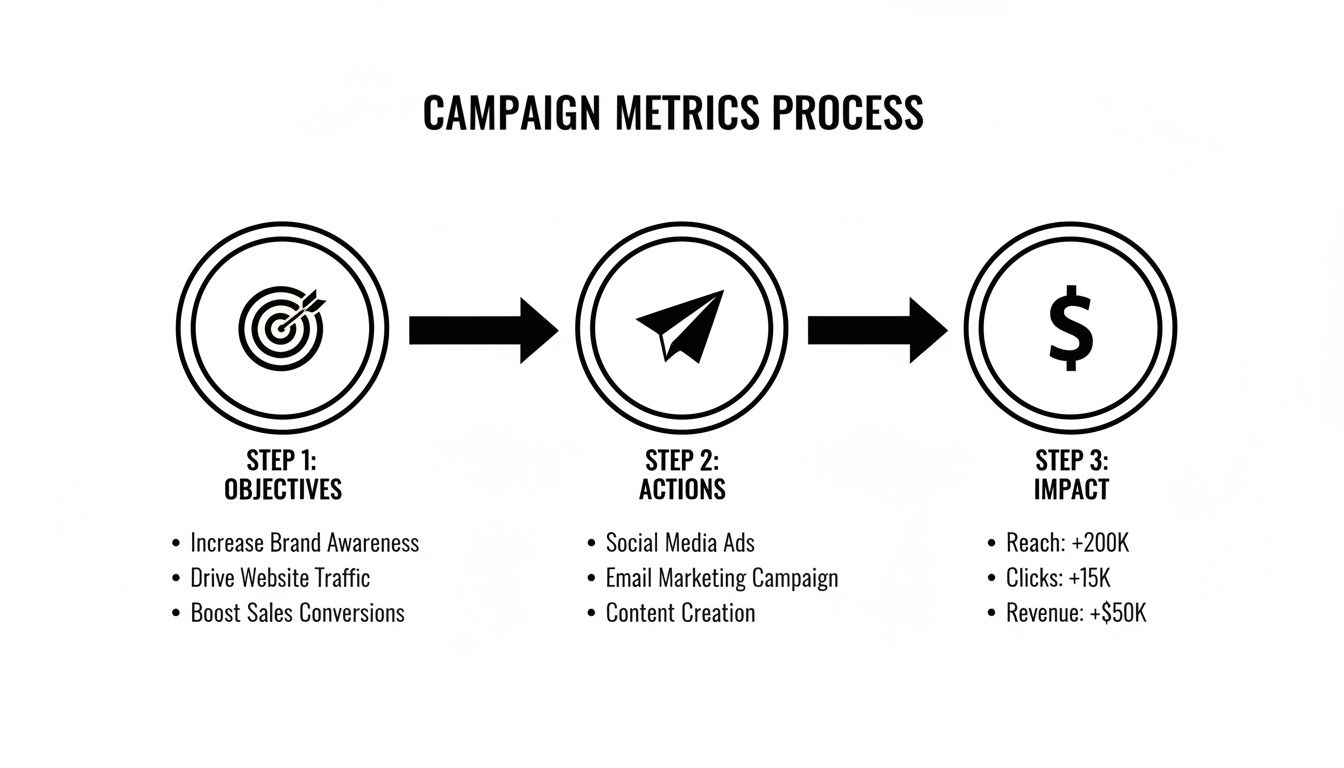
Think of it this way: every marketing action must be a deliberate step toward achieving a specific, quantifiable business outcome.
Once your tracking is humming along, you have to decide how you're going to assign credit for a conversion. This is where attribution models come into play. They're basically the rulebook that determines which touchpoint gets the "win" when a customer finally converts.
A common starting point for many is last-touch attribution, where 100% of the credit goes to the final interaction before the sale. It's simple, but it has a huge blind spot—it completely ignores all the earlier touchpoints that warmed up and nurtured the lead. More sophisticated models, like linear or time-decay, do a better job of distributing credit across the entire customer journey.
The key is to choose an attribution model that actually reflects your typical sales cycle. A last-touch model might be perfectly fine for a quick SMS flash sale, but a multi-touch model is far more accurate for a longer B2B sales process that involves multiple messages and channels over weeks or months.
The holy grail here is creating a closed-loop system. This means connecting your messaging platform, like Call Loop, directly to your Customer Relationship Management (CRM) system. When a lead that came from a ringless voicemail campaign becomes a paying customer in your CRM, the two systems talk to each other.
This integration is what automatically attributes that new revenue back to the original campaign source. It literally closes the loop between your marketing spend and the revenue it generates, giving you undeniable proof of your ROI.
Without this connection, you're stuck with siloed data and a frustratingly incomplete picture of what’s truly driving your business forward. For anyone using multi-channel outreach, having robust analytics is essential. You can see why integrated campaign reporting and analytics tools are so critical for tying everything together.
Once you have your tracking framework locked in, it's time for the moment of truth—where your marketing efforts hit the balance sheet. This is the part where you go beyond just tracking clicks and opens to actually proving financial impact.
The key is to demystify the formulas that turn raw campaign data into real business intelligence. By getting a handle on Return on Investment (ROI) and Customer Lifetime Value (LTV), you can finally see which channels and campaigns are actually driving sustainable growth.
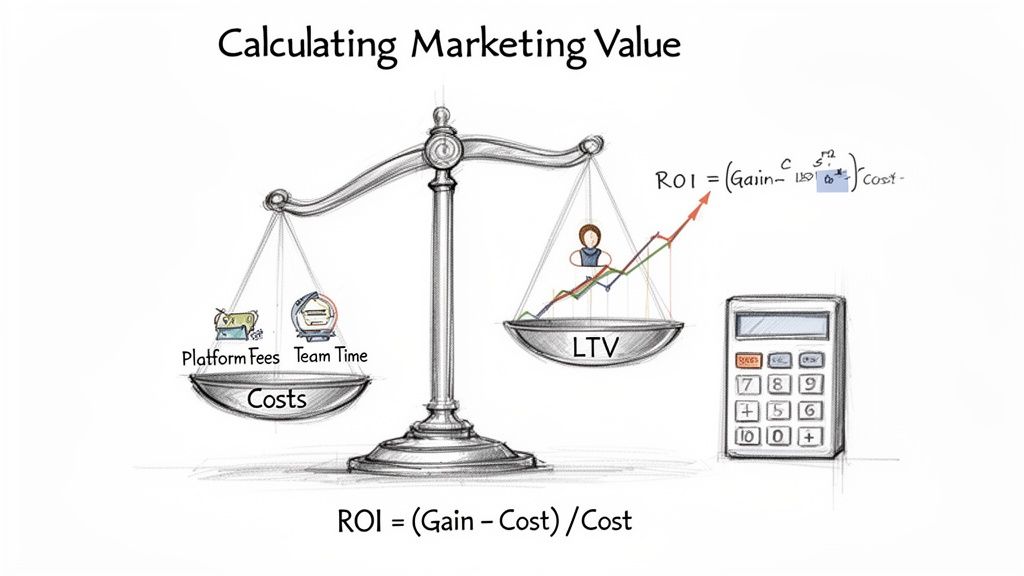
Before you can calculate any return, you need an honest look at your investment. A classic mistake is to only count ad spend, which gives you a wildly inflated and misleading ROI.
A true cost analysis goes much deeper. You have to account for every single resource that went into the campaign.
Adding all this up gives you your "Total Marketing Investment." This figure is the foundation for an accurate ROI calculation that will actually stand up to scrutiny.
People often use Return on Investment (ROI) and Return on Ad Spend (ROAS) interchangeably, but they tell two very different—and equally important—stories.
ROAS is a direct, tactical metric. It only looks at the revenue generated from your advertising costs. In the digital marketing world, a 4:1 ratio is often seen as a solid benchmark—for every dollar you put into ads, you get four dollars back. For businesses running bulk SMS or ringless voicemails, hitting that kind of ROAS can turn an outreach channel into a serious revenue driver.
ROI, on the other hand, is the big-picture, strategic metric. It takes into account the total investment—ad spend, software, labor, creative—and measures it against the net profit you generated.
ROAS tells you if your ads are working. ROI tells you if your entire marketing effort is profitable. You can have a fantastic ROAS, but if your overhead or labor costs are through the roof, your overall ROI could still be in the red.
Let's be real: true success isn't about the profit from a single campaign. The real goal is to bring in customers who stick around and provide value long after that first sale. This is where Customer Lifetime Value (LTV) becomes your most powerful metric.
LTV projects the total profit you can expect from an average customer over their entire relationship with your brand. It shifts your focus from short-term wins to long-term health.
Think about these two customers:
The SMS campaign might have a higher initial ROAS, but the ringless voicemail campaign delivered a far more valuable customer. That's a critical insight. LTV helps you pinpoint which channels attract your most profitable customers, so you can put your budget where it will generate the most sustained growth.
Of course, a huge piece of LTV is retention. To really get a grip on customer value, you need to know how to calculate customer retention rate for your business. That number tells you how good you are at keeping the valuable customers you fought so hard to win.
A winning multi-channel approach isn’t about using the same playbook everywhere. You can’t measure an SMS campaign the same way you measure a voice broadcast or a ringless voicemail drop. When you lump everything together, you end up with muddy data that hides what’s really working.
To effectively measure marketing campaign effectiveness, you have to get granular. It's about moving past generic vanity metrics and zeroing in on the specific KPIs that show you how each channel is actually performing. This is how you find the clarity to double down on your winners.
With SMS, it’s so easy to fixate on delivery rates. But knowing a message landed in someone’s inbox doesn’t tell you if it made an impact. The real story is in the engagement.
Generally, a good e-commerce benchmark to aim for is around a 3% CTR and a 2.5% CR. When you’re using a platform that offers link shortening and click tracking, these numbers give you a clear, immediate picture of how your bulk campaigns are performing. You can discover more insights on experiential marketing statistics here to see how you stack up.
Voice campaigns are a different beast. You’re not chasing clicks; you’re measuring direct, audible connection and attention.
The KPIs that matter most here are:
Don't get fooled by a high answer rate. A thousand answered calls mean nothing if only ten people listened to the whole message or transferred to your team. The real win is in the meaningful interactions.
Ringless voicemail is a unique, non-intrusive tool, so it needs its own set of metrics. Success isn't about someone answering a call, but about your message landing silently in their inbox and sparking a response.
To make it even clearer, let's break down the essential metrics for each channel side-by-side. Trying to apply SMS metrics to a voice campaign is like trying to fit a square peg in a round hole—it just doesn't work. Each channel has a unique job to do, and you need to measure it accordingly.
By tailoring your measurement strategy to the specific channel, you go from a blurry, one-size-fits-all view to a high-definition picture of what's actually driving results. This is the kind of clarity that lets you confidently invest more in what’s working and intelligently refine everything else.
Let's be honest, raw data is just noise. The numbers you pull from your campaigns don't mean a thing until you can weave them into a clear story that tells you exactly what to do next. This is where the magic happens, turning analytics into a concrete plan for improvement.
The real goal isn't just to report on what happened. It's to figure out why it happened so you can do more of what works and stop wasting money on what doesn't. This process transforms your marketing from a series of educated guesses into a smart, repeatable cycle of optimization.
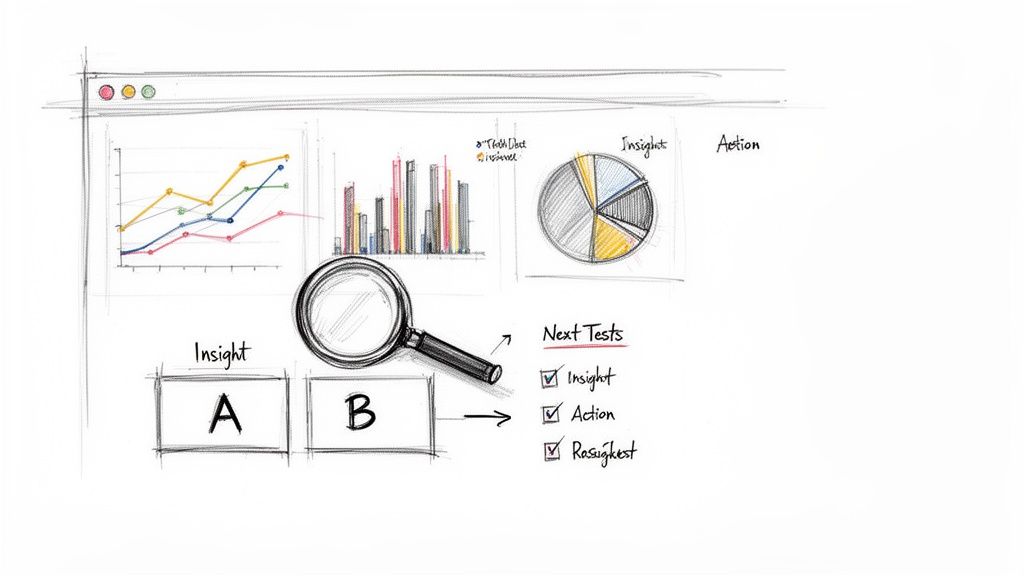
Your post-campaign report should never be a data dump. Leadership and stakeholders don't have time to sift through a hundred different metrics. They want the bottom line: what was the business impact?
This is where data visualization becomes your best friend. Use simple charts and graphs to make key trends and opportunities pop. Instead of just stating your conversion rate, show a bar chart comparing it against your benchmark. That tells a story instantly in a way a plain number never could.
The best reports I've ever seen answer three simple questions: What were our goals? Did we hit them? And what did we learn to make us smarter next time? Keep your reporting focused on that, and you'll keep everyone's attention.
When you focus on clarity and business results, you create a document that actually drives decisions, not one that just gets filed away and forgotten.
A solid post-campaign analysis goes way beyond just looking at the overall ROI. This is your chance to dig into the nitty-gritty and find those hidden gems that give you a real competitive edge. It's time to ask some tough questions and let the data do the talking.
Structure your analysis to uncover specific, practical learnings. Here are the core questions you should be asking:
Answering these questions gives you a clear roadmap for what's next. You'll know exactly which audience to target, what message to use, and which channel deserves more of your budget.
The insights you uncover are worthless if you don't act on them. The final step of any good analysis is a list of specific A/B tests to run in your next campaign. This is how you guarantee that every campaign you launch is smarter than the last one.
For example, if you found that messages creating a sense of urgency had a 25% higher click-through rate, your next test is obvious: pit a "24-hour flash sale" message against your standard offer. This is the engine of continuous improvement.
This cycle of analyzing and testing is the heart of a truly data-driven marketing strategy. You can even automate these follow-up tests and sequences to build on your learnings with less manual work. Understanding how to build effective marketing automation workflows is the key to scaling this process. Each test provides new data, which fuels new insights, which in turn lead to even smarter tests.
Even with the best framework, you're going to hit a few snags when you get into the nitty-gritty of campaign measurement. Let's tackle some of the most common questions that pop up, with clear, no-fluff answers to get you back on track.
If you could only track one thing, it has to be Return on Investment (ROI). Hands down.
It’s the ultimate bottom-line number. ROI cuts through all the noise and answers the single most important question from your boss, your client, or your own balance sheet: "Did we make more money than we spent?"
Sure, metrics like Conversion Rate or Click-Through Rate are vital for figuring out why a campaign is working (or isn't). But ROI is what proves the campaign was a financial success.
For campaigns where a direct sale isn't the goal—like generating leads for a sales team—the crown goes to Cost Per Acquisition (CPA). It tells you exactly how much you're paying to get a qualified lead in the door.
This is a big one, especially for channels like ringless voicemail or voice broadcasts. When there's no direct online conversion to track, it feels like you're flying blind. But you're not.
The key is to create your own trackable path. You can't just hope people will find your website; you have to build a dedicated bridge from that offline touchpoint to an online action.
It's actually pretty simple:
You’re essentially creating a closed loop. Every callback, every site visit is neatly tied to the message that sparked it.
Measuring offline channels isn't about fancy, expensive tools. It’s about being disciplined in your setup. A simple unique phone number or a specific URL can turn a measurement black hole into a crystal-clear source of data.
The honest answer? It depends. There's no magic number here. The right rhythm for checking your stats depends entirely on the campaign's pace and duration.
A good rule of thumb is: the shorter and faster the campaign, the more you need to watch it.
Here's how I think about it:
Setting a review schedule keeps you from drowning in data and ensures your insights are timely enough to actually act on.
Ready to put these measurement principles into action? With Call Loop, you get all the tools you need to track every SMS click, voice transfer, and ringless voicemail callback baked right in. Our analytics and reporting make it dead simple to prove your ROI and build smarter campaigns from day one.
Chris Brisson
Chris is the co-founder and CEO at Call Loop. He is focused on marketing automation, growth hacker strategies, and creating duplicatable systems for growing a remote and bootstrapped company. Chat with him on X at @chrisbrisson


Trusted by over 45,000 people, organizations, and businesses like


