
See a Demo
You're just one step away from seeing Call Loop in action.
Enter your information below to watch a demo right now.

You're just one step away from seeing Call Loop in action.
Enter your information below to watch a demo right now.

Imagine having a tireless assistant who can make thousands of calls for you, delivering the perfect message every time without getting tired or going off-script. That's exactly what an automated calling system does. At its core, it's a technology platform that automatically dials numbers from a list to either play a pre-recorded message or connect interested folks to a live agent.
Think of an automated calling system as a megaphone for your business. It lets you reach a massive audience with a consistent message, all without a single person having to manually dial a phone. Instead of tying up your team with repetitive, mind-numbing tasks, this tech does the heavy lifting. This frees them up to focus on the more complex, high-value conversations that actually require a human touch.
An automated calling system is a key piece of the puzzle in the world of customer services automation, built specifically to make communication more efficient.
This technology isn't just about blasting out calls; it’s about making smart, strategic connections at scale. There's a reason the global Automated Voice Answering System market is seeing such explosive growth. It was valued at USD 1.11 billion and is projected to shoot up to USD 2.55 billion by 2033. This surge shows just how much businesses worldwide are leaning on automation to handle customer interactions better.
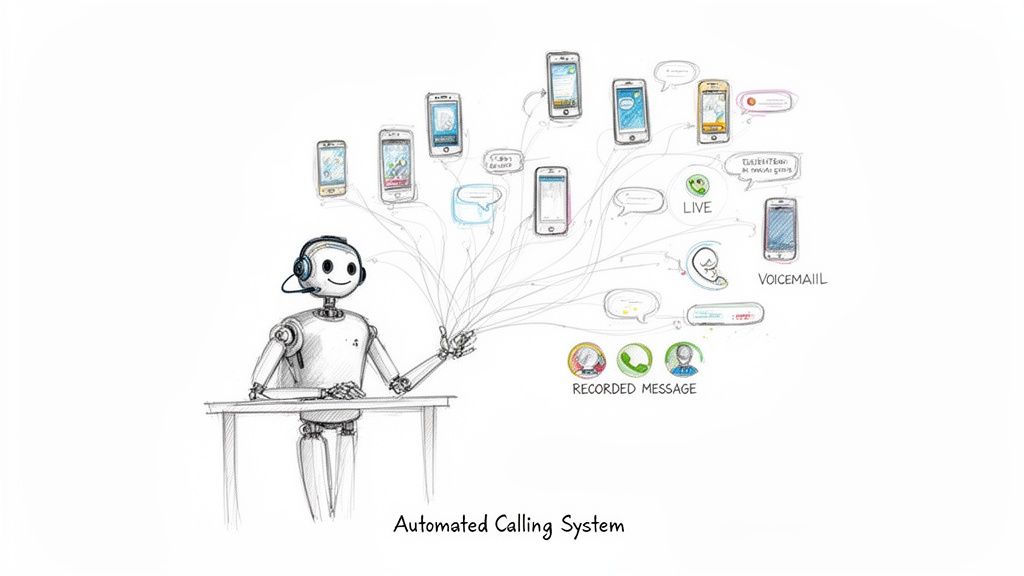
At its heart, an automated calling system is incredibly versatile. It can be bent and shaped to fit a huge range of communication needs, going way beyond simple one-way messages. These systems offer dynamic features that help you hit different goals, whether that's generating leads, sending reminders, or gathering feedback.
Here's a quick look at the main tools you'll find in your automated calling toolbox.
These core functions transform a basic dialer into a powerful engine for engagement and efficiency.
By automating routine outreach, businesses can ensure every lead is followed up on, every customer receives timely information, and every appointment is confirmed, all without manual intervention. This creates a more reliable and efficient communication workflow.
Throughout this guide, we'll dig deeper into how these components work, where they shine brightest, and how you can use them responsibly to grow your business or improve your patient communications.
To really get the most out of an automated calling system, you need to peek behind the curtain and see how it all works. Think of it like a high-performance engine; every part has a job, and they all have to work together perfectly to get a powerful result. Once you break the system down, you can see how a simple list of phone numbers gets turned into a full-blown communication campaign.
These are the building blocks for any solid outreach plan, whether you're sending simple reminders or running complex interactive surveys.
First up, you have the contact list manager. This is the fuel for your entire campaign. It’s way more than a digital address book—it's a dynamic database where you can upload, organize, and slice and dice your contacts. A clean, well-managed list is the absolute foundation of a successful automated call.
A good list manager lets you pull in contacts from all over, like your CRM or even a basic spreadsheet. More importantly, it helps you segment your audience into targeted groups based on things like demographics, what they've bought before, or how they've engaged with you. This is how you make sure the right message gets to the right people, every single time.
For instance, a healthcare clinic could easily create separate lists for patients who need appointment reminders versus those who are due for a flu shot.
If your contact list is the fuel, the message creation studio is the ignition. This is where you actually build the audio message your contacts will hear. Modern platforms give you a few different ways to create your message, offering a ton of flexibility.
You can upload a pre-recorded audio file, which is perfect for keeping your brand consistent with a familiar voice. Or, you could use a text-to-speech (TTS) engine, which turns written text into surprisingly natural-sounding audio.
The real magic of TTS is in the personalization. By using merge tags, you can drop in specific details like a customer's name or appointment time, making a mass broadcast feel more like a one-on-one conversation.
This kind of personal touch can seriously boost engagement, since people are way more likely to listen when a message feels like it was made just for them.
Next is the dialing engine, the powertrain that does all the heavy lifting. This is the tech that blitzes through your list, dials the numbers, and plays your message. It's the heart of the system, but how it delivers that message can vary a lot.
You can pick different dialing modes based on what you're trying to achieve. A standard voice broadcast, for example, will actively call each number and play your message when someone answers or leave it on their voicemail. You can also explore the diverse features of an automated outbound calling system to see what other options are out there for proactive outreach.
Another powerful tool is ringless voicemail. This slick feature lets you drop a message right into someone's voicemail box without their phone ever ringing. It’s a great, non-intrusive way to handle marketing follow-ups or gentle reminders because people can listen whenever it’s convenient for them. The system just bypasses the live call and places the audio file directly on the voicemail server.
Finally, the analytics and reporting dashboard is your control panel. After you’ve run a campaign, this is where you get all the critical data to measure what worked and fine-tune your next move. It’s not just about seeing how many calls were made; it’s about understanding what actually happened on each one.
Key metrics you’ll want to track include:
This kind of feedback is priceless. It lets you A/B test different messages, call times, and audiences so you can keep getting better results.
Once you've got the basics of your automated calling system down, the real fun begins. This is where you start using the powerful tools in your kit, and two of the most effective are voice broadcasting and ringless voicemail. They both get your audio messages to people, but they do it in very different ways for very different situations.
Think of voice broadcasting as your digital megaphone. It’s the perfect tool for blasting a single, important message out to a huge group of people all at once. The system actively dials every number on your contact list, making it a lifesaver for time-sensitive news where you need everyone to know right now. This direct approach guarantees your message gets delivered, whether a real person answers or it goes to their voicemail.
For example, imagine a local school district has to call a snow day. It's simply not possible to manually phone hundreds, or even thousands, of parents in time. Voice broadcasting turns this logistical nightmare into a simple three-step process:
This is incredibly efficient for emergency alerts, big event promotions, and any community announcement where mass reach is the name of the game. If you want to dive deeper into the nuts and bolts, check out our detailed guide on voice broadcast software.
While voice broadcasting is loud and proud, sometimes you need a softer touch. That’s where ringless voicemail comes in. Just like the name says, this clever tech drops a pre-recorded message straight into someone's voicemail box without their phone ever ringing. It’s like slipping a note under their door instead of banging on it.
This non-intrusive method is a total game-changer for outreach that isn't an emergency. It respects people's time by letting them listen when it's convenient, which is perfect for marketing follow-ups or gentle reminders. It works by connecting directly to the mobile carrier's voicemail server, bypassing the live phone network entirely.
Ringless voicemail lets you stay in touch and deliver valuable info without interrupting someone's day. That simple act of respect can do wonders for engagement and keeps your message from feeling like spam.
The diagram below shows just how simple the workflow for a typical automated calling campaign really is.
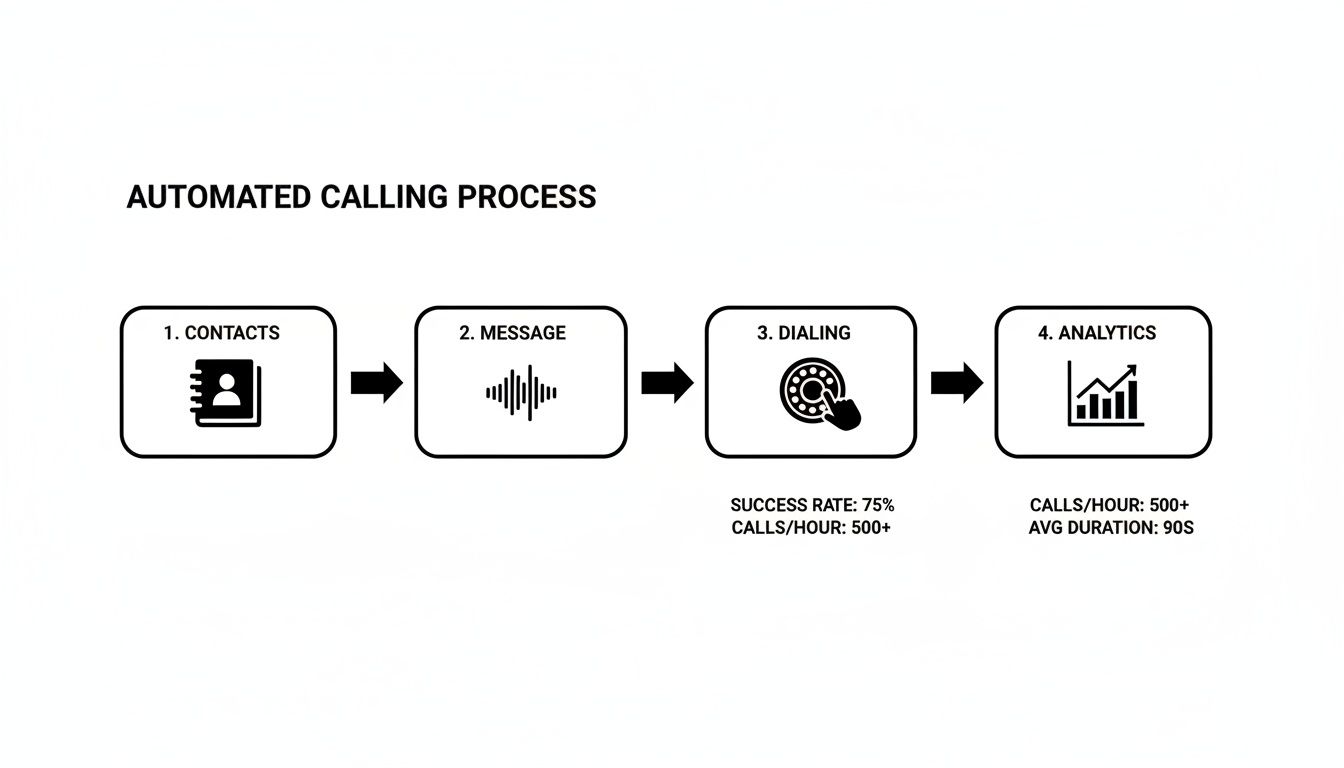
As you can see, it's a seamless path from your contact list all the way to the final analytics, giving you a clear picture of how your campaign performed.
The secret is knowing which tool to pull out of the toolbox for each specific task. An automated calling system that gives you both options is the most versatile platform you can have. Your choice really just boils down to your goal and the tone of your message.
Let's look at a few scenarios:
Ultimately, getting good at this means understanding your audience and the context. By strategically choosing between a direct broadcast and a subtle voicemail drop, you can make your outreach far more effective, respectful, and impactful.
Okay, let's move past the technical talk and see how this stuff actually works in the real world. An automated calling system isn't just about dialing numbers faster; it's about solving real business problems and making things happen.
The true power of this technology really clicks when you see how different businesses apply it. From healthcare to e-commerce, it’s all about matching the right tool—like voice broadcasting or a ringless voicemail drop—to the right job.
For any clinic or hospital, communication is everything. It directly impacts patient care and keeps the whole operation from falling into chaos. This is where automated calling systems come in, sending out HIPAA-compliant appointment reminders that drastically cut down on costly no-shows. A missed appointment isn't just lost revenue; it throws the entire day's schedule off track.
A simple, automated reminder call the day before an appointment can slash no-show rates by as much as 25% or more. But it doesn't stop at reminders. Healthcare providers are using these systems for so much more:
These small touches don't just help patients stay on top of their health; they free up administrative staff from spending hours on the phone. That means more time focusing on the people right in front of them.
In the cutthroat world of online retail, abandoned carts are the enemy. You have to find a way to bring those almost-customers back, and this is where the subtlety of ringless voicemail is a game-changer. Instead of an intrusive live call, a brand can drop a message straight into a potential customer's inbox without making their phone ring.
Picture this: a customer leaves a few items in their online shopping cart. A day later, they get a friendly voicemail: "Hi Alex, we noticed you left a few items in your cart at Trendify. We saved them for you and wanted to offer you free shipping on your order." It's a non-disruptive nudge that's incredibly effective at getting people to come back and finish what they started.
Sales teams, especially in real estate, are drowning in leads. The challenge is figuring out who's serious and who's just kicking tires. Interactive "Press-1" campaigns are perfect for this. A real estate agent can send a broadcast to a list of new leads with a message like, "Hi, this is Jane from Premier Homes. Are you actively looking to buy a new home in the next three months? Press 1 for yes, or press 2 to be removed from our list."
This simple interaction instantly separates the hot leads from the cold ones. The system can even automatically transfer anyone who presses "1" directly to a live agent, making sure sales pros spend their time on conversations that actually matter.
This is a world away from old-school outreach. While traditional cold calling has a miserable success rate of just 2.3%, modern teams are using smarter, automated sequences to get far better results. Smart reps now make 40 strategic calls a day instead of 200 random dials, boosting their efficiency by a whopping 50%. You can discover more insights about modern sales outreach on Trellus.ai. By pre-qualifying interest, an automated calling system ensures every minute spent on the phone is a minute well spent.
Using an automated calling system gives you incredible power to scale your outreach, but that power comes with some serious legal responsibilities. Getting a handle on the rules isn't just about dodging massive fines; it’s about building trust and making sure your communication feels respectful, not like an invasion of privacy.
The two big players you absolutely have to know are the Telephone Consumer Protection Act (TCPA) and the National Do Not Call (DNC) Registry.
The TCPA is a federal law created to shield people from a barrage of unwanted telemarketing calls, faxes, and texts. At its heart is one simple, crucial concept: consent. If you're sending marketing messages with an automated system, you almost always need to have prior express written consent from the person you're contacting. They have to clearly and unambiguously agree to get these kinds of calls from you.
Just because someone is a customer and you have their phone number doesn't mean you have a green light for marketing broadcasts.
Think of consent like getting an invitation to someone's house. If they haven't specifically invited you over to pitch your products, you can't just show up on their doorstep. For purely informational messages—things like appointment reminders or shipping updates—the rules can be a little more forgiving, but it's always smarter and safer to get clear permission upfront.
Another major piece of the compliance puzzle is respecting quiet hours. The TCPA is very clear: telemarketing calls can only be made between 8 AM and 9 PM in the recipient's local time zone. This is a huge deal. A good automated calling system will manage time zones for you, so you don't accidentally wake someone up in California at 7 AM just because it's 10 AM where you are.
Sticking to these rules is non-negotiable. Fines for TCPA violations can be brutal, running anywhere from $500 to $1,500 per call. Responsible communication isn't just good manners—it's essential for protecting your business.
The National Do Not Call Registry is exactly what it sounds like: a list of people who have raised their hands and said, "Don't call me for marketing." Before you even think about launching a campaign, you have to scrub your contact list against this registry and remove anyone who's on it. This also goes for your own internal do-not-call list, which you are legally required to keep.
Thankfully, modern automated calling platforms build compliance tools right into their software to make this less of a headache. You should look for features like:
These features help put compliance on autopilot, protecting both you and your audience. If you want to dive deeper into how technology can help you run a responsible outreach campaign, check out our guide on automatic voice messaging. At the end of the day, a compliant approach is what ensures your messages are actually welcomed, not immediately hung up on.
The old-school automated calling system is getting a major upgrade. Thanks to artificial intelligence, these platforms are no longer just robotic dialers—they're becoming smart communication tools that can actually learn and adapt. It's a huge shift in how businesses can connect with people, making every call feel more personal and, frankly, more effective.
AI-powered features go way beyond just playing a pre-recorded message. Now, systems can use AI text-to-speech (TTS) engines to create personalized audio on the fly. By pulling information straight from your CRM—like a customer's name, their appointment time, or what they last bought—the system can craft a message that sounds natural and is genuinely relevant to the person on the other end.
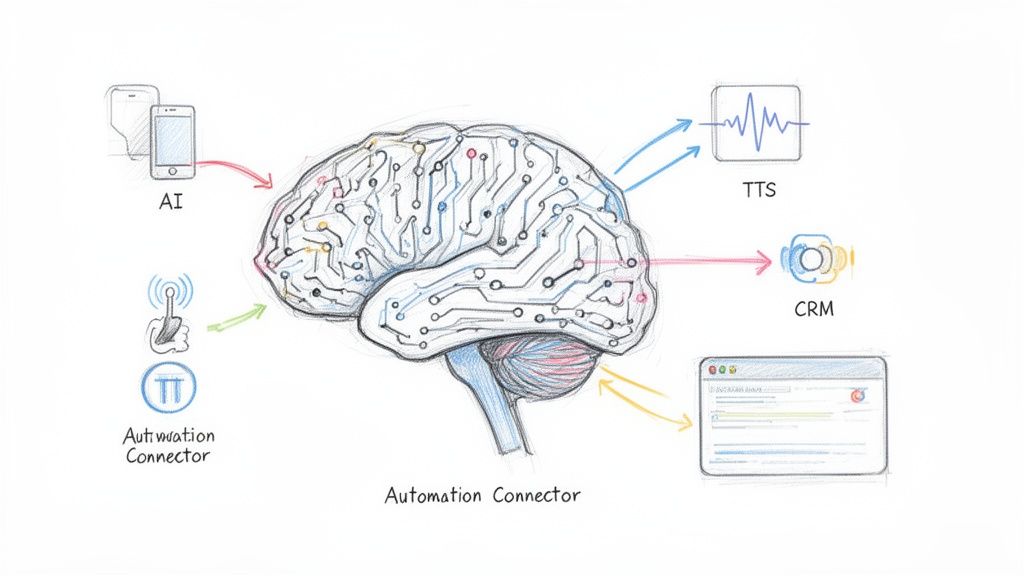
One of the slickest uses of AI is intelligent answering machine detection. We've all experienced it: a recorded message starts playing before the voicemail beep, cutting off the first few seconds. Traditional systems have always struggled with telling a live person apart from a machine, leading to those awkward, clipped messages. But modern AI is much better, analyzing audio cues in real-time to figure it out with near-perfect accuracy.
This little bit of intelligence has a big impact on your wallet. When your messages are left correctly and live calls are only transferred when a real human picks up, you stop wasting time and money on failed attempts. For campaigns using less intrusive methods like ringless voicemail drops, AI can even help verify phone number types to make sure more of your messages get delivered successfully.
The market for the AI that powers these systems is exploding. Valued at USD 2.41 billion, it's expected to rocket to USD 13.52 billion by 2034. North America is leading the charge with a 37.50% market share as businesses rush to adopt smarter engagement tools. You can learn more about the call center AI market on Fortune Business Insights.
The real magic happens when you connect an AI-driven calling system with the other tools you already use. Integrations, especially with platforms like Zapier, act as a bridge, letting your calling platform talk to thousands of other apps. This is how you build communication flows that automatically react to what your customers do.
Think about how these automated workflows could play out:
These intelligent triggers transform your outreach from a simple broadcast into a conversation that responds to customer behavior. It ensures your messages are not just efficient but perfectly timed, creating a much better experience and building a stronger relationship with your audience.
Jumping into the world of automated outreach always brings up a few good questions. We've gathered some of the most common ones here to help you see how these tools can fit into your business and what you need to know to get started.
Yes, it's perfectly legal—as long as you play by the rules. The big one to watch is the Telephone Consumer Protection Act (TCPA), which means you generally need to get someone's express consent before sending them marketing calls.
For informational messages, like appointment reminders or delivery updates, the rules can be a bit different. Any good platform will have built-in safety nets, like DNC list scrubbing and simple opt-out features, to keep you on the right side of the law. Just make sure you understand the specific rules for your situation.
Think of voice broadcasting as an active phone call. The system dials a number, and if someone picks up, your message plays. If it hits voicemail, the message gets recorded. It’s direct and great for urgent news or campaigns where you want an immediate response.
On the other hand, ringless voicemail is much more subtle. It drops your audio message directly onto the voicemail server without making the person's phone ring. This approach is perfect for marketing follow-ups or gentle reminders when you don’t want to interrupt their day.
Pricing varies, but most systems are built to be flexible and grow with you. You'll typically see two main models:
The final cost really depends on how many calls you're making and what features you need, like advanced analytics or CRM integrations. This keeps the technology accessible for businesses of all sizes, from a small shop sending a few hundred reminders to a large company running a massive campaign.
The best part about modern pricing is its flexibility. You only pay for what you actually use, whether you're a small business or a huge enterprise.
Absolutely—and you definitely should! Personalization is where these systems really shine. Using text-to-speech technology with merge tags, you can automatically pop in specific details like a customer's name, their appointment time, or an order number right into your audio message.
This one simple step turns a generic blast into a message that feels personal and relevant. When a message feels like it was made just for them, people are way more likely to listen and take action, which means much better results for you.
Ready to streamline your outreach with a powerful and compliant automated calling system? With Call Loop, you can automate SMS, voice broadcasts, and ringless voicemail campaigns to connect with your audience effectively. Explore how Call Loop can transform your communication strategy today!
Chris Brisson
Chris is the co-founder and CEO at Call Loop. He is focused on marketing automation, growth hacker strategies, and creating duplicatable systems for growing a remote and bootstrapped company. Chat with him on X at @chrisbrisson


Trusted by over 45,000 people, organizations, and businesses like


