
See a Demo
You're just one step away from seeing Call Loop in action.
Enter your information below to watch a demo right now.

You're just one step away from seeing Call Loop in action.
Enter your information below to watch a demo right now.

Which SMS platform fits your workflow, not just your feature checklist? The best SMS marketing tools aren't interchangeable. A Shopify store needs native customer data and coupon attribution, while a healthcare provider needs stronger compliance controls and a CRM-connected outreach process. An engineering team may prefer APIs, webhooks, and carrier controls. A local service business may need reliable two-way texting, scheduling, and list growth without a long implementation project.
This comparison ranks platforms by operating context, including automation depth, implementation effort, pricing structure, opt-in support, deliverability, analytics, integrations, and multichannel capability. SMS has become a mainstream business channel. 2026 market benchmarks place the U.S. SMS marketing market at about $12.6 billion, with annual growth around 20.3%, while global mobile messaging estimates range from roughly $16 billion to $18 billion (2026 SMS marketing market benchmarks). The same source reports that 75.3% of businesses use SMS marketing and 65.4% plan to increase texting budgets, so the decision is now about operational fit, not whether texting deserves a place in the stack.
Ringless voicemail can extend an SMS sequence when voice outreach is useful, but it isn't a compliance shortcut. Teams considering broader marketing automation for churches or any other organization-wide workflow should evaluate voice, voicemail, and texting together.
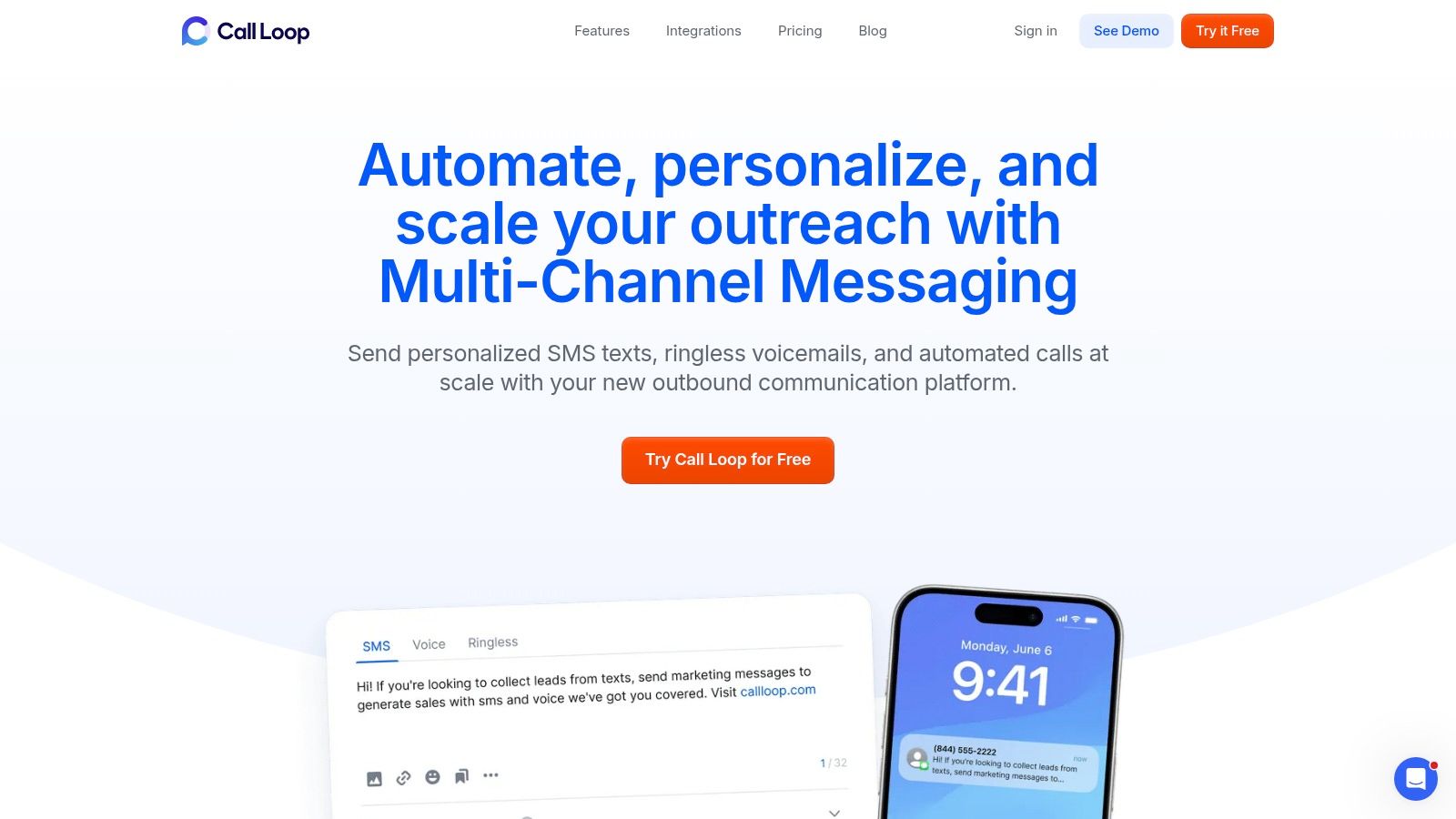
Best for coordinated SMS, voice broadcasting, and ringless voicemail
Need one workflow for texting, voice broadcasts, and voicemail drops? Call Loop fits organizations that want more than a standalone SMS inbox. It combines SMS/MMS, voice broadcasting, and ringless voicemail in one outbound messaging platform, so agencies, healthcare providers, event organizers, sales teams, local services, and ecommerce operators can coordinate reminders, follow-up, promotions, and voice escalation.
The SMS tools cover bulk campaigns, text-to-join keywords, segmentation, merge fields, rich media, scheduling, link shortening, click tracking, number validation, double opt-in, and toll-free compliance controls. Those features address common execution problems, including weak list hygiene, unclear consent, untracked links, and invalid numbers. Industry benchmarks commonly report around a 98% open rate, about 90% of texts read within three minutes, and click-through rates in the 12% to 20% range (SMS engagement benchmarks). Call Loop's validation and tracking features help teams assess whether campaigns are reaching opted-in contacts and producing clicks.
The voice tools include live and machine answer detection, press-1 transfers, custom caller ID, uploaded or AI text-to-speech audio, and DNC management. Ringless voicemail supports mobile and landline delivery, scheduling, unlimited recordings, and billing per successful drop. That billing approach can suit teams that want voicemail outreach without paying for unsuccessful drops, although carrier availability and local rules still affect delivery.
Compliance rule: Ringless voicemail to wireless phones requires consumer consent in the United States. The FCC treated it as a call made with an artificial or prerecorded voice under the TCPA in its 2022 ringless voicemail ruling.
Multi-channel drip campaigns can coordinate SMS, calls, and voicemail through timers, calendar triggers, custom-date triggers, and appointment reminders. Integrations include ActiveCampaign, HubSpot, Keap, and more than 4,000 apps through Zapier. The platform is built with HIPAA compliance for healthcare workflows, while Call Loop states that it is trusted by more than 45,000 users, a product detail listed on its outbound messaging platform.
Implementation is broader than a basic SMS tool, so teams should map consent, CRM fields, routing rules, and escalation timing before launch. Public pricing details are limited. Request exact costs, volume terms, and enterprise information, then test the free trial against expected message and voicemail usage. Ringless voicemail is charged per successful drop.
Pros
Cons
Best for small teams that want to launch quickly
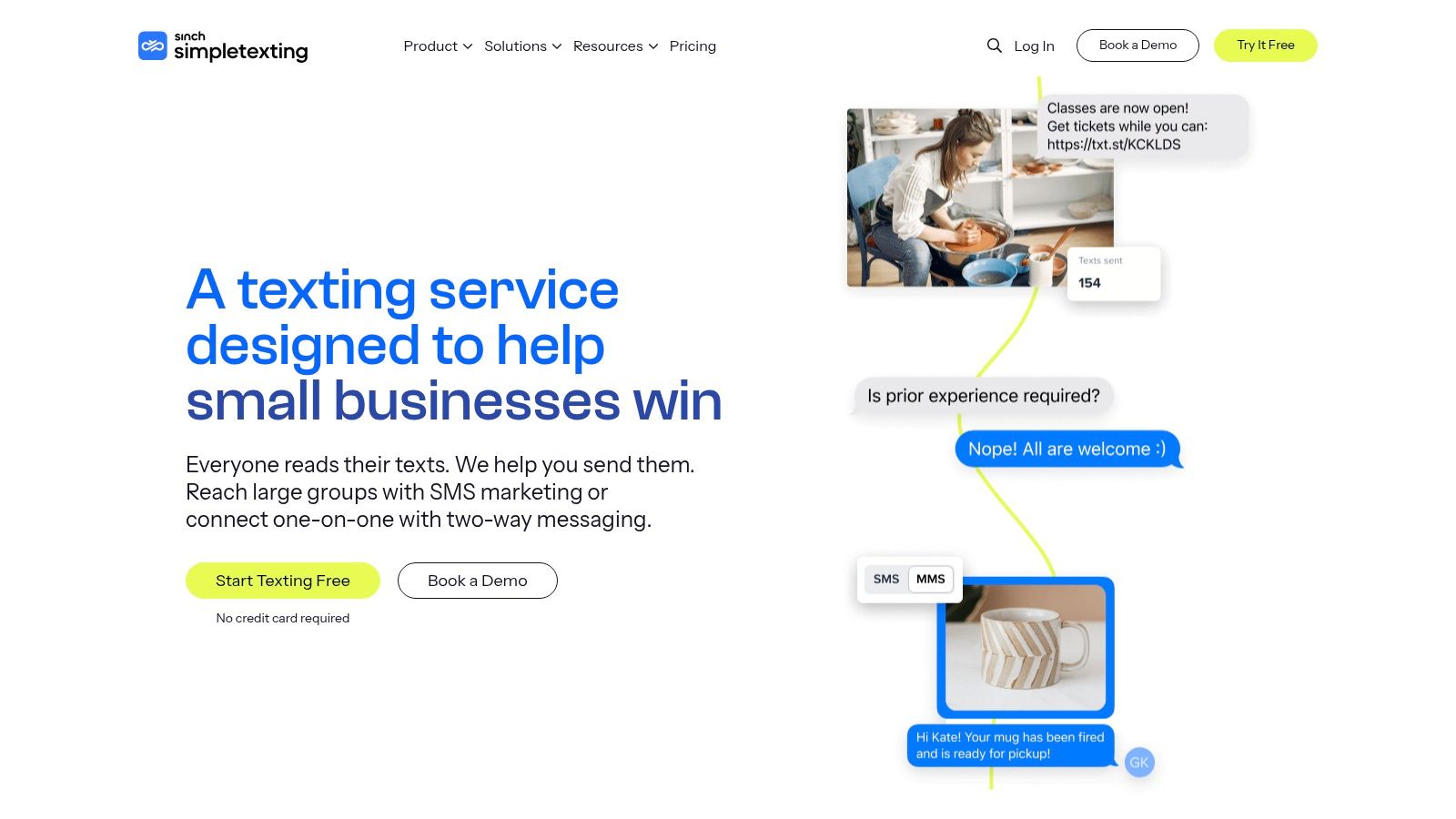
SimpleTexting is a practical choice for marketers who need SMS/MMS, two-way conversations, scheduling, list growth, and basic automation without a developer-heavy setup. Local businesses can create text-to-join keywords, web forms, and pop-ups, then use a shared inbox for replies. That makes it suitable for promotions, event registration, appointment reminders, and modest ecommerce campaigns.
The platform includes a link shortener and click tracking, segmentation, templates, autoresponders, and an API for teams that want light integrations later. Nontechnical users can start with a campaign workflow and add automation as their needs become more demanding. That gradual path is useful for a karate studio sending class notifications, an event organizer filling seats, or a small retailer promoting a limited-time offer.
SimpleTexting uses a credit and usage-based model. Longer messages and MMS consume more credits, so teams should test their actual message format before estimating monthly spend. A short promotional SMS and an image-heavy MMS campaign won't have the same consumption pattern.
The platform isn't marketed as a HIPAA-secure messaging tool, and ordinary SMS should generally not be treated as a safe channel for protected health information. Healthcare teams should choose a platform and workflow designed for their regulatory obligations rather than assuming that a general business texting tool is sufficient.
For teams comparing onboarding effort, SimpleTexting is easier to approach than an API-first platform. It still needs a documented consent process, clear opt-out language, and a plan for handling replies. Promotional texts in the United States require prior express written consent under TCPA-oriented guidance, and opt-outs should be explicit and immediate (U.S. SMS compliance guidance).
See this SMS marketing platform comparison when you want to compare a simpler texting workflow with broader multichannel automation.
Pros
Cons
Best for straightforward SMB campaigns and mobile team access
EZ Texting focuses on familiar small-business jobs, including mass texting, MMS, reminders, promotions, and one-to-one support. Its two-way inbox, templates, link shortening, click tracking, contact management, bulk uploads, and segmentation cover the fundamentals without forcing a small team into a complex journey builder.
The iOS mobile app is particularly useful for owners and field staff who need to answer customer messages away from a desktop. A local service business can respond to a scheduling question, while an event organizer can monitor replies during registration. Multiple number types, including 10DLC, toll-free, and dedicated short code options, give teams choices for different operating needs.
EZ Texting includes SafeSTOP compliance aids and offers onboarding designed for SMB users. That makes it approachable for a business sending promotions or reminders for the first time. It also supports AI assistants and basic automation, but its ecommerce automation is lighter than platforms built specifically around Shopify data.
The main budgeting issue is that price per message varies by plan, and the difference between credits and message parts can confuse forecasting. A long message may consume more than a single message unit, so a team should model campaigns using the actual copy and media it plans to send. This is more useful than comparing only a plan's headline allowance.
EZ Texting works well when a business values clarity and mobility over deep ecommerce orchestration. It's less compelling when the central requirement is a complex abandoned-cart journey, unified email and SMS profile, or custom application messaging.
Best for advanced list growth and compliance-conscious journeys
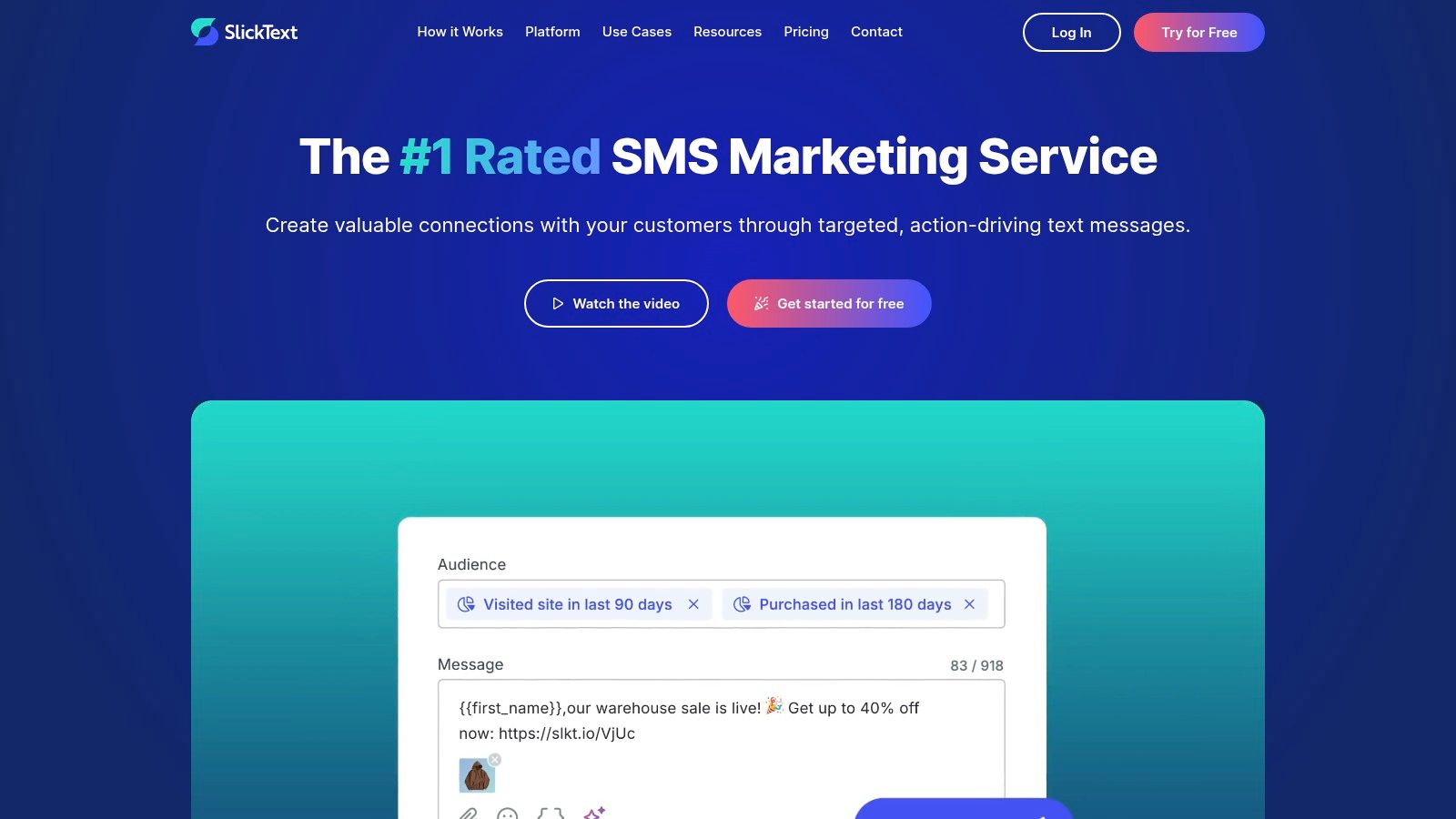
SlickText suits teams that want more depth than a broadcast tool but don't need a large enterprise engagement suite. Its keywords, pop-ups, QR codes, double opt-in, consent records, segmentation, analytics, and drip sequences support a complete subscriber lifecycle. A business can attract subscribers, document consent, branch audiences, and measure link engagement inside one platform.
The journey automation is the main reason to choose SlickText. Multi-step flows can handle welcome sequences, event reminders, promotional follow-ups, and re-engagement. Integrations with Shopify, ActiveCampaign, Zapier, Make, and other systems help connect texting to ecommerce, CRM, and operational events.
SlickText embeds compliance guidance into the product, which is valuable for teams that don't want opt-in management treated as an afterthought. Consent records and double opt-in workflows create a stronger operational record than just importing a spreadsheet of phone numbers.
The trade-off is its credit system. Longer texts and MMS use more credits, so a campaign with rich media or detailed copy requires closer budget monitoring. That doesn't make the platform a poor value, but it changes how finance and marketing should plan usage.
SlickText is a good middle ground for an agency or growing retailer that needs branching journeys, list-growth assets, and compliance support. A business that only sends occasional announcements may find the workflow depth unnecessary, while an enterprise with complex customer profiles may need a more expansive omnichannel system.
Best for engineering teams building custom messaging products
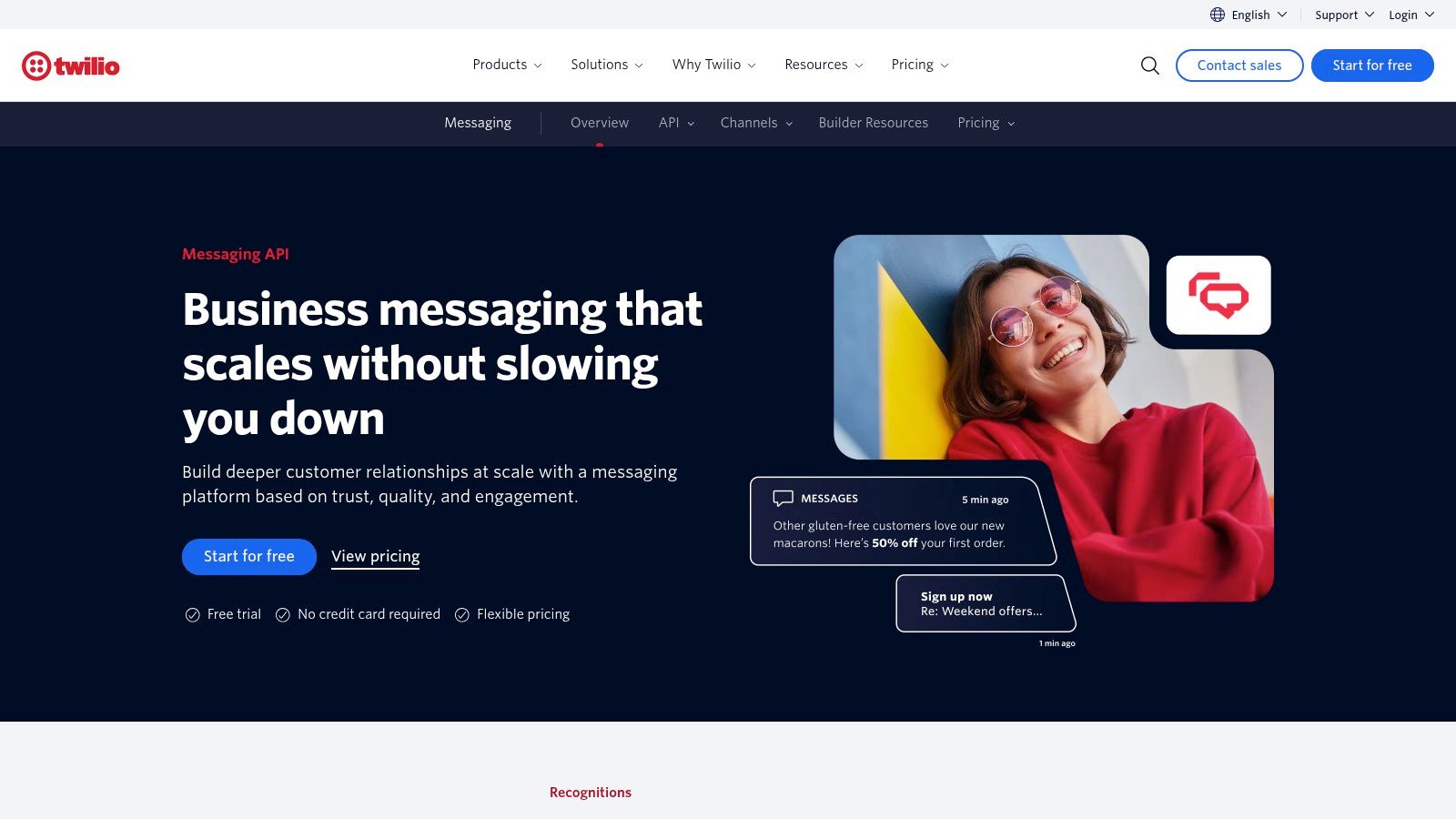
Twilio Programmable Messaging is a CPaaS, not a ready-made SMS marketing dashboard. It gives developers APIs, webhooks, number provisioning, and channel access for SMS, MMS, WhatsApp, and RCS. Teams can embed messaging into a customer portal, dispatch system, healthcare application, CRM, or custom ecommerce service.
The platform supports short code, toll-free, and 10DLC number types, along with carrier compliance tooling and deliverability controls. Its pay-as-you-go structure and broad channel coverage make it attractive when the organization wants granular control over how messages are triggered, stored, routed, and reported.
Twilio won't give a marketing team a finished segmentation interface, visual journey builder, consent database, or campaign calendar in the same way a purpose-built marketing platform does. Your team must build those functions or connect Twilio to an orchestration layer. That may be the right investment for an engineering-led company, but it's unnecessary work for a local business that needs a reliable broadcast and shared inbox.
Total cost also includes carrier fees and any CRM, automation, analytics, or user-interface tools added around the API. Before choosing Twilio, define who owns message templates, opt-out processing, campaign QA, reporting, and incident response.
Engineering fit: Choose Twilio when messaging is part of your product or operational architecture. Don't choose it merely because an API sounds more scalable than a dashboard.
Teams exploring API-based workflows can also review this guide to send SMS online through an API before deciding whether to build or buy.
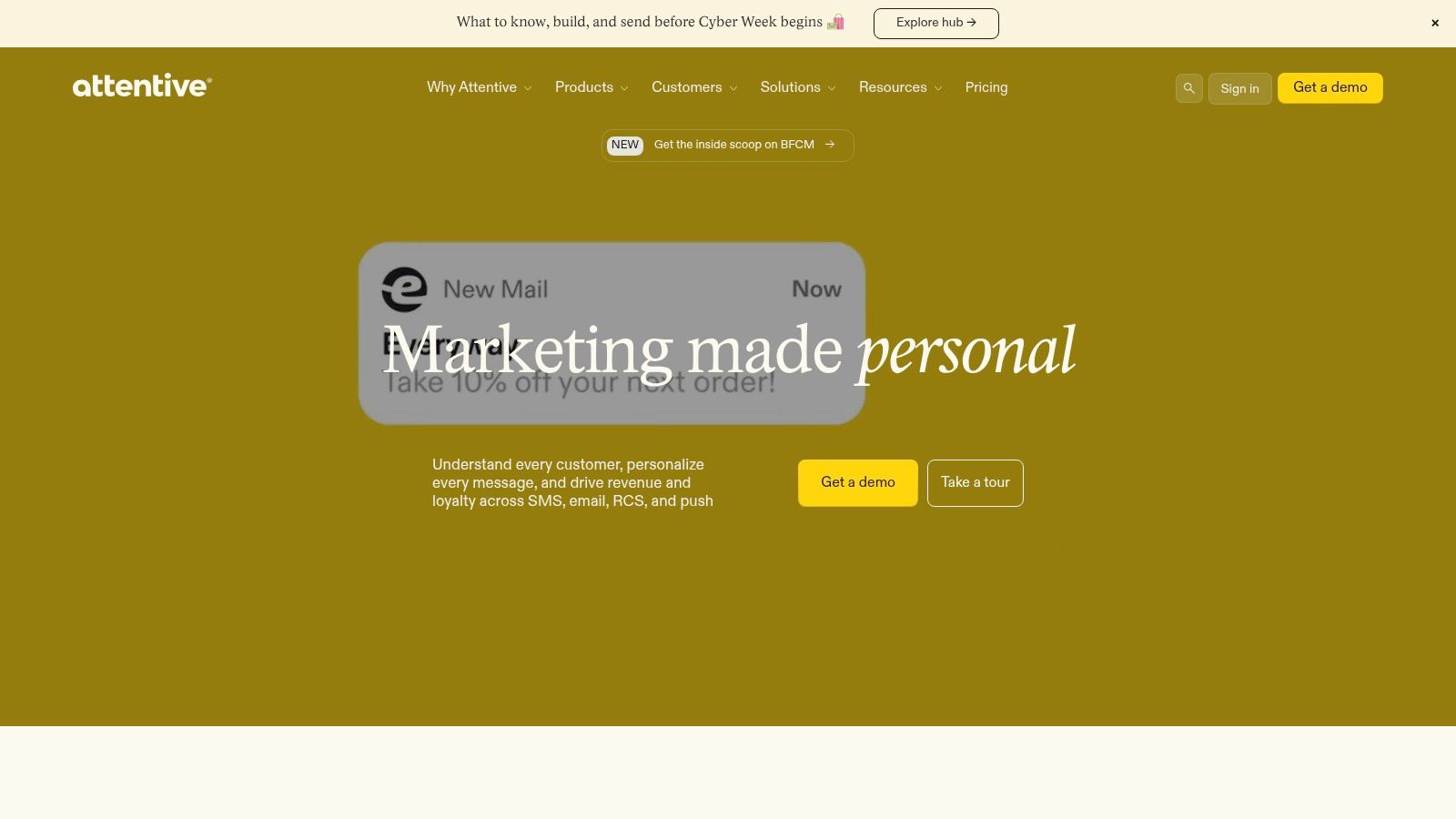
Best for large ecommerce brands with a sales-led engagement program
Attentive is built for ecommerce organizations that treat SMS as a major lifecycle and revenue channel. It brings together compliant onsite sign-up units, landing pages, SMS and email campaign creation, push campaigns, AI-assisted content and journeys, ecommerce playbooks, partner support, and established compliance processes.
Its value comes from coordinating a complex program. A larger DTC brand may need support with opt-in experiences, customer segments, email and SMS timing, and consistent execution across internal teams and agencies. Attentive keeps those ecommerce workflows in one operating environment.
Attentive uses sales-led custom pricing rather than a published rate card. Smaller teams may find that difficult to compare with dashboard-based tools. The platform can also exceed the needs of a healthcare provider, local service company, or event organizer focused on two-way texting and reminders.
The fit improves when a retailer has complex ecommerce operations and can support managed implementation. During evaluation, ask how pricing changes with contact growth, message volume, added channels, onboarding, and services. SMS pricing can change as lists and send volumes expand, as explained in this review of scale economics across SMS and email platforms.
Deliverability and compliance support may justify the sales process for a high-volume retailer, but buyers should still define ownership for consent, opt-outs, campaign approval, and reporting. Attentive also suits teams coordinating SMS with email and push, while a simpler business may gain more from a shared texting inbox.
Attentive is a strong fit for the right retailer, not a sensible first choice for basic campaign messaging.
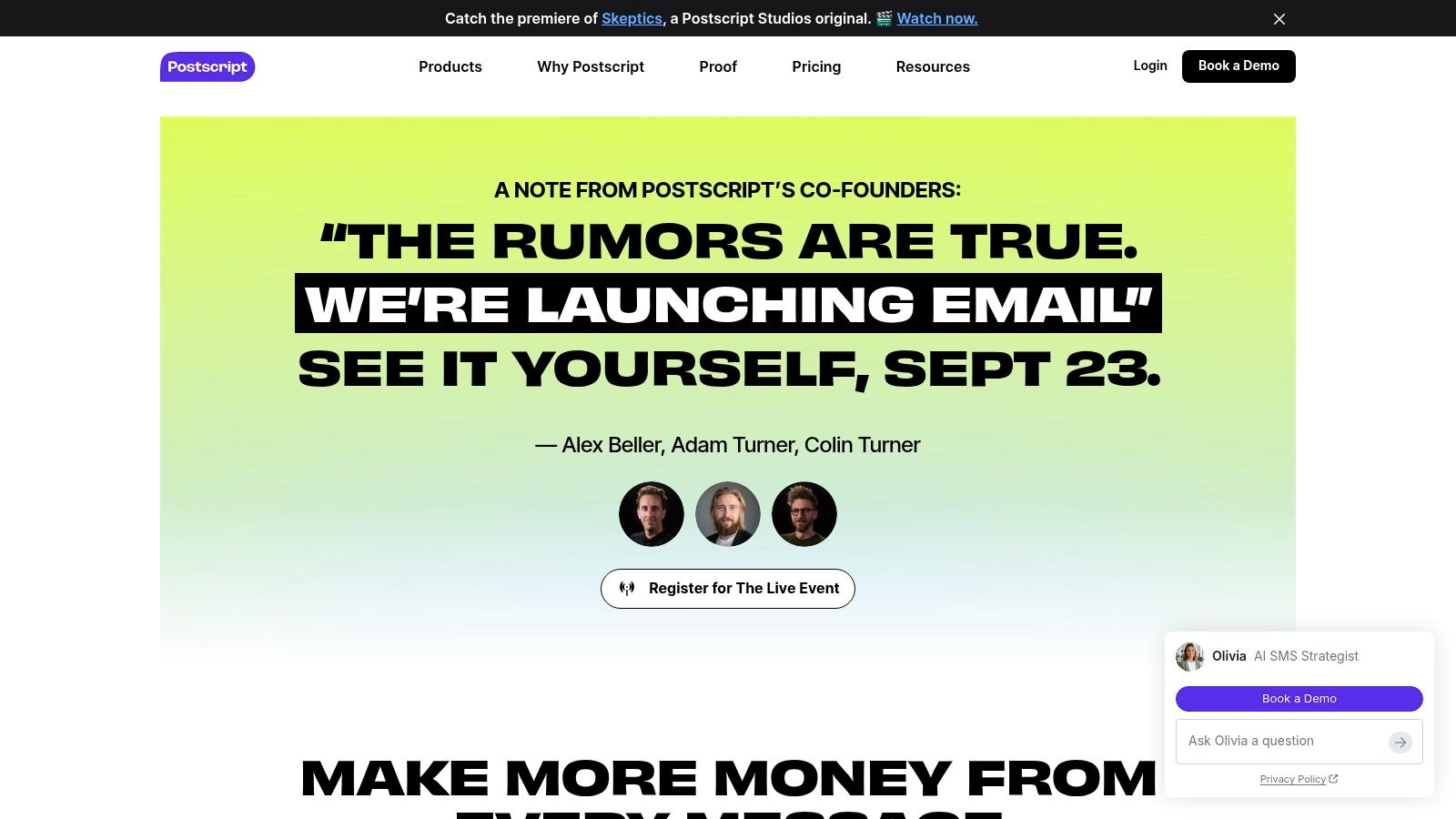
Best for Shopify-native DTC campaigns
Postscript is built around Shopify data, which gives it a clear advantage for stores that want fast implementation and native ecommerce workflows. Its segmentation uses Shopify and app data, while onsite pop-ups, landing pages, and checkout opt-in tools help merchants grow a compliant SMS list.
The Flow Builder supports promotional and conversational sequences. Shopify coupon insertion and attribution controls connect a message to a purchase path, making the platform easier to evaluate than a tool that only reports sends and clicks. Integrations with Klaviyo and other Shopify apps help merchants coordinate SMS with the rest of their store stack.
Postscript's strength is also its boundary. A Shopify merchant can get more relevant segmentation and faster setup than it might receive from a general-purpose texting tool. A company that doesn't use Shopify won't gain the same value, and a healthcare provider or event organizer may have little reason to adopt a Shopify-centered platform.
Billing is usage-based and passes carrier fees without markup, which can be attractive when the team wants a direct view of send costs. It also means someone must monitor volume, carrier fees, and campaign frequency. A store running several automations should test how promotional broadcasts interact with abandoned-cart and post-purchase flows before scaling.
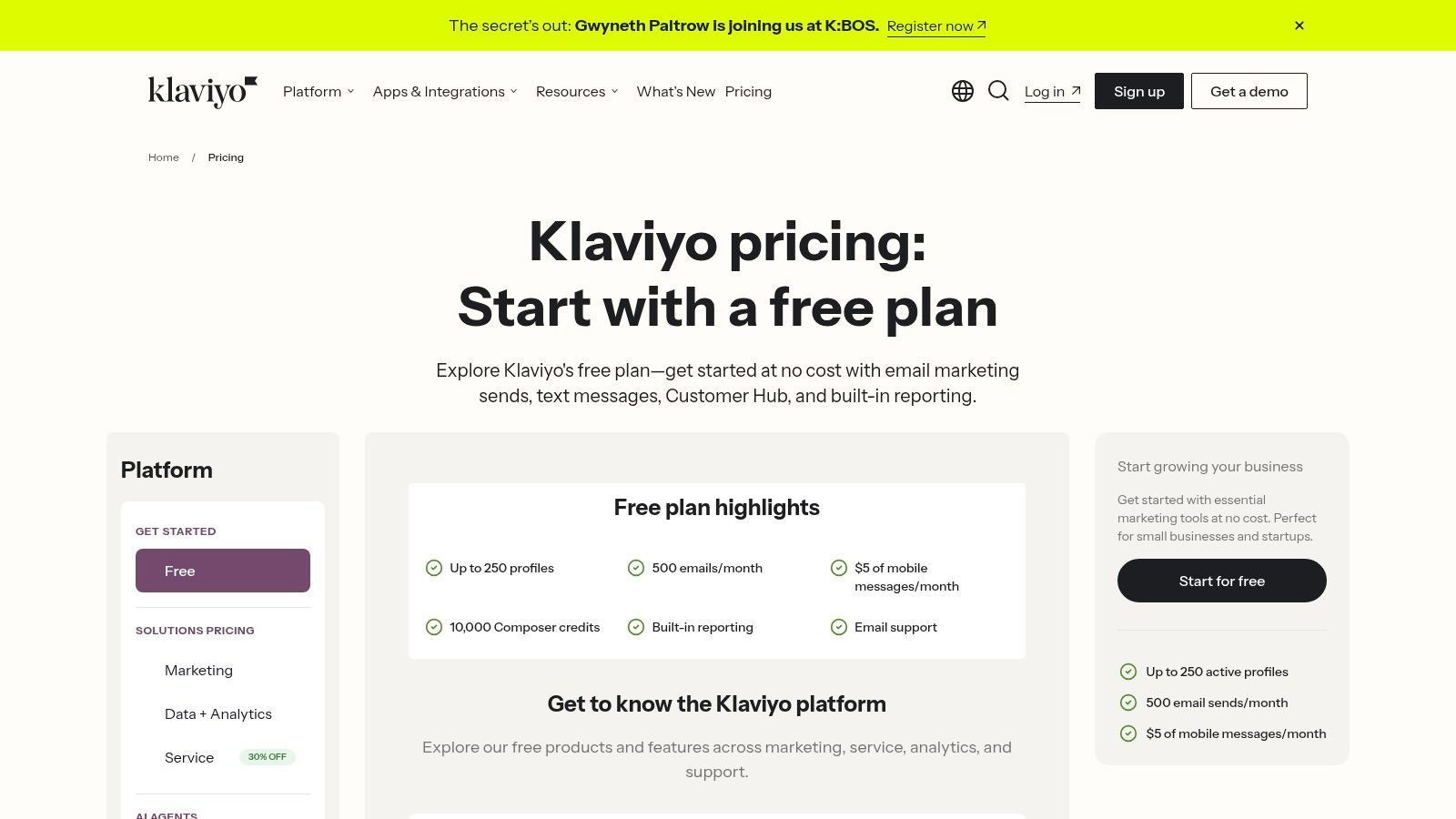
Best for brands already operating Klaviyo email
Klaviyo SMS is most compelling when email already runs in Klaviyo. The platform gives the team shared customer profiles, unified flows, common segmentation, and reporting across email and SMS. That reduces the operational cost of maintaining separate audience logic and helps marketers decide which channel should carry a particular message.
Smart opt-in tools and compliant forms support list growth, while ecommerce integrations, including Shopify, connect behavior and purchase data to campaigns. A brand can use email for longer-form education, SMS for urgency, and shared flows to manage the handoff between the two.
The fit depends heavily on existing investment. A company starting from scratch may prefer a dedicated SMS platform with deeper texting-specific workflow features. Some ecommerce niches may also find Shopify-first specialists more focused on onsite capture, coupon logic, or SMS conversations.
SMS pricing is per message and varies by country and number type. That makes message design, audience rules, and frequency controls important to the forecast. A broad segment receiving both email and SMS may create unnecessary costs if the team doesn't define channel priorities.
Klaviyo is a strong orchestration layer for lifecycle marketers. It's less suitable when the business needs voice broadcasting, ringless voicemail, operational calling, or a shared SMS inbox as the center of its outreach program. For teams deciding whether to coordinate channels inside one customer profile, this email and SMS comparison offers a useful alternative perspective.
Best for ecommerce teams that want email and SMS together
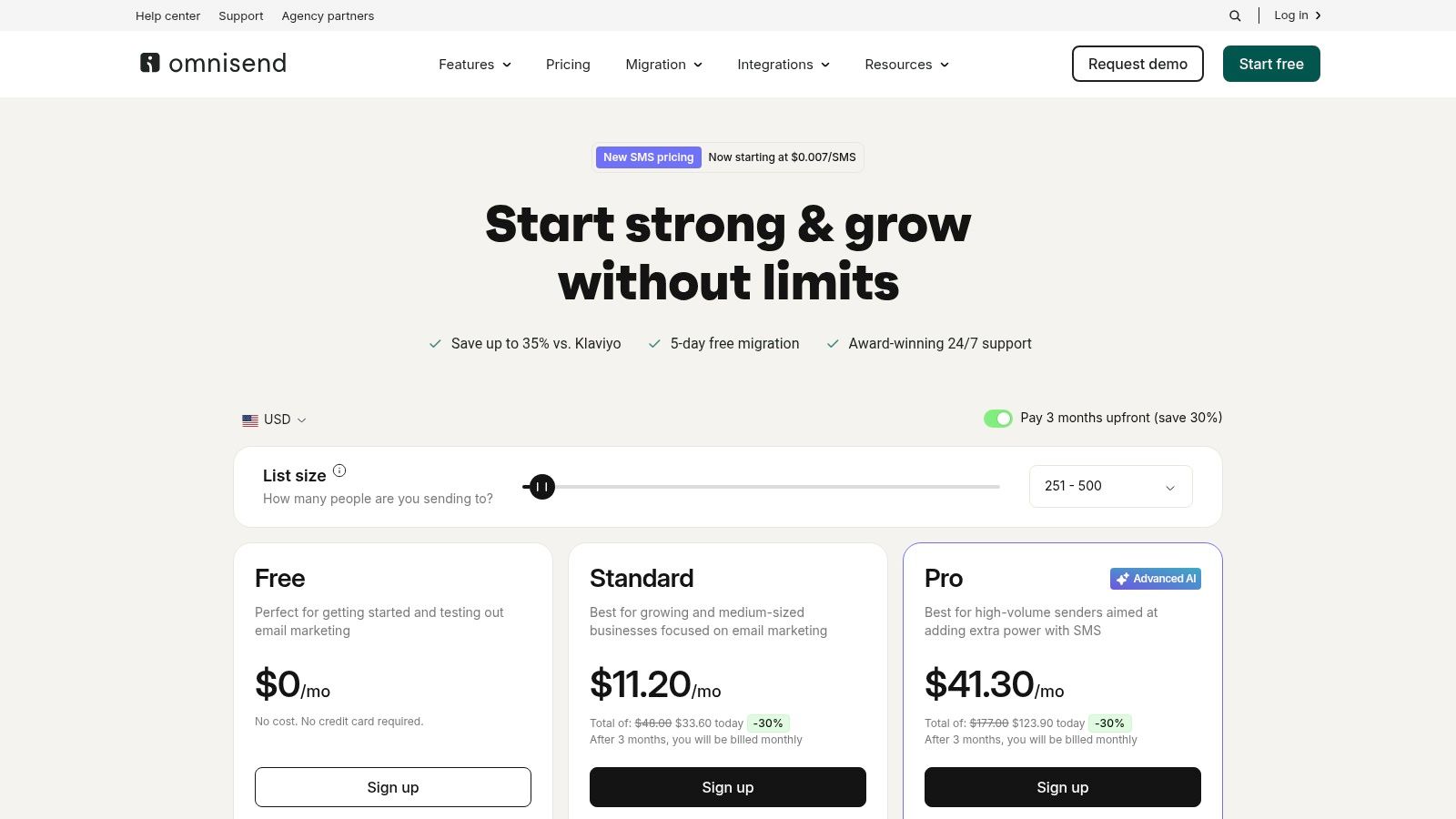
Omnisend combines ecommerce email and SMS automation with pop-ups and integrations for Shopify, BigCommerce, and WooCommerce. That broad store coverage makes it a practical choice for merchants who want to coordinate welcome flows, cart recovery, post-purchase messages, and promotional campaigns without adopting a standalone SMS system.
The Pro plan includes monthly bonus SMS credits equal to the plan price, which can improve the economics for brands already committed to the platform. Teams should still confirm how included credits apply to their country, number type, message format, and actual usage. A credit allowance only helps when it matches the campaign mix.
Omnisend is straightforward to add alongside email, especially for a growing ecommerce team that doesn't need the deepest SMS-first feature set. It may be less specialized than Postscript for Shopify-native workflows or less extensive than Attentive for a large managed ecommerce program.
Newer plans gate SMS behind the Pro tier, so buyers should evaluate the complete plan rather than assuming texting is available at the lowest entry point. The practical question is whether the team wants a balanced email and SMS platform or a dedicated texting engine with stronger channel-specific controls.
Performance data reinforces why measurement matters. Omnisend's benchmark dataset reported an average SMS click-through rate of 12.39%, with the result tied to a source dataset rather than a promise for every campaign (Omnisend SMS benchmark data). Use that kind of benchmark as context, then judge the platform by deliverability, tracked clicks, conversion events, and unsubscribe behavior.
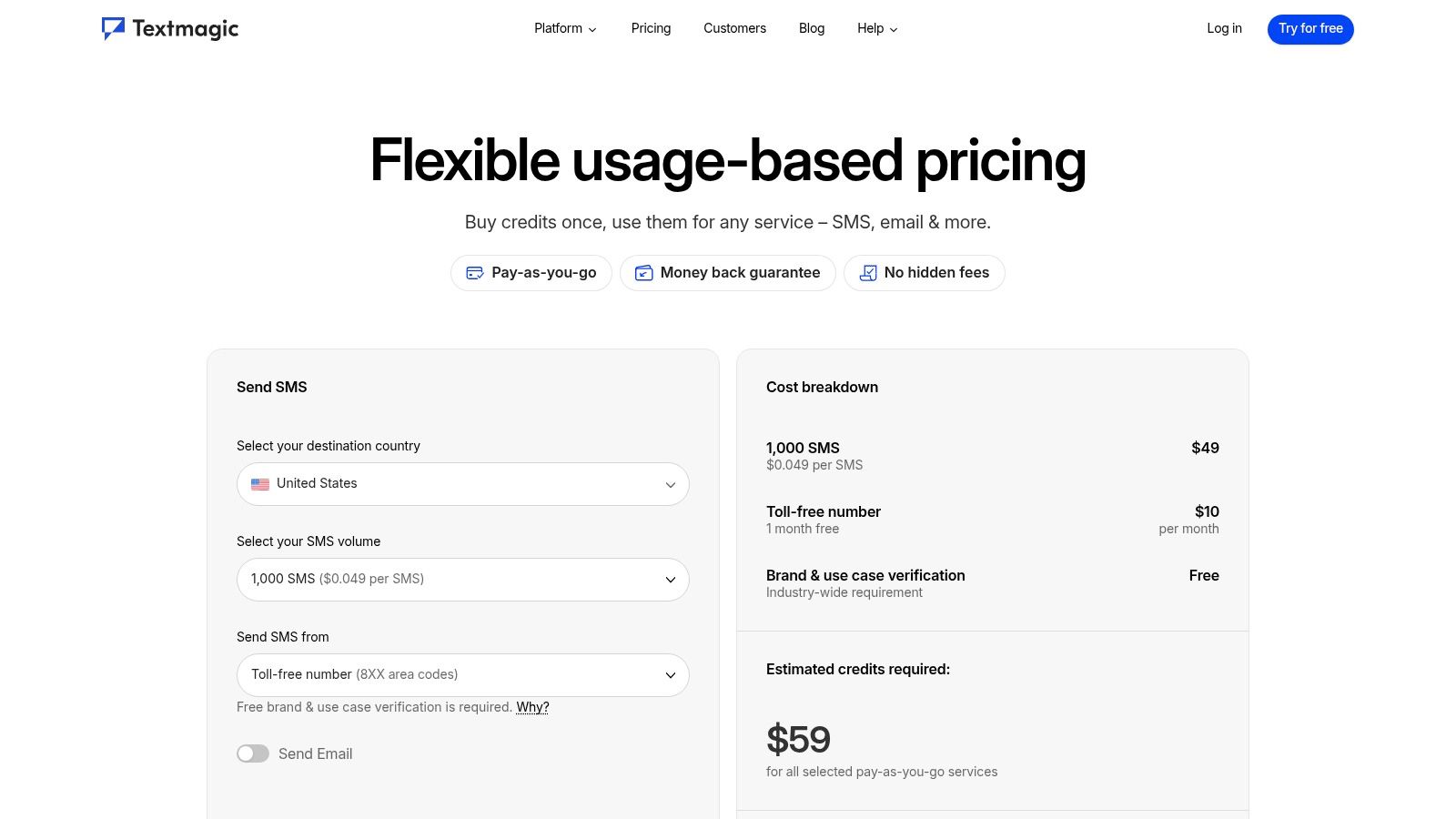
Best for flexible pay-as-you-go texting and shared inboxes
TextMagic works well for teams that need broadcasts, two-way SMS, scheduling, and a shared inbox without adopting a full ecommerce marketing suite. Pay-as-you-go credits, optional monthly plans, unlimited seats in the shared inbox, a REST API, Zapier, Shopify integrations, consent tools, and 10DLC support give it more flexibility than a basic bulk sender.
The BYOC option is a notable differentiator. Teams can use Twilio, Vonage, Sinch, or Bandwidth as their CPaaS provider, potentially lowering per-message costs while keeping TextMagic's interface and workflow layer. That arrangement is useful for an organization with procurement or engineering preferences around carrier infrastructure.
TextMagic's native marketing automation is lighter than the journey systems in SlickText, Attentive, or ecommerce-first platforms. It's a good fit for recurring announcements, appointment messages, event updates, and team-managed replies. It's less appropriate when the campaign depends on complex branching, deep product recommendations, or a unified lifecycle profile across multiple channels.
Pay-as-you-go credits don't expire, and optional monthly plans can support teams that later need more predictable sending. Per-message costs vary by number type, while MMS costs extra, so the team should test representative messages before choosing a billing model. Transparent granular pricing helps, but it doesn't eliminate the need to account for carrier fees and media usage.
| Platform | Core features | Target audience | Key strengths / USPs | Pricing & billing model |
|---|---|---|---|---|
| Call Loop (Recommended) | Multi-channel: SMS/MMS, voice broadcast, ringless voicemail; drip campaigns; integrations; deliverability tools; HIPAA-ready | SMBs, agencies, healthcare, e‑commerce, event organizers, sales/CS teams | All-in-one multi-channel automation; HIPAA & compliance tooling; ringless voicemail pay-per-success; strong analytics & 4,000+ app integrations | Free trial; ringless voicemail charged per successful drop; enterprise pricing via sales |
| SimpleTexting | SMS/MMS, two-way inbox, keywords, pop-ups, link tracking, basic automation, API | Local businesses, events, SMB e‑commerce, non-technical teams | Easy onboarding; ready list-growth tools; simple 1:1 texting | Credit/usage-based pricing; MMS/long messages consume more credits |
| EZ Texting | Mass texting, two-way inbox, MMS, contact management, mobile app, multiple number types | SMBs for promotions, reminders, modest volumes | Mobile app for on-the-go replies; supports 10DLC/toll-free/short code | Plan/credit models; per-message pricing varies by plan and parts |
| SlickText | Keywords, pop-ups/QR, double opt-in, multi-branch journeys, analytics, integrations | Teams needing advanced journeys and built-in compliance | Robust compliance guidance; powerful journey builder; scalable support tiers | Credit/usage model; credits used more for long messages/MMS |
| Twilio Programmable Messaging | APIs for SMS/MMS/WhatsApp/RCS, webhooks, number provisioning, compliance tooling | Developers, engineering teams, platforms, enterprises | Extremely flexible CPaaS; global reach; transparent base pricing | Pay-as-you-go + carrier fees; number provisioning costs; developer build required |
| Attentive | On-site sign-up units, SMS+email campaign composer, AI content tools, ecommerce playbooks | Large DTC brands, retailers scaling SMS & email | Ecommerce-focused opt-in experiences; strategic services & partner ecosystem | Sales-led custom pricing; typically premium (no public rate card) |
| Postscript | Shopify-native popups, 45+ segmentation filters, Flow Builder, coupon insertion, attribution | Shopify DTC brands | Deep Shopify integration; fast implementation; transparent usage billing (passes carrier fees) | Usage-based billing; monitor send volumes and carrier fees |
| Klaviyo SMS (with Email) | Unified email + SMS profiles & flows, smart opt-ins, per-message SMS rates, ecommerce integrations | Brands already using Klaviyo email | Single platform for email+SMS data and flows; strong segmentation | Per-message pricing (varies by country & number type) |
| Omnisend | Email + SMS automations, popups, ecommerce integrations; Pro plan includes SMS credits | Ecommerce brands wanting combined channels | Good value on Pro (included SMS credits); easy email+SMS setup | Tiered plans; SMS gated to Pro on newer plans; credits included on higher tiers |
| TextMagic | Pay-as-you-go credits, optional monthly plans, BYOC (use other CPaaS), shared inbox, API | Teams needing transparent granular pricing and simple broadcasts | Transparent non-expiring credits; BYOC to lower per-message costs; unlimited seats | Pay-as-you-go credits or monthly plans; per-message costs vary by number/MMS |
The best SMS marketing tools are the ones your team can operate consistently. A technically impressive platform won't help if marketers can't build campaigns, customer replies sit unanswered, consent records are incomplete, or nobody understands how message parts and carrier fees affect the budget.
Choose Call Loop when your organization needs coordinated SMS, voice broadcasting, and ringless voicemail. It's especially well suited to healthcare teams, agencies, event organizers, sales and customer-success groups, and businesses connecting outreach to CRM workflows. The combination of SMS/MMS, voice features, voicemail delivery, drip campaigns, analytics, CRM integrations, Zapier connectivity, and HIPAA compliance gives it a broader operational range than a text-only platform.
Choose Postscript for Shopify-native campaigns where store data, onsite capture, coupons, and attribution matter most. Choose Klaviyo SMS or Omnisend when email is already central to lifecycle marketing and your team wants one orchestration layer. Choose Attentive when a larger ecommerce organization wants a sales-led program with strategic support and mature opt-in processes.
For engineering teams, Twilio Programmable Messaging offers the greatest control over APIs, webhooks, channels, number types, and custom application behavior. For simpler broadcasts, shared inboxes, local services, and event communication, SimpleTexting, EZ Texting, or TextMagic may reduce implementation effort. SlickText sits between those categories, offering stronger journey automation and list-growth controls without requiring a fully custom build.
Pricing deserves its own review. One 2026 comparison lists monthly costs ranging from $49 at 2,500 contacts to $559 at 100,000 contacts for one omnichannel platform, showing why a tool that looks affordable for a small list can become expensive as contacts grow (SMS and email scale pricing comparison). Ask each vendor how costs change with contact count, sends, MMS, carrier fees, number registration, additional users, automation, and extra channels.
Before scaling, confirm the following operational details:
Full-width images also improve comparison pages when they're allowed to use the available layout instead of sitting inside a narrow column. A responsive pattern such as width: 100%; height: auto; preserves aspect ratio, while viewport-based sizing such as width: 100vw with an offset like margin-left: calc(50% - 50vw) can create a full-bleed figure (CSS full-width image guidance). The presentation should support the decision, not create distracting white space around product screenshots.
Start with the workflow you can document, test, and measure. Then choose the platform whose automation, compliance controls, pricing model, and channel coverage match that workflow instead of forcing your organization into a feature list.
Call Loop combines SMS/MMS, voice broadcasting, and ringless voicemail with scheduling, segmentation, consent tools, click tracking, analytics, and CRM integrations. If your team needs compliant, measurable outreach across more than one channel, visit Call Loop to explore the platform and start evaluating it for your campaigns.
Chris Brisson
Chris is the co-founder and CEO at Call Loop. He is focused on marketing automation, growth hacker strategies, and creating duplicatable systems for growing a remote and bootstrapped company. Chat with him on X at @chrisbrisson


Trusted by over 45,000 people, organizations, and businesses like


