
See a Demo
You're just one step away from seeing Call Loop in action.
Enter your information below to watch a demo right now.

You're just one step away from seeing Call Loop in action.
Enter your information below to watch a demo right now.

SMS still wins attention in a way most channels can't match, with open rates commonly reported at 98% and business email benchmarks sitting around 20% in the same comparison set. That's why the search for the bulk SMS best service isn't really about buying cheap credits, it's about choosing a platform that can deliver, stay compliant, and fit into the rest of your outreach stack.
The right service should do more than blast texts. You want segmentation, automation, delivery analytics, and, for many teams, the ability to extend beyond SMS into voice broadcasting and ringless voicemail without juggling disconnected tools. That matters even more in 2026, because the market for bulk SMS marketing services is projected to grow from USD 6.61 billion in 2026 to USD 13.05 billion by 2033, a forecast that points to a more operationally demanding buying environment where compliance, throughput, and workflow design matter as much as send capability market forecast.
The list below cuts straight to the platforms that are worth evaluating. If you care about promotions, reminders, transactional alerts, and multi-channel follow-up, these are the tools to compare first.
Call Loop belongs near the top of this list because it handles more than basic texting. It combines SMS, voice broadcasting, and ringless voicemail in one platform, which matters when you want a lead or customer to move through different touchpoints without stitching together separate tools. That makes it a practical fit for small and mid-sized teams that need reach and control without building a custom messaging stack.
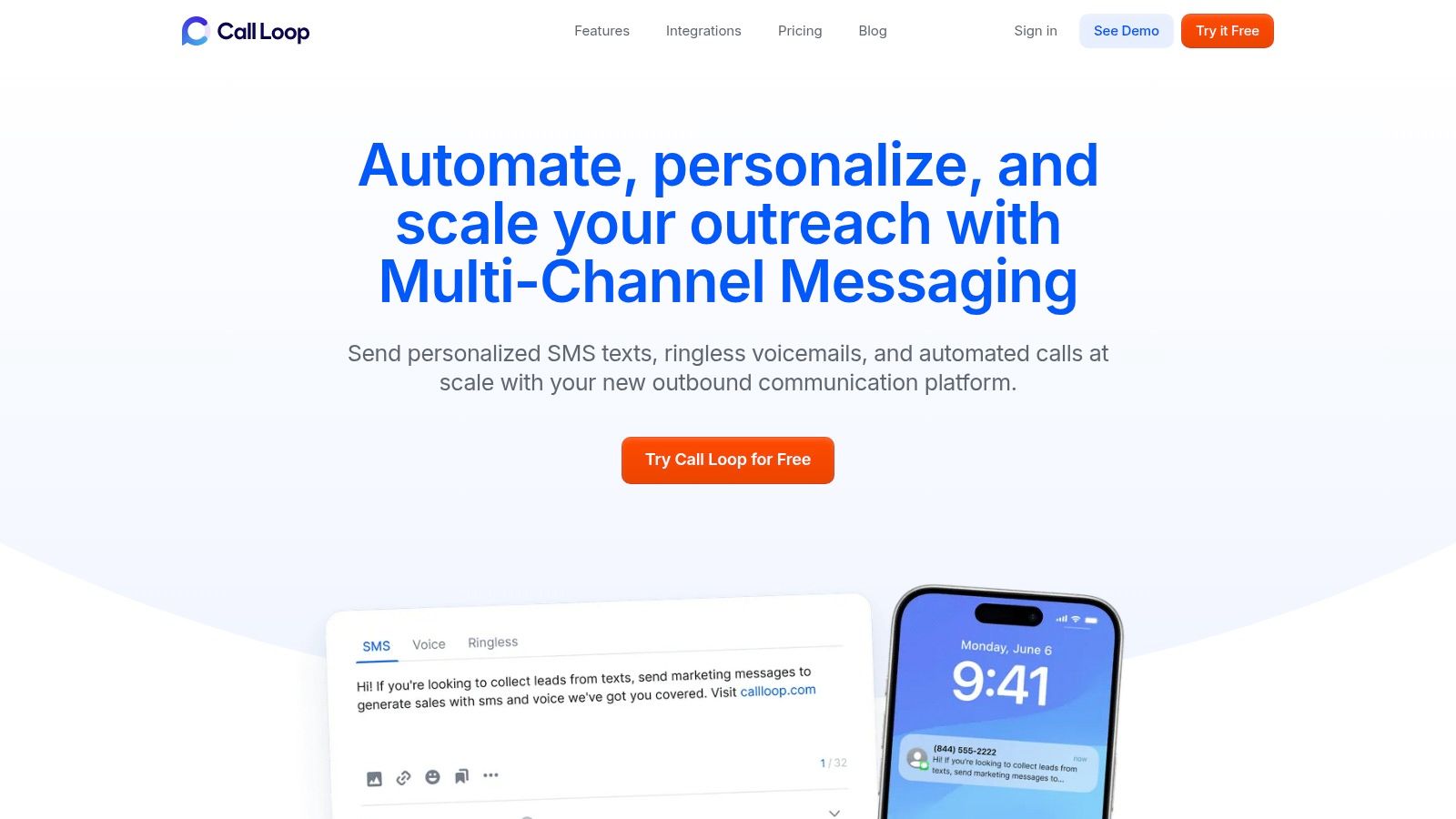
Call Loop covers the campaign mechanics that matter in day-to-day outbound work. You get custom fields, merge tags, text-to-join keywords, number validation, double opt-in, and toll-free compliance, which helps teams keep lists cleaner and reduce avoidable carrier problems. It also supports drip campaigns with precise timers and calendar or custom-date triggers, which fits webinar reminders, appointment sequences, and promotion follow-ups that depend on timing.
Practical rule: If a texting platform cannot help you control compliance and timing, it usually creates more cleanup than growth.
The platform also reaches beyond SMS in ways that matter operationally. Its voice tools include live and machine detection, press-1 transfers, custom caller ID, uploaded or AI text-to-speech audio, and DNC management. Ringless voicemail is charged only for successful drops, and it supports mobile and landline delivery with flexible scheduling, which can make budgeting easier when you are running larger outbound programs.
Call Loop connects with ActiveCampaign, HubSpot, Keap, and 4,000+ apps via Zapier, so it can sit inside the stack many growing teams already use. It also says it supports HIPAA-compliant messaging for healthcare, which makes it more relevant for regulated workflows. If verification is part of your process, Growform's SMS verification guide is a useful reference point for tightening lead quality before messages go out.
For buyers who want an API-led approach, [Call Loop's SMS API guide](https://www.callloop.com/blog/expert-guide-send-sms-online-api) shows how the platform can fit into automated workflows. Call Loop also lists over 45,000 users on its site, which suggests it has been used across more than one narrow niche Call Loop.
The site's proof points are tied to actual campaign use. It highlights 50% opt-in rates from keyword campaigns, a 24% boost in webinar attendance, and a reported 31% increase in close rates for another customer, which gives you a clearer sense of how the platform performs in the field. For teams that want measurable outbound across SMS, voice, and voicemail, Call Loop is a strong fit.
Twilio is the platform to look at when your priority is raw messaging infrastructure and developer control. It supports US SMS, MMS, short code, toll-free, and A2P 10DLC, and it gives teams mature APIs, real-time status callbacks, and Event Streams for observability. If you have technical staff and need a dependable programmable layer, it is one of the most established options in the market.
The trade-off is complexity. Twilio can power high-throughput messaging, but the total cost is rarely as simple as it first appears because carrier surcharges and number fees can stack up quickly. That works for an engineering-led team, but it is a tougher fit for operators who want a plug-and-play campaign tool.
Twilio's HIPAA-eligible services can be used with a signed BAA when configured correctly, which keeps it relevant for healthcare and other regulated workflows Twilio. If you are evaluating API-led messaging more broadly, [Call Loop's guide to sending SMS online via API](https://www.callloop.com/blog/expert-guide-send-sms-online-api) is a useful reference for how a texting workflow can be structured around automation instead of heavier infrastructure.
Twilio integration guide is also worth a look if your team wants a more implementation-focused view of how Twilio fits into a connected stack. That matters when SMS is only one part of the system and you also need voice broadcasts, ringless voicemail, or compliance controls that sit alongside messaging.
Twilio is strong when you need to build. It is weaker when your team wants to launch quickly without developer support.
One practical note for readers comparing options. Twilio fits best with teams that already have a clear compliance process and internal ownership for messaging setup. If your biggest concern is sending speed, delivery control, and API flexibility, it belongs on the shortlist. If you want a simpler operational experience, a more packaged platform may fit better.
Plivo is the kind of platform that makes sense when you want a developer-friendly alternative without paying for the biggest name in the category. It supports US SMS and MMS, plus short code, toll-free, and 10DLC, and its documentation is built for teams that want to move quickly without a lot of mystery around implementation. For many buyers, that combination is the sweet spot between flexibility and cost discipline.
The reason Plivo keeps showing up in serious comparison lists is simple, it tends to be easier to justify at scale than some larger incumbents. The platform offers pay-as-you-go and growth plan options, with published pricing and volume comparisons, so teams can model spend before they commit. That matters if you're running recurring reminders, alerts, or outbound sequences where message volume rises predictably.
Plivo works best when your team already knows what it wants from messaging. You're probably not shopping for fancy campaign UI, you're shopping for a clean API, dependable delivery, and enough number-type support to keep compliance and routing sane. The platform's strength is in that middle ground, where you want a production-ready SMS layer without overbuilding your stack.
Its downside is the same one that comes with many API-first tools. The ecosystem is smaller than some of the category giants, and some advanced behavior may require custom work. If your operations team wants more out-of-the-box campaign tooling, that can slow rollout.
For buyers comparing hidden operational friction, the better question isn't just whether Plivo can send texts. It's whether your team has the resources to maintain the setup over time. If the answer is yes, the platform can be a strong value play Plivo.
Use Call Loop's international SMS sending guide if global routing is part of your decision. It helps frame the difference between raw sending capability and a workflow that stays manageable once multiple markets are involved.
Telnyx is a strong fit for teams that care about network control and visibility. As a carrier-network operator and CPaaS provider, it offers direct routing, US SMS and MMS, and published controls for throughput and compliance. That combination can be especially valuable when message reliability and operational transparency matter more than a flashy interface.
The appeal of Telnyx is that it feels closer to the infrastructure itself. You can see more of the network behavior, tune throughput more deliberately, and work from published rate-limit guidance and hosted SMS enablement runbooks. For some operators, that level of control is exactly what they need to keep bulk texting stable as volume rises.
Telnyx is not the easiest choice for a team without telecom experience. It can deliver strong value, but the platform assumes you're comfortable making technical decisions about sender types, throughput, and setup. If your team wants a very guided campaign environment, this probably isn't the first stop.
Its HIPAA implementation guidance is also a real plus for regulated use cases, because it signals that the platform takes compliance architecture seriously Telnyx. Still, the advantage is not the compliance page itself, it's the ability to operate with more visibility into how messages move.
Choose Telnyx when you want control first, convenience second.
That's also why it tends to work well for businesses that already have messaging ops experience. The platform is a better match for teams that want to fine-tune performance and potentially lower messaging costs, not teams that need a guided marketing layer. If that sounds like your environment, it deserves a close look.
Vonage, formerly Nexmo, is a long-standing SMS API provider that fits enterprises and product teams that care about stability. In the US, it supports A2P 10DLC, toll-free, and short code, and it offers pass-through carrier fee transparency plus a Pricing API for programmatic fee lookups. That kind of visibility is useful when multiple teams need to forecast cost without guessing.
The practical benefit here is predictable engineering and finance collaboration. Developers get stable APIs and rich documentation, while operators get a clearer sense of how carrier fees flow through the stack. That helps when SMS isn't just a marketing tool, but part of support, notifications, or transactional messaging.
Vonage is strongest when you need a mature platform that won't surprise your team with opaque routing behavior. It's also helpful for companies that want flexible number-type support without building from scratch. The main downside is that pricing and carrier fees can still become complex, especially if your use case spreads across campaigns and regions.
For teams in regulated environments, the structure matters. The platform can work well, but you still need internal process discipline around opt-ins, sender configuration, and message intent Vonage. If your team wants API stability with better pricing visibility, it's a credible contender.
If you're also building a compliance framework around outbound texting, review Call Loop's SMS compliance checklist. It's a useful lens for deciding whether your provider helps you stay clean or just sends messages.
Bird, formerly MessageBird, is best understood as an omnichannel messaging provider with SMS at the center. It supports US 10DLC, toll-free, and short code, and it publishes surcharge tables that help teams estimate total cost more realistically. If you're planning to move beyond SMS into channels like WhatsApp or other OTT messaging, Bird is a logical place to evaluate.
The reason many teams like Bird is breadth. You don't just buy a texting layer, you get a framework for managing communication across channels. That can reduce platform sprawl if your roadmap includes more than one customer touchpoint.
Bird is a smart fit if your messaging strategy is evolving. The omnichannel approach lets you think beyond single-channel campaigns, which is useful for brands that want to unify notifications, support, and promotions. It also has managed number provisioning and registries, which can simplify the administrative side of scaling outreach.
The downside is procurement friction. Retail per-message pricing is harder to pin down publicly, and volume pricing often means requesting a quote. For operators who want quick cost certainty, that can be annoying. For teams that care more about breadth and international footprint, it's an acceptable trade-off.
Bird is also one of the better options for companies that know SMS won't stay isolated inside their stack. If your customer journey is already multi-channel, it can help bring that into a single operational frame Bird. That matters more than a low headline rate when the core cost is workflow fragmentation.
ClickSend is a good option for SMBs and agencies that want a straightforward, budget-aware texting platform. It offers US SMS and MMS, pay-as-you-go and volume-tiered pricing, clear SLA documentation, and flexible integrations including email-to-SMS. That makes it especially useful for alerts, notifications, and more basic marketing sends where simplicity beats complexity.
The biggest reason ClickSend stays relevant is that it's easy to understand. You don't need a long implementation cycle to get started, and the cost model is accessible for domestic senders who want to test campaigns without overcommitting. For smaller teams, that matters a lot.
There is a clear limitation, though. Voice features are no longer available to new customers, which means ClickSend is less compelling if you're trying to build a broader multi-channel stack. It's SMS-centric, and that's either a feature or a constraint depending on your goals.
For teams that only need messaging, that focus can be efficient. For teams that want SMS, voice, and voicemail in one workflow, it's not enough. The right call is to judge it by your channel roadmap, not just by today's send volume ClickSend.
If you're trying to compare user-facing workflow tools across the category, this can also complement a search for a text scheduler app that reduces manual work. The right scheduler can make a simple platform feel much more operationally useful.
SimpleTexting is one of the most approachable choices for teams that want to launch SMS campaigns without building from APIs. It gives you drip campaigns, keywords, MMS, polls, and a team inbox, which makes it a natural fit for marketing teams, event organizers, and SMBs that want quick time to first campaign. The interface is a major part of the value.
The platform also leans into integrations, with support for tools like Zapier, Mailchimp, and CRMs, plus AI Assist features that help teams move faster. That makes it practical for marketers who want an all-in-one workspace rather than a technical messaging layer.
SimpleTexting's main downside is economic, not functional. Credit-based plans can become expensive at higher volumes, and long messages or MMS consume more credits, which can quickly raise spend. That means it's often a better fit for moderate-volume marketing than for heavy outbound operations.
Its compliance education is helpful, especially around HIPAA-safe texting practices that steer non-PHI use cases toward standard SMS SimpleTexting. That kind of guidance matters for teams that want to avoid accidental overreach while still moving quickly.
For non-technical staff, the platform is very easy to adopt. That ease is a real operational advantage, because tools only help if your team uses them. If you want speed, clarity, and support, SimpleTexting belongs near the top of the shortlist.
EZ Texting is built for teams that want packaged campaign workflows with less setup friction. Its core strengths are mass texting, segmentation, MMS, keywords, and list growth tools, plus compliance features like double opt-in and opt-out automation. If you want a familiar interface and clear campaign structure, it's a strong mainstream option.
This is a platform that leans into accessibility. Non-technical staff can get campaigns live without a steep learning curve, and the built-in education around compliance basics helps reduce mistakes. For businesses that value guardrails, that's useful.
The trade-off is cost at scale. Per-message pricing can be higher than API-centric CPaaS options, so it's not always the right answer for very high-volume senders. Plan structures also vary, which means you need to study the packaging carefully before committing.
Its healthcare guidance is useful because it clarifies acceptable non-PHI usage and helps teams avoid assuming standard SMS is a substitute for secure clinical communication EZ Texting. That's a sensible posture for organizations that need to stay within boundaries while still using texting effectively.
For many SMBs, the appeal is straightforward, it's easy, familiar, and geared toward campaign execution rather than infrastructure. If your team wants speed over depth, that can be exactly what you need.
Textedly is a strong fit for small teams that want a fast setup and predictable texting workflows. It includes keywords, autoresponders, scheduled campaigns, MMS, and list tools, which covers the basics most SMBs need to get moving. A free trial with starter credits also makes it easier to test how your campaigns will behave before you commit.
The platform's appeal is mostly practical. It's intuitive, the plan structure is easy to understand, and small teams can start without much operational overhead. That makes it especially useful for businesses that need to send reminders, announcements, or promo messages without a lot of internal training.
The main limitation is that costs can rise as volume grows, and add-ons such as extra keywords or seats can add up. So while it's easy to start, growing teams should watch the economics closely. A simple platform is only a good deal if it stays simple as usage scales.
Textedly works best when your needs are clear and fairly contained Textedly. If you're running straightforward messaging and value predictability, it's worth a look. If your roadmap includes voice, voicemail, or more complex multi-channel workflows, another platform may fit better.
| Product | Key features | Ease of use | Best for | Unique selling point | Pricing model |
|---|---|---|---|---|---|
| Call Loop (Recommended) | SMS/MMS, voice broadcasting, ringless voicemail, multi‑channel drips, CRM integrations, HIPAA support | Easy for non‑dev teams; campaign builders & automation | SMBs, marketers, sales teams, healthcare providers | Compliance‑focused multi‑channel automation + pay‑per‑successful‑drop voicemail | Free trial; pricing not public; ringless voicemail charged per successful drop |
| Twilio | Global SMS/MMS, short codes, toll‑free, 10DLC, mature APIs, Event Streams | Developer‑centric; steep for non‑devs | High‑volume senders, dev teams, enterprises | Global scale, robust APIs and observability | Usage‑based + carrier surcharges and number fees |
| Plivo | SMS/MMS, short code, toll‑free, 10DLC, clear rate card | Developer‑friendly, straightforward APIs | Cost‑sensitive developer teams | Competitive per‑message pricing at scale | Pay‑as‑you‑go; published pricing and volume plans |
| Telnyx | Direct routing, CPaaS, throughput controls, HIPAA guidance | Requires telecom knowledge to tune | Teams needing network control and savings | Network ownership visibility and granular controls | Pay‑as‑you‑go with volume discounts |
| Vonage (Nexmo) | SMS API, Pricing API, global coverage, enterprise support | Developer/enterprise friendly | Enterprises needing stable APIs and programmatic pricing | Programmatic fee lookups and enterprise tooling | Usage‑based with pass‑through carrier fees |
| Bird (MessageBird) | Omnichannel API (SMS, OTT, WhatsApp), 10DLC, managed provisioning | Modern APIs; good for multi‑channel adoption | Businesses expanding beyond SMS internationally | Strong omnichannel reach (WhatsApp, OTT) | Quote/volume pricing; published surcharge tables |
| ClickSend | SMS/MMS, dashboard, email‑to‑SMS, clear SLA | Very easy; SMB focused | SMBs & agencies for alerts, notifications, marketing | Budget‑friendly with simple dashboard | Pay‑as‑you‑go with volume tiers |
| SimpleTexting | Drip campaigns, keywords, MMS, team inbox, Zapier | Very user‑friendly for marketers | SMB marketers wanting all‑in‑one UI | Fast time‑to‑campaign for non‑technical teams | Credit‑based plans (can be costly at high volume) |
| EZ Texting | Mass texting, templates, segmentation, TCPA features | Approachable UI with compliance help | Teams needing packaged workflows and compliance | TCPA‑friendly workflows and healthcare guidance | Tiered plans; per‑message costs may be higher at scale |
| Textedly | Keywords, autoresponders, scheduled campaigns, MMS | Intuitive; quick setup | Small teams testing SMS marketing | Simple, predictable plans with starter credits | Plan‑based message allotments; free trial credits |
The best service depends on what you're trying to ship, not just what looks good on a pricing page. If you need raw API control and already have technical resources, Twilio and Plivo are both strong options. If you want a platform that non-technical teams can adopt quickly, SimpleTexting, EZ Texting, and Textedly are easier to run day to day.
For more complex outreach, especially when SMS needs to sit beside voice broadcasting and ringless voicemail, the evaluation changes. You're no longer buying a text tool, you're buying a communication stack. In that frame, Call Loop stands out because it combines bulk SMS/MMS with voice, voicemail drops, compliance controls, automation, and workflow integrations in one system.
That distinction matters for sales teams, customer success teams, healthcare providers, agencies, webinar hosts, and ecommerce brands. A campaign that needs reminders, follow-up, and callback paths is easier to manage when all of those actions live in one place. It's also easier to keep compliant when number validation, double opt-in, DNC handling, and HIPAA-aware messaging are built into the platform rather than patched on later.
The market is moving toward more operational sophistication, not less. As noted earlier, the bulk SMS services market is projected to expand sharply through 2033, and the businesses that win with texting will be the ones that treat deliverability, compliance, and automation as core requirements. Cheap credits are useful, but only if the messages land, the workflow is clean, and the platform supports the channels your team uses.
If your priority is a multi-channel outbound system that can handle SMS, voice broadcasting, and ringless voicemail without turning into a compliance headache, Call Loop is the most distinctive option on this list. If your priority is developer infrastructure or the lightest possible marketing layer, one of the other tools may fit better.
If you're ready to build a more reliable outbound stack, visit Call Loop and see how its bulk SMS, voice broadcasting, and ringless voicemail tools can support your campaigns. It's a practical way to bring compliance, automation, and multi-channel follow-up into one system.
Chris Brisson
Chris is the co-founder and CEO at Call Loop. He is focused on marketing automation, growth hacker strategies, and creating duplicatable systems for growing a remote and bootstrapped company. Chat with him on X at @chrisbrisson


Trusted by over 45,000 people, organizations, and businesses like


