
See a Demo
You're just one step away from seeing Call Loop in action.
Enter your information below to watch a demo right now.

You're just one step away from seeing Call Loop in action.
Enter your information below to watch a demo right now.

Your domestic text campaign works. The copy is tight, the offer is clear, and your team knows how to manage replies. Then you try to send the same campaign to customers in India, the UAE, the UK, and Canada, and things break fast. Messages get filtered, sender IDs don't display the way you expected, replies disappear, and the invoice doesn't match the volume you thought you sent.
Such is the nature of international SMS sending. It isn't just domestic SMS with more country codes attached. Every market has its own carrier rules, registration flow, sender ID format, encoding quirks, and compliance expectations. Small mistakes turn into blocked traffic, inflated costs, and weak campaign performance.
The upside is big. Globally, an average of 25 billion text messages are sent and received daily, and markets such as China with 1.081 billion SMS users and India with 730 million SMS users give businesses huge outbound reach when they get execution right, according to global SMS usage data. SMS still matters because it reaches nearly every mobile device without asking the recipient to install anything first.
A local SMS strategy usually assumes three things: your sender format will work everywhere, your message will keep the same cost structure everywhere, and your compliance process will carry over. None of those assumptions hold up internationally.
Domestic programs often rely on one number type, one opt-in flow, and one content style. That's manageable inside a single market. The minute you expand, carriers start enforcing local rules that don't care how well your campaign performed at home. A message that looks normal in one country can look suspicious, noncompliant, or technically malformed in another.
The first failure point is usually deliverability, not copy.
A business owner sees “sent” in the platform and assumes the message made it to the handset. In international traffic, “sent” only means your platform accepted the request. The message still has to pass through gateways, carrier checks, local formatting rules, and market-specific filtering. If any of those layers reject it, your campaign underperforms before the customer ever has a chance to read it.
Practical rule: If you treat global texting like one campaign with many destinations, you'll pay for mistakes in routing, compliance, and segmentation all at once.
The channel is too broad to ignore. Businesses don't need perfect coverage in every country. They need a working plan for the countries that matter to them. For an SMB, that usually means a small set of priority markets where customers already exist, support requests already come in, or expansion is already underway.
That's the right mindset. Start narrow. Build country-specific rules. Test before you scale. International SMS sending rewards operators who are disciplined, not flashy.
Most business owners don't need telecom engineering detail. They do need to understand why one route performs well and another falls apart. The simplest way to think about international SMS routing is as an international postal system. Your platform creates the message, then other systems decide how that message gets handed off across borders until the local carrier delivers it.
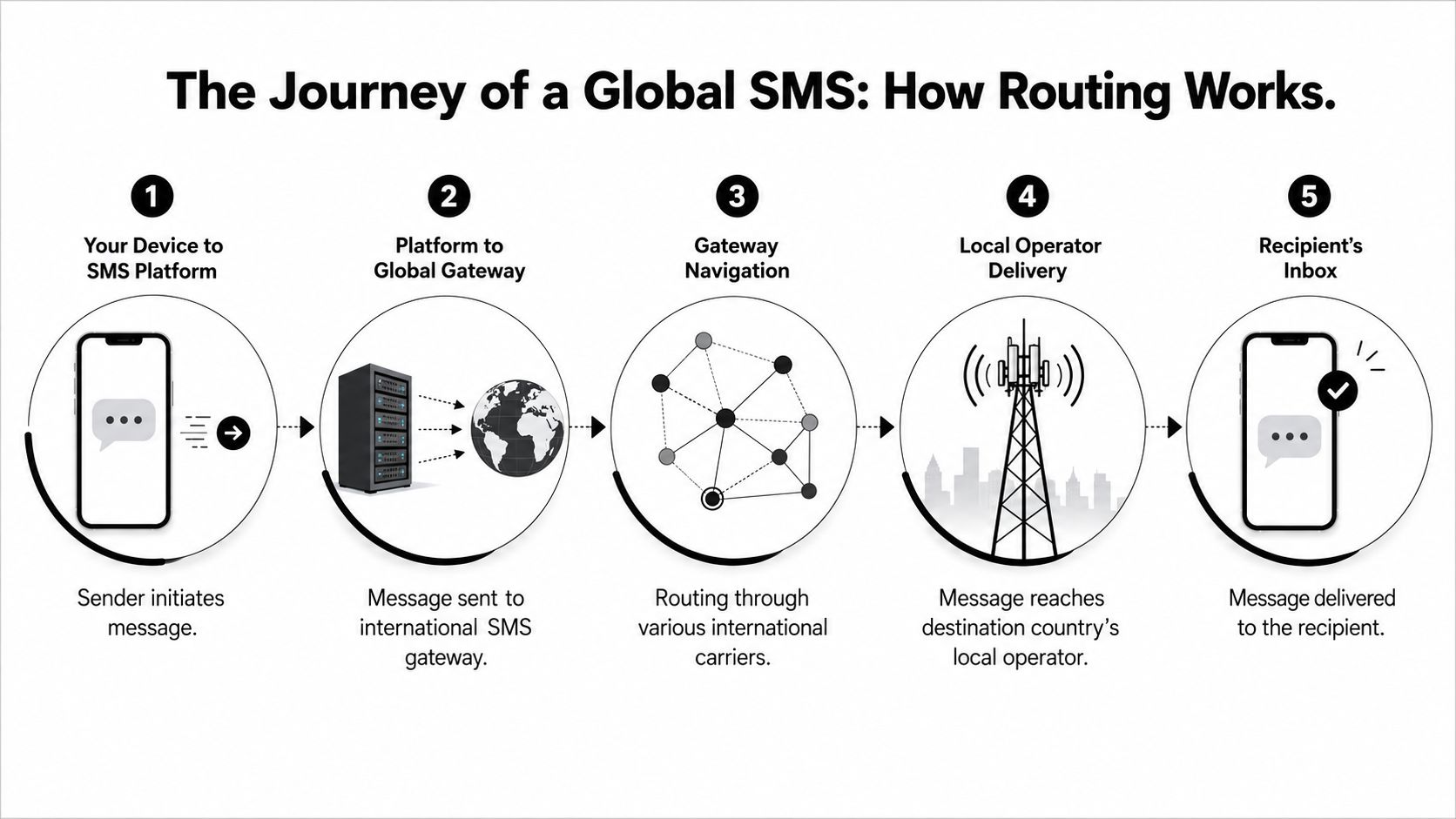
Each step can alter outcomes. A weak route can add delay. A bad sender ID setup can trigger filtering. A formatting mistake can stop the message before it gets anywhere near the recipient.
International traffic is unforgiving about number formatting. If your contact list has inconsistent country codes, missing prefixes, or recycled records from old imports, the route can fail before delivery is even attempted. That's why teams should standardize numbers before launch, not after the first wave of errors. A practical reference for cleaning lists is this guide on phone number formatting for business messaging.
Routing quality isn't abstract. It shows up as delays, failed sends, missing replies, and inconsistent delivery from one country to the next.
You don't control every handoff. You do control whether your platform, data hygiene, sender setup, and campaign design make those handoffs easier or harder. When teams ignore the infrastructure behind international SMS sending, they blame copy for problems caused by routing.
That's why a message can look fine in your dashboard and still fail in market. The route wasn't built for your destination, your sender format didn't match local expectations, or the local carrier rejected the traffic on policy grounds.
The toughest international deliverability problems usually come back to one issue. Compliance and carrier registration. Businesses often look for a clever workaround when the actual fix is administrative: register correctly, configure sender identity correctly, and send the right traffic type into the right market.
Some countries let you activate business messaging quickly. Others absolutely do not.
In India and the UAE, carriers enforce strict registration channels. Businesses must complete Sender ID and traffic registration with local regulators like India's DLT portals before any messages can be delivered, and unregistered traffic is completely blocked, as outlined in this overview of registration requirements in India and the UAE.
That's the rule that catches many SMBs off guard. They assume sender reputation or clean lists will carry them through. It won't. If the market requires registration, the carrier can block you regardless of how responsible your program is.
Another compliance trap is assuming a branded sender name will work everywhere. It won't.
Some regions support alphanumeric sender IDs, where recipients see a brand name. Other markets require numeric-only sender IDs. If you use the wrong sender type, delivery can fail or the message can be rewritten by the receiving network. That affects trust, reply handling, and campaign measurement.
Here's a practical snapshot:
| Region / Country | Sender ID Type | Pre-registration Required? |
|---|---|---|
| United States | Numeric-only | Yes, business messaging setup is typically required |
| Canada | Alphanumeric commonly supported in many cases, but business setup still matters | Often depends on route and use case |
| UK | Alphanumeric supported | Varies by provider and traffic type |
| EU | Alphanumeric supported in many markets | Country-specific |
| India | Numeric-only | Yes |
| UAE | Country-specific sender setup | Yes |
| Philippines | Numeric-only | Country-specific approval may apply |
| Australia | Alphanumeric supported | Country-specific |
This isn't a substitute for legal review or carrier confirmation. It's a reminder that there is no universal sender setup.
Compliance problems don't stay inside the messaging team. Poor handling of privacy, consent, and market access can affect customer trust and commercial expansion. For a broader legal and business perspective, this analysis on the impact on market access and corporate value is worth reviewing.
Key distinction: Deliverability is often a compliance outcome before it's a marketing outcome.
A workable process is simple, even if the rules aren't:
Most international SMS failures that look mysterious are not mysterious at all. They're compliance misses that were discovered by carriers before they were discovered by the sender.
The expensive mistakes in international SMS sending are usually small on paper. A single special character. An unvalidated list. A send time that ignores local norms. Teams miss these details because each one looks minor in isolation. In production, they stack.

This is one of the most common technical mistakes. International SMS segmentation efficiency drops by 56% when using Unicode (UCS-2) encoding for non-Latin characters, reducing message capacity from 160 to 70 characters. A standard 140-character message can require three segments instead of one, tripling delivery cost, based on this breakdown of Unicode segment behavior in international SMS.
That matters even if most of your message is in English. One smart quote, one accented character, or one non-Latin symbol can force Unicode handling. If your platform doesn't make segment counts obvious before send, your budget can drift without warning.
Bad number data creates fake performance problems. Teams think a country is hard to reach when the underlying issue is a dirty contact file.
Use PhoneCheckr before a major send. It helps validate whether a number is mobile, landline, VoIP, or invalid. That's practical, not optional. If you push a large campaign into international markets without validating numbers first, you waste spend, distort reporting, and increase the chance of blocks from poor traffic quality.
Many teams solve for local time and stop there. That isn't enough.
A message can hit at a technically reasonable hour and still feel wrong in context. Promotional timing norms vary by market, and that affects opt-outs, replies, and brand perception. The safest approach is to localize send windows by region, test small batches first, and keep marketing sends conservative until you see stable engagement.
The message isn't just entering a phone. It's entering a local business culture.
Most failed global campaigns don't fail because SMS stopped working. They fail because the operator skipped preflight discipline.
International SMS pricing punishes buyers who shop by headline rate alone. Costs differ from country to country, and that's normal. The bigger issue is whether the cheap route provides enough messages to justify the apparent savings.

Cost-per-delivered message is the right metric for international SMS economics. A cheaper route delivering only 70% of messages costs more per successful delivery than a premium route delivering 98%, which is why businesses need to audit throughput and success rates instead of headline pricing, as explained in this analysis of global SMS delivery economics.
That single idea fixes a lot of bad buying decisions.
If a provider offers a low advertised rate into a target market, ask what kind of route they're using, how they report delivery outcomes, and whether they can separate failed sends from actual handset delivery. If they can't explain that cleanly, the “cheap” route may not be cheap in practice.
A serious evaluation should include:
For many SMBs, North America behaves differently from Asia or Europe in both pricing and operational requirements. That doesn't mean one region is always more expensive in a way that can be generalized. It means your budget model should be country-specific from the start.
A useful benchmark is to compare providers using pilot sends, validated lists, and identical message content. Then review actual outcomes against what you paid. If you're evaluating vendors more broadly, this guide to choosing the best bulk text messaging service for business use is a sensible framework.
Cheap messaging that doesn't arrive is not efficient. It's just harder to spot on the invoice.
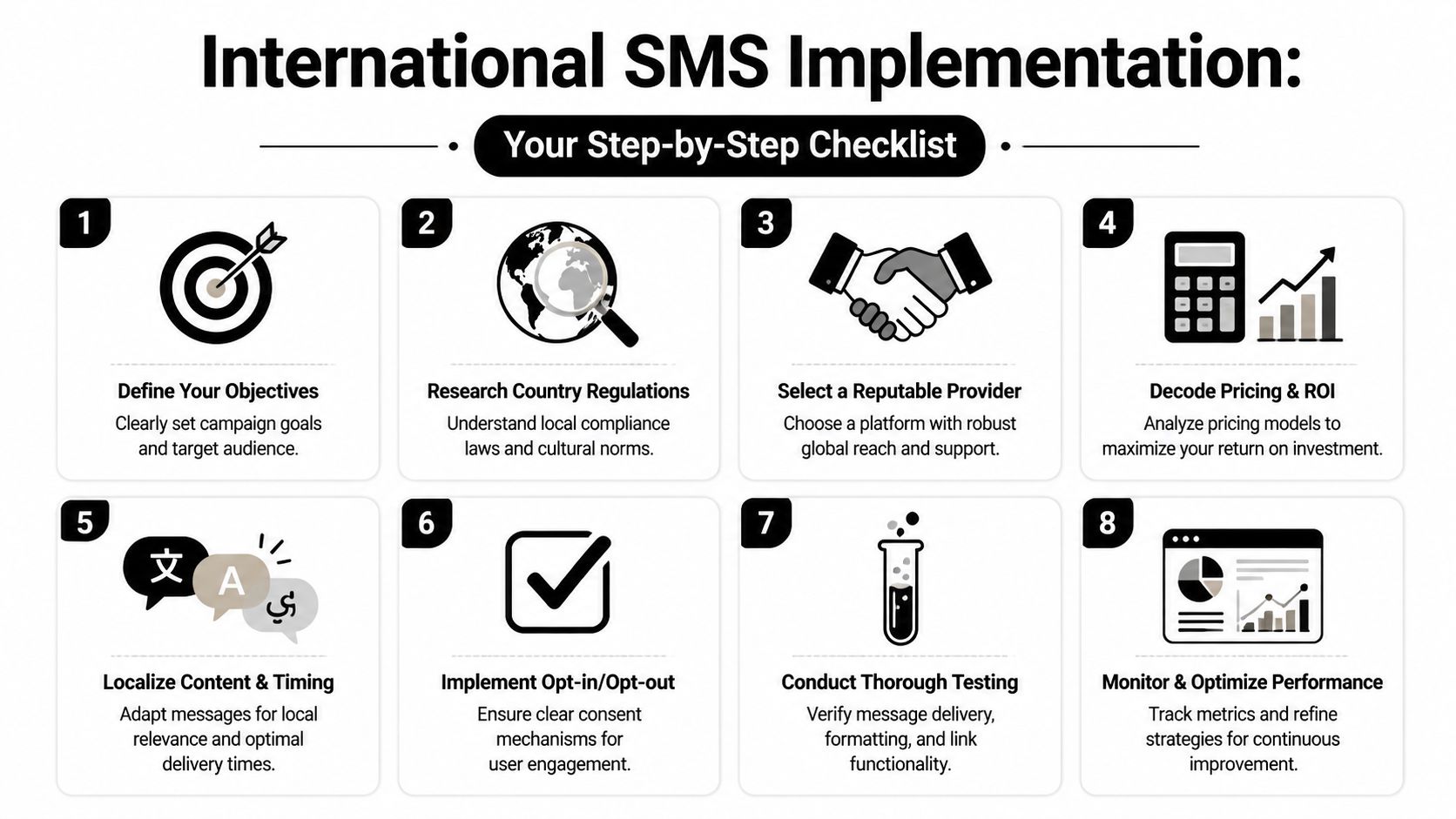
Execution gets easier when you stop treating international messaging as one campaign and start treating it as a sequence of setup decisions. The checklist below is the approach that keeps SMB teams out of the usual traps.
In the United States and Canada, 80% of inhabitants use SMS, totaling approximately 292 million people, which makes those markets attractive, but they also come with stricter business messaging setup requirements to avoid filtering, according to SMS adoption and registration context in North America.
That's a good example of the broader rule. Don't pick a platform first and hope it fits your countries. Pick your countries first, then confirm the platform can support them correctly.
Choose your first few countries carefully.
Pick places where you already have inbound demand, existing customer records, or a clear revenue reason to send.
Map compliance before creative work starts.
Sender type, registration flow, opt-in language, and reply support should be settled before anyone writes the campaign.
Validate every number.
Use PhoneCheckr to identify whether records are mobile, landline, VoIP, or bad. This keeps your launch data clean.
Configure sender IDs by market.
Don't force one sender identity into every region. Set country rules and document them.
Write for segment control.
Keep messages short, watch for Unicode triggers, and test localized versions before full deployment.
Run small live tests first.
Send to internal devices, trusted contacts, or controlled sample lists in each market.
Layer channels where it makes sense.
SMS works well alongside voice outreach and ringless voicemail, especially for reminders, follow-ups, and sequences where text alone may not carry the whole campaign. Ringless voicemail can support appointment reminders, reactivation, and sales follow-up when used carefully and compliantly. It shouldn't replace SMS. It should complement it.
Build automation after the first wins.
Once a market is stable, add drip campaigns, scheduling logic, segmentation, and CRM-triggered sends.
When you review providers, look for practical features: list validation, scheduled sending, segmentation, analytics, compliance support, and solid integration options. If you're comparing business messaging tools, one example in the market is Salesmessage for business texting workflows. The right choice depends on your target countries, required channels, and how much operational control you need.
This is also where multi-channel planning gets useful. A customer who ignores a text reminder may respond to a ringless voicemail drop later in the sequence. A sales prospect who won't answer a call may still reply to SMS. Good operators don't argue over channels. They coordinate them.
International SMS sending works when you treat it as an operational discipline, not a shortcut channel. The businesses that do well internationally tend to follow three rules.
First, compliance drives deliverability. Registration, sender IDs, consent handling, and country-specific setup aren't paperwork you do after launch. They are the foundation of launch.
Second, route quality beats low headline pricing. If messages don't arrive, lower rates won't save the campaign. Measure success by delivered outcomes, not promised cost.
Third, country-specific execution wins. Each market has its own mechanics, expectations, and failure points. The teams that respect those differences usually outperform the teams that try to standardize everything globally.
International growth doesn't require a massive telecom team. It requires a disciplined process, a clean contact database, a provider that's transparent about country rules, and a willingness to test before scaling. Get those parts right, and SMS becomes one of the most dependable channels you can use across borders.
If you want a platform built for scalable outbound communication across SMS, voice broadcasting, and ringless voicemail, take a look at Call Loop. It gives teams a practical way to manage bulk outreach, automation, compliance-minded workflows, and multi-channel follow-up from one place.
Chris Brisson
Chris is the co-founder and CEO at Call Loop. He is focused on marketing automation, growth hacker strategies, and creating duplicatable systems for growing a remote and bootstrapped company. Chat with him on X at @chrisbrisson


Trusted by over 45,000 people, organizations, and businesses like


