
See a Demo
You're just one step away from seeing Call Loop in action.
Enter your information below to watch a demo right now.

You're just one step away from seeing Call Loop in action.
Enter your information below to watch a demo right now.

Bulk SMS service cost in the U.S. usually lands around $0.0075 to $0.03 per message, and a 100,000-message month often works out to about $750 to $3,000 before compliance and platform fees. That number surprises first-time buyers because the invoice rarely stops at the message rate. Once carrier charges, 10DLC registration, and plan fees stack up, the quote on the pricing page is only the first line of the bill.
A small business owner usually sees this confusion right away. One vendor lists a low per-text rate, another talks about credits, and a third adds compliance items that weren't obvious at the start. The easiest way to make sense of it is to read the invoice in layers, from the message itself to the carrier, then to the platform, then to the registration and routing costs that sit underneath.
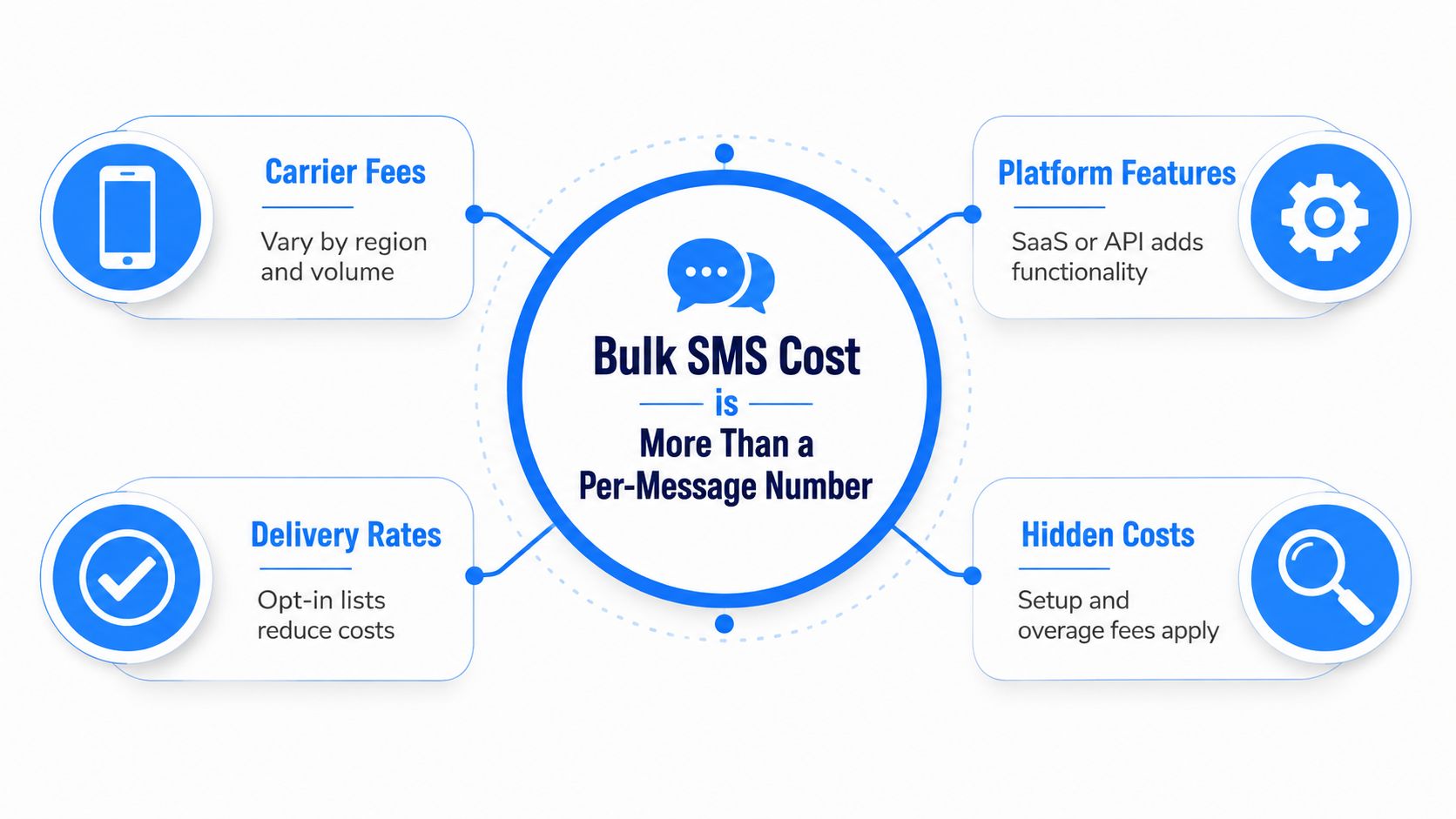
A bulk SMS service cost quote is really a stack of smaller charges, not a single number. In major markets, the final price changes by destination country, carrier, and whether the sender uses a developer API or a marketing platform. That's why two businesses with the same send volume can pay very different totals, even if the headline rate looks similar at first glance.
The first layer is the per-message rate. In the U.S., Twilio's carrier pricing ranges from $0.0035 to $0.005 per outbound SMS depending on carrier, while industry roundups place typical U.S. SMS rates at about $0.0075 to $0.03 per message. Higher-cost regions are different again, with the UK around $0.04 to $0.06 and the EU around $0.05 to $0.07 per SMS, according to the figures in the brief.
Once you know that, the invoice starts to make sense. A sender with the same list and the same message copy can still land on a different bill because one platform charges a plan fee, another passes through carrier fees, and another folds compliance into a bundled rate. That's why buyers shouldn't ask only, “What's the SMS price?” They should ask, “What sits on top of it?”
Practical rule: treat the quoted SMS rate as the starting point, then check whether the vendor adds platform access, registration, or compliance charges after that.
The historical shift matters too. Bulk SMS pricing used to look closer to a simple message fee, but U.S. buying now usually includes a per-segment message rate, a monthly platform or plan fee, and a one-time A2P 10DLC carrier registration fee. That layered model is why invoice reading matters more than ever.
The major picture is still large-scale. Market Research Future estimated the global bulk SMS market at $91.06 billion in 2024 in the pricing guide, which shows how mature the channel remains even as the billing model becomes more segmented. If you're new to this, that's the main lesson, bulk SMS isn't one price, it's a bill made of several parts.
The pricing model shapes the bill as much as the rate itself. A buyer usually runs into three structures, pay-as-you-go, subscription tiers, and hybrid plans that combine a quota with overage charges. The right choice depends on whether volume is steady, seasonal, or still being tested.
Pay-as-you-go is the cleanest model to read because you pay for usage as you send. It works well when a team is testing an offer, warming up a new list, or sending messages in uneven bursts. The downside is that a low send volume can make fixed fees feel heavy, because registration and platform charges don't shrink just because the campaign is small.
Monthly plans usually make the most sense when send volume repeats. They can look more expensive on paper if you compare only the headline fee, but they often absorb part of the administrative burden that would otherwise show up as separate invoice lines. For a buyer comparing vendors, CallZent's transparent pricing breakdown is a useful example of how service pricing can be presented in a clearer, line-item format even outside the SMS category.
Hybrid plans sit in the middle. You get a monthly bundle, then pay overage if you exceed the included quota. That structure can help a team that knows its range but doesn't want to overbuy capacity.
| Model | Best for | Cost behavior | What to watch |
|---|---|---|---|
| Pay-as-you-go | Testing and irregular sends | Closest to usage-based pricing | Registration and carrier add-ons |
| Subscription tier | Steady monthly volume | Predictable monthly spend | Included quota and overage rate |
| Hybrid bundle | Growing teams | A base fee plus extra usage | Whether unused credits expire |
If you're comparing providers, pair the plan type with the sending pattern, not just the rate. A vendor can look cheap on a per-message basis and still cost more once the monthly floor, number fees, or message overages show up. For related registration detail, the short code process at this registration guide helps clarify how number setup can affect the total cost structure.
A useful way to think about it is this: the lowest sticker price isn't always the lowest invoice. The cheapest model is the one that matches your volume shape and avoids paying for capacity you won't use.
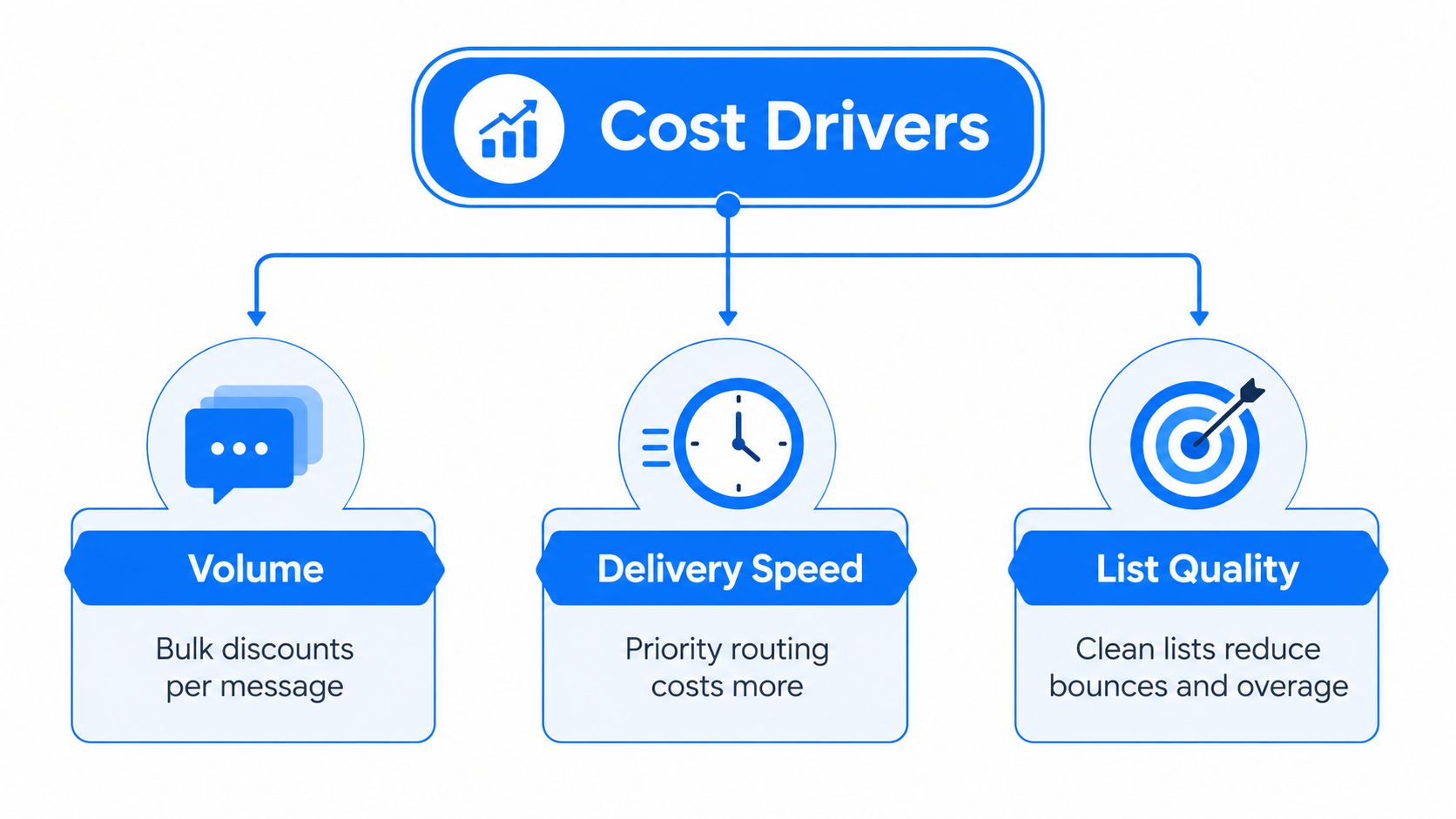
The bill changes for reasons that don't always appear in the product page headline. The biggest ones are volume, delivery speed, list quality, and compliance overhead. Those four levers decide whether a campaign stays efficient or starts leaking money through fees and wasted sends.
Higher volume can lead to better rates, but only if the sender keeps the list clean. If a campaign goes to stale numbers, the sender pays for messages that don't help the business. Clean lists reduce bounces and wasted carrier charges, which is why list hygiene isn't just an inbox-quality issue, it's a cost-control issue.
Delivery speed matters too. Priority routing usually costs more, while slower or standard delivery keeps the invoice softer. That tradeoff makes sense when the message is time-sensitive, but it's wasteful when the content doesn't need immediate arrival.
Carrier surcharges can reshape a U.S. bill. Smarterblast says carrier surcharges add roughly $0.003 to $0.005 per message from major U.S. carriers such as T-Mobile, AT&T, and Verizon, and its pricing breakdown also notes that 10DLC registration can run about $4 to $50 one time plus $1.50 to $10 monthly per brand and per campaign in its cost breakdown. That matters because a low per-text rate can still become a less attractive total once those extras are added.
Another guide notes that U.S. bulk SMS often falls in the $0.0075 to $0.025 range depending on carrier fees and 10DLC trust score as summarized in the provider guide. The practical point is simple, the route your message takes can matter almost as much as the message itself.
Compliance isn't a setup task you finish once, it's part of the monthly cost structure.
A buyer who understands these levers can ask sharper questions. How much of the quote is carrier pass-through? What part is compliance? Does a higher trust score reduce the rate? Those are the questions that change the final number.
Not every outbound message should be judged on the same unit of cost. Short code, toll-free, long code, MMS, and ringless voicemail each solve a different problem, and each changes the math in a different way. The format you choose can raise cost, lower friction, or improve reach.
| Format | Best use case | Pricing behavior | Best fit sender |
|---|---|---|---|
| Short code | High-volume A2P messaging | Premium setup and routing | Large senders with heavy throughput |
| Toll-free | Brand presentation and broad reach | Verification and compliance matter | Teams wanting recognizable numbers |
| Long code | Conversational, lower-volume use | Usually simpler and lighter | Small teams and one-to-one messaging |
| MMS | Rich media campaigns | Costs more than plain SMS | Brands that need images or richer content |
| Ringless voicemail | Direct inbox delivery | Charged per successful drop | Outreach teams using voice-like follow-up |
Short codes are usually the premium choice when a sender needs high throughput. Toll-free numbers give a cleaner brand presentation, while long codes are better when the conversation is lighter and the audience expects a normal phone-number look. For a plain-English comparison of message formats, the SMS versus MMS guide is a helpful reference point.
Ringless voicemail uses a different unit entirely. It's charged per successful drop, and it supports both mobile and landline delivery with unlimited recordings, so it doesn't behave like standard SMS pricing. That makes it useful when the goal is to reach a contact by voice-like delivery without paying the same way you would for a standard text.
MMS adds another layer because rich media usually changes the per-message economics. If the image or attachment matters to the offer, the extra cost can make sense. If the message is just a reminder, the richer format may not earn back its price.
The right choice depends on the campaign goal. Use the cheapest format that still gets the response you need, and reserve the premium options for moments where format affects conversion.
A simple cost worksheet starts with one question, how many messages are you sending, and to where? After that, you add the per-message rate, then the compliance and platform charges, then any overage or routing premium. That sequence keeps you from underestimating the invoice.
For a U.S. sender, a low-volume plan can look modest until the fixed fees appear. The brief notes that some monthly outcomes at 1,000 texts range from about $15 on low-friction plans to $59+ on bundled plans, even before compliance add-ons are counted in the pricing roundup. That spread shows why one quote isn't enough to estimate a real budget.
At higher volume, the message rate itself becomes easier to forecast. A company sending 100,000 SMS per month could pay roughly $750 to $3,000 in message fees alone at common U.S. marketing rates, before platform, registration, or compliance charges are added. That's the point where carrier differences and plan structure start to matter as much as the listed rate.
India is priced differently. One industry guide says bulk SMS there ranges from ₹0.10 to ₹0.60 per message, while transactional SMS typically costs ₹0.15 to ₹0.25 per message and promotional SMS typically costs ₹0.10 to ₹0.18 per message according to the pricing guide. At higher volume bands of 2,00,001 to 10,00,000 messages per month, promotional traffic falls to roughly ₹0.10 to ₹0.13 and transactional traffic to roughly ₹0.12 to ₹0.16 per message.
A usable estimate always includes message price, registration, platform access, and overages, not just the quote that caught your eye.
A simple formula helps here, even if your vendor uses different labels. Start with volume, multiply by rate, then add platform and compliance fees, then check for overages or routing premiums. If you can map every line item to one of those buckets, you can defend your budget in a meeting without guessing.
The fastest savings usually come from sending fewer wasted messages, not from chasing the absolute lowest sticker rate. Good list hygiene, cleaner segmentation, and the right number type often reduce the final bill more than a minor per-message discount. That's because carrier fees and compliance penalties become less painful when fewer messages are wasted.
List hygiene removes invalid numbers before they generate cost. Double opt-in helps protect sender reputation because people who confirmed interest are less likely to ignore or report messages. Segmentation lowers over-messaging, which means fewer unnecessary sends to contacts who won't convert.
Link handling also matters. Short links and click tracking make campaigns easier to measure, and that can improve the decisions behind the next send. If a message performs better, you waste less budget repeating the wrong offer.
If a campaign needs a richer format, MMS may be worth the extra cost. If a reminder can work as a voice-style inbox drop, ringless voicemail may fit better than a text blast. If a message is routine and conversational, a lighter number type can keep the rate more manageable.
For teams that want to automate some of that decision-making, the AI-powered SMS support workflows resource is useful context for how automation can reduce manual follow-up work. That matters because labor is part of the cost, even when it doesn't appear on the carrier invoice.
A short priority list usually works best:
The best savings come from reducing friction before the message leaves your system. That lowers waste, protects trust scores, and keeps the bill easier to predict.
Call Loop changes the math by combining message delivery with tools that reduce waste and help you measure what worked. It supports bulk SMS and MMS, built-in link shortening, click tracking, number validation, double opt-in, and toll-free compliance, which all help with deliverability and measurement. It also handles ringless voicemail, which is charged per successful drop, so teams can use voice-style follow-up when it fits the campaign better than a text.
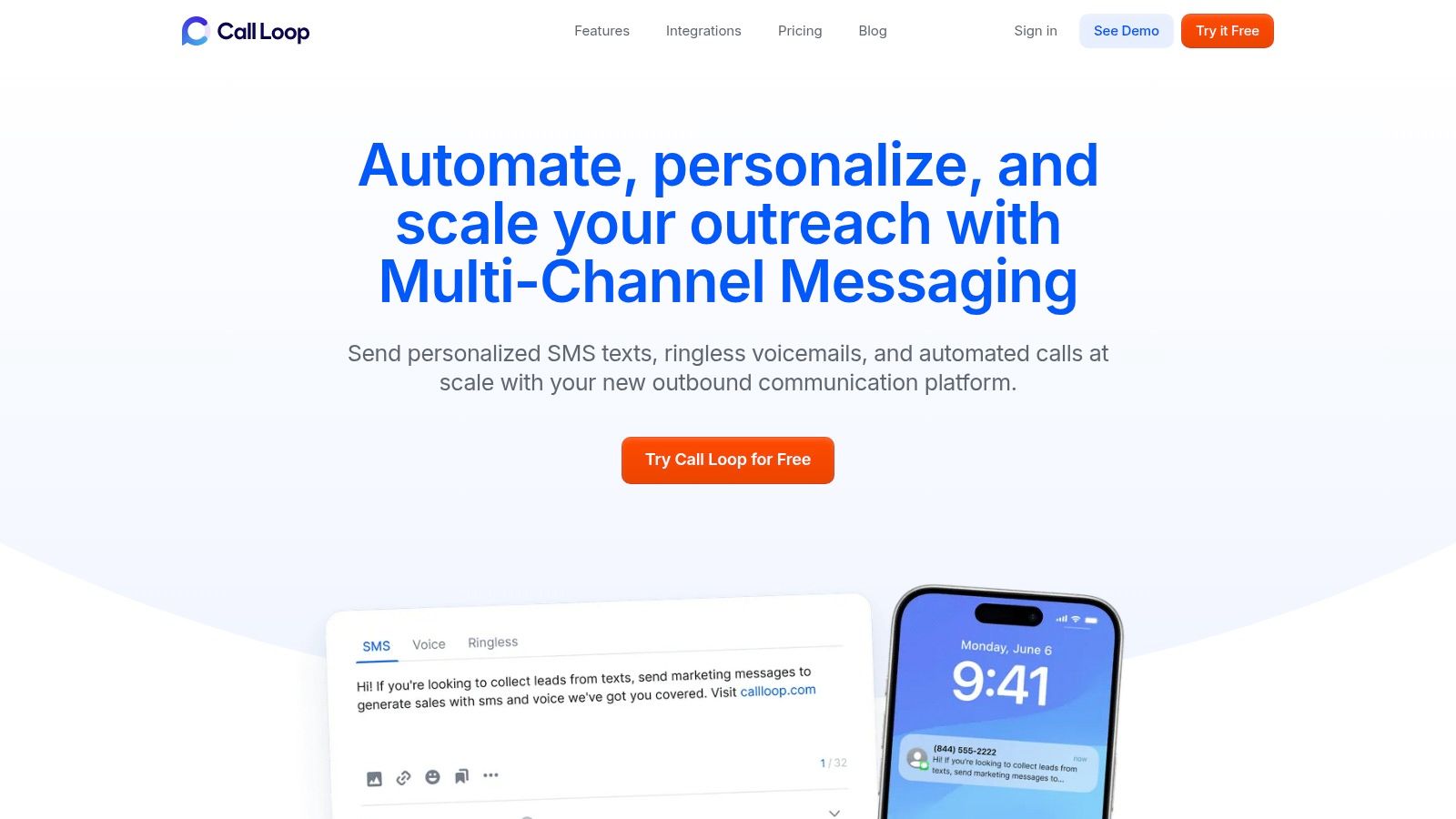
Drip campaigns matter because they let teams sequence SMS, voice, and ringless voicemail with precise timers. That means a reminder doesn't have to be a high-cost text if a lower-cost touch makes more sense for the audience and timing. For teams comparing automation stacks, the Orbit AI Salesmsg page is one of several places to see how messaging workflows are being packaged for sales teams.
Call Loop also connects with ActiveCampaign, HubSpot, Keap, and 4,000+ apps via Zapier, which reduces manual work that often becomes hidden labor cost. For buyers checking plan fit, the Call Loop pricing page is the direct place to review how the platform is packaged. That's especially relevant for small and mid-sized businesses, agencies, ecommerce teams, event organizers, and healthcare providers that need outreach to stay organized and compliant.
HIPAA-covered workflows add another layer of cost pressure, because compliance has to be part of the operating model, not an afterthought. In that environment, a platform that already supports secure communications can lower the operational burden around message handling and workflow setup. Call Loop also mentions support for text-to-join keywords, custom fields, merge tags, segmentation, scheduling, rich media, and appointment reminders, which are the kinds of features that make an outbound program easier to run without extra manual steps.
If you're trying to read a bulk SMS invoice with a clearer eye, start by separating message cost from compliance, routing, and labor. Then compare platforms on the work they remove, not just the rate they advertise. If that's the lens you need, visit Call Loop and look at how SMS, voice broadcasting, and ringless voicemail can be combined in one outbound workflow.
Chris Brisson
Chris is the co-founder and CEO at Call Loop. He is focused on marketing automation, growth hacker strategies, and creating duplicatable systems for growing a remote and bootstrapped company. Chat with him on X at @chrisbrisson


Trusted by over 45,000 people, organizations, and businesses like


