
See a Demo
You're just one step away from seeing Call Loop in action.
Enter your information below to watch a demo right now.

You're just one step away from seeing Call Loop in action.
Enter your information below to watch a demo right now.

A small business sending 25,000 messages a month should expect the right bulk SMS service to cost more than its headline rate suggests, because delivery, compliance, registration, and support determine what ultimately reaches customers. The cheapest quote often becomes the expensive one after filtered traffic, hidden fees, and manual list cleanup enter the calculation.
A retailer comparing two proposals usually sees one provider offering $0.01 per message and another asking $0.012 with managed 10DLC review and routing support. The first quote looks like the obvious win until messages are filtered, opt-outs require manual work, and a carrier flag interrupts the campaign. By then, the buyer isn't comparing message prices. They're comparing delivered conversations, operational risk, and the cost of rebuilding a damaged sender reputation.
SMS has been a foundational business channel for decades. Neil Papworth sent the first SMS, “Merry Christmas,” on December 3, 1992, and cross-network texting became possible by 1999, helping SMS move from a carrier feature to a global communication tool. By 2010, worldwide SMS volume had reached about 200,000 messages per second, or roughly 100 billion messages per year. The history of SMS shows why the channel still matters, but scale makes careless buying more costly.
A healthcare provider moving to a new messaging platform can save on send rates and still lose money during migration. Consent records may need cleaning, workflows may need rebuilding, replies may require new routing, and an interruption can leave patients without timely reminders. The platform decision affects the full customer lifecycle, not just the invoice.
Evaluate deliverability, 10DLC registration, consent records, opt-out automation, link tracking, routing, support, and workflow integration before signing a contract. These capabilities determine whether campaigns reach the right people, produce usable responses, and remain manageable after launch.
The cost of an undelivered message includes more than the send fee. It can include wasted creative work, missed sales, inaccurate attribution, customer complaints, and staff time spent investigating a campaign that should have been routine. A low rate offers little value when carriers filter the traffic or your team must process STOP requests manually.
Practical rule: Compare the cost per useful conversation, not the cost per attempted send.
Buying bulk SMS service means buying the process around every campaign. That process starts with list acquisition and consent capture, continues through segmentation and scheduling, and ends with delivery reporting, replies, suppression, and re-engagement. Choose a provider that can support two-way conversations, API access, automated workflows, and multiple sending identities as your programs grow.
Include ringless voicemail and voice in the evaluation when the campaign needs a different response path. SMS may suit time-sensitive prompts, while voice or ringless voicemail can support longer explanations or follow-up. The right platform should let you coordinate those channels without losing consent history, opt-out status, or campaign attribution.
SMS has remained a large business channel for decades. The Week's SMS history illustrates its reach, while market research estimates the bulk SMS market at USD 91.06 billion in 2024, USD 97.94 billion in 2025, and a projected USD 203.03 billion by 2035, with a 7.56% CAGR. The bulk SMS market estimates reinforce the commercial scale, but market size does not make every vendor suitable for your use case.
Score providers against operational outcomes. Define the messages you need to send, the replies you must handle, the markets you serve, and the evidence required if a carrier or customer questions your traffic. The key question is whether messages reach customers and drive action, rather than whether they clear a per-message price floor.
A polished demo can hide an impractical campaign workflow. Test the features with a real list structure, a real message, and a realistic reply path.
Segmentation should let you filter by behavior, geography, lifecycle stage, purchase history, or appointment status. A reminder audience shouldn't receive the same copy as a promotional audience, and a customer who clicked yesterday shouldn't be treated like a cold subscriber.
Merge tags personalize messages without forcing your team to create individual campaigns. Names, locations, appointment details, and account references can make a broadcast feel like a useful notification rather than a generic blast. Test how the platform handles missing fields, because a blank personalization token can make a compliant message look careless.
Timezone-aware scheduling protects customers from poorly timed sends. The platform should determine the recipient's local timezone and apply quiet-hour rules automatically, not rely on someone exporting a spreadsheet and sorting it manually.
Double opt-in gives your team stronger evidence that a subscriber intended to join. It also helps catch mistyped numbers and protects the list from accidental or fraudulent signups.
Link shortening and click attribution should connect each campaign to a destination and an outcome. Delivery receipts need to arrive through a usable dashboard and, for technical teams, through webhooks that can trigger retries or suppression logic.
Entry-level plans often restrict API throughput, webhook access, number types, shared short codes, or dedicated short codes. Ask whether your traffic uses a shared sender and how other customers' activity can affect reputation. If your outreach includes voice or ringless voicemail, confirm whether those channels share contacts, suppression rules, scheduling, and reporting with SMS.
Call Loop's bulk SMS features are relevant to buyers who need segmentation, merge fields, scheduling, link tracking, validation, and coordinated outreach rather than a basic send button.
| Feature | What It Changes in a Campaign | Priority For |
|---|---|---|
| Segmentation | Sends different messages to audiences with different needs or behaviors | Essential for marketing and lifecycle programs |
| Merge tags | Adds relevant recipient details while keeping one campaign manageable | High for reminders, sales follow-up, and service |
| Link tracking | Connects clicks with the campaign, audience, and destination | Essential for measurable promotions |
| Timezone scheduling | Reduces mistimed sends and supports local communication windows | Essential for national or international lists |
| Double opt-in | Confirms subscription intent and strengthens consent records | Essential for marketing traffic |
| Delivery webhooks | Sends delivery outcomes into internal workflows and reporting | High for technical and high-volume teams |
| Voice or ringless voicemail add-ons | Supports a coordinated multi-channel sequence | Useful for mixed outreach teams |
Transactional senders may prioritize routing, delivery receipts, integrations, and support. Marketing-heavy teams usually need deeper segmentation, consent controls, link attribution, and automated reply handling.
A useful quote must show the total landed cost for the same monthly volume. For a comparison at 25,000 messages per month, ask each provider to separate message charges from registration, number, verification, support, and overage costs.
| Pricing Model | Headline Rate | Estimated Monthly Cost | Hidden Fees to Watch |
|---|---|---|---|
| Per-message | $0.01 per message | $250 before extra charges | Carrier surcharges, setup, registration, number rental, failed delivery treatment |
| Monthly subscription | Fixed plan fee | Depends on plan and included volume | Unused capacity, user fees, API limits, overages |
| Tiered volume | Lower rate at committed volume | Depends on the selected tier | Locked budget, rollover rules, threshold pricing, registration |
| Pay-per-delivered | Charge applies to delivered traffic | Depends on delivery results and premium | Higher unit price, delivery definitions, retries, reporting limits |
The per-message example produces $250 before extra charges, but that figure doesn't tell you what happens to filtered traffic or whether compliance support is included. A subscription can work well for predictable senders, yet it can punish a business that sends heavily during seasonal periods and lightly during the rest of the year. Tiered pricing rewards commitment, but commitment can become waste if the list doesn't grow as expected.
Pay-per-delivered pricing aligns the vendor's incentives with successful delivery, but providers generally charge a premium for taking on more delivery risk. Read the definition of “delivered.” A carrier acceptance event isn't always the same as a customer receiving or acting on a message.
Request these line items on every proposal:
Use the bulk SMS pricing information as one reference point, but don't compare any provider until every quote uses the same volume and the same definition of delivery.
Treat deliverability and compliance as buying criteria from the first vendor call. Ask each provider to show the total landed cost for the same monthly volume, itemized by message charges, registration, number costs, and compliance support. The 2026 SMS marketing benchmark connects delivery performance directly to consent quality, campaign registration, and message classification.
First, verify delivery evidence. Request carrier-level confirmation, delivery-receipt reporting, throughput limits, and an explanation of failed DLR events. A dashboard that says “sent” without separating accepted, delivered, expired, filtered, and rejected traffic cannot support a serious buying decision.
Second, confirm 10DLC registration. US application-to-person messaging through local numbers requires attention to 10DLC registration. Ask whether the provider submits the brand and campaign, which information you must provide, how review works, and what happens after the campaign content changes. 10DLC opt-in guidance sets out the permission and unsubscribe framework your process must support.
Third, inspect consent mechanics. The platform should retain the opt-in source, wording, timestamp, and relevant contact context. It must process STOP and other reasonable opt-out methods quickly, with clear instructions such as “Reply STOP to unsubscribe.” Require an exportable record so your team can answer complaints without reconstructing consent from scattered systems.
Fourth, review every planned channel together. If the program includes voice broadcasting or ringless voicemail, ask how suppression and consent work across channels. The FCC treats ringless voicemail sent to wireless phones as a covered call under the TCPA because it uses an artificial or prerecorded voice. The ruling took effect immediately on November 21, 2022. The FCC ruling on ringless voicemail makes explicit consent part of the purchase decision.
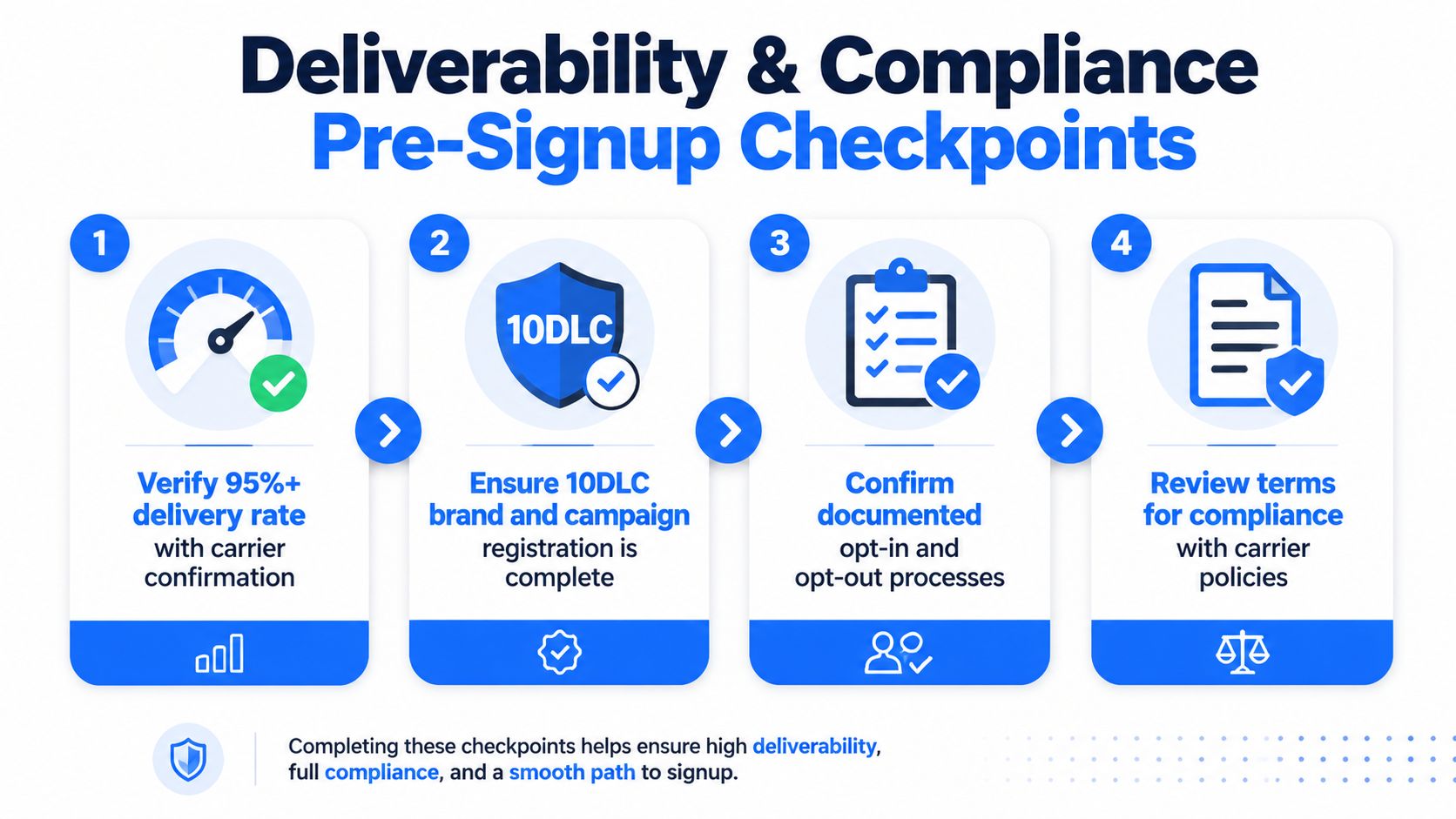
Put toll-free verification, quiet-hours controls, consent-record storage, suppression updates, and carrier-policy obligations in the contract. If delivery performance falls below the 95%+ benchmark, audit registration records, opt-in wording, and traffic classification before increasing volume.
Use this SMS compliance checklist during vendor calls. Ask: “What throughput tier applies to this campaign? How do you report DLR failures? Who investigates a carrier filter? How quickly does a STOP request suppress future traffic? What evidence can I export if a complaint arrives?”
Compliance controls protect the budget. Unregistered or non-consented traffic can be filtered, throttled, or blocked, raising the effective cost of every message that reaches a customer.
Don't choose a channel because it can reach the largest list. Choose it based on the action you need from the recipient.
SMS is the default for appointment reminders, alerts, confirmations, short promotions, and follow-up that benefits from a reply. It gives the recipient a compact written instruction and supports keywords such as STOP, HELP, YES, or CONFIRM.
Voice broadcasting fits situations where tone, explanation, or urgency matters. A recorded message can carry nuance that a short text can't, especially for community announcements, event changes, or outreach that needs a human voice. It also creates a heavier operational burden because teams must manage caller identity, do-not-call controls, consent, and answer behavior.
Ringless voicemail is a passive nudge. It can fit a verified, non-urgent follow-up where the recipient can listen when convenient, but the consent requirement for wireless phones makes it unsuitable as a loophole around calling rules. Treat ringless voicemail as a consent-dependent channel, not as an invisible shortcut.
| Channel | Cost per Contact | Compliance Burden | Best-Fit Use Case |
|---|---|---|---|
| SMS | Usually efficient for short, high-volume communication | Consent, opt-out, registration, content, and carrier rules | Reminders, alerts, confirmations, promotions |
| Voice broadcasting | Depends on recording, routing, and connected calls | Consent, caller controls, do-not-call management, content rules | Persuasive or detailed announcements |
| Ringless voicemail | Depends on successful voicemail drops and vendor model | Explicit consent is required for covered wireless calls | Low-pressure, non-urgent follow-up |
| Multi-channel sequence | Combines channel costs and governance requirements | Requires shared suppression and channel-specific controls | Lifecycle outreach with escalation paths |
Use SMS when action is required, voice when persuasion is required, and ringless voicemail only when a passive nudge fits a documented consent path.
Organizations often create channel confusion by sending reminders, announcements, and promotions through the same workflow. Churches and community groups can benefit from reviewing common church communication pitfalls, especially when multiple audiences, leaders, and message types share one database. The lesson applies to businesses too: define who should receive what, through which channel, and with what reply path.
Launch order matters. A strong message sent to an unverified list through an unregistered route can fail before copy quality has any chance to help.
Validate every number against the carrier's HLR or a real-time validation API. Remove landlines when the use case requires mobile delivery, identify unreachable records, and preserve the validation result alongside the contact record.
Then confirm the opt-in source and timestamp for every contact. A spreadsheet column that says “subscribed” isn't a reliable audit trail. Store the form, keyword, QR code, event, or other acquisition source with the consent record and the language shown at signup.
Build a double opt-in flow with clear merge tags and recognizable STOP and HELP keywords. Test missing names, unusual characters, duplicate numbers, and contacts who reply with an opt-out phrase instead of the exact standard keyword.
Create your shortened links and click tracking before the first send. Decide what each click should mean, such as a booking, purchase, registration, or support request, then connect the tracking to the campaign record.
Set quiet hours and timezone logic at the platform level. Don't ask individual campaign managers to remember local timing rules. Configure DLR webhooks so undelivered messages are flagged, reviewed, and retried only when the failure reason supports another attempt.
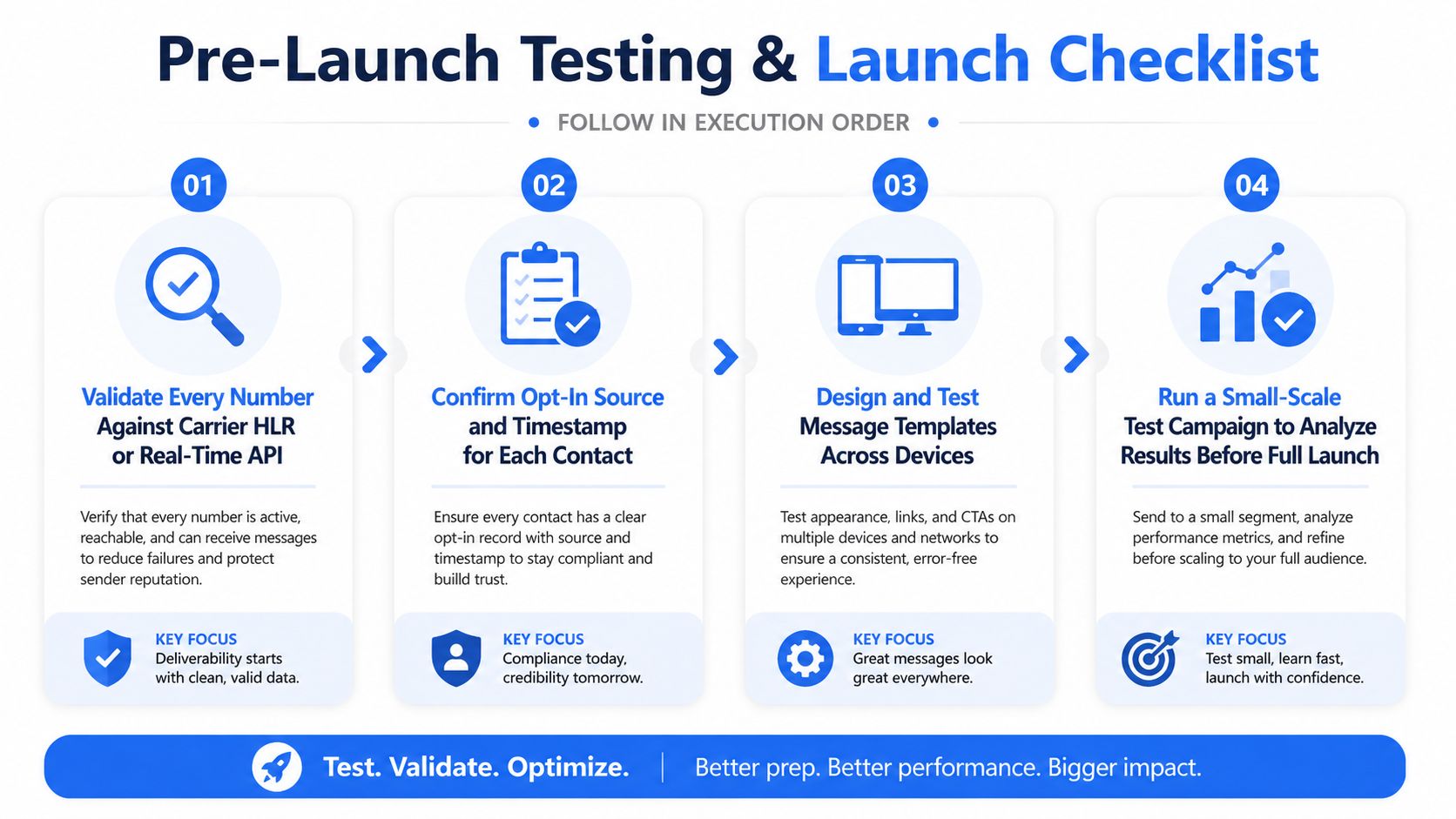
Send a small test batch of 50 to 200 messages across morning, midday, and evening windows. Measure actual delivery rate, opt-out rate, and click-through rate before scaling. The test isn't a formality. It exposes bad personalization, broken links, quiet-hours mistakes, carrier filtering, and an inaccurate estimate of response capacity.
On launch day, document the sending window, vendor escalation contact, campaign owner, and rollback plan. If delivery drops mid-campaign, pause the send, preserve the logs, identify whether the problem is content, registration, throughput, or list quality, and restart only after the provider explains the failure.
Rank vendors with a scorecard, then test whether their systems protect the full outreach lifecycle. Start with the weighted framework below: Deliverability at 30%, compliance at 25%, cost at 20%, features at 15%, and support at 10%.
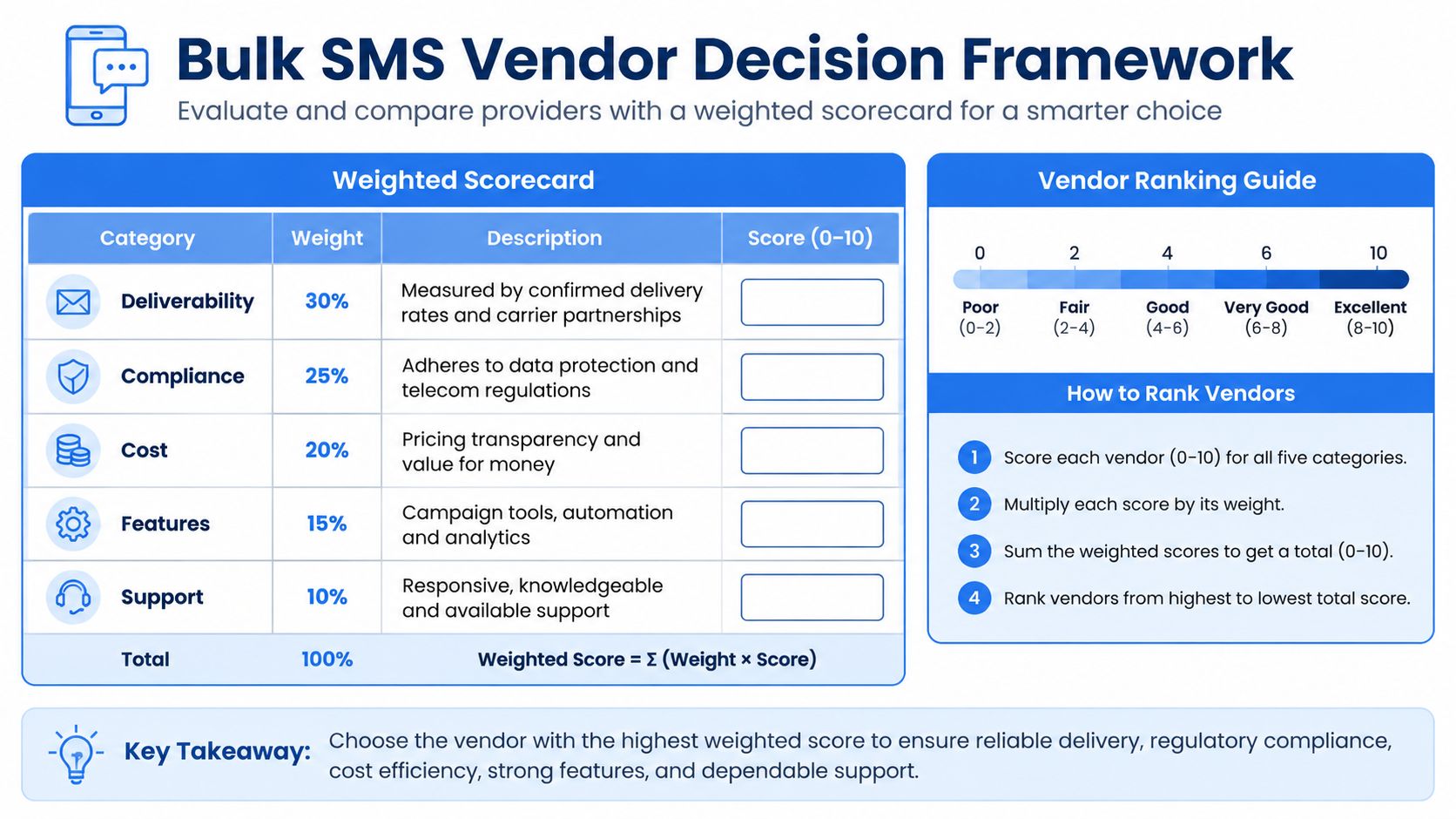
Adjust those weights to match the operation. A dental clinic sending appointment reminders should prioritize consent records, delivery receipts, timezone controls, integrations, and human reply handling. An ecommerce store running flash promotions may prioritize segmentation, link attribution, throughput, campaign registration, and fast launch support.
Require every provider to demonstrate the same workflow:
Judge the workflow under real operating conditions. Filtered traffic, incomplete records, weak support, and confusing tools create costs that a low per-message rate cannot offset. Check 10DLC registration, route ownership, consent handling, and ringless voicemail controls before approving a vendor. A plan labeled “unlimited” says little about whether the campaign can run safely.
Ask how the provider protects list health, fits your team's daily process, and supports later campaigns without a painful migration. Once delivery, compliance, and support controls are confirmed, the per-message rate becomes a secondary differentiator. The true cost includes the operational time required to manage replies, suppressions, integrations, reporting, and failures after launch.
If you need bulk SMS with segmentation, merge tags, scheduling, link tracking, number validation, and coordinated voice or ringless voicemail workflows, review the capabilities available through Call Loop. Test the provider against your real consent records, campaign flow, and reporting requirements before committing your outreach budget.
Chris Brisson
Chris is the co-founder and CEO at Call Loop. He is focused on marketing automation, growth hacker strategies, and creating duplicatable systems for growing a remote and bootstrapped company. Chat with him on X at @chrisbrisson


Trusted by over 45,000 people, organizations, and businesses like


