
See a Demo
You're just one step away from seeing Call Loop in action.
Enter your information below to watch a demo right now.

You're just one step away from seeing Call Loop in action.
Enter your information below to watch a demo right now.

You're already paying for calls. You just may not know which marketing caused them, which callers were worth your team's time, or which outbound touches pushed someone to finally pick up the phone.
That's the usual SMB problem. You run paid search, post on social, send direct mail, maybe send SMS reminders or a ringless voicemail campaign. The phone rings. Someone on your team answers. A few calls become appointments or sales. Most businesses stop there and call it “working.”
That's not measurement. That's guesswork.
Call tracking and analytics fixes that by turning each call into a record you can use. For SMBs, that matters even more when the phone sits at the center of the funnel. Home services, healthcare, legal, clinics, agencies, real estate, franchise locations, and local businesses often close business on calls, not forms. If you can't connect those calls to campaigns, your reporting is incomplete and your budget decisions are softer than they should be.
The overlooked part is outbound. A lot of guides talk only about inbound website calls. In practice, many SMBs also generate calls from outbound SMS, voice broadcasts, and ringless voicemail. If you don't assign the right tracking numbers to those campaigns and route the results back into your CRM, you miss a big part of what's driving response.
If you advertise in more than one place, you already know the attribution problem. A customer sees a mailer, clicks a search ad two days later, gets an SMS reminder, then calls your office. Your staff asks, “How did you hear about us?” The answer is usually incomplete, vague, or wrong.
Call tracking solves that by assigning unique phone numbers to campaigns so you can tie each call back to a channel, keyword, or asset. Modern platforms also capture source, time, duration, and location, turning what used to be an anonymous offline event into measurable marketing data for campaign optimization, as described in this overview of call tracking fundamentals.
At a simple level, the setup looks like this:
Phone leads are often high intent. Someone calling usually wants an answer now, not next week. If that lead came from a campaign you can identify, you can stop treating phone calls like a black hole in your reporting.
Practical rule: If a channel can make the phone ring, it needs its own tracking number or a clear tracking method.
The first mistake is using one number everywhere. That gives you call volume, but not attribution.
The second is tracking only inbound website traffic while ignoring outbound campaigns. If you send text reminders, promotional SMS, voice broadcasts, or ringless voicemail, those campaigns need their own tracking logic too. Otherwise you'll over-credit whichever channel happened to get the last click before the call.
The third is treating every call as equal. A wrong number, a billing question, and a booked consultation should not sit in the same bucket.
The true value of call attribution isn't the dashboard. It's the decisions you can make from it.
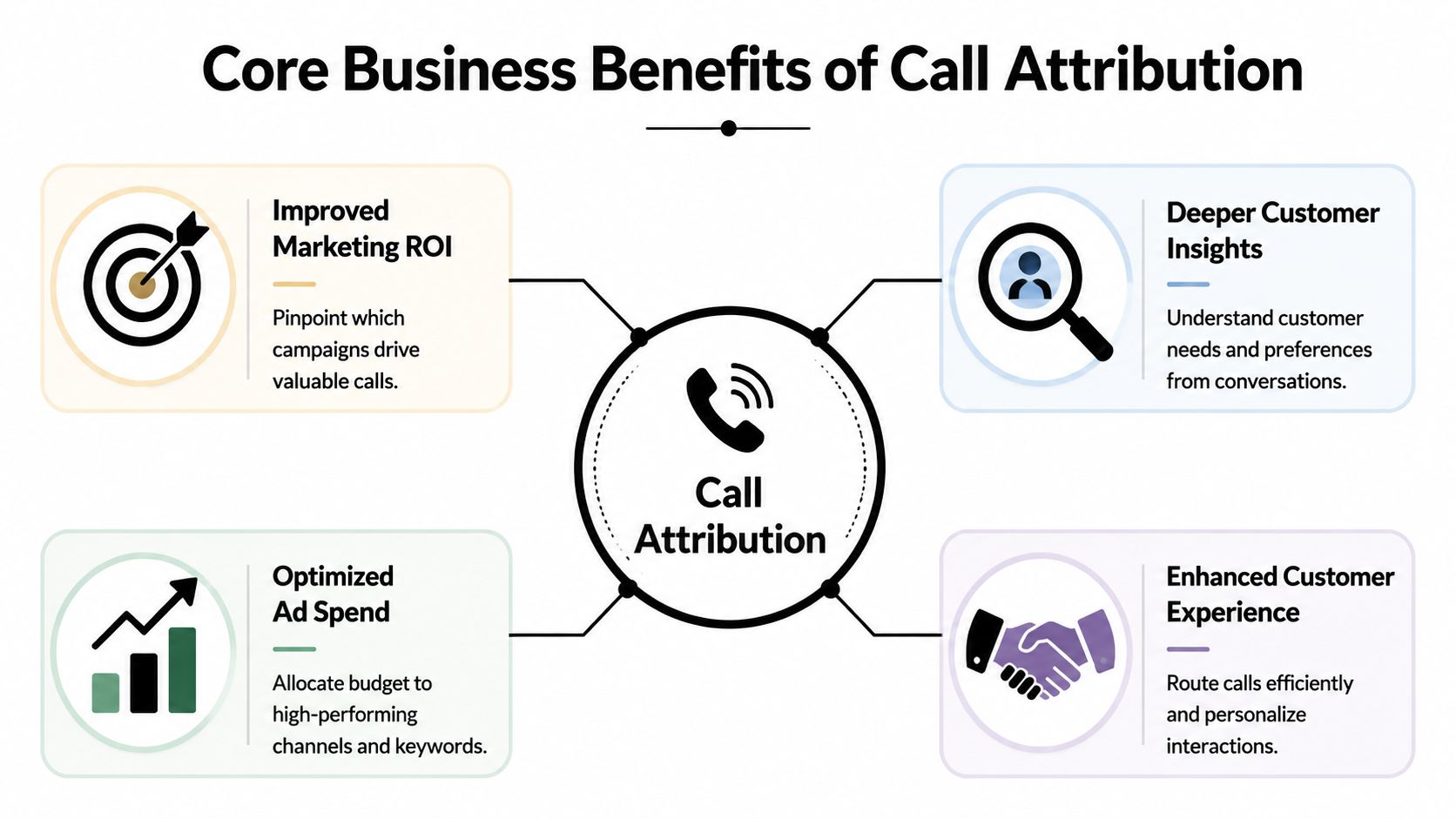
When each campaign has its own phone number, you can stop lumping all calls together. That changes budget conversations fast. You can see whether paid search is driving consultations, whether direct mail is producing serious callers, or whether an outbound SMS follow-up is reactivating older leads.
For SMBs, this is usually the first win. You don't need a complicated attribution model to make better choices. You need enough separation between campaigns to see which ones produce valuable calls.
Call attribution gets even more useful when inbound and outbound work together.
A common pattern looks like this:
That's where many teams lose visibility. They track the first call, but not the outbound touches that brought the lead back.
Call attribution isn't only about acquisition. It also helps you spot service and operations issues.
If one campaign generates a lot of calls that don't convert, the problem might be bad targeting. If a campaign drives good leads but callers keep dropping after long hold times, the issue is on the phone side. Attribution tells you where to look first.
A useful call report should answer two questions at once: what caused the call, and what happened after the call.
Once you know which campaigns drive which types of calls, you can route them better. New patient inquiries, support questions, appointment confirmations, and promotion-driven callbacks shouldn't all land in the same queue with the same script.
The business benefits usually fall into four buckets:
| Benefit | What it improves | What to look for |
|---|---|---|
| Marketing ROI | Channel and campaign decisions | Which sources produce calls that lead to sales or follow-up |
| Customer insight | Message and offer quality | Patterns in caller questions, objections, and intent |
| Spend efficiency | Budget allocation | Which campaigns deserve more spend and which need to be cut |
| Customer experience | Handling and routing | Missed calls, slow response, wrong routing, repeat questions |
For most SMBs, call attribution starts as a reporting fix. It becomes an operations tool once the team starts using it to route better, coach faster, and follow up with more context.
Most businesses start by watching call volume. That's fine for a week. After that, it hides more than it shows.
Modern analytics tools have moved beyond simple call logging. They now transcribe conversations, detect keywords, score sentiment, and track operational KPIs such as first-call resolution and call abandonment rate, which supports both marketing ROI analysis and service-quality management, as covered in this call center analytics guide.
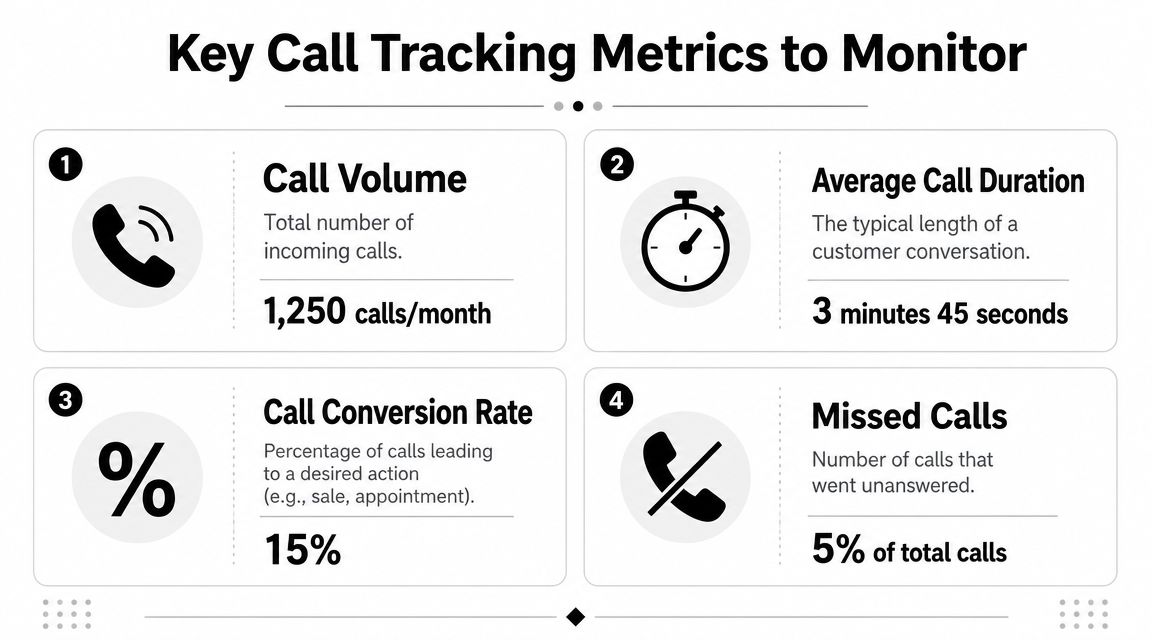
These are the first metrics worth checking every week:
| Metric | What it measures | What business question it answers |
|---|---|---|
| Call volume | Number of inbound calls by source or campaign | Which channels are producing response |
| Source or channel | Where the call came from | Which campaign, keyword, or asset drove the call |
| Call timing | Day and time of each call | When you need staff coverage and which campaigns trigger peak demand |
| Call duration | How long the conversation lasted | Whether calls are quick dead ends, support issues, or fuller sales conversations |
| Call outcome | Sale, appointment, follow-up, voicemail, missed | Which calls actually moved the business forward |
These are not glamorous metrics, but they're useful. If your call volume rises while booked appointments don't, you probably have a targeting or handling problem. If one source generates shorter calls and more missed connections, you may be buying the wrong kind of attention.
This is the layer many guides skip. Counting calls is easy. Measuring whether a call was good is harder.
A simple quality review can include:
That's how you separate “busy” from “productive.”
If your platform includes transcripts and keyword detection, use them. Search for repeated objections, common questions, and phrases that show purchase intent. That feedback should shape your ads, your landing pages, and your call scripts.
If you need a broader framework for evaluating channel performance, this article on measuring marketing campaign effectiveness is a useful companion to phone-based reporting.
Watch for mismatch: A campaign can look strong on call volume and weak on call quality. Don't let top-of-funnel activity fool you.
Marketing is only half the story. Some metrics tell you where your team is losing good calls:
A healthy setup measures both source and outcome. If you only know how many calls came in, you still don't know much.
Implementation doesn't need to be complicated. Most SMBs can get this running if they keep the structure clean from the start.
The most reliable setups use dynamic number insertion or per-campaign tracking numbers to create a deterministic attribution chain from channel to call to conversion, which is more dependable than asking customers how they heard about you, as explained in this breakdown of call tracking methods.
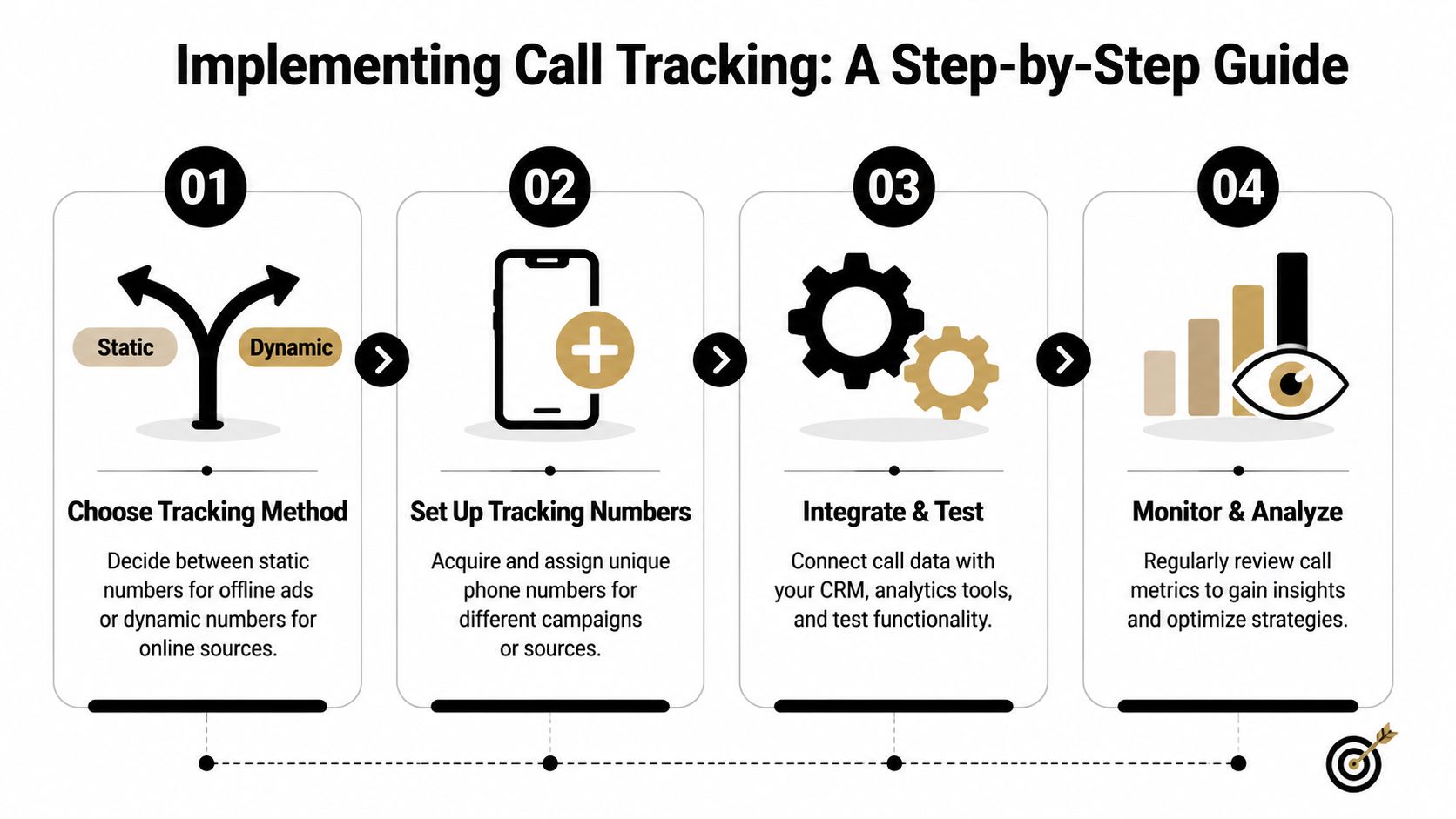
You usually need two methods, not one.
Static tracking numbers work best for offline and outbound campaigns. Use them for direct mail, flyers, print, local sponsorships, QR campaigns, SMS blasts, voice broadcasts, and ringless voicemail. Each campaign gets its own number.
Dynamic number insertion, or DNI, works best on your website. It swaps the displayed phone number based on how a visitor arrived, so a visitor from paid search can see a different number than someone from organic search or social.
That split matters. Offline and outbound campaigns need campaign-level attribution. Website traffic often needs visitor-session attribution.
Before you buy numbers, map the campaigns you need to measure.
A practical SMB setup might include:
Keep the naming clean inside your reporting. If campaign names are messy, the reports will be messy too.
Here, the setup often breaks.
If you send a text campaign telling people to call for scheduling, quote requests, or limited-time offers, the callback number in that message should be trackable to that campaign. The same goes for ringless voicemail. A voicemail drop that asks a prospect to call back should never point to a generic main line if you want real attribution.
One option in this category is Call Loop call tracking numbers, which can be used alongside SMS, voice broadcasting, and ringless voicemail workflows so callbacks can be tied to the specific outbound campaign that triggered them.
If outbound messaging is part of your funnel, track the callback path, not just the send.
Run live tests before launch.
Call each tracking number yourself. Check where the call routes, how it logs, what source appears, whether recordings or transcripts work, and whether the CRM receives the right fields. Test on mobile and desktop for DNI. Test after hours if you use voicemail routing or on-call staff.
A clean implementation is less about software and more about discipline. Fewer campaigns tracked correctly will beat a sprawling setup no one maintains.
Call data becomes more valuable once it stops living in a separate dashboard.
At minimum, your CRM should receive:
That gives your sales or intake team context before the next conversation starts.
For example, if a contact first calls from a Google Ads campaign, then later responds to a ringless voicemail reminder, your CRM should show both touches in the same record. Without that, your team sees fragments instead of a customer journey.
When call tracking is integrated properly, teams stop doing manual cleanup work.
A rep doesn't have to ask where the lead came from. A manager doesn't have to merge spreadsheets to compare call outcomes by campaign. A marketer doesn't have to chase the front desk for notes about which calls turned into appointments.
The system should create one working record, not three partial ones.
Most SMBs don't need a huge architecture. They need a dependable flow:
If you already use HubSpot, a direct HubSpot integration for messaging and follow-up workflows can help connect outreach and call activity without forcing your team to re-enter contact data.
The best CRM integration is the one your team doesn't have to think about after setup.
Avoid overbuilding. If your front desk, sales team, or care coordinators won't consistently use six custom fields, don't create six custom fields. Push only the data people will use.
Tracking calls is useful. Changing campaigns because of what you learned is where the money is.
Advanced call analytics can use speech-to-text transcription and sentiment analysis to pull out customer intent, recurring objections, escalation patterns, and compliance issues from call content, which helps teams understand why calls convert or fail, as explained in this overview of advanced call center analytics.
Listen to a handful of calls and you'll hear things your ad account never tells you.
You'll hear people asking for services you don't offer. You'll hear confusion around pricing, insurance, availability, location, or turnaround time. You'll hear repeat objections that should have been handled earlier on the landing page or in the message itself.
Use that data to tighten campaigns:
Outbound campaigns often work best as a nudge, not a standalone closer. That's especially true with SMS reminders and ringless voicemail.
If your analytics show that callbacks after a ringless voicemail tend to involve pricing questions, change the script so the voicemail sets expectations better. If SMS-driven calls convert when they mention scheduling urgency, keep that theme and drop weaker copy angles.
For teams building faster response systems, this guide to real-time analytics is helpful because speed matters when a lead calls soon after a message lands.
A campaign that triggers a lot of short, low-intent calls can eat staff time. Another campaign may drive fewer calls but better ones. That's why quality scoring matters.
A practical scoring model can include:
| Signal | What it can tell you |
|---|---|
| Conversation topic | Whether the caller is a fit for the offer |
| Outcome | Whether the call produced an appointment, transfer, or next step |
| Objections raised | Whether the campaign is attracting the right audience |
| Sentiment or tone | Whether the script or handling is creating friction |
That kind of scoring helps you reallocate budget toward campaigns that produce business, not just noise.
The best optimization loop is simple.
Marketing updates the message. Sales or intake updates the script. Operations fixes routing gaps. Then you watch whether call quality improves.
If analytics only sit in a reporting tab, nothing changes. If the team uses them to adjust targeting, copy, scheduling, and follow-up, the system compounds.
Call tracking is easier to set up than it is to govern well. That's especially true if you work in healthcare or handle sensitive customer data.
As browser and platform tracking gets weaker, businesses also have to deal with consent requirements and the loss of third-party identifiers, which makes privacy-resilient measurement a more important part of call tracking strategy, as discussed in this overview of phone call tracking and privacy challenges.
If you're in a HIPAA-covered environment, don't bolt compliance on later. Start with it.
That means thinking through:
For healthcare teams, the key issue isn't just tracking calls. It's making sure the entire flow, including reminders, callbacks, voicemail delivery, and CRM sync, is handled in a HIPAA-compliant environment.
Most call tracking issues fall into a few buckets:
A short troubleshooting checklist helps:
Privacy-safe measurement is now part of call tracking quality, not a separate legal task.
If the setup is simple, documented, and tested, most SMBs can run call tracking and analytics without making it a burden on the team.
If you want to connect inbound call attribution with outbound SMS, voice broadcasting, and ringless voicemail in one workflow, Call Loop is one option to review. It supports multi-channel outreach, reporting, CRM integrations, and HIPAA-compliant use cases for teams that need secure patient or customer communications while still measuring callback activity.
Chris Brisson
Chris is the co-founder and CEO at Call Loop. He is focused on marketing automation, growth hacker strategies, and creating duplicatable systems for growing a remote and bootstrapped company. Chat with him on X at @chrisbrisson


Trusted by over 45,000 people, organizations, and businesses like


