
See a Demo
You're just one step away from seeing Call Loop in action.
Enter your information below to watch a demo right now.

You're just one step away from seeing Call Loop in action.
Enter your information below to watch a demo right now.

The short answer? Yes, you can absolutely text a landline. It just doesn't work the way you think it does.
A traditional landline phone can't display a text message like a smartphone can. But thanks to some clever technology, your message can still get through.
Ever sent out a marketing text and had that nagging feeling that a chunk of your contacts never saw it because they're still using a landline? It's a valid concern, but the reality is that reaching these folks is not only possible, it’s surprisingly simple.
You don't send a text that magically appears on a non-existent screen. Instead, your message gets converted into a format a landline can actually handle.
Think of it like this: you want to send a digital photo to a friend who only has a physical photo album. You'd have to use a service to print the photo and mail it to them. The photo arrives, just in a different format. Technology does pretty much the same thing for texting landlines.
The secret sauce is a service that translates your text message into a voice message. Instead of your words arriving silently, they get delivered as audio. This opens up a couple of powerful ways for businesses to connect with everyone on their list.
These technologies are a game-changer. They turn a potential communication dead-end into a valuable touchpoint, ensuring your message reaches every single person, whether they have the latest smartphone or a trusty old home phone.
This is huge for any business that relies on broad outreach. Imagine sending out appointment reminders, flash sale alerts, or community updates and knowing with certainty that every customer—including those who prefer landlines—gets the memo. It’s about making sure no one gets left behind, which goes a long way in building strong customer relationships and making your campaigns more effective.
So, can you really text a landline? The short answer is yes, but it's not as simple as texting a mobile phone. Think of it like a clever translation service. A normal text to a cell phone is a direct delivery, but sending one to a landline needs a middleman to convert your written message into something the older phone tech can understand.
It's a bit like sending a package. A standard SMS is like handing the package right to your friend. Texting a landline is more like giving it to a courier who opens it, reads the contents out loud, and delivers the message verbally over the phone.
The entire process hinges on a service that bridges the gap between text and voice.
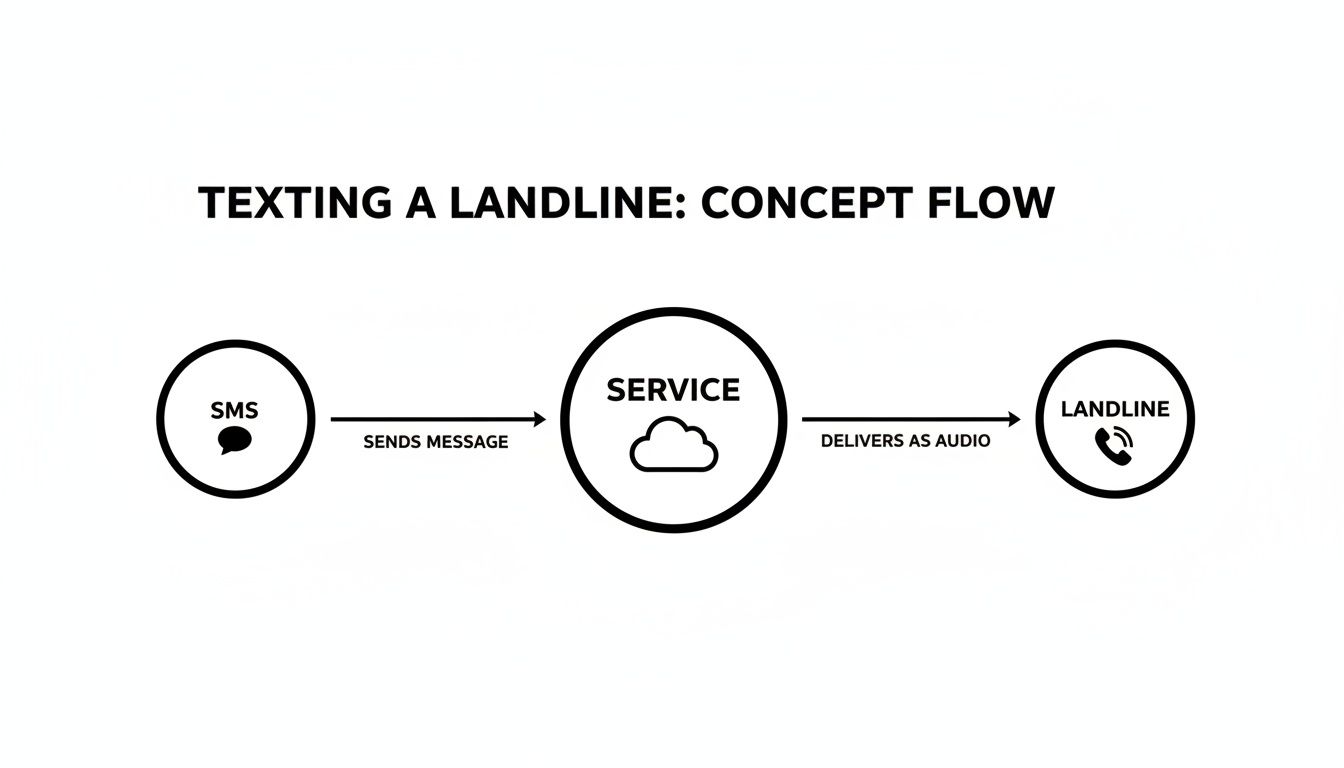
As you can see, a third-party service is the essential go-between. It takes your text and transforms it into a format that a landline can handle. Without that conversion, the message would just hit a dead end.
This "translation" happens in a few different ways, each offering unique advantages for businesses trying to connect with every customer.
Ringless voicemail is a non-intrusive powerhouse. It allows you to deliver a personal, high-impact message—like a special offer or an appointment reminder—without interrupting your customer’s day, ensuring they get the information when it’s convenient for them.
Even with smartphones everywhere, the landline is far from dead. Globally, landline subscriptions have been holding steady at around 850 million in recent years.
Sure, that's down from the peak, but it’s still a massive number. Key markets like India (over 20 million active lines) and the US (about 35 million residential lines in 2023) show there's a significant, and often overlooked, customer base out there. You can dig into more statistics about global communication trends to see the full picture.
Ultimately, these delivery methods are more than just clever workarounds. They’re strategic tools that let you reach every customer, no matter what kind of phone they use. By turning texts into voice calls or dropping silent voicemails, you make your outreach inclusive and ensure your message gets heard, opening up a channel to a demographic many of your competitors are probably ignoring.
Now that we've covered how you can text a landline, let's dig into the why. It's about way more than just a clever tech workaround; it’s a massive business advantage hiding in plain sight.
In a world obsessed with mobile-first everything, the landline demographic is a huge, often completely ignored, opportunity. When you write off this group, you're leaving a substantial and much less competitive market on the table for someone else to grab.
Lots of businesses just assume everyone is glued to a smartphone, but that’s just not reality. Key groups, like older adults or folks in rural areas with spotty cell service, still lean on their landlines every single day. By working landline messaging into your outreach, you can connect with an audience your competitors aren't even thinking about.
Being able to message landlines gives you a direct line to a loyal customer base. And while you can't send a traditional text, modern platforms have cracked the code by delivering your message through methods like ringless voicemail and voice broadcasts. These are sometimes called voicemail drops or direct-to-voicemail messages, but they all achieve the same goal: delivering your message silently and effectively.
And this audience isn't small. Not by a long shot. Global data shows there were still over 800 million landline subscriptions worldwide in 2023. You can dig into the numbers yourself by checking out the global phone subscription trends on Our World in Data.
This isn't just about raw numbers, though. It's about building stronger, more inclusive relationships with your customers.
When you make sure your communications reach everyone—no matter what tech they use—you're showing a level of customer care that builds serious loyalty and trust. That simple act of being inclusive can make your business stand out in a big way.
Think about the real-world uses. A local plumbing company can send automated appointment reminders to all their clients, cutting down on no-shows from customers who only have a home phone. A community center can broadcast announcements for upcoming events, making sure its older members who don't use smartphones stay in the loop.
Bringing landline communication into the mix isn't just a nice idea—it gets real results. Take a look at these examples:
In every case, the business gets a reliable way to talk to a part of its audience that would otherwise be silent. This all-in approach means no customer gets left behind, which ultimately builds a stronger community and leads to better business.
When you need to reach someone on their landline, you’ve got powerful options that go way beyond a simple text-to-voice call. The two most effective tools in the shed are ringless voicemail and voice broadcasting. While both deliver an audio message, they operate in completely different ways and are built for different jobs. Picking the right one boils down to your campaign's goal and how you want your audience to feel when they get your message.
Think of it this way: ringless voicemail is like slipping a note under someone's door. It’s quiet, respectful of their time, and they find it when they're ready. Voice broadcasting, on the other hand, is like ringing the doorbell—it’s direct, it asks for immediate attention, and it’s meant to start a conversation right now. Both get the job done, but you wouldn't ring the doorbell just to deliver a casual flyer.
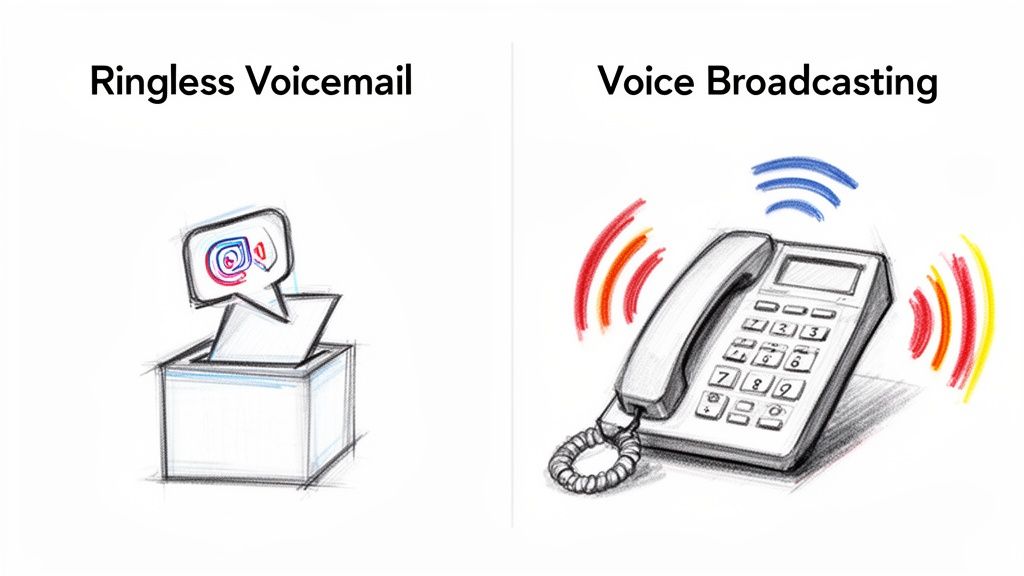
Ringless voicemail is your secret weapon for non-intrusive communication. This technology cleverly delivers a pre-recorded audio message straight to someone's voicemail box without their phone ever ringing. The process is totally seamless and silent on their end. Also known as a voicemail drop, this method is perfect for marketing messages, gentle reminders, or updates that aren't screaming for immediate attention.
Because it doesn't interrupt someone's dinner or an important meeting, it feels less like a cold call and more like a helpful heads-up. If you're curious about the nuts and bolts, our guide breaks down in detail what ringless voicemail is and how to put it to work.
Use Ringless Voicemail for:
Voice broadcasting is built for immediate impact. Plain and simple. This tool sends out a pre-recorded message that actively dials the landline number. When the person picks up, your message plays automatically.
This approach is tailor-made for urgent communications where you absolutely need to grab someone’s attention. Think emergency alerts, last-minute schedule changes, or announcements that just can't wait. It's all about making sure your message is heard as soon as humanly possible. Some businesses even integrate these tools into their core systems using VoIP Services in Canada to build a more robust communication strategy.
Use Voice Broadcasting for:
To make the choice even clearer, let's break down how these two powerful methods stack up side-by-side.
Ultimately, the choice comes down to matching the tool to the tone and urgency of your message. One builds goodwill, the other commands attention.
The core difference lies in urgency and intrusion. Ringless voicemail respects the recipient's time and gives them control, making it ideal for building goodwill. Voice broadcasting prioritizes speed and immediate awareness, making it essential for time-critical information.
Getting this right is crucial. Using voice broadcasting for a simple sales promo could easily annoy potential customers. On the flip side, sending a ringless voicemail for an emergency alert might mean it isn't heard in time. By matching the tool to the message, you make sure your landline outreach is not just possible, but incredibly effective.
Using powerful tools like ringless voicemail to connect with customers is a game-changer, but doing it the right way is absolutely critical. The moment you start sending automated messages to landlines, you're stepping into a regulated space. These rules aren't just suggestions; they're in place to protect consumers, and ignoring them can land your business in serious legal and financial trouble.
The big one you need to know is the Telephone Consumer Protection Act (TCPA). This is the federal law that sets the ground rules for how businesses can contact people using automated systems, which includes things like voice broadcasts and ringless voicemail. The core principle is simple: you need permission first.
Before you even think about launching an automated campaign to landlines, you need what's called prior express written consent. This is a fancy way of saying a customer has to clearly and explicitly give you the thumbs-up to send them marketing messages. This could be a checkbox they tick on your website form, a signed agreement, or a keyword they text to you.
Let's be crystal clear: just having a customer's phone number doesn't count. The TCPA demands unambiguous, documented permission for any marketing outreach. This puts the consumer in the driver's seat, and it's not optional—it's the law.
Fail to get that consent, and you could be looking at fines up to $1,500 per violation. For a big campaign, you can do the math. Those numbers add up terrifyingly fast, making compliance a non-negotiable part of your strategy.
Getting permission is just step one. You also have to give people an easy way to change their mind. This boils down to two key practices:
Once someone opts out, you have to honor that request immediately and forever. Keeping your own internal DNC list is the best way to track these requests and make sure you don't accidentally contact them again. For a deeper dive into responsible messaging, check out our guide on following an anti-spam policy.
Following these rules does more than just keep you out of hot water. It shows your audience that you respect their privacy and their time, and that's how you build real trust.
Alright, let's move from theory to action. Getting your first landline messaging campaign off the ground is a lot simpler than you might think. We've boiled it down to a clear, five-step workflow that will help you connect with your entire audience, landlines and all.
First things first: you need to know who you're talking to. The very first step is to segment your contact list. You have to figure out which numbers are landlines and which are mobile phones. This is a crucial step because it dictates the delivery method. Get this right, and you avoid wasted effort and immediately boost your success rate. A good phone lookup service can be a lifesaver here, helping you clean up and organize your lists before you send a single message.

Once your list is sorted, it's time to craft a clear and concise audio message. Your recording needs to get straight to the point. Make sure it has a clear call-to-action, like asking them to call a specific number or visit a website. A professional but friendly tone always works best and makes people more likely to engage.
With your message ready, you'll need to select the best delivery method for what you're trying to achieve.
The method you choose has a huge impact on how your message is received, so it's a critical decision during your campaign setup.
The most effective campaigns are built on a simple principle: match the tool to the task. Use a subtle approach for gentle nudges and a direct one for urgent calls to action. This ensures your message feels appropriate and respectful of the recipient's time.
The final steps are to schedule and launch your campaign, and then track your success. Keep a close eye on key metrics like delivery rates and the number of callbacks you receive to see how people are engaging. This data is gold—it gives you the insights you need to tweak your strategy for future campaigns and really dial in your connection with landline customers.
Even after you get the hang of the technology, a few questions always pop up about how this all works in the real world. Let's clear up some of the most common ones.
Generally, no. Think of most of these methods, especially ringless voicemail, as one-way broadcasts. They’re fantastic for getting information out, but not for starting a two-way chat.
The best move is to always bake a clear call-to-action right into your audio message. Something like, "call us back at..." or "head over to our website at..." gives people an easy next step to take.
Yes, it's perfectly legal—as long as you play by the rules. The big one here is the Telephone Consumer Protection Act (TCPA). It boils down to this: you need to have prior express consent from people before you send them marketing messages.
Just make sure you have that permission on record, and your campaigns will stay on the right side of the law.
The delivery rates are typically very high. Of course, this depends on a few things, like having a valid, active phone number and carrier support on the other end.
Platforms that specialize in landline messaging are built from the ground up to nail this. They're designed to maximize deliverability and make sure your message reliably lands in a valid voicemail box.
Pricing can vary, but a popular and fair model is paying per successful delivery, or per "drop." This is a super cost-effective way to do it.
Why? Because you only pay for the messages that are actually placed in someone's voicemail inbox. You're not wasting money on disconnected or bogus numbers.
Ready to connect with every single customer on your list? Call Loop makes it easy to reach landline users with powerful ringless voicemail and voice broadcasting campaigns. Start your free trial with Call Loop today!
Chris Brisson
Chris is the co-founder and CEO at Call Loop. He is focused on marketing automation, growth hacker strategies, and creating duplicatable systems for growing a remote and bootstrapped company. Chat with him on X at @chrisbrisson


Trusted by over 45,000 people, organizations, and businesses like


