
See a Demo
You're just one step away from seeing Call Loop in action.
Enter your information below to watch a demo right now.

You're just one step away from seeing Call Loop in action.
Enter your information below to watch a demo right now.


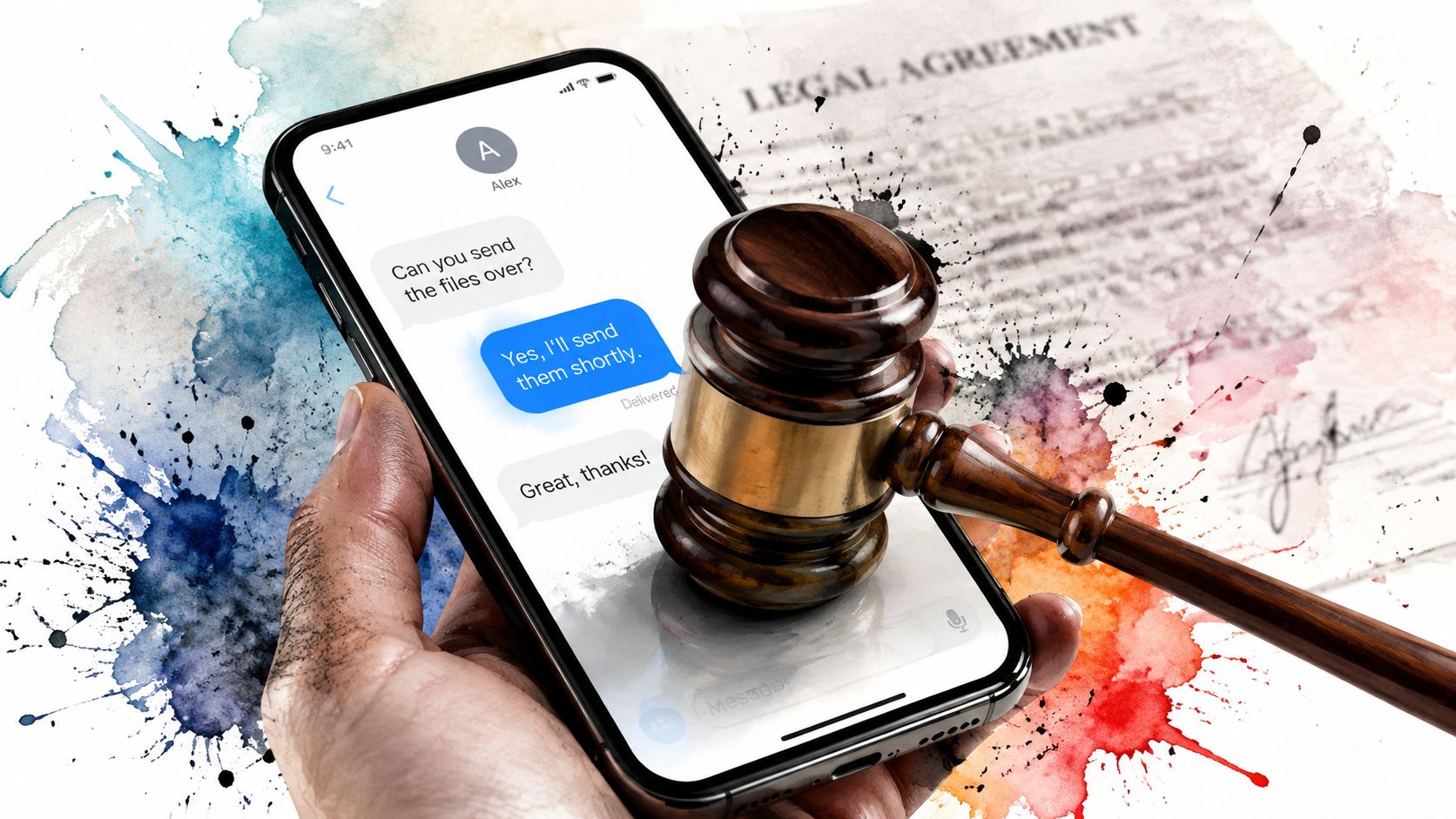
Yes, text messages can absolutely hold up in court. But it’s not as simple as just showing the judge your phone. For a text to be treated as valid evidence, it has to jump through some serious legal hoops to prove it’s authentic, relevant, and reliable.
Text messages now sit at the center of contract disputes, family cases, workplace investigations, harassment claims, and small-claims fights. The short answer is yes: courts can and do consider texts. The harder question is what makes one set of messages persuasive and another easy to attack.
This article is grounded in the evidence principles courts regularly apply to digital communications: authentication, relevance, hearsay, preservation, metadata, and chain of custody. We also compared stronger forms of proof—device exports, carrier records, forensic extractions, and messaging-platform logs—against weaker forms such as isolated screenshots with no source records behind them.
In practice, we look for a few things before calling a message record defensible: a clearly identified sender, the full conversation rather than a cropped excerpt, source information that ties the text to a phone number or account, and a documented path showing who collected the messages and when. We also weigh what weakens a text as evidence: altered screenshots, deleted portions of the thread, no witness who can explain the conversation, missing dates or numbers, or no underlying records from the device, platform, or carrier.
That framework tracks mainstream evidence rules. Under Federal Rule of Evidence 901, the proponent must produce enough evidence to support a finding that the item is what the proponent claims it is. And under Federal Rule of Evidence 801 and Rule 802, even an authentic text can still face a hearsay objection if it is offered for the truth of what it says without a valid exclusion or exception.
One nuance matters: courts are not all operating at the same level of formality. In New York small claims matters, for example, parties may present texts more informally by showing the phone and testifying about who sent or received the message and when, as noted in this Avvo discussion of New York small claims practice. In higher-stakes civil or criminal litigation, judges usually expect much more foundation.
For businesses, that difference is huge. An SMS confirming revised contract terms, a ringless voicemail with an operational warning, or an MMS documenting a damaged shipment can become central evidence. In our review, the records that hold up best are the ones created and preserved in ordinary business operations, not reconstructed after a dispute starts.
Courts no longer treat digital messages as exotic evidence. Texts, app messages, and call logs are routine exhibits now. What has changed is not whether judges will look at them, but how carefully they examine source, context, and reliability.
The safest general rule is simple: the more your proof resembles an original business or device record, the better. A full-thread export, carrier log, or forensic extraction usually gives a court much more to work with than a single image clipped from a phone screen. I would not build an argument around one dramatic screenshot if a fuller source record exists, because that is exactly the kind of presentation opposing counsel attacks first.
At its core, the court needs to be certain of three things: who sent the message, that the message hasn't been changed, and that it's relevant to the case. This is why official records are always better than a simple screenshot.
For a text to make it into evidence, it generally has to tick these boxes:
To help you keep track, here's a quick rundown of what courts are looking for.
This table breaks down the core requirements for a text message to be considered valid evidence in a court of law. Getting these details right can be the difference between a key piece of evidence being admitted or thrown out.
| Factor | Why It Matters | Example |
|---|---|---|
| Authenticity | The court needs proof the message is real and from the person you claim sent it. | Showing phone records or testimony from the person who received the text. |
| Chain of Custody | You must show the evidence hasn't been tampered with from the moment it was collected. | Using specialized software to export message logs directly from a device or platform. |
| Context | A single message can be misleading. The full conversation provides necessary context. | Presenting the entire thread of messages, not just one cherry-picked text. |
| Metadata | Hidden data like timestamps, sender/receiver info, and dates are crucial for verification. | Exporting logs that include the exact date, time, and phone numbers involved in the exchange. |
Ultimately, the more of these factors you can satisfy, the stronger your case will be for getting those text messages admitted as evidence.
Texts are often usable in court, but admissibility turns on foundation, not drama. A judge usually wants to know six things quickly: who sent the message, whether the exhibit shows the full exchange, whether there is source data behind it, whether a witness can explain it, whether it matters to a disputed issue, and whether the statement clears the hearsay problem.
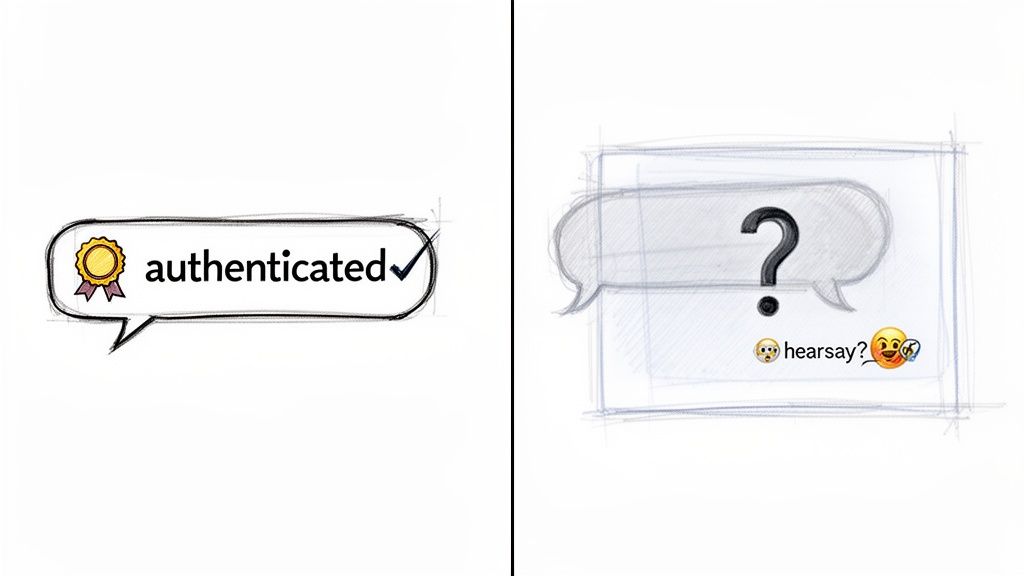
Texts are more likely to be admitted when you can show:
Texts are more likely to be challenged when:
In our review, authentication is where many weak submissions start to unravel. The ABA Judges' Journal discussion of digital evidence highlights recurring authenticity problems with electronic records, including disputes over authorship and manipulation. That lines up with what we watch for editorially: if a message could have been sent by a borrowed phone, altered after capture, or stripped of its surrounding thread, the fight is no longer about content alone.
Authentication is the process of proving your evidence is what you say it is. It involves connecting that text message to a specific person and confirming its content is exactly as it was sent. Courts have a few go-to methods for this, and they usually work best when you combine them.
Here are a few common ways to get it done:
Getting this right can sometimes involve bringing in an expert to explain the technical side of things. If you want to dive deeper into the procedural requirements and rules governing expert evidence, it’s worth understanding how their testimony is handled in court.
Screenshots may be accepted, especially in lower-stakes settings or when both sides effectively agree they are accurate. But they are easier to attack because they usually do not carry the metadata, collection history, or surrounding context that stronger records provide.
A screenshot can still help as a demonstrative exhibit. It can show the judge what a message looked like on screen. What it usually cannot do, by itself, is answer the hard questions: Was the contact name changed? Was part of the thread cropped out? Was the image edited? Is the phone number visible? Is there a source export that matches it?
If I had to rank evidence quickly, I would put a full device or platform export above a carrier log, a carrier log above a screenshot, and a screenshot with no witness or source record at the bottom. That does not make screenshots useless; it means they should be backup visuals, not your only foundation.
Once you've authenticated the message, you hit the second hurdle: the hearsay rule. In simple terms, hearsay is an out-of-court statement used to prove that what it says is true. Basically, the court doesn’t like relying on "he said, she said"—it wants the person who made the statement to be in court, under oath, where they can be cross-examined.
A text message often falls squarely into the hearsay category. But many texts still come in because the rule has exclusions and exceptions that matter in everyday disputes.
Key Takeaway: A statement isn't considered hearsay if you're using it for a different reason—like showing the effect it had on the person who read it, or proving the sender's state of mind.
For example, a threatening text might be used not to prove the threat was real, but to show that the recipient was terrified. That's a critical difference.
Here are some of the most common hearsay paths that apply to text messages:
The important practical point is that a text can fail even after you prove it is genuine. Admissibility is usually a two-step exercise: first prove it is authentic, then explain why the court may consider it for the purpose you want.
Once a text message makes it past the initial legal hurdles, a detailed inspection begins. Think of it like a digital crime scene investigation. A court needs to look beyond the words on the screen and dig into the underlying data to make sure the evidence is trustworthy and hasn't been messed with.
This is why the answer to "can text messages hold up in court?" is always "it depends." It’s not just about what was said, but about proving how, when, and by whom it was said—all while keeping a perfect, unbroken trail of evidence from the phone straight to the courtroom.
Every single text message, voice broadcast, or ringless voicemail comes with a hidden layer of information called metadata. This is the message's digital fingerprint, and it is invaluable for proving authenticity. Metadata isn't the message content itself; it's the data about the data.
Courts love metadata because it’s much, much harder to fake than the text of a message. It typically includes:
This information paints a rich, verifiable picture that a simple screenshot just can't provide. It’s the digital version of a postmarked envelope, telling the court exactly where the message came from and when it was sent. That level of detail makes the evidence far more convincing.
The chain of custody is a critical legal concept. It's basically a chronological paper trail documenting who has handled the evidence, when they handled it, and what they did with it—from the moment it's collected until it's shown in court. A clean chain of custody proves the text message hasn't been altered or tampered with.
For digital evidence, this means using a forensically sound method to extract the messages. Simply forwarding a text or taking a screenshot breaks this chain, as the data can be easily modified in the process.
Professional communication platforms give you a massive advantage. They can generate official, uneditable logs that serve as a rock-solid link in the chain of custody. Understanding how this fits into the overall workplace investigation process shows just how vital these procedural steps are in any formal inquiry.
A single text message, yanked out of a longer conversation, can be misleading. Sarcasm, inside jokes, and simple clarifications get completely lost, which can change the entire meaning of a message. Courts know this and are usually very skeptical of cherry-picked texts.
For example, a message saying, "I'll make sure you pay for this," sounds like a threat on its own. But if the previous five texts were about splitting a dinner bill, the context changes everything. To avoid this kind of misinterpretation, you should always aim to present the entire conversation thread. It gives the judge or jury the full, honest picture they need to make an informed decision. The security of these threads is also a factor, as communication integrity is important.
Digital forgery is a very real risk, so courts are rightly cautious. Technology has made it alarmingly easy to create fake text message conversations that look completely authentic. This is the biggest reason screenshots are such weak evidence—they are the easiest format to manipulate. Official records from a phone carrier or a secure business messaging platform will always be the gold standard, providing the metadata and verifiable proof needed to stand up to tough legal scrutiny.
For businesses, the most useful question is not whether texts can ever be used in court. It is how to preserve them so they can be submitted without a fight over missing records. That means treating important communications as records from the moment they are created.
If you think a conversation may matter in a dispute, start with preservation before presentation.
This is the step many people skip: they gather messages for persuasion, not admissibility. We consistently prefer records that can be traced back to a device, carrier, or platform without guesswork.
| Format | Strengths | Weaknesses | Best Use Case |
|---|---|---|---|
| Screenshot | Fast, easy to read, useful for showing what appeared on screen | Easy to crop, edit, or challenge; limited metadata; often lacks full context | Backup visual paired with stronger source records |
| Carrier record | Independent source, timestamps and number data may support authenticity | Often does not include full message content or rich context | Confirming communication occurred between two numbers |
| Forensic extraction | Strong metadata, device-level collection, better chain of custody | More expensive; may require expert handling | High-value disputes, contested authenticity, criminal or serious civil matters |
| Messaging-platform export | Preserves thread history, timestamps, delivery data, and account records | Quality depends on platform features and retention settings | Business communications preserved in ordinary course |
Using personal cell phones for business messaging is risky because records scatter across individual devices. A professional communication platform is far better suited to creating a centralized, secure, and reviewable history.
Let’s look at the essential features a business messaging platform should have to ensure your communications are organized, compliant, and ready for court if the need arises.
| Feature | Legal Benefit | How It Helps |
|---|---|---|
| Comprehensive Message Logs | Chain of Custody: Provides a complete, unalterable record of all sent and received communications (SMS, MMS, etc.). | Export full conversation histories to show exactly what was said and when, preventing claims of missing or altered messages. |
| Accurate Timestamps | Timeline Establishment: Verifiable timestamps show precisely when messages were sent, delivered, and sometimes opened. | Crucial for reconstructing a sequence of events, proving when a contract was agreed to or when a notice was delivered. |
| Detailed Delivery Receipts | Proof of Delivery: Confirms that a message successfully reached the recipient's device. | Key for TCPA defense, as it helps prove a ringless voicemail was a "successful drop" or that a message was received. |
| Secure Archiving | Evidence Preservation: Long-term, secure storage prevents accidental deletion or tampering with communications. | Protects against "spoliation" claims (destroying evidence) and ensures you have access to records years down the line. |
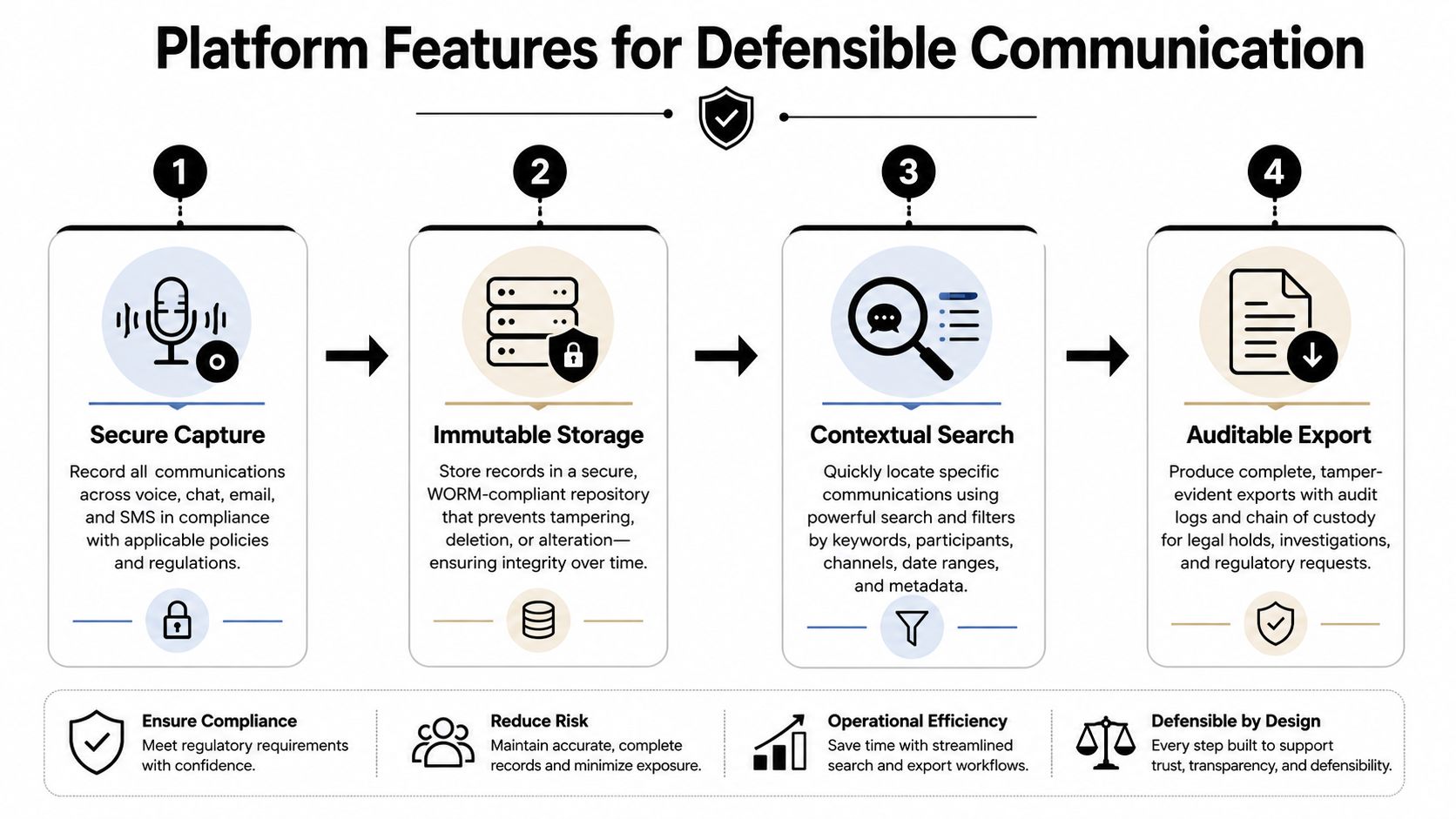
These features matter because they make later collection easier and cleaner. If your business already uses Call Loop, the legal value is not just convenience; it is the ability to produce organized records rather than scramble through personal phones after a dispute begins.
One of the most powerful things you can do to make your communications court-ready is to meticulously document user consent. A clear opt-in record not only keeps you compliant with rules like the TCPA but also proves the communication was legitimate and wanted.
Having an easily accessible record of when and how a user opted in can shut down disputes before they even begin. It establishes a clear, consensual relationship from the start.
This requirement is essential in highly regulated industries. In healthcare, secure messaging is vital. Choosing a platform that enforces data privacy rules is crucial for protecting patient information and defending your practices. See the guide on HIPAA compliant texting apps to learn how the right technology keeps you on the right side of the law.
Beyond the platform, your internal processes are just as important. Get these few best practices locked in, and you'll always be prepared.
If you need to submit texts, think like the person who will challenge them. The strongest exhibit is one that answers obvious objections before they are raised.
Start by preserving the phone or account, then collect the messages in the strongest form available. If possible, use a device export, platform archive, forensic extraction, or carrier-supported record. Keep the full thread, not just the excerpt you like. Make sure the exhibit shows dates, times, and the phone numbers or account identifiers involved. If the messages use nicknames or saved contacts, be ready with testimony explaining whose number that was and how you know.
Next, prepare a clean exhibit package. That usually means:
For businesses, an ordinary-course record from the messaging platform is often the most practical middle ground between a casual screenshot and an expensive forensic extraction.
Text evidence often gets excluded or discounted for very predictable reasons:
In practical terms, the easiest attacks are usually authorship and completeness. If an opponent can say, “That was not my number,” “Someone else had access to that phone,” or “You left out the messages immediately before and after,” the judge has a reason to hesitate.
Judges usually care less about flashy presentation and more about whether the exhibit makes common-sense evidentiary sense. A family-law judge may focus on whether the full thread shows the context of co-parenting exchanges. In an employment dispute, a court may care whether the message came from a work-managed device or whether company records support the timeline. In a contract fight, a text saying “agreed” gets stronger if it aligns with invoices, performance, or follow-up communications. In harassment matters, repeated messages, timestamps, and corroborating conduct can matter far more than one isolated screenshot.
I have found that the strongest text evidence nearly always has a second layer behind it: a witness, a log, a carrier record, a device extraction, or contemporaneous business records. Without that second layer, the argument becomes much more fragile.
The same evidentiary ideas apply beyond standard SMS. Courts often evaluate app messages, voicemail, call logs, and other digital communications through the same lens: authenticity, context, preservation, and lawful collection.
For businesses, ringless voicemail and recorded outreach can still matter, but mainly because they may generate independent delivery or account records. A ringless voicemail for business campaign can produce logs showing when a message was dropped and to which number, which may help establish notice or sequence. But those logs are only useful if they are preserved and tied to the actual dispute.
What matters more than channel choice is how the evidence fits the type of case:
That is why I would treat every business communication channel as a recordkeeping question first and a marketing feature second. The court’s focus is rarely “Was this sent by SMS or voicemail?” It is “Can you show this is real, complete, and fairly presented?”
Knowing what not to do is just as important as knowing what you should do when preparing evidence for a legal challenge. Even with the best intentions, a few simple missteps can completely torpedo your efforts and get critical text message evidence tossed out by a judge.
If you want your communications to hold up in court, you have to steer clear of these common—and costly—pitfalls.
The biggest mistake we see people make? Relying on screenshots. They seem fast and easy, but in the eyes of the court, they're notoriously weak. That's because they are simple to fake.
A sharp opposing counsel will pounce on the authenticity of a screenshot, and they'd be right to. Dozens of apps exist that can generate a completely fabricated text conversation in seconds.
Think of a screenshot like a photocopy of a handwritten note. Sure, it shows the words, but it does absolutely nothing to prove who wrote it or when. This is exactly why judges are so skeptical.
To build a solid foundation for your evidence, you need official, exportable logs from your communication platform or phone carrier. These records provide the hard, verifiable data that screenshots just can't offer:
Relying on screenshots is a gamble you just don't want to take. When the authenticity of your evidence comes into question, a verifiable log is your best—and often your only—defense.
Another fatal error is deleting messages, even if you think they’re irrelevant or potentially unhelpful to your case. This act has a legal name: spoliation of evidence, and it can come with some seriously severe consequences.
If a court decides you intentionally destroyed potential evidence, it won't just hurt your case; it can get you hit with major penalties.
We're talking heavy fines, the outright dismissal of your claims, or an "adverse inference" instruction. That last one is a real killer. It's when the judge tells the jury to assume that whatever you deleted would have been bad for your side.
Suddenly, that innocent inbox cleanup looks like a deliberate attempt to hide the truth. That's a perception you'll have a very hard time shaking.
Finally, never, ever present cherry-picked messages. Ripping a single text out of a long, back-and-forth conversation is a massive red flag for any judge. Context is king.
When you only show the messages that paint you in a good light while hiding the rest, your evidence immediately looks manipulative and untrustworthy.
Always be prepared to present the entire conversation thread. This transparency shows the court you have nothing to hide and gives a full, honest picture of the exchange. It builds your credibility and makes it far more likely that your digital evidence will be taken seriously.
Even when you think you have the rules down, everyday practice throws curveballs, and common questions about text messages, ringless voicemail drops, and other digital communications in a legal setting frequently come up. Quick, practical answers help with situations you might run into.
You can submit screenshots, but you're walking in with some of the weakest evidence possible. They're easy to challenge in court.
Why? Because they lack the verifiable metadata—the digital breadcrumbs like precise timestamps and sender info—that a court needs to trust that they're authentic. Not to mention, it's shockingly simple to edit a screenshot.
That's why courts heavily favor evidence with a clean, provable chain of custody. Official records exported straight from a business messaging platform or phone carrier are infinitely more credible because they include all the underlying data that makes the evidence trustworthy.
Deleting texts that are tied to a current or even a potential legal case is a massive mistake. In legal terms, this is called spoliation of evidence, and it can land you in serious hot water.
If a judge finds you intentionally destroyed evidence, the penalties can be severe. We're talking significant fines or what's known as an "adverse inference" instruction. In such a case, the judge tells the jury to assume the deleted messages would have hurt your case. The only safe policy is to preserve everything.
A core principle of evidence preservation is to act as if every communication could one day be scrutinized. This mindset protects you from accidental spoliation and ensures you maintain a complete and honest record.
HIPAA adds a whole other layer of complexity. While you can absolutely use patient communications as evidence, they have to be handled with extreme care, following strict privacy and security rules to protect Protected Health Information (PHI).
First off, using a HIPAA-compliant messaging platform is essential. This ensures that every bit of PHI is encrypted and stored securely. In a legal case, you'll need either proper patient authorization or a court order to disclose any of these messages. The secure, detailed logs from your platform will be your best friend, proving that you handled every communication compliantly and protecting you from any claims of HIPAA violations. If you need a practical overview of record-preservation expectations around audit trails and discovery, this Ares guide is a useful companion resource.
Ready to make your business communications court-ready? Call Loop provides the secure, compliant, and verifiable messaging platform you need. With features like full message logs, detailed delivery receipts for SMS and ringless voicemail, and secure archiving, you can build a solid evidentiary record. Protect your business and communicate with confidence.
Chris Brisson
Chris is the co-founder and CEO at Call Loop. He is focused on marketing automation, growth hacker strategies, and creating duplicatable systems for growing a remote and bootstrapped company. Chat with him on X at @chrisbrisson


Trusted by over 45,000 people, organizations, and businesses like


