
See a Demo
You're just one step away from seeing Call Loop in action.
Enter your information below to watch a demo right now.

You're just one step away from seeing Call Loop in action.
Enter your information below to watch a demo right now.

A church text messaging service is a tool that lets ministry leaders send messages straight to their congregation's phones. It’s less like a notice on a crowded community board and more like a friendly, personal tap on the shoulder.
Let's be real. It's getting harder to cut through the noise. Email inboxes are overflowing, and Sunday bulletins often get left behind in the pews. You need a way to get important messages to your people where they’ll actually see them. This is where a church text messaging service completely changes the game.
The real power here is how immediate and visible texting is. While other messages fight for attention, a text message gets right through. This isn’t just for announcements; it’s about building a stronger, more connected church family.
A healthy church community isn’t just built on Sunday mornings—it thrives on connection all week long. Texting is the perfect way to create those consistent, meaningful touchpoints.
Here are just a few ways texting keeps the momentum going between services:
This infographic lays it out perfectly. The visibility of texting just blows email out of the water.
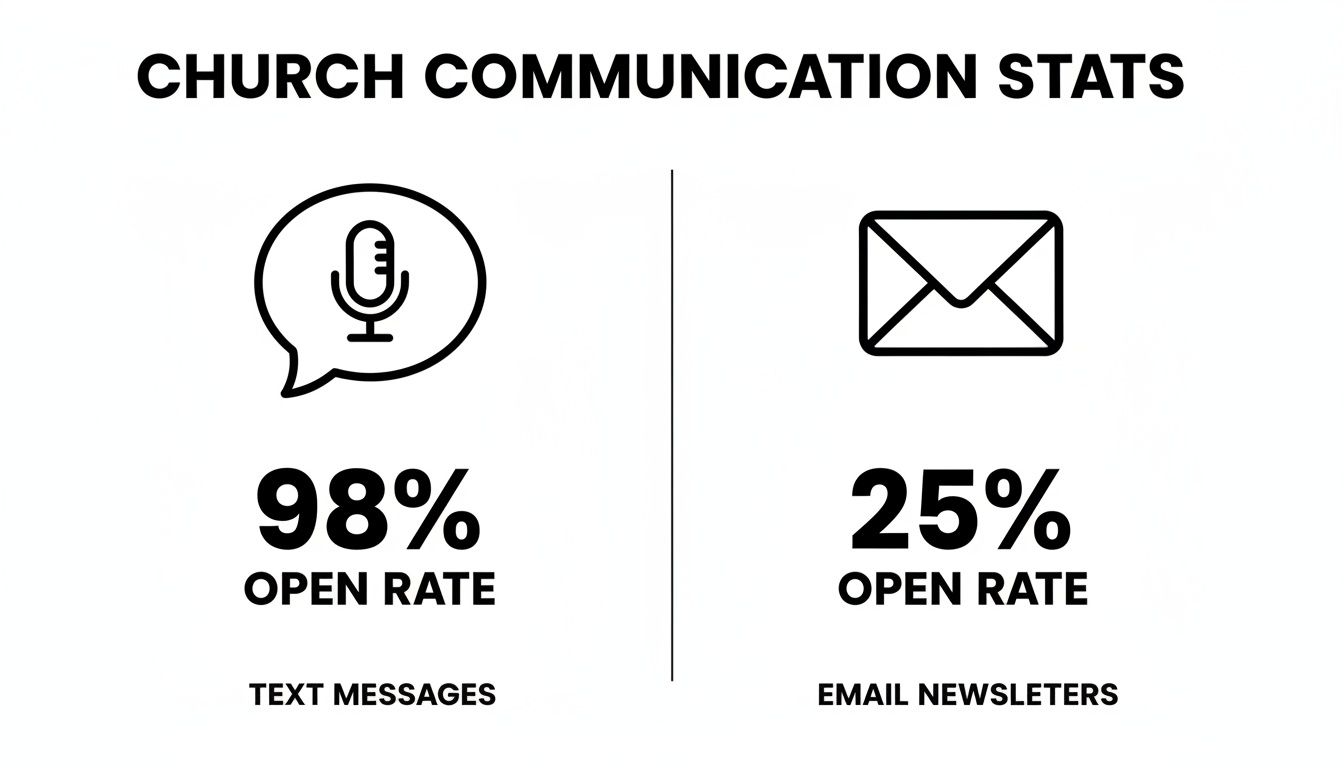
The numbers don't lie. While only about one in four emails ever gets opened, nearly every single text message gets seen. If you're serious about connecting with your congregation today, you have to look at enhancing your church's communication strategies with texting.
The stats are just too good to ignore. Text messages have a staggering 98% open rate, and 90% of them are read within 3 minutes. Compare that to the 20-30% open rate you’re lucky to get with an email newsletter. It’s not even a fair fight.
What’s more, the average response rate for texts is 45%. That's active engagement, not just passive consumption. And it’s a tool for every generation—studies even show older members often respond more quickly to texts than younger ones.
A quick comparison shows just how different these channels are for ministry.
Here’s a quick look at how today's primary communication channels stack up for ministry outreach, highlighting where texting delivers unmatched value.
As you can see, when speed and visibility are what you need, nothing comes close to texting.
When you start using a service for mass texting, you're doing more than just sending information. You are opening up new doors for real-time fellowship, care, and involvement that will strengthen your entire church family.
This strategy is a proven winner for nonprofits of all kinds. You can dive deeper into how a mass texting service benefits nonprofits.
Bottom line: a church text messaging service isn’t a "nice-to-have" anymore. It's an essential part of effective, modern ministry.
Texting is great, no doubt. It's perfect for quick updates and back-and-forth conversations. But what about those moments when a message from your ministry needs a more personal, human touch? This is where a fantastic tool called ringless voicemail comes in, adding a whole new layer to your church's outreach.
Think about it. Your pastor wants to share a heartfelt prayer or a special invitation for Easter service. An impersonal text just doesn't feel right. Instead, imagine delivering their actual voice directly into a member's voicemail inbox—without their phone ever ringing. It’s the modern-day equivalent of leaving a warm, personal message of encouragement without interrupting their family dinner or workday. This technique, sometimes called a voicemail drop, is a powerful way to add a human element to your digital communications.
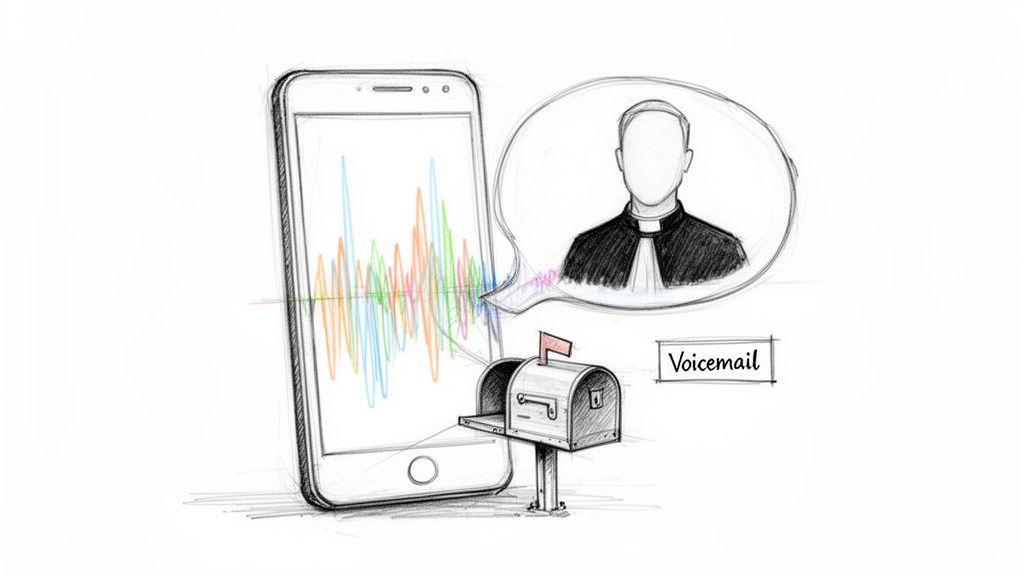
This kind of non-intrusive outreach creates a powerful connection that text messages alone often can't match. It closes the distance between the speed of digital messaging and the warmth of a personal phone call.
The idea is simple but incredibly effective. Ringless voicemail technology sends an audio file straight to the carrier's voicemail server, completely bypassing the regular phone network. The result? Your member gets a voicemail notification without their phone buzzing once, letting them listen whenever it's convenient for them. This method is also referred to as a direct to voicemail service.
For churches, this opens up some really unique ways to connect on a deeper level. Hearing a familiar, caring voice from your church leadership can mean the world to someone, offering comfort and a real sense of belonging. If you're curious about the nuts and bolts, we've got a guide that digs into the question: what is ringless voicemail?
A ringless voicemail feels less like a mass broadcast and more like a personal message left just for you. It’s a way to show individual care on a large scale, making every member feel seen and valued.
This personal touch really shines in specific ministry situations where a simple text might feel too cold or just get lost in the noise.
When you pair ringless voicemail with your text messaging, you build a much stronger, more complete communication plan. Each tool has its own strengths, and using them together means you can handle just about any communication need your ministry has.
Here are some of the biggest benefits of adding ringless voice drops to your toolkit:
Modern platforms make this technology surprisingly easy to use. A good ringless voicemail service will deliver messages right to inboxes—charging only for successful drops—and work for both mobile and landline numbers. You can also schedule drops in advance and have unlimited recordings. It's a cost-effective and powerful way for any ministry, big or small, to add that crucial personal touch to their church text messaging service.
Getting your church’s text messaging service off the ground is a lot simpler than you might think. This isn't about becoming a tech guru overnight; it's about following a clear, five-step path to better connection with your community.
We’ve cut through the jargon to give you a practical roadmap for launching your ministry texting with confidence.
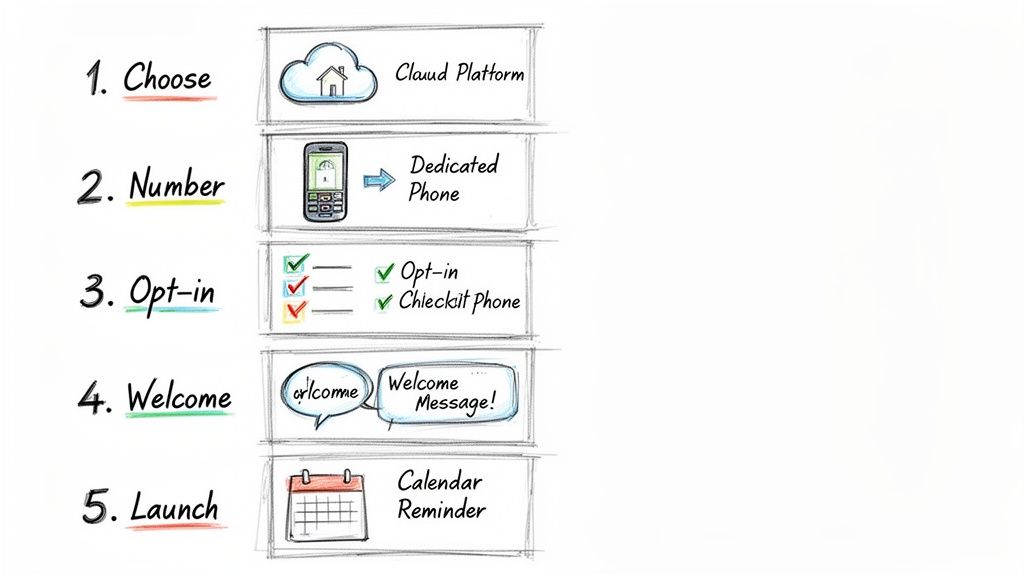
Let’s walk through everything from picking the right tools to sending that first message, so you can start building community right away.
Your first decision is the most critical: picking a platform that actually fits your church's needs and budget. Look for a service with features you'll use from day one, like group messaging for different ministries, two-way texting for real conversations, and scheduling to plan ahead.
But don't just think about today. Will you need ringless voicemail for more personal pastoral messages down the road? How well does it connect with the other software your church already relies on? Before you commit, it’s a good idea to check out a broader church management software comparison to see how all the pieces can fit together.
Once you’ve found a platform, you need a phone number. Most services will let you choose between a local 10-digit number or a toll-free one (like an 888 or 877 number). A local number often feels more personal and familiar, which can build trust and encourage more people to reply.
This number becomes your church's official texting identity. It’s what your members will save in their phones and what you’ll print on all your opt-in materials. A consistent, dedicated number is the key to looking professional and trustworthy.
Now it's time to invite people to join your texting community. The golden rule here is simple: you must have explicit permission to text someone. The easiest way to get this is with a text-to-join keyword.
For example, you could ask your congregation to text "GRACE" to your church's new number. This automatically signs them up.
This method really works. Some churches have engaged hundreds of students by using keywords to send out daily devotionals and YouTube links, giving their youth ministry a huge boost in participation. You can find more details in this report on church texting statistics and trends.
That first automated message someone gets after opting in is huge. It confirms they’re connected and sets the tone for every message that follows. A great welcome text does three things: confirms the subscription, tells them what to expect, and gives clear opt-out instructions.
"Welcome to Grace Community's text alerts! We're so glad you're connected. Expect 1-2 msgs/week with encouragement & event reminders. Reply STOP to unsubscribe. God bless!"
A simple message like this builds trust and manages expectations right from the start.
Don’t try to boil the ocean. Start with a simple, high-value campaign that delivers an immediate win, like a weekly service reminder. This gives your congregation something useful right away and helps you get comfortable using the platform.
Schedule a text to go out every Saturday evening: "Hey [First Name]! Just a friendly reminder that service is tomorrow at 10 AM. We can't wait to worship with you! You can find directions here: [link]."
This one small act keeps your church top-of-mind and can genuinely help increase attendance. It’s the perfect way to get your texting ministry started on a strong footing.
So, you're on board with church text messaging. That’s the easy part. The harder question is, what do you actually say?
Staring at that blank message box can be intimidating. But the good news is you don’t have to reinvent the wheel. The most powerful texts your church can send are often simple, to the point, and come straight from the heart.
We’ve put together a collection of proven, copy-and-paste templates to get you started immediately. Think of these as your practical toolkit—a way to save time while sending messages that genuinely strengthen your church family.
Consistency builds community. Sometimes, a simple reminder is the exact nudge someone needs to make gathering with their church a priority. The key is to keep them friendly and encouraging.
Weekend Service Reminder:
"Hey [First Name]! Just a friendly reminder that service is tomorrow at 10 AM. We can't wait to worship with you! You can find directions or watch online here: [Link]"
Mid-Week Bible Study Reminder:
"Hi [First Name], don't forget about our mid-week study tonight at 7 PM in the fellowship hall. We're diving into Chapter 3. See you there!"
Special Event Reminder:
"Get excited! Our annual Family Fun Day is this Saturday from 11 AM - 2 PM. There will be games, food, and fun for all ages. Hope to see your family there!"
A visitor's first impression doesn't stop when they walk out the door. A thoughtful text message makes them feel seen and valued, which dramatically increases the chance they’ll come back.
Initial Thank You (Send within 24 hours):
"Hi [First Name], this is Pastor John from Grace Community. We were so honored to have you with us this morning! We hope you felt welcomed. If you have any questions, feel free to text this number."
Mid-Week Check-In (Send 2-3 days later):
"Hello again, [First Name]! We hope you're having a great week. We'd love to hear about your experience on Sunday. If you have a moment, here's a quick 2-question survey: [Link]"
Invitation to Connect (Send ~1 week later):
"We're having a Newcomers' Lunch this Sunday right after service, and we'd love for you to join us. It’s a great, casual way to meet some people. Hope you can make it!"
Your volunteers are the absolute lifeblood of your ministry. Texting is the perfect tool to keep them organized, informed, and feeling appreciated for all they do.
Shift Reminder:
"Friendly reminder for our awesome Children's Ministry volunteers: you are scheduled to serve this Sunday at the 9 AM service. Thank you for making a difference!"
Urgent Need Request:
"Hi team, we have an urgent need for 2 more volunteers to help with parking for our Easter service. Can you help? Reply YES if you're available. Thank you!"
Volunteer Appreciation:
"We just wanted to say a huge THANK YOU to everyone who served at the food pantry yesterday. You are a blessing to our community! We couldn't do it without you."
When a need pops up, texting lets you get your prayer warriors on the case in an instant. It's also an incredible way to show personal care from your leadership team.
"A text message can be a lifeline. For someone feeling isolated, a simple 'We're praying for you' message can be a powerful reminder that they are loved and not alone. It’s ministry in its purest form."
Prayer Chain Alert:
"PRAYER ALERT: Please join us in praying for the Smith family. John is going into surgery this morning. Pray for peace and for the surgeons' hands. (Please reply with 'Praying')"
Pastoral Check-In (using Ringless Voicemail):
For those moments that need a more personal touch, a ringless voicemail drop from the pastor can be incredibly powerful. A pre-recorded message like, "Hey [First Name], it's Pastor Steve. I was just thinking about you and wanted you to know I’m praying for you this week. Hope you’re doing well," delivers that human connection without being intrusive.
Text-to-give campaigns make generosity incredibly simple and immediate. These messages are most effective when they tie the act of giving directly to the impact it creates.
General Donation Appeal:
"Help us reach our goal! We're raising funds for our summer youth camp. Every gift helps send a student to experience a life-changing week. Give securely here: [Link]"
Impact Update:
"Because of your generosity, we were able to provide 500 meals to families in need last month! Thank you for being the hands and feet of Jesus in our city."
As platforms get better, the results are becoming undeniable. For example, Subsplash reports over 22 million messages sent through their platform—including countless prayers and words of encouragement. Churches that embrace these tools are seeing better attendance, smoother operations, and deeper fellowship.
For more on the data, you can review some key church texting statistics. Using these templates is your first step toward that kind of connection.
Using text messaging to connect with your congregation is an incredible opportunity. But with that opportunity comes a big responsibility to be both ethical and legal in how you communicate.
The word "compliance" can sound a little stiff or corporate, I get it. But really, it all comes down to one simple idea that’s at the heart of any ministry: respect.
You wouldn't just walk into someone's home uninvited, right? The same principle applies to their text message inbox. Thinking this way is the key to building real trust with your people through texting and protects both your members and your ministry.
Before you send a single message, you absolutely must get clear permission. This is called express written consent, and it's not something you can skip. It's basically the digital version of someone raising their hand and saying, "Yes, please keep me in the loop!"
Thankfully, getting this permission is pretty straightforward. Here are a few of the most effective ways we've seen churches do it:
Starting with this step builds your entire texting ministry on a solid foundation of trust. If you want to dig deeper into the specifics, our guide on what counts as express written consent breaks it all down for you.
Okay, so you've got permission. Now what? Two simple habits will keep your texting healthy and compliant from here on out.
First, always identify your church in every message. A new member or visitor might not have your number saved yet, so starting with something like "Hi from Grace Community Church..." prevents any confusion.
Second, you must give people a clear and easy way to opt out. Including a phrase like "Reply STOP to unsubscribe" at the end of your messages isn't just a good idea—it's a requirement. This puts your members in control and shows them you respect their choice to listen or not.
Think of it this way: clear identification and an easy opt-out are like having a friendly welcome mat and an open front door. You're making it clear who you are and letting people know they are free to leave anytime, which paradoxically makes them more comfortable staying.
Following these rules isn't just about avoiding trouble. It's about being a good steward of the relationships you're trying to build.
With 91% of Americans owning smartphones and checking them a staggering 144 times a day, texting is an incredibly direct line for building community. When you respect people's consent and communicate with transparency, you make sure this powerful tool strengthens your ministry's integrity and drives genuine involvement.
So, you’re sending out texts. That’s step one. But how do you know if it’s making a real difference?
Sending messages is easy. Understanding their impact is what sparks real growth and connection in your ministry. This is where we move past just sending and praying and start looking at the numbers that tell the story of your community's engagement.
The goal isn't to get bogged down in corporate-style analytics. It's about gaining real-world insight. Are your messages hitting home? The data has the answers.
Thinking about metrics can feel a little impersonal, but it’s actually the opposite. When you understand what’s working, you can serve your people far better. Are your event reminders getting clicked? Are prayer requests being seen and acted on?
Start with your delivery rate. This shows you how many of your messages successfully landed on your members' phones. A healthy delivery rate is usually above 95%. If it’s high, great! Your contact list is in good shape. If it’s low, it’s probably time to do a little spring cleaning on old or incorrect numbers.
Next up is your click-through rate (CTR). This one is huge, especially when you send a link for event registration, a donation page, or a sermon video. If you text 200 people and 50 click the link, your CTR is 25%. This tells you exactly how compelling your message and your offer were.
While delivery and clicks are a great start, the most meaningful data for a church comes from genuine, two-way interaction. This is where you actually see community being built, one text at a time.
One of the most important metrics you can track is the response rate. This is simply the percentage of people who reply to your texts. If you send a prayer request and ask folks to reply "Praying," this number shows you how many people are actively engaging with the needs of their church family. A high response rate is a fantastic sign of a healthy, connected community.
Another powerful, but often forgotten, metric is the opt-out rate. Sure, you never want to see people leave your list. But a low opt-out rate—think under 1-2%—is a strong signal that your congregation finds your messages valuable and that you're not overdoing it on the frequency.
Tracking these numbers helps you listen to your congregation at scale. A sudden spike in response to a devotional text, or a high click-rate on a volunteer sign-up, gives you direct feedback on what your community needs and cares about most.
This data isn't just for fancy reports; it’s for making smarter, more impactful decisions. By looking at these simple metrics, you can fine-tune every part of your outreach.
Here’s a quick look at the most important numbers and what they mean for your church's texting strategy.
Think about it this way: if you notice your CTR for event reminders is highest on Saturday mornings, you've just discovered the perfect time to send those texts. If a message with a warm, personal tone gets a much higher response rate, it tells you your congregation values that connection.
This is how data stops being a set of numbers and starts being a powerful tool for serving your people better.
Jumping into any new communication tool for your church is a big decision. It’s totally normal to have a few questions pop up about how it all works in practice.
We've heard them all. To make sure you feel confident moving forward, here are some straightforward answers to the most common questions church leaders ask us.
Yes, absolutely! And honestly, this is where things get really exciting.
Standard texts (SMS, or Short Message Service) are just that—short messages limited to 160 characters of plain text. But modern services use MMS (Multimedia Messaging Service), which lets you send pictures, short videos, GIFs, and even audio files.
This is a game-changer for engagement. Think about it. You can send a vibrant photo from the youth retreat, a quick video invitation from your pastor for the Easter service, or a picture celebrating that you just hit a missions fundraising goal. Visuals grab attention and share emotion in a way text just can't, making your messages stick.
A picture of smiling volunteers at the food drive or a short clip of the choir practicing for Christmas does more than just inform. It invites your people to feel connected to the life of the church all week long.
Pricing can look a little different from one provider to the next, so it's smart to know the main options to find what fits your ministry's budget. Most services fall into one of these buckets:
When you're comparing prices, remember to look past the sticker price. Check if features like two-way texting, MMS capabilities, and ringless voicemail are included.
Yes, and you should definitely look for a service that allows this.
Any solid church texting platform should offer multi-user access with different permission levels. What that means is you can give trusted volunteers and staff members their own logins to help out, but without handing over the keys to the entire kingdom.
For example, your youth leader could have permission to send messages only to the "Youth Group" list. Your head usher could manage the "Volunteer Team" group. This spreads the work around, prevents one person from getting overwhelmed, and makes sure the right people are sending the right messages—while you keep an eye on everything.
Ready to build a more connected and engaged church community? Call Loop provides all the tools you need—from SMS and MMS to ringless voicemail—in one simple, powerful platform. Start connecting with your congregation today.
Chris Brisson
Chris is the co-founder and CEO at Call Loop. He is focused on marketing automation, growth hacker strategies, and creating duplicatable systems for growing a remote and bootstrapped company. Chat with him on X at @chrisbrisson


Trusted by over 45,000 people, organizations, and businesses like


