
See a Demo
You're just one step away from seeing Call Loop in action.
Enter your information below to watch a demo right now.

You're just one step away from seeing Call Loop in action.
Enter your information below to watch a demo right now.

Think of your customer's journey like a road trip. Every single interaction they have with your brand is a stop along the way. These stops—from seeing your ad on social media to getting an SMS appointment reminder—are your customers touch points.
These are the individual moments that, when added up, define their entire experience and shape how they feel about your business.
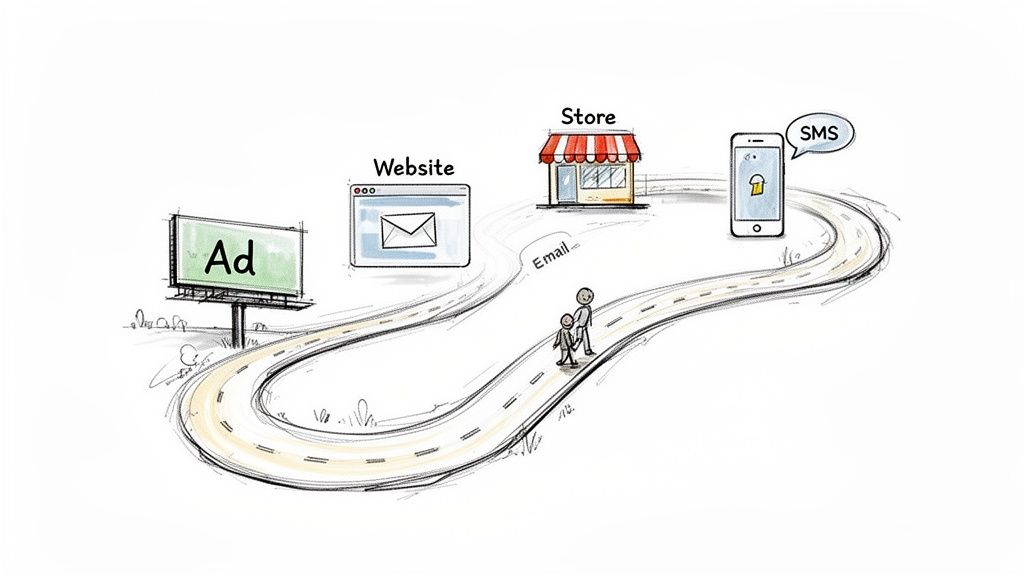
A customer touch point is really any time a person comes into contact with your brand. It’s like a relationship—every conversation and experience either strengthens that bond or pushes you further apart. Each touch point is a chance to deliver a great experience that slowly turns a curious browser into a loyal fan.
These interactions pop up across all sorts of channels and at every stage of their journey. For example, a potential customer might first see an online ad (that's touch point #1). They then click over to your website (touch point #2), decide to make a purchase (touch point #3), and get a confirmation text (touch point #4).
Getting these interactions right isn't just a "nice-to-have" anymore—it's the engine for growth. The global customer experience management market was valued at USD 12.04 billion in 2023 and is projected to soar to USD 32.87 billion by 2030. That incredible growth is all because customers now expect seamless, personal engagement at every turn.
A single negative touch point can wipe out dozens of positive ones. A brilliant ad means nothing if the checkout is a confusing mess, and a friendly sales call is quickly forgotten if your post-purchase support is nonexistent.
This is exactly why you have to look at the entire journey. It’s not about perfecting one or two moments in a silo. It’s about making sure every interaction connects smoothly to create one cohesive, positive experience. This even includes interactions you might not think of, like a financial touchpoint when a patient receives their bill.
Touch points can happen on channels you control, like your website or a direct ringless voicemail drop, and channels you don't, like a third-party review site or a social media mention.
Proactive communications like SMS messages, voice calls, and ringless voicemail drops are powerful ways to shape these moments directly. Understanding all these different points of contact is the first step in building customer communication strategies that actually work. When you identify and improve each interaction, you start creating experiences that not only boost your bottom line but build relationships that last.
Before you can start improving your customer's journey, you first have to know where all the stops are. Finding your brand's unique customer touch points is a bit of a discovery process. It’s all about swapping guesswork for real knowledge and creating a complete inventory of every single place a customer or prospect interacts with you.
Think of yourself as a detective gathering clues. Your mission is to uncover every possible interaction, no matter how small it seems. A great way to get started is to put yourself directly in your customer's shoes. Walk through their entire experience, from the moment they first hear about you until long after they've made a purchase.
Get your team together—bring in people from sales, marketing, and customer support—and just start listing every conceivable touch point. Don't filter anything at this stage; no idea is too small. Think about how customers find you, what happens when they decide to buy, and how you stay in touch with them afterward.
To get the ball rolling, consider these three main categories for your brainstorming session:
The goal here is to build your master list. A local gym’s touch points (class sign-up sheets, the front desk check-in, promotional flyers) will look completely different from a software company’s (demo request forms, onboarding emails, support tickets). Don't just pull a generic list from the internet; you need to uncover what makes your business's journey unique.
Once you have this complete list, you've officially laid the groundwork for the next step: creating a customer touch point map. This inventory is what lets you finally see your business from your customer's perspective and pinpoint which moments have the biggest impact. Every single touch point is an opportunity to strengthen that relationship, and knowing exactly where they are is the first step to making each one count.
Alright, you’ve brainstormed and inventoried every possible way a customer interacts with your brand. Now it’s time to connect the dots.
A customer touch point map is your visual playbook for seeing your business through your customer's eyes. This isn't just some static document you create once and forget about. It's a strategic tool you’ll use again and again to find gaps and, more importantly, opportunities.
Think of it like planning a road trip. You wouldn’t just get in the car and start driving without a route. You'd want to know the major highways, the best places to stop, and where you might hit a snag. Your touch point map does the exact same thing for your customer experience, laying out every interaction in chronological order.
This process turns a bunch of abstract data points into a clear, visual story. You’ll immediately see where the journey is smooth and where friction is causing people to get stuck or even turn back.
Building your map really comes down to a few key steps. It all starts with getting crystal clear on who is taking this journey—your customer—and then plotting their path from one interaction to the next.
This simple flow shows you exactly how to get started.
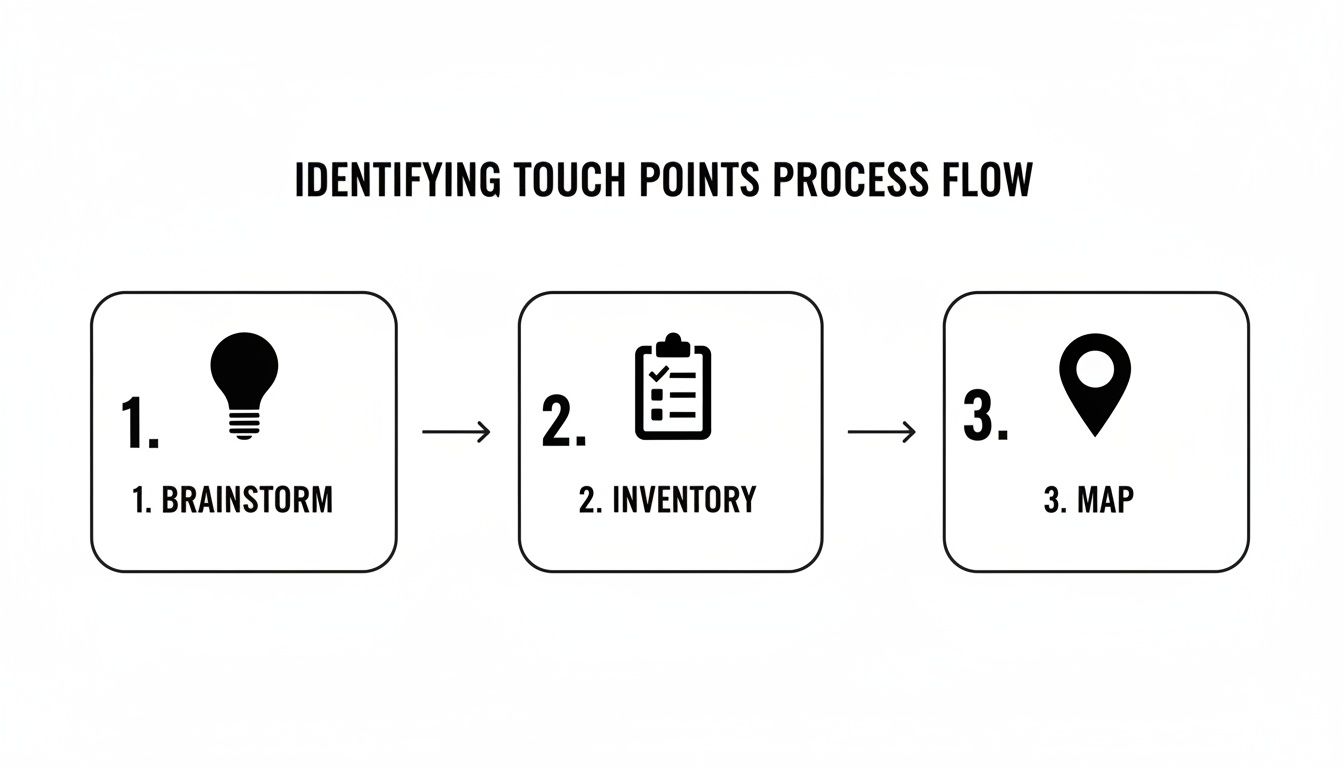
As you can see, mapping is the final piece of the puzzle, coming only after you’ve brainstormed all the interactions and built a solid inventory.
First, define your main customer personas. The map for a first-time buyer will look completely different from the map for a long-time, loyal customer.
Next, take the touch points you identified and list them chronologically for that specific persona. A typical sequence might look something like this:
As you start plotting these points, you'll notice patterns emerging. Some interactions will stand out as being way more important than others. These are your "moments of truth"—the make-or-break interactions that have a huge impact on how a customer feels about your brand.
For example, a confusing checkout process is a massive moment of truth that can kill a sale and erase all the goodwill you built up. On the flip side, a helpful and quick voice call from your support team can turn a frustrating problem into an experience that builds serious loyalty.
When you're putting your map together, understanding the entire path is key. A good guide on customer journey mapping can give you a great framework for this whole process.
The real power of a touch point map is that it forces you to see the emotional journey of your customer. At each step, ask: What are they thinking? What are they feeling? Charting these emotional highs and lows shows you exactly where you need to focus your energy.
Getting this right is what separates brands that struggle from those that thrive. For instance, 55% of retail purchases still happen in a physical store, often after the customer has done their research online. They want that in-person confirmation.
Yet, even though 74% of organizations are pouring more money into customer experience, only 31% of executives feel their customers are truly satisfied. That massive gap? It’s often caused by a failure to connect the touch points, which is exactly the problem that mapping helps you solve.
So you’ve mapped out your customer journey. Think of that as drawing the map for a road trip. Now, it's time to actually get in the car and drive. This is where your strategy gets real, and outbound customer touch points are how you take control of the wheel.
Instead of just waiting for customers to find you, outbound channels like SMS, voice, and ringless voicemail let you proactively guide them. You can reach out at the perfect moment to send a reminder, a special offer, or a helpful follow-up that keeps your brand top of mind.
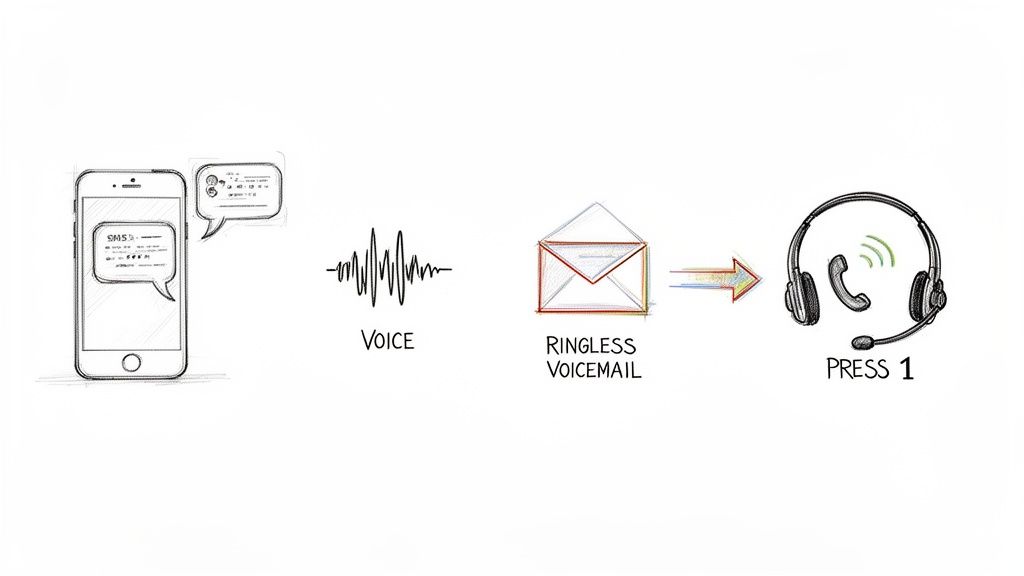
SMS is hands-down one of the most direct ways to manage touch points. With open rates pushing past 90%, your message is almost guaranteed to be seen. That makes it perfect for any communication that's time-sensitive.
For example, you can grab leads in real-time at a webinar or live event with a simple text-to-join keyword. Just tell attendees to text "JOIN" to your number, and boom—they're on your contact list for immediate follow-up. You can get the full rundown on setting these up by reading about the basics of SMS messaging.
Sending personalized bulk SMS messages using custom fields is a game-changer. Addressing a customer by name in an appointment reminder or including their specific order number in an update makes the interaction feel personal, not automated. This small touch transforms a generic broadcast into a one-to-one conversation.
While text is great for quick hits, sometimes you need to add a human touch. That's where voice calls come in. A voice broadcast commands attention, making it the go-to for important announcements or urgent matters where you need to make an impact. And with modern AI text-to-speech, you can run huge voice campaigns without ever stepping into a recording booth.
Think about these scenarios for voice touch points:
That "press-1" feature is incredibly powerful. It closes the gap between an automated message and a real conversation, making sure your hottest leads get the attention they deserve the second they show interest.
What if you need to deliver a message without blowing up someone's phone in the middle of their day? This is the magic of ringless voicemail. It lets you drop a pre-recorded message directly into their voicemail inbox, and their phone never even rings.
This makes it the perfect tool for non-urgent follow-ups, gentle reminders, or even a personal thank-you message. The beauty of ringless voicemail is its subtlety; people can listen to your message when it's convenient for them, making it respectful but still highly effective. Plus, you’re often only charged for successful drops, so it’s a cost-effective way to stay in touch.
It’s the perfect balance—you can stay present and nurture leads without being pushy.
To give you a clearer picture, here’s a table with some actionable tactics for optimizing these outbound touch points across the customer lifecycle.
| Touch Point | Channel | Optimization Tactic |
|---|---|---|
| Lead Capture | SMS | Use a text-to-join keyword at events or on marketing materials to instantly add contacts. |
| Onboarding Welcome | Ringless Voicemail | Send a warm, personal welcome message from the founder or account manager. |
| Appointment Reminders | SMS | Send an automated text 24 hours before an appointment with the option to confirm or reschedule. |
| Flash Sale Announcement | Voice Broadcast | Create urgency with a voice message announcing a limited-time offer. |
| Cart Abandonment | SMS | Send a text with a small discount code 1 hour after a cart is abandoned to recover the sale. |
| Post-Purchase Follow-Up | Ringless Voicemail | Drop a "thank you" voicemail a few days after purchase to build goodwill. |
| Feedback Request | SMS | Text a link to a short survey after a support interaction or purchase. |
| Re-Engagement | Voice Broadcast | Target dormant customers with an exclusive "welcome back" offer via a voice message. |
| High-Intent Lead Transfer | Voice & Press-1 | Immediately connect interested prospects from a voice broadcast to a live sales agent. |
By weaving these tactics into your customer journey map, you can create a communication strategy that feels personal, timely, and incredibly effective at driving results.
There's an old saying in business: you can't improve what you don't measure. This is especially true when it comes to your customer touchpoints.
Once you’ve mapped out your touchpoints and started optimizing them, the real work begins. You need to track their performance. This is how you shift from just having a good plan to running a data-driven engine that gets better and better over time.
By looking at the right numbers, you can quickly see which interactions are falling flat, put more resources into what’s working, and make smart adjustments on the fly. It's not about vague, big-picture results. It's about knowing exactly how effective each SMS, voice broadcast, or ringless voicemail is.
Different channels tell different stories, so you need the right key performance indicators (KPIs) to understand them. Chasing vanity metrics will only lead you astray. You need to track the data that actually shows engagement and proves your efforts are paying off.
Here are the essential KPIs you should be watching for your main outbound touchpoints:
For SMS Campaigns: Delivery rates are just the start. The real magic is in the click-through rates (CTR). Using a link tracker tells you exactly how many people clicked your link, giving you instant feedback on how compelling your message was.
For Voice Campaigns: Your most important metric here is the answer rate. This shows how many people actually heard your message, which is a great indicator of your list quality and whether you're calling at the right time. If you’re running an interactive campaign, keep a close eye on your "press-1" transfer rate to see how many hot leads you're generating.
For Ringless Voicemail: The number to watch is the successful delivery rate. Since you’re often charged per successful drop, this metric tells you about your reach and your cost-effectiveness.
Customer touchpoints are where loyalty is won or lost. A massive 99% of consumers say service quality impacts their buying decisions, yet only 25% felt "very satisfied" with their last experience. That gap is a huge opportunity. Metrics like SMS click-tracking and voice drop success rates help you decode what customers really want from each interaction.
Collecting data is only half the job. You have to use that data to make your strategy better.
For example, if you see a low CTR on an SMS campaign, that’s your cue to start A/B testing. Send two different versions of your message—maybe with different offers or calls to action—to a small part of your list and see which one gets more clicks.
Likewise, a low answer rate for a voice campaign might just mean you need to try calling at different times of the day. By making these small, data-backed tweaks, you can dramatically improve the impact of every message you send. For a deeper look at this, check out our guide on measuring marketing campaign effectiveness.
Finally, don’t forget that smart measurement and compliance go hand-in-hand. Keeping a clean and current Do Not Call (DNC) list isn't just a legal chore—it's a core part of your strategy. When you respect opt-outs, you ensure your messages are actually wanted. This keeps your contact list engaged and makes all your other metrics that much more valuable.
As you start digging into your customer interactions, a few questions always seem to pop up. You're not alone. Let's clear up some of the most common ones so you can get back to improving your customer's journey with confidence.
This one trips a lot of people up, but it’s actually pretty simple. A channel is the where—the platform you use to talk to your customers. A touch point is the what—the specific thing that happens on that channel.
Think of it this way: SMS is a channel. The specific appointment reminder text you send is a touch point. Your website is a channel, but a customer filling out your contact form is a touch point.
Imagine channels are the roads a customer can travel on, and touch points are the specific stops they make along the way. Your job is to make every single stop a great experience, no matter which road they took to get there.
Your journey map isn't a "set it and forget it" project. It should be a living, breathing document that reflects what your customers are actually experiencing right now.
A good rule of thumb is to review and update your map at least once a year. You'll also want to revisit it anytime you make a big change to your business.
Key triggers for an update include:
Keeping your map current ensures you’re not making decisions based on old, outdated assumptions.
Trying to manage every single interaction can feel like a massive chore, especially when you're running a small team. The secret isn't to do everything—it's to prioritize.
Not all customer touch points carry the same weight. Some have a much bigger impact on how a customer feels about you than others.
Start by zeroing in on your "moments of truth." These are the critical interactions that can either win you a customer for life or send them running to a competitor. For most businesses, these are:
Focus your energy on nailing these high-impact moments first. You don’t need a huge team to send a personalized SMS follow-up or use a ringless voicemail drop to thank a new customer. By using smart tools and focusing on what truly matters, even the smallest business can create a standout customer journey.
Ready to take control of your most important outbound touch points? Call Loop gives you the tools to automate and personalize SMS, voice, and ringless voicemail campaigns, turning every interaction into an opportunity. See how it works.
Chris Brisson
Chris is the co-founder and CEO at Call Loop. He is focused on marketing automation, growth hacker strategies, and creating duplicatable systems for growing a remote and bootstrapped company. Chat with him on X at @chrisbrisson


Trusted by over 45,000 people, organizations, and businesses like


