
See a Demo
You're just one step away from seeing Call Loop in action.
Enter your information below to watch a demo right now.

You're just one step away from seeing Call Loop in action.
Enter your information below to watch a demo right now.

Let’s start with the basics. SMS, or Short Message Service, is the simple text messaging feature that comes standard on every single mobile phone. No app to download, no internet connection required.
For any business, that’s a direct, reliable line to your customers. It's perfect for everything from sending out a flash sale alert to making sure someone doesn't miss their appointment.
In a world drowning in notifications and app alerts, SMS simply cuts through the noise. What started as a basic way to send a quick note has become a non-negotiable part of how modern businesses talk to their customers. Its power is in its simplicity and massive reach.
It all started on December 3, 1992, when an engineer sent the first-ever text message: 'Merry Christmas'. From that one message, the technology exploded. Today, over 5 billion people send something like 23 billion SMS messages every single day. That’s a testament to its staying power.
To give you a quick snapshot of what makes SMS so effective, here’s a simple breakdown.
As you can see, the core attributes of SMS are exactly what you need for clear, effective communication that gets results.
At first, texting was just for catching up with friends. Now, it’s a powerhouse for marketing, sales, and customer service. Businesses have caught on to its incredible immediacy and sky-high open rates, making sure their most important messages actually get seen.
Think about the core ways you can use it:
SMS isn't just another channel; it's a direct conversation with your customer. Its simplicity is its greatest strength, ensuring your message is not only delivered but also read.
The power of SMS also comes from its role as a digital key. Many services lean on it for two-factor authentication, sending a code to a user's phone to prove it's really them. This process is a common use for phone number for SMS verification.
This built-in trust factor makes it a perfect partner for other communication tools. For instance, you could use ringless voicemail to leave a message and then immediately follow up with a text. This powerful combination of a voicemail drop and SMS ensures your outreach is both heard and seen. It’s a one-two punch that makes your communication far more effective.
Ever wonder what actually happens between the moment you hit 'send' on a business text and your customer's phone buzzing? It’s not quite the same as sending a message through an app like WhatsApp or Messenger.
Unlike apps that need an internet connection, SMS messages travel on a cellular network's control channel. Think of it as a dedicated, high-priority lane on the highway, the same one used to set up phone calls. This is exactly why a text message almost always gets through, even when your customer’s internet service is shaky or completely down.
The journey itself is surprisingly simple. Your text goes to a Short Message Service Center (SMSC), which then zips it straight to your recipient's phone. This direct-to-carrier path is what makes delivery feel almost instant.
You've seen both SMS and MMS, but they're built for different jobs. It helps to think of them as two different kinds of mail.
While SMS is king for urgent, need-to-know info, MMS gives you the canvas to send richer, more branded messages. This chart shows how you can apply these tools across your business.
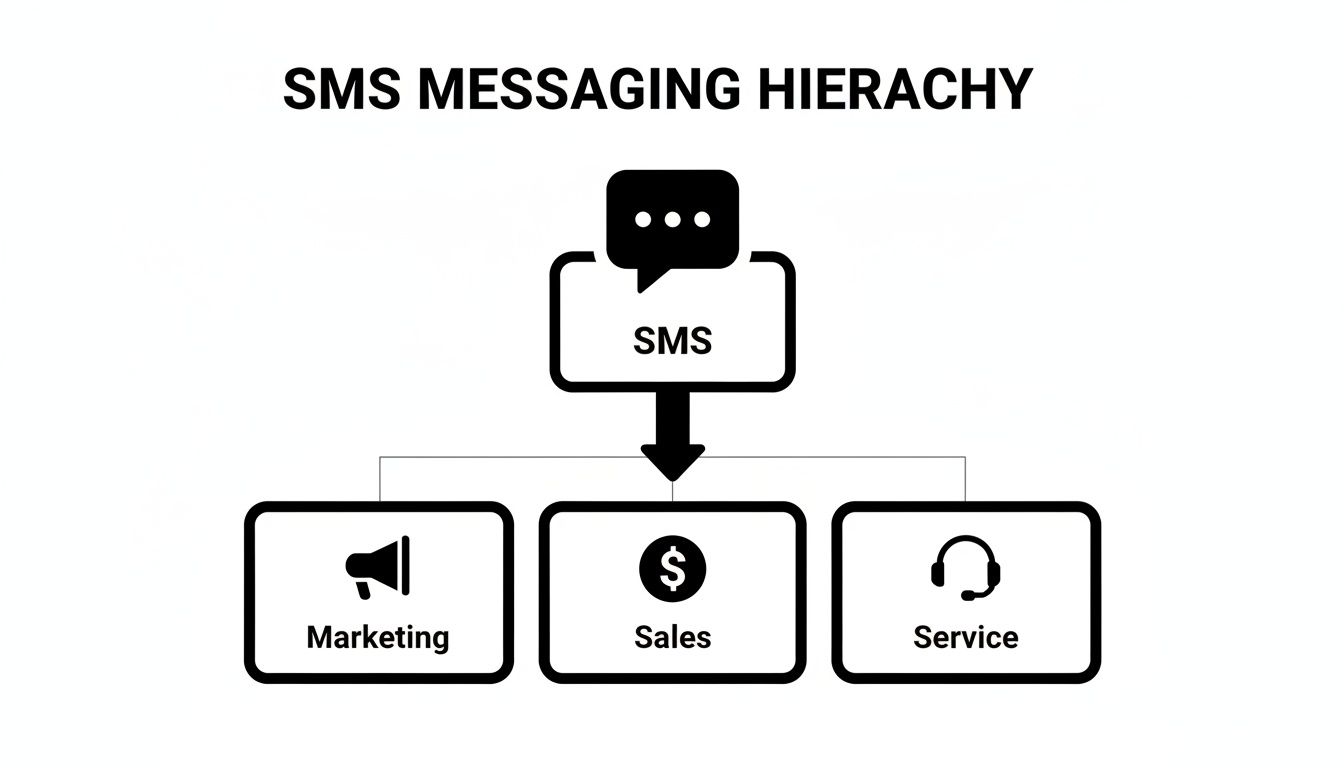
As you can see, this one core technology branches out to support your most important business functions—from marketing and sales all the way to customer service.
When you send texts as a business, you're not going to be using your personal cell phone. Instead, you'll use a platform like Call Loop that gives you access to specialized phone numbers, each designed for a different kind of messaging.
Choosing the right number type is like picking the right vehicle. You wouldn't use a sports car to haul furniture, and you wouldn't use a cargo truck for a quick trip to the store.
Here are the main options you'll run into:
You can also get creative by pairing SMS with other outreach methods like ringless voicemail. For example, you could send a voicemail drop with a detailed audio message about a new offer, then immediately follow up with a text containing a direct link to the product page. This one-two punch ensures your message is both heard and seen, which can seriously boost your response rates.
Think about your own phone for a second. How many unread emails do you have? How cluttered is your social media feed? Now, how many unread text messages do you have?
For most people, the answer is zero. That's the power of SMS. While other channels are fighting for scraps of attention in crowded inboxes, texting gives you a direct, uncluttered line straight to your customers. It's an immediacy that translates into real business results, moving you past vanity metrics and into real impact.
The numbers don't lie. A massive 91% of customers actually want to get texts from businesses they like. And the engagement? It's practically perfect. Text messages have a staggering 98% open rate, with most of those opens happening within just three minutes. On top of that, 82% of consumers read their texts within five minutes. It’s hands-down the best way to send a time-sensitive message.
This near-guaranteed visibility is what makes a simple text such a potent tool. It's the difference between a special offer getting buried in a spam folder and a customer clicking your link to buy something on the spot.
Modern business is all about building relationships, and SMS is fantastic for sparking genuine, two-way conversations. This is what we call conversational commerce. It’s not about shouting ads into the void; it's about creating a dialogue that builds trust and helps guide customers.
Just picture it:
This kind of direct interaction makes people feel seen and valued. It turns a simple transaction into a loyal relationship. Of course, to make sure these conversations are always welcome, it’s vital to follow the rules of the road. You can learn more by reading up on SMS marketing best practices.
The core strength of SMS is its ability to cut through the noise. It’s a personal, immediate, and direct channel that prompts action, whether that’s confirming an appointment or clicking 'buy now'.
SMS is a powerhouse, but it gets even stronger when you pair it with other tools. By creating a multi-channel strategy, you can grab attention from multiple angles. One of the most effective pairings we've seen is SMS and ringless voicemail.
With a voicemail drop, you can send a pre-recorded audio message directly to someone's voicemail without ever making their phone ring. It’s perfect for leaving a more detailed or personal-sounding message.
Then, you hit them with the one-two punch. Immediately after the voicemail drop, you send a follow-up text with a link, a quick summary, or a clear call to action. This combination of hearing your voice and seeing your message dramatically increases the odds of getting a response and driving the results you’re after.
Okay, we've talked about the "how." Now let's see what SMS messaging actually looks like in the wild. The best way to grasp its potential is to see how real businesses are using simple text messages to get incredible results.
These aren't just hypotheticals; these are proven strategies that work.
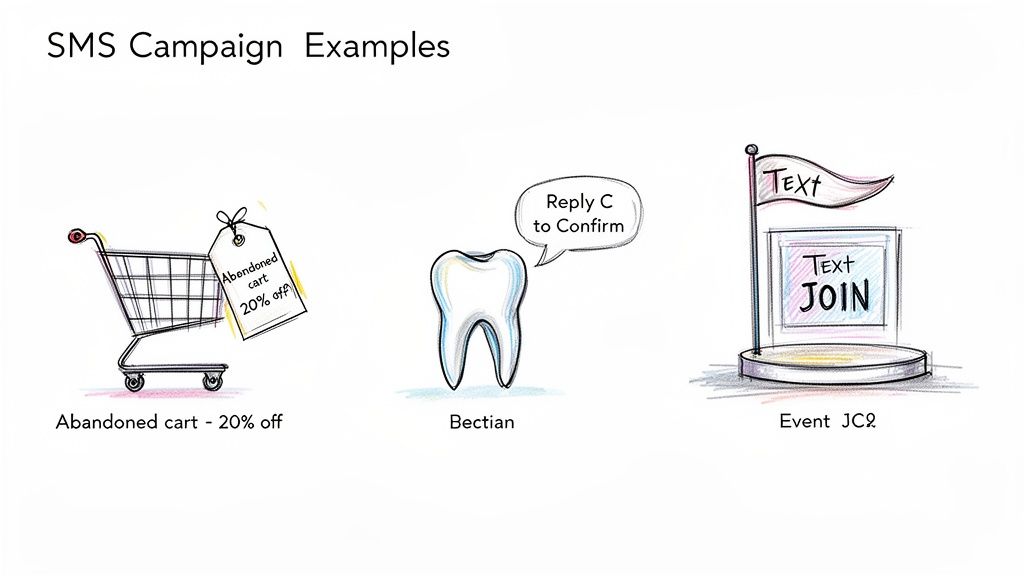
An online clothing boutique was facing a classic e-commerce problem: customers added items to their cart but never finished checking out. They decided to tackle it with an automated SMS campaign.
Here's what they did: 60 minutes after a cart was abandoned, the customer received a text: "Hey [FirstName], you left something behind! Complete your order now and get 15% off with code SAVE15."
The result? A 22% increase in recovered carts. It’s a perfect example of using personalization (the customer's name) and a time-sensitive offer to create a sense of urgency that’s hard to ignore. It’s this kind of immediate ROI that has driven spending in the global SMS marketing market to $327.1 billion.
Imagine you run a busy dental clinic. No-shows are a killer, leaving expensive gaps in your schedule and throwing the whole day off. One clinic solved this with a dead-simple SMS reminder system.
Forty-eight hours before a visit, patients got a text: "Hi [FirstName], this is a reminder of your appointment on [Date] at [Time]. Please reply C to Confirm or call us to reschedule."
This one small change slashed their no-show rate by over 40%. Why? Because SMS is direct. The message got seen, and the "Reply C" action was so easy that confirming became a reflex.
The most successful SMS campaigns are not just about sending a message. They are about prompting a specific, valuable action, whether that's completing a purchase or confirming attendance.
A marketing agency at a packed trade show needed a way to cut through the noise and capture leads instantly. Forget flimsy paper sign-up sheets that get lost or are impossible to read.
They set up a simple sign with a text-to-join keyword: "Text BIZTIPS to 555-555 to get our free marketing guide!" When an attendee texted the keyword, their number was immediately captured in a contact list. It’s a brilliant way to handle promotions, just like using SMS for coupon management.
In just one day, the agency pulled in over 300 qualified leads, completely blowing past their previous efforts.
To give you a few more ideas, here are some campaigns you could run in different industries.
As you can see, a well-planned text can do more than just send information—it can drive measurable growth for almost any business.
The power of SMS is undeniable. But with that power comes a clear set of rules. Think of it like this: your customer's phone is their personal space, and you need a direct invitation to show up there. Getting that permission isn't just a good idea; it's a legal must-have that builds trust and makes sure your messages are actually welcome.
The most important rule of all? You need explicit consent, or an opt-in, before you fire off a single marketing message. This means a customer has to clearly and knowingly agree to get texts from you. Skip this step, and you're not just risking your brand's reputation—you're looking at some seriously heavy fines.
Getting that "yes" is actually pretty straightforward. You've got two main ways to do it:
The golden rule of SMS marketing is to only text people who have asked you to text them. This single principle is the foundation of a successful and compliant SMS strategy.
Once you've got permission, keeping that trust means sticking to a few simple but non-negotiable best practices. These guidelines are mostly shaped by regulations like the Telephone Consumer Protection Act (TCPA), which exists to shield people from unwanted texts and calls.
Here's what you need to do for every single campaign:
These rules aren't just about dodging legal trouble. They're about building real, solid relationships with your customers. Staying compliant is crucial, and you need to understand the nuances for different number types. To make sure your campaigns are always above board, you can learn more about the specific rules for 10-digit long code compliance. Following these standards makes sure your messages are welcomed, effective, and build confidence with every text you send.
Alright, so you're ready to go from theory to actually getting results. This is where the rubber meets the road. Picking the right SMS platform is the single most important step you'll take. Think of it less like buying software and more like hiring a partner that’s going to help you grow.
A good platform is your command center for everything we've talked about, making it easy to launch the kinds of campaigns that get a real response.
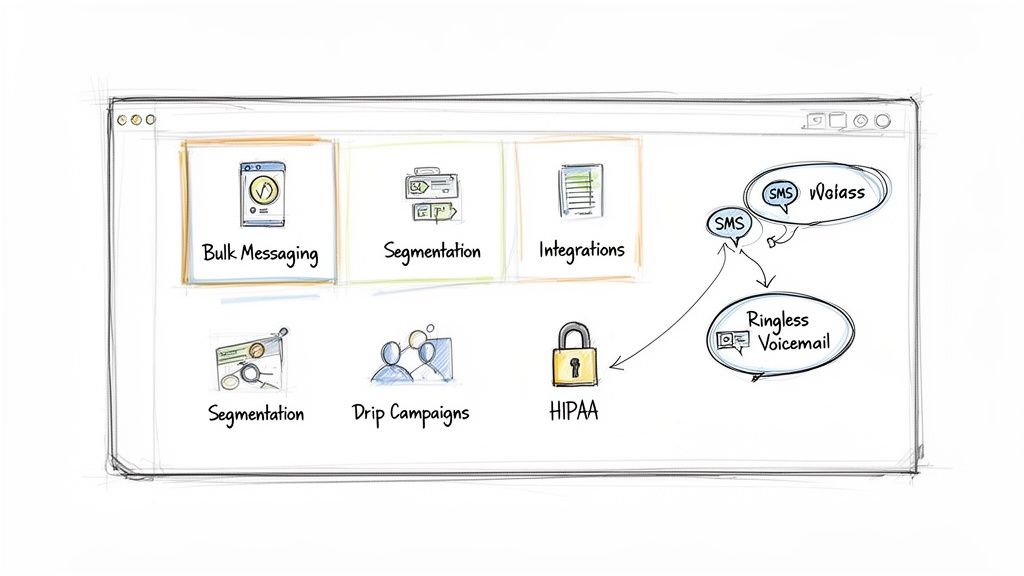
So, what should you look for? Let's break it down.
When you're comparing your options, don't get distracted by shiny objects. Focus on the core tools that form the foundation of any great SMS strategy.
A great SMS platform does more than just send texts. It provides the strategic tools to automate communication, personalize outreach, and measure what’s working, all while ensuring your messages stay compliant.
Once you’ve got the basics down, you’ll want to scale. That's where more advanced features come into play, especially things like multi-channel drip campaigns.
Imagine sending a ringless voicemail that drops right into their inbox, followed up a few minutes later with a text message that has a clickable link. It’s a one-two punch that grabs attention from multiple angles and seriously boosts your response rates. This is a key strategy for making your outreach more effective.
For certain industries, these advanced features are a must-have right from the start. Take healthcare, for example. You absolutely need a platform with HIPAA compliance to protect patient data while still using texts for things like appointment reminders.
Choosing a platform with these kinds of capabilities makes sure you’re not just solving today’s problems, but you're geared up and ready for whatever comes next.
As you start thinking about using SMS for your business, a few questions always seem to pop up.
Let's tackle the most common ones I hear from business owners who are on the fence about adding texting to their game plan.
Not at all. In fact, it’s one of the most affordable ways to reach customers, with a killer ROI.
Most platforms run on a pay-as-you-go model, so you only pay for the texts you actually send. When you stack that against the high cost and dismal engagement of old-school advertising, SMS is a smart, direct investment in your customer relationships. The pricing is built to scale right alongside your business.
The big difference comes down to one word: reach.
A push notification only works if a customer downloads your app and gives you permission to send them alerts. SMS, on the other hand, works on every single mobile phone right out of the box. No app needed.
This makes SMS a much wider, more reliable net to cast. Push notifications are fantastic for keeping your most dedicated app users in the loop, but SMS is how you talk to everyone else, instantly.
A push notification speaks to your app users; an SMS text speaks to everyone. The universal nature of SMS ensures your message can reach your whole audience, not just a fraction of it.
You technically can, but I strongly advise against it. It's completely unprofessional, impossible to manage as you grow, and you get zero automation or data to see what’s working.
More importantly, it’s a huge compliance risk. You could easily run into trouble with regulations like the TCPA. A dedicated SMS platform gives you the professional tools, compliance guardrails, and powerful features like scheduling and analytics that every serious business needs.
This is a big one: You must always get explicit permission—an 'opt-in'—before you send anyone a marketing text.
Common ways to do this are a simple checkbox on your website’s checkout page, a 'text-to-join' keyword campaign (like, 'Text DEALS to 55555'), or a signup form at an event.
Whatever you do, never buy a list of phone numbers. It's illegal, it doesn't work, and it will absolutely torpedo your brand's reputation.
Ready to put these strategies into action? Call Loop provides a powerful, compliant, and easy-to-use platform that brings together SMS, ringless voicemail, and voice broadcasting to help you build better customer relationships. See how Call Loop can transform your outreach today.
Chris Brisson
Chris is the co-founder and CEO at Call Loop. He is focused on marketing automation, growth hacker strategies, and creating duplicatable systems for growing a remote and bootstrapped company. Chat with him on X at @chrisbrisson


Trusted by over 45,000 people, organizations, and businesses like


