
See a Demo
You're just one step away from seeing Call Loop in action.
Enter your information below to watch a demo right now.

You're just one step away from seeing Call Loop in action.
Enter your information below to watch a demo right now.

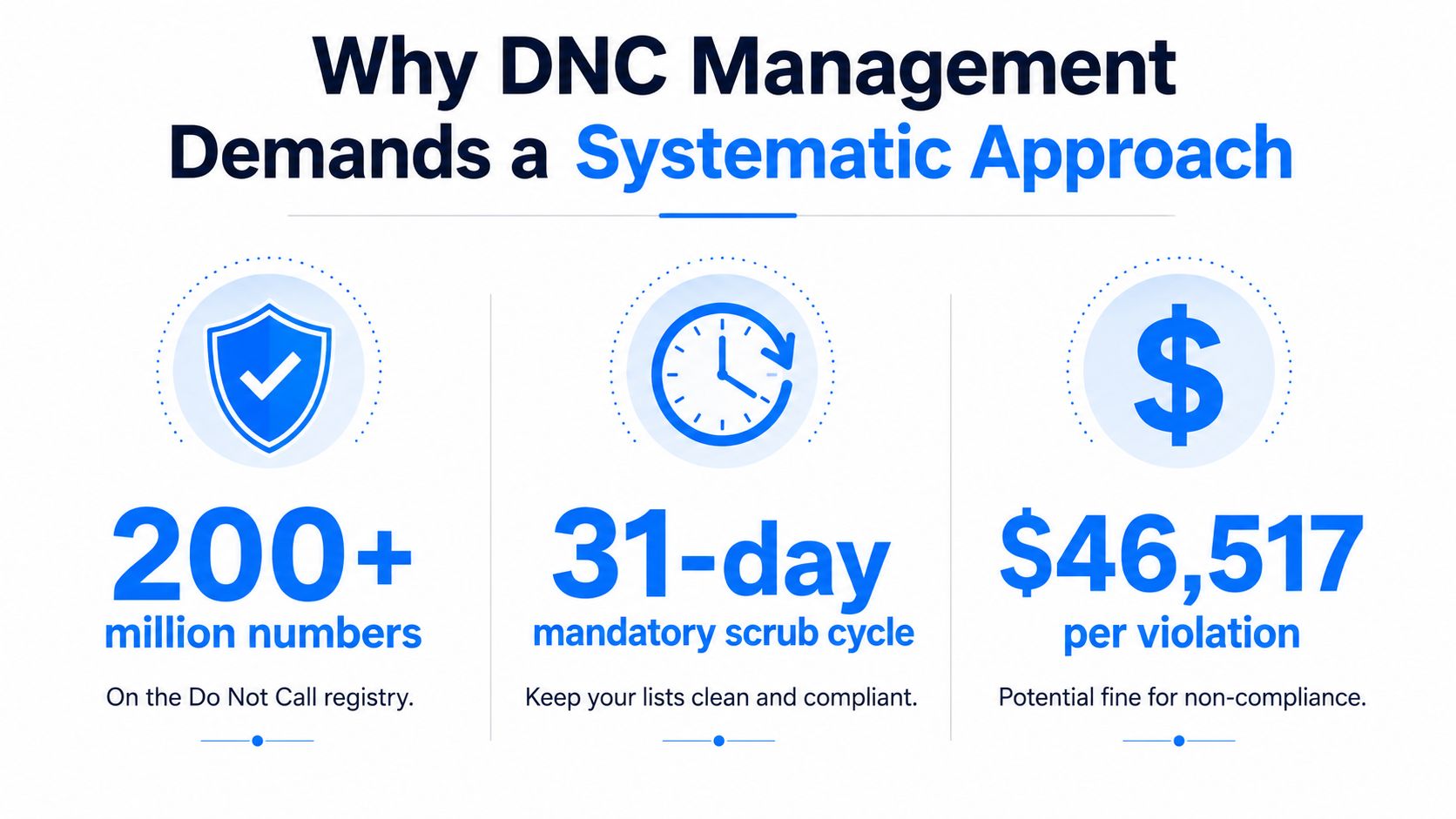
More than 258 million phone numbers were active on the U.S. National Do Not Call Registry by the end of fiscal year 2025, while the FTC received more than 2.6 million Do Not Call complaints during the same year. The figures, reported in the FTC's fiscal year 2025 Registry data, change the way outbound teams should think about DNC management. This isn't a list you scrub once before a campaign. It's a live operating system for consent, suppression, revocation, and channel-specific contact decisions.
The hard part is that SMS, live voice, prerecorded calls, and ringless voicemail don't always share the same rules. A number can be permitted for one channel and blocked for another, or a consent record can look complete until someone asks who the consumer consented to hear from, what topic they accepted, and whether they later revoked permission. Reliable DNC management connects those details before the dial, send, or voicemail drop happens.
The National Do Not Call Registry has become a large, continuously changing suppression source. During fiscal year 2025, consumers added roughly 4.8 million phone numbers to the registry, and the FTC recorded more than 2.6 million complaints, according to the FTC's annual Do Not Call Registry data book release. That combination matters operationally. Your campaign file can become outdated while it moves through acquisition, enrichment, segmentation, approval, and launch.
A mature program therefore treats DNC status as a decision made at multiple points, not as a spreadsheet column. The workflow should account for the federal registry, applicable state lists, your internal suppression requests, consent scope, revocations, reassigned numbers, and the channel selected for outreach.
A national registry scrub answers one question, whether a number appears on that registry at the time of the check. It doesn't answer whether the consumer has submitted an internal Do Not Call request, revoked consent through SMS, changed phone numbers, or authorized a particular seller and communication purpose.
That's why teams need connected controls:
The best system creates a conservative outcome when data conflicts. If the number is suppressed but consent appears elsewhere, the platform should block the outreach until an authorized reviewer resolves the conflict. A policy that depends on every representative interpreting fragmented records correctly isn't a control. It's a recurring failure point.
Operational rule: Store compliance state outside the campaign file. Campaign files change, get duplicated, and get re-imported. Suppression and consent history must survive those events.
DNC management also needs ownership. Marketing may capture the lead, sales may place the call, a messaging vendor may send the SMS, and a separate platform may deliver ringless voicemail. If each system maintains its own version of consent and suppression, the organization can't reliably enforce the consumer's latest request. The practical target is one authoritative status model distributed to every sending and dialing system.
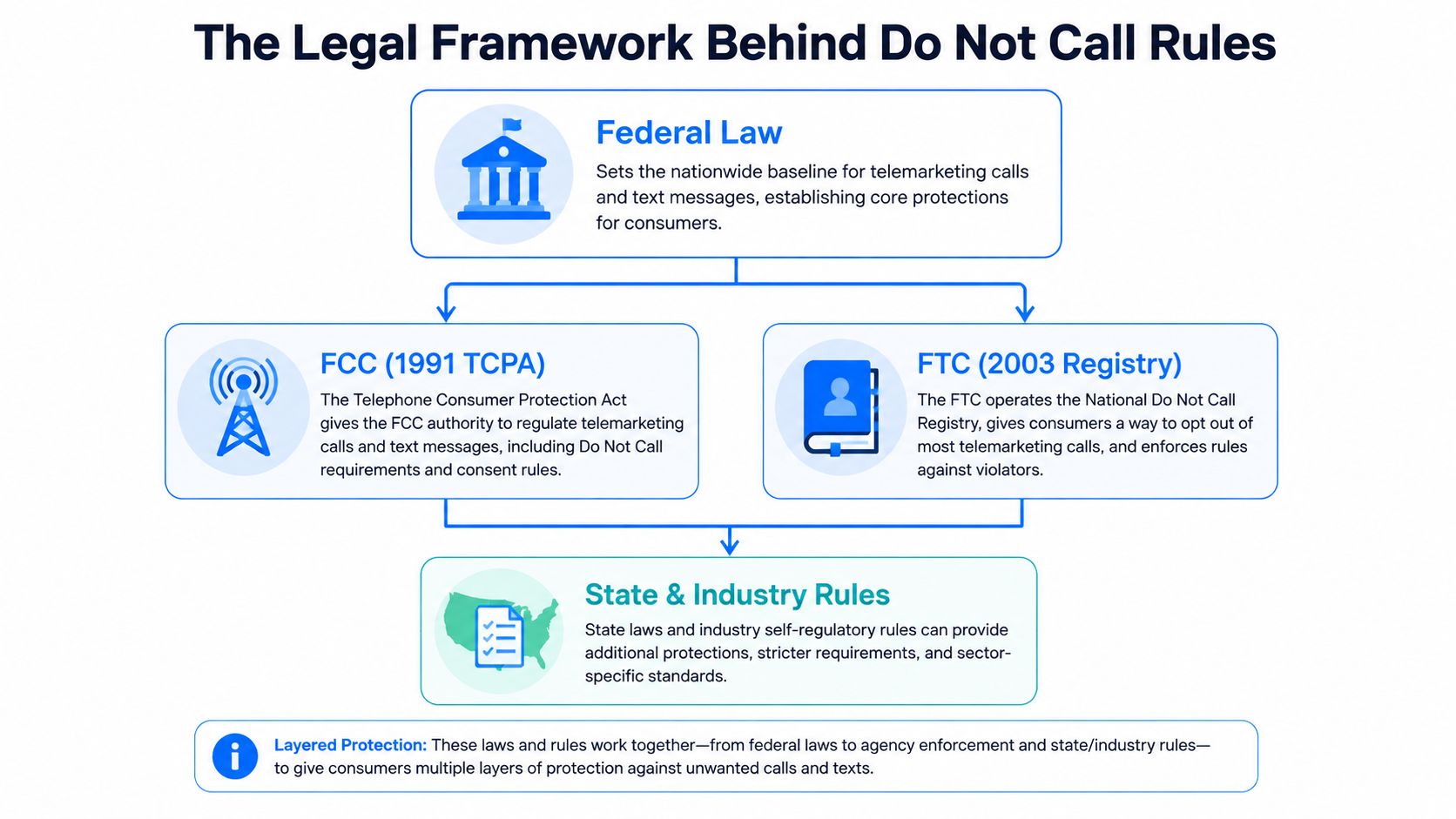
The federal framework took shape in 2003, when the FCC and FTC coordinated the national Do-Not-Call Registry. It covers interstate and intrastate telemarketing calls nationwide. Telemarketers generally must stop calling a registered number within 31 days, subject to applicable exceptions. The FCC's consumer guidance on unwanted calls and texts explains the registry's role and restrictions on commercial telemarketing calls.
The contact's purpose determines which protections apply. Commercial sales, political outreach, charitable solicitation, customer service, and nonprofit communications do not receive identical federal DNC treatment. The FTC states that its Registry does not apply to political calls or calls from non-profits and charities, while telemarketers calling on behalf of charities are covered, as described in the FTC's National Do Not Call Registry overview.
Federal DNC status is one input in a larger decision. State requirements, calling windows, the Reassigned Numbers Database, internal opt-outs, and message-delivery technology can change the result. A national scrub does not settle a state requirement or establish that the number still belongs to the person who gave consent.
TCPA analysis also depends on the channel. Automated calls, prerecorded voice, SMS, and ringless voicemail may involve different consent questions and restrictions. Teams can use this TCPA compliance guide as a concise framework, then apply counsel's interpretation to the campaigns they run.
A practical decision tree starts with the proposed contact:
The legal question is not only whether a number appears on the DNC list. It is which rules apply to this seller, recipient, purpose, channel, and moment in time.
A DNC control fails when it treats suppression as a one-time file import. The workflow must connect registry updates, internal opt-outs, consent evidence, number quality, and channel rules before any voice call, SMS, or ringless voicemail starts.
Schedule registry synchronization for every area code the organization calls. FTC guidance and compliance summaries state that telemarketers must access the National DNC Registry at least every 31 days. Create a job, record completion, retain the resulting file or transaction evidence, and alert an owner when the job fails.
Internal requests need durable records rather than a contact flag. Timestamp each request, link it to the source, preserve the communication channel, and retain it for at least five years, based on the operational requirements described in reliable predictive dialer compliance processes.
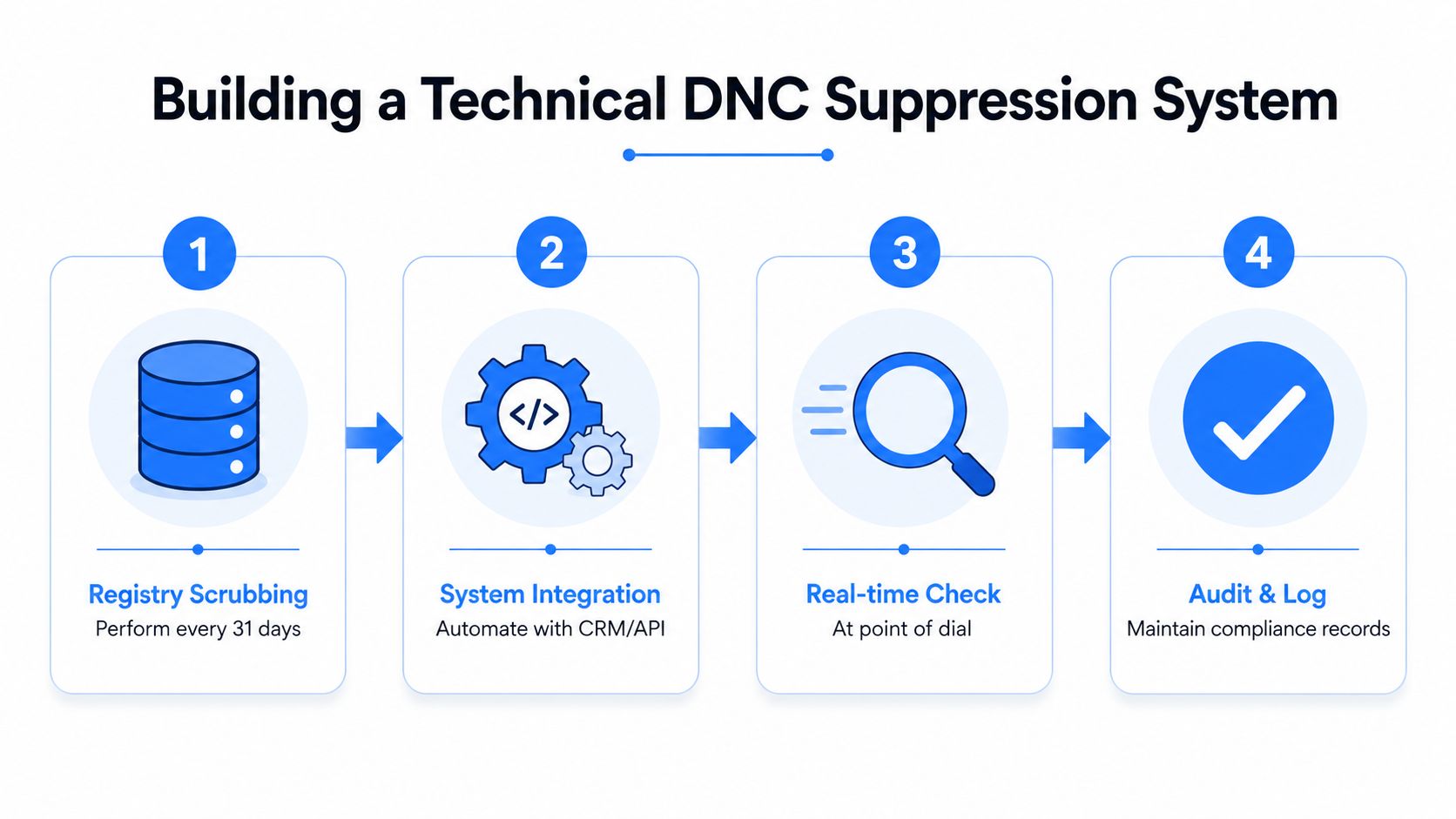
A practical design follows the record through its full lifecycle:
Number quality belongs upstream of suppression matching and should be checked again when a record changes. Teams can use a service to verify phone numbers for sales when lead sources provide inconsistent formats or outdated records. The validation of phone numbers supports cleaner matching, but a reachable number is not permission to contact.
The decision service should return a reason, not only a Boolean. Useful outcomes include “blocked by internal request,” “missing channel consent,” “federal registry match,” and “manual review required.” Those outcomes help agents, campaign operators, and auditors understand why voice, SMS, or ringless voicemail was stopped.
Deduplication must preserve evidence. If a number arrives through a CRM, form integration, and purchased file, merge the records without losing the earliest consent, latest revocation, or original source.
Failed controls should fail closed. A stale registry sync, unavailable suppression service, or missing consent record should pause the affected campaign or send the record to review. Letting outbound activity continue while a compliance dependency is offline creates avoidable exposure.
The most common mistake is treating a clean national scrub as permission to contact. It isn't. A scrub tells you about one external list at one point in time. It doesn't establish that the consumer consented to this seller, this subject, or this channel, and it doesn't show whether the person later asked your organization to stop.
Consent that looks valid on paper can fail at the point of dial when the record lacks context. A database may say “opted in” while omitting the form language, source, timestamp, seller identity, or channel. That gap becomes especially serious when one team collected consent and another team launches a campaign using a broader purpose than the original interaction supported.
Recent compliance guidance emphasizes record-level consent and retrievable details, while 2025 TCPA consent collection rules highlight the importance of seller, topic, scope, jurisdiction, and revocation status. Many legacy workflows still store a single Boolean field, which can't distinguish current permission from historical permission.
Revocation creates a second failure point. A consumer may reply to an SMS, tell an agent during a call, use a web form, or communicate through another reasonable method. The organization's system needs to interpret that request consistently and block future outreach according to its compliance policy, rather than waiting for a nightly spreadsheet process.
A contact may have a mobile number, a landline, and a newly assigned number. Suppressing only the number that received the request can leave the same person reachable through another record or channel. Re-imports make this worse when a deleted contact returns without its previous suppression state.
State and channel differences create another blind spot. The 2025 TCPA business guide describes the need to consider the National DNC Registry, state registries, the Reassigned Numbers Database, revocation methods, local calling windows, and channel-specific restrictions. A contact might be eligible for a live conversation under one analysis while remaining blocked for SMS or prerecorded voice.
Audit your workflow by asking four uncomfortable questions:
A ringless voicemail can reach a phone without producing an audible ring, but that delivery method does not remove the consent analysis. For wireless phones, the FCC classified ringless voicemail as a call using an artificial or prerecorded voice under the TCPA. Prior consumer consent is therefore required under that classification. The FCC order on ringless voicemail is the controlling reference.
A common workflow starts with a prospect joining a marketing list, receiving an SMS, and later entering a ringless voicemail campaign. The campaign manager sees the original lead record and treats that opt-in as permission for the voicemail. That decision can fail when the consent omitted the seller, did not cover prerecorded voice, was revoked by SMS, or applied to a different campaign purpose.
Ringless voicemail needs a channel-specific decision before delivery, even when voice and SMS use the same phone number. The system should evaluate:
A ringless voicemail event should enter the same consent and suppression workflow as SMS and voice. If a recipient opts out by text, the system should apply the organization's rules across the planned voicemail, future voice broadcasts, and related outreach. A shared phone number is not a shared permission record.
Teams assessing channel design can review ringless voicemail marketing guidance. Call Loop describes delivery to mobile and landline numbers, scheduling, recordings, and DNC management. The compliance outcome still depends on the consent data collected and the rules applied to each recipient.
The operational test is simple: before sending, can the platform show documented permission, current suppression status, and a channel-specific decision? If any answer is unclear, the voicemail should remain blocked for review.
A campaign marked “passed” is not compliance proof. The audit trail must show why each contact passed, when the decision occurred, and which records supported it. That evidence matters when a consumer disputes outreach or a regulator asks how the organization applied its policy across SMS, voice, and ringless voicemail.
Capture the decision sequence rather than only its outcome. Each campaign and contact record should preserve the registry source and synchronization time, internal suppression state, consent metadata, revocation events, number-validation result, channel, campaign identifier, and the decision made immediately before dialing or sending.
Operations managers need queues and summaries. Compliance reviewers need an unaltered history of events. Both views can use the same event store while serving different tasks:
Evidence standard: Someone outside the campaign should be able to reconstruct the decision without relying on memory or a manually edited spreadsheet.
Retention should follow legal advice and documented policy. Internal DNC requests should remain available for at least five years, consistent with the operational guidance cited earlier and predictive dialer compliance guidance. Consent artifacts, registry scrub receipts, vendor transfer records, and revocation events need the same treatment. Otherwise, evidence can disappear at the handoff between a CRM, suppression service, and sending platform.
Automation can reduce manual compliance work by producing recurring reports and flagging exceptions. Keep access to the underlying events. A polished dashboard helps management, while raw records establish what the system enforced.
Run controlled log reviews before relying on the reports during an audit. Select both blocked and allowed records, trace each decision to its source, and compare the recorded status with the action taken by the sending system. Include cross-channel cases, such as an SMS revocation followed by a planned voice call or ringless voicemail. If the result cannot be reproduced, the reporting process has a control gap, even when no complaint followed the campaign.
The platform should enforce the workflow where outreach happens. Importing a file into a compliant system isn't enough if a later CRM sync, drip sequence, or agent action can bypass the suppression state.
For a multi-channel team, evaluate the platform against the complete lifecycle:
Call Loop is one example of an outbound platform that combines SMS, voice broadcasting, and ringless voicemail workflows with DNC management. Its documented capabilities include contact validation, double opt-in, segmentation, scheduling, drip campaigns, and campaign analytics, so teams can evaluate whether those controls align with their own consent model and legal requirements.
The trade-off is straightforward. A unified platform can reduce synchronization gaps, but it doesn't eliminate governance. Someone still needs to define seller identity, consent scope, state coverage, escalation rules, retention, and permitted exceptions. Automation enforces the policy you configure, including a poorly designed policy.
Before selecting a tool, test it with difficult records rather than a clean demo file. Import a duplicate, apply an internal opt-out, change the consent scope, schedule a ringless voicemail, and confirm that the system blocks the event at execution. Teams comparing dialing workflows can also review DialNexa outbound dialer insights as part of a broader technology assessment.
Call Loop offers coordinated SMS, voice broadcasting, and ringless voicemail campaigns with DNC management, contact validation, consent-oriented controls, scheduling, and analytics. Visit Call Loop to assess whether its multi-channel workflow can centralize suppression and provide the operational records your outbound team needs.
Chris Brisson
Chris is the co-founder and CEO at Call Loop. He is focused on marketing automation, growth hacker strategies, and creating duplicatable systems for growing a remote and bootstrapped company. Chat with him on X at @chrisbrisson


Trusted by over 45,000 people, organizations, and businesses like


