
See a Demo
You're just one step away from seeing Call Loop in action.
Enter your information below to watch a demo right now.

You're just one step away from seeing Call Loop in action.
Enter your information below to watch a demo right now.

A single TCPA mistake can cost $500 per violation, or $1,500 per willful violation, and one class action produced a $925 million penalty according to DNC.com's TCPA overview. That's why “what is TCPA compliance” isn't really a definition question. It's an operating model question.
If your business sends promotional texts, drops ringless voicemails, runs voice broadcasts, or automates outbound follow-up, TCPA compliance sits directly between growth and avoidable legal exposure. The businesses that get this right don't treat compliance as a legal footnote. They build consent, opt-out handling, list hygiene, and audit trails into the campaign itself.
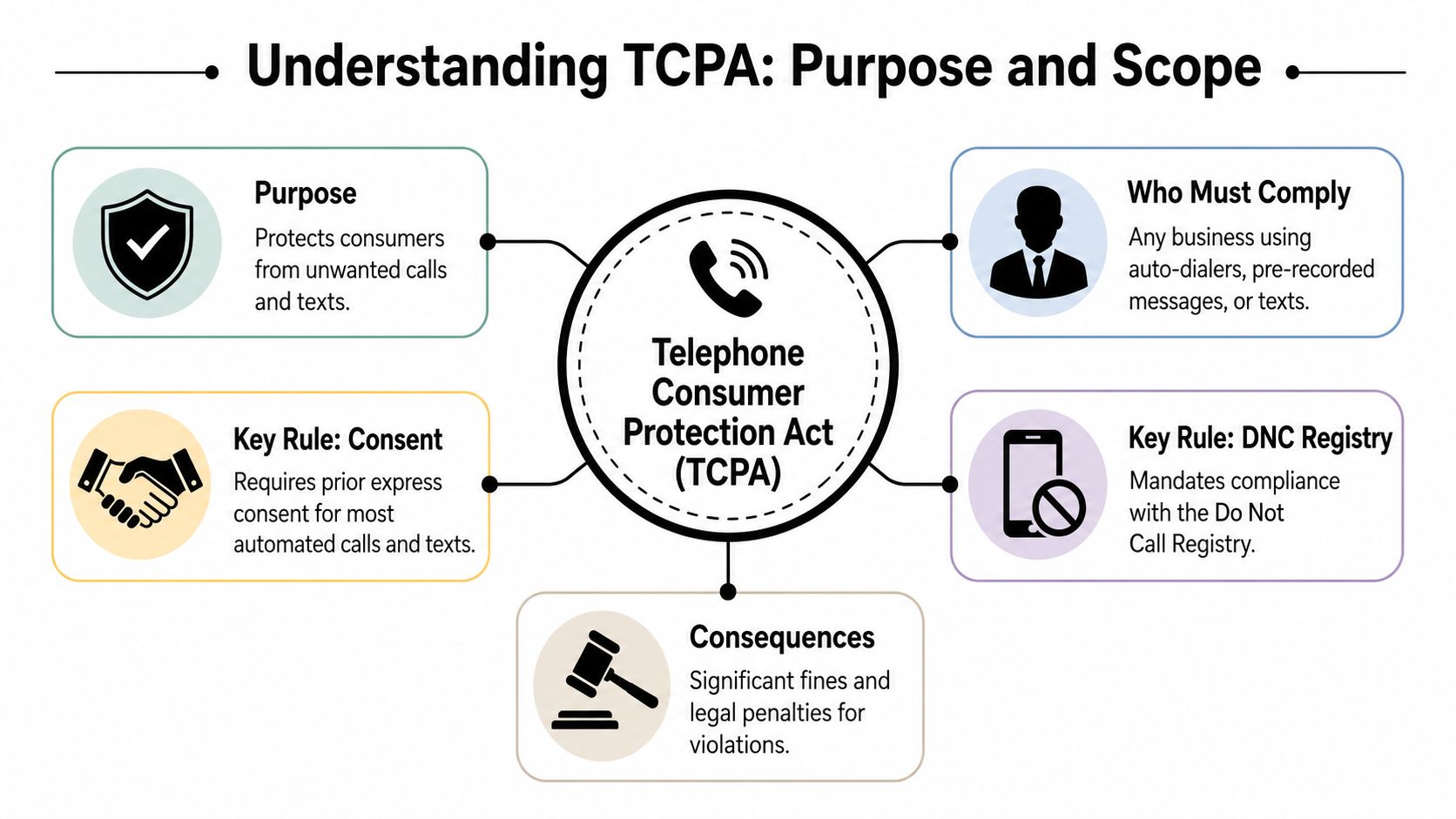
The Telephone Consumer Protection Act (TCPA) is the federal law that limits how businesses use phones and automated messaging to reach consumers. For day-to-day operations, it matters any time your business sends promotional SMS, places prerecorded voice calls, uses automated dialing, or delivers ringless voicemail to a mobile number.
What matters is not just the message. It is the combination of channel, device type, consent record, and delivery method.
A practical compliance program starts by identifying every outbound channel you use, not just the ones your team labels as marketing. In many businesses, risk shows up in mixed workflows. A lead gets a web form follow-up by text, then a prerecorded appointment reminder, then a ringless voicemail after no response. If those steps are automated, the TCPA analysis follows the workflow across channels.
TCPA exposure commonly appears in:
The phone number type changes the risk. A mobile number and a residential landline are not treated the same in every scenario. If your team needs a quick reference, this breakdown of landline vs. mobile phone compliance differences helps clarify where the rules diverge.
Ringless voicemail often gets pitched as a safer alternative to a call. That assumption creates problems.
The FCC has treated ringless voicemail to mobile phones as a form of call under the TCPA. For compliance purposes, that means your voicemail drop strategy should be reviewed with the same discipline you apply to SMS and prerecorded voice. If your platform supports ringless voicemail, it should also support consent capture, suppression lists, time-of-day controls, and audit logs. Otherwise, you are adding a channel without adding the controls that make the channel defensible.
Any business that initiates, directs, or benefits from outbound calling or messaging activity can be pulled into TCPA liability. That includes local service companies, multi-location brands, agencies running campaigns for clients, franchises, healthcare organizations, ecommerce teams, real estate groups, and internal sales teams using automation.
Size does not change the rule.
I tell clients to look past job titles and vendor contracts. If your business approves the campaign, buys the leads, loads the contact list, writes the script, or chooses the platform, you need a process that proves consent was collected, opt-outs were honored, and restricted numbers were not contacted. A messaging platform can help by automating those controls across SMS, voice, and ringless voicemail, but the legal responsibility does not disappear because a vendor pressed send.
Consent is where most TCPA programs either hold up or collapse. The law doesn't treat every contact the same, and your records need to match the channel and message purpose.
The most important distinction is between informational contact and marketing contact. The more promotional your message becomes, the stronger your proof of permission needs to be.
There are three useful tiers to think about in day-to-day operations:
The last one matters most for marketing automation. Prior Express Written Consent (PEWC) became mandatory for autodialed marketing calls to wireless numbers on October 16, 2013, and it requires a clear written agreement that explicitly authorizes contact and isn't buried in terms of service, as outlined in this PEWC overview.
If you're building web forms or keyword opt-ins, this explanation of express written consent requirements is worth reviewing with both your marketing and legal teams.
| Consent Type | What It Is | When It's Required | Example |
|---|---|---|---|
| Oral Consent | Verbal permission given by the consumer | Lower-risk, non-marketing situations where verbal permission may be sufficient under the specific contact context | A customer gives permission on a recorded service call to receive a follow-up about an existing request |
| Prior Express Consent | Consent given by the consumer to be contacted, typically tied to a specific interaction or provision of contact details | Informational or operational outreach where written marketing authorization is not the governing standard | A patient provides a mobile number for appointment-related communication |
| Prior Express Written Consent | A clear digital or physical written agreement authorizing contact, with the specific opt-in language, phone number, and date captured | Automated telemarketing calls, marketing texts, and comparable promotional outreach to wireless numbers | A web form checkbox next to a clear disclosure agreeing to receive automated promotional texts |
A lot of businesses think a phone number in a CRM equals consent. It doesn't.
For PEWC, your records should show the actual disclosure language, the number tied to consent, and when the consent was captured. The point isn't paperwork for its own sake. The point is being able to prove, after the fact, that the person agreed to that specific type of contact.
The safest consent record is the one a plaintiff's lawyer can't easily attack.
What works
What fails
A “contact us” form is rarely enough for automated promotional messaging. If you plan to market by text, voice, or ringless voicemail, your consent process has to say that plainly and preserve proof.
The hardest TCPA problems aren't basic ones. They show up in the exceptions, the partial exemptions, and the campaign tweaks that turn a compliant workflow into a risky one.
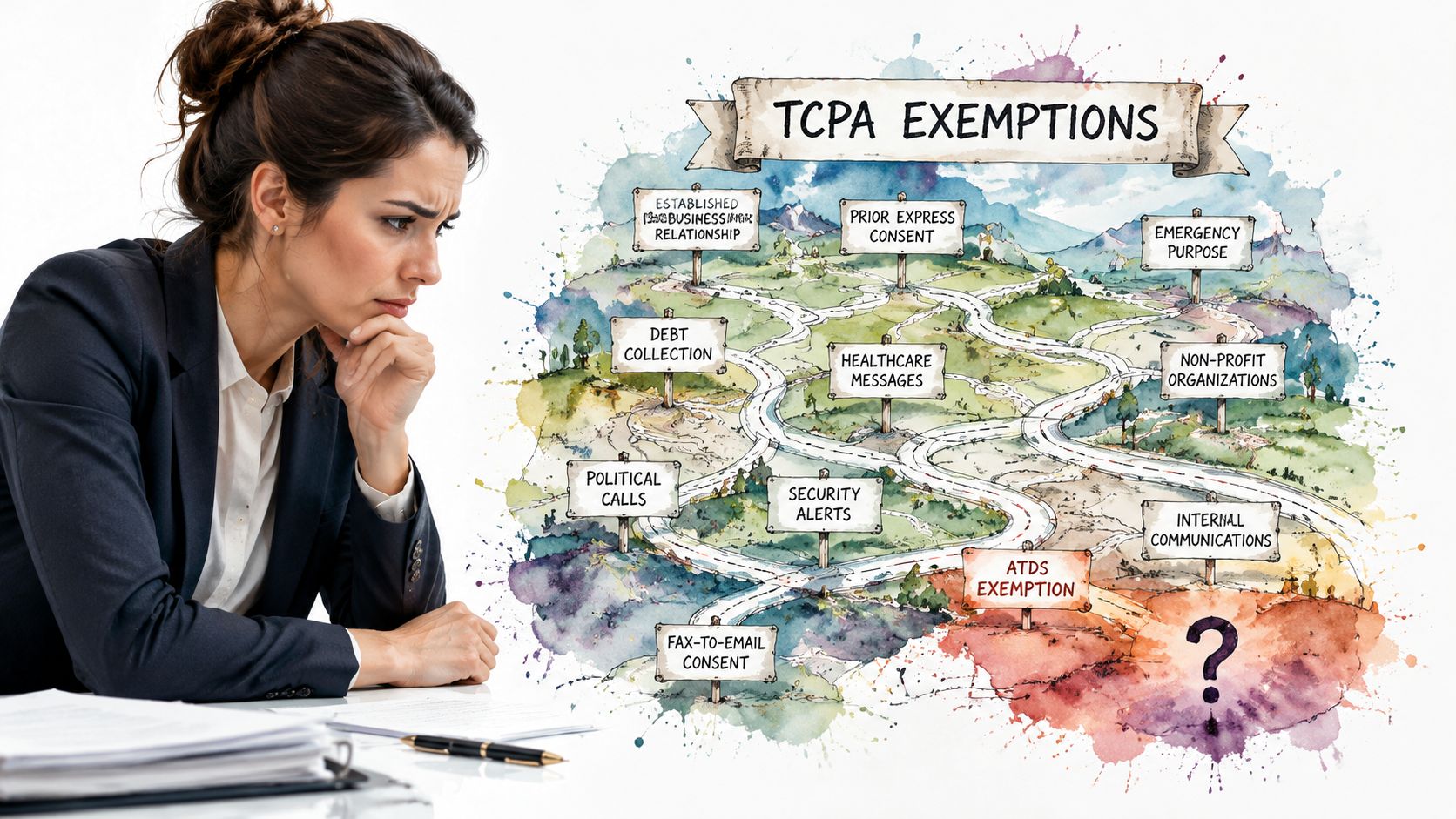
Healthcare organizations often overread the exemption. Treatment, payment, and operations messages may fit within the healthcare framework, but promotional content does not automatically ride along with that permission.
A 2024 FTC enforcement case against a regional health network resulted in a $1.2M fine for sending automated promotional texts about discounted eyewear to patients without the required prior express written consent, according to this healthcare TCPA analysis. The lesson is straightforward. HIPAA compliance doesn't give you a blanket TCPA exemption.
Here's where businesses get tripped up:
The exact same patient database can support both compliant care communication and noncompliant promotional messaging, depending on the message content.
A business collects an SMS opt-in. Then marketing adds that person to a voice drop or ringless voicemail workflow. Operationally, that feels efficient. Legally, it can be a problem.
The TCPA expects channel-specific consent documentation. Consent for one method doesn't automatically authorize another. That matters most in omnichannel automation where a single trigger can launch text, voice, and voicemail steps.
If your workflow moves from SMS to voice or ringless voicemail, review consent at the channel level, not the contact level.
Some teams also miss the operational rules that sit behind campaign execution. For example, telemarketing systems need safeguards around abandoned calls, and businesses need real-time opt-out handling across channels. The technical expectations described in this TCPA operations guide are a good reminder that compliance isn't only about legal language. It's also about how your systems behave.
State laws can create another layer. Federal TCPA rules are the baseline. Your state may impose stricter rules, broader autodialer definitions, or narrower exemptions. If you operate nationally, build for the stricter scenario where practical.
TCPA cases become expensive fast because liability is often calculated per call or per text. One workflow error can touch hundreds or thousands of records before anyone notices.
The statute allows $500 per violation and up to $1,500 for willful or knowing violations. You do not need a massive outbound program to create real exposure. A single signup form with weak disclosures, an SMS campaign sent without matching consent, or a ringless voicemail drop to the wrong segment can turn into a claim your business has to defend.
That is the primary risk. TCPA problems rarely stay isolated.
A consent defect at the point of capture can affect every lead collected through that source. A suppression failure can keep sending messages after an opt-out. If your platform lets teams launch SMS, voice, and ringless voicemail from the same contact record without checking channel-specific permissions, you can multiply exposure across channels with one automation.
In practice, I see four patterns create the biggest legal bills:
The lawsuit risk is not limited to large brands. Plaintiff firms look for repeatable process failures because that is what supports class claims. If your records are incomplete or your systems cannot show who consented, when they consented, and to which channel, your defense gets harder and more expensive.
This is why platform configuration matters as much as policy. Your system should store consent artifacts, separate SMS consent from voice and voicemail permission, enforce quiet hours, process opt-outs immediately, and prevent suppressed numbers from reentering campaigns through imports or syncs. Those controls reduce mistakes before they become evidence.
The practical business view is simple. It is far cheaper to prevent one bad campaign than to explain it later to opposing counsel, your carrier, and a court.
A usable TCPA program lives in your daily workflow. It's not a policy PDF sitting in a shared folder.
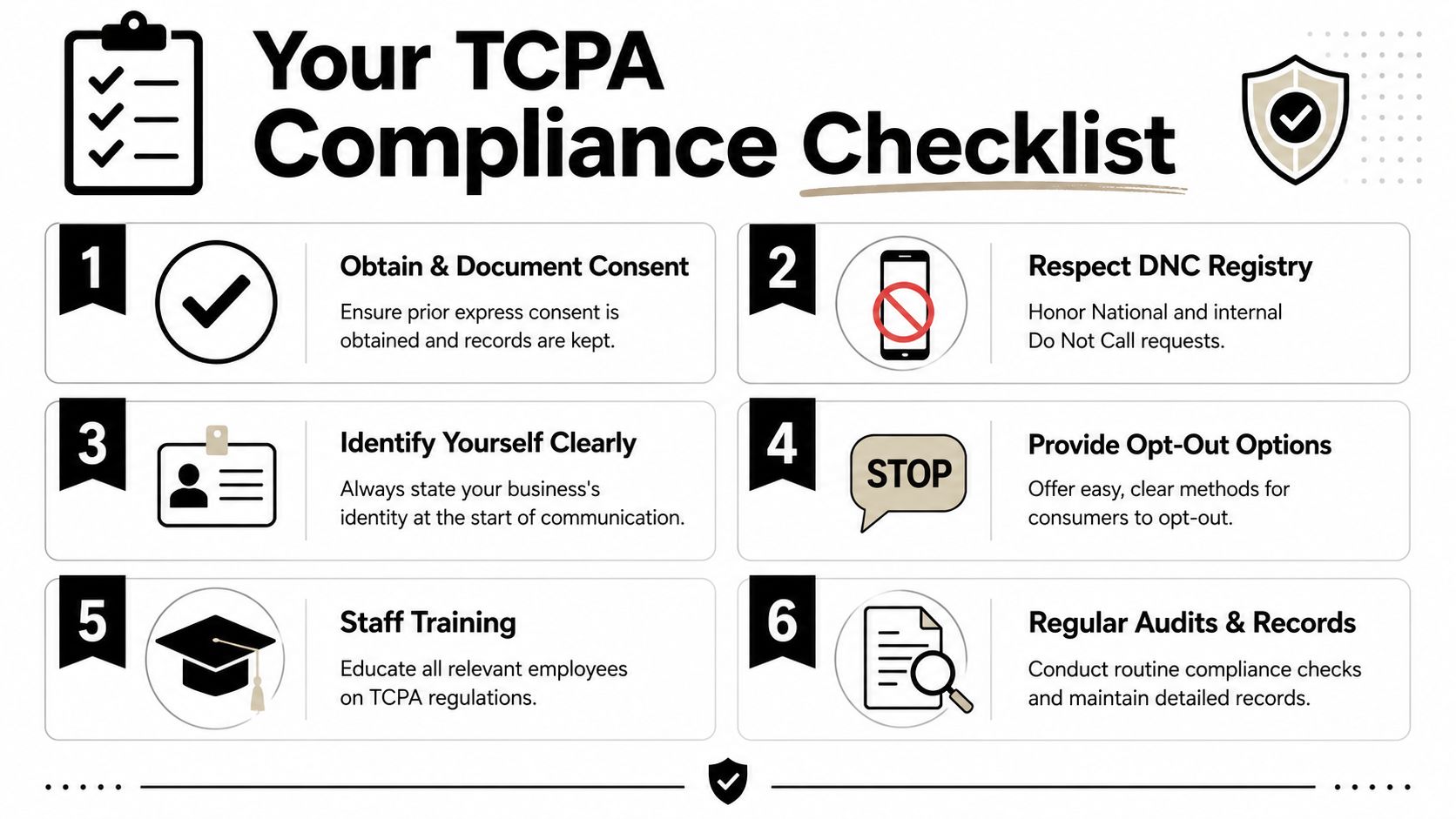
Start with the actions that directly reduce exposure.
Write disclosures that match the campaign
If you plan to send marketing texts, voice broadcasts, or ringless voicemail, say so clearly at the point of opt-in. Don't hide the disclosure in terms of service or a privacy link. The channel, purpose, and nature of the communication should be understandable to a normal person reading the form.
Capture proof, not just permission
Store the form version, timestamp, source, phone number, and consent language shown at signup. If a lead comes from a partner, make sure you can retrieve the underlying consent record and not just a spreadsheet with phone numbers.
Honor opt-outs immediately
Every channel needs a working suppression path. SMS should process replies like STOP. Voice and ringless voicemail should provide a clear opt-out method and route that choice into your internal do-not-contact logic.
Operational test: Submit your own opt-out request and confirm it suppresses future contact across every connected workflow.
TCPA compliance is also a list management discipline.
According to this ringless voicemail compliance guide, businesses must scrub against the National Do-Not-Call Registry at least every 31 days, and every message must clearly identify the business and provide a clear opt-out mechanism.
That means your checklist should include:
A lot of compliance trouble starts before messaging ever begins. If your team collects leads from scraping, third-party forms, purchased lists, or mixed-source databases, you need to review whether the contact data was obtained and documented in a way that supports lawful outreach. At this stage, broader data collection rules become critical, and a practical overview of 2026 web scraping laws helps frame the upstream risk.
Policies fail when only legal understands them.
The checklist is simple in concept. Clear consent. Verifiable records. Clean lists. Fast opt-outs. Consistent audits. That's what holds up.
Most businesses don't struggle because they've never heard of the TCPA. They struggle because manual compliance breaks under volume.
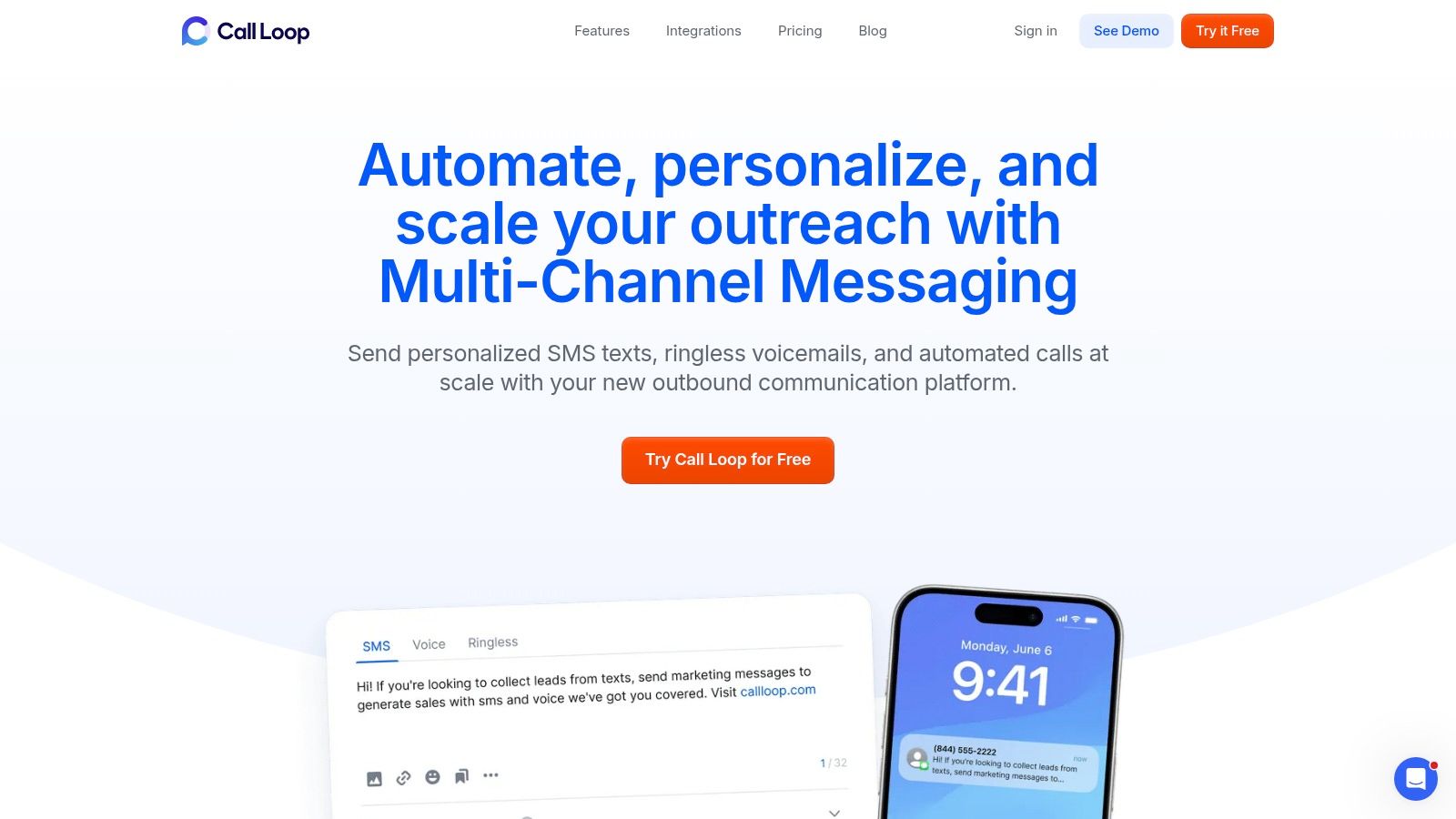
A capable messaging platform should do more than send messages. It should enforce the rules you already decided to follow.
Look for these features:
This is also where operational partners can help. If your team is building cross-channel automation at scale, an outside implementation partner such as an AI automation agency can help map business logic, triggers, and data flows so compliance rules aren't lost between systems.
Here's the trade-off. Manual processes feel flexible, but they're fragile. The first CSV import, CRM sync issue, or vendor handoff can break your audit trail.
A platform such as Call Loop can support this work with features for SMS, voice broadcasting, ringless voicemail, double opt-in, number validation, and DNC management. If your team is cleaning databases before launch, this guide on managing contact lists for outbound campaigns is directly relevant.
Compliance automation works best when it blocks bad sends by default, not when it creates reminders for someone to fix them later.
What doesn't work is treating the platform as a magic shield. Software can automate controls, but your team still has to define valid consent language, campaign purpose, suppression rules, and review standards.
It can be, but only when the campaign meets TCPA requirements. Ringless voicemail is treated as a call under the FCC's ruling discussed earlier, so you shouldn't treat it as a loophole. For marketing use, review whether you have the right consent for that specific channel, and make sure your message identifies your business and gives a clear opt-out path.
The federal National Do Not Call framework is the baseline. State laws can add separate do-not-call rules or stricter calling restrictions. If you contact consumers across multiple states, don't assume the federal list is the only suppression source you need to honor.
Your records should be kept long enough to defend the outreach if challenged. One practical baseline from the earlier source material is that proof of honoring internal do-not-call requests should be maintained for at least five years for internal DNC requests, based on the requirements discussed in the MSLaw Group FAQ cited earlier. In practice, keep consent and opt-out records in a structured, retrievable format and align retention with legal advice for your business.
Not automatically for automated marketing. A business card shows contact information, not necessarily consent to receive promotional SMS through an automated system. If you want to use automated marketing texts, get a proper opt-in that clearly authorizes that type of contact.
Don't assume that. Multi-channel campaigns create risk when one opt-in is stretched across another communication method. Review the original disclosure and confirm that the person consented to the channel you plan to use.
If your team sends SMS, voice broadcasts, or ringless voicemail, Call Loop gives you one place to manage consent-based outreach, opt-outs, contact lists, and multi-channel campaign execution without relying on scattered manual steps.
Chris Brisson
Chris is the co-founder and CEO at Call Loop. He is focused on marketing automation, growth hacker strategies, and creating duplicatable systems for growing a remote and bootstrapped company. Chat with him on X at @chrisbrisson


Trusted by over 45,000 people, organizations, and businesses like


