
See a Demo
You're just one step away from seeing Call Loop in action.
Enter your information below to watch a demo right now.

You're just one step away from seeing Call Loop in action.
Enter your information below to watch a demo right now.

In a world of constant digital noise, generic, one-size-fits-all campaigns are quickly ignored. To capture attention and drive real action, businesses must master the art of the drip campaign: a series of automated, timed messages sent to a specific group of people. But what separates a successful drip sequence from one that gets lost in the shuffle? The answer lies in a strategic, multi-channel approach that combines deep personalization, precise timing, and compelling, action-oriented content.
This guide moves beyond basic theory to deliver 10 essential drip campaign best practices you can implement immediately. We will cover everything from advanced audience segmentation and clear goal-setting to designing logical message flows that guide contacts toward conversion. Understanding the fundamentals of email marketing for small business provides a solid foundation, but modern campaigns require more. You will learn how to orchestrate multi-channel sequences using SMS, voice, and even ringless voicemail to create a unified customer experience.
Furthermore, we'll dive into the critical details of TCPA compliance, data hygiene, and CRM integration to ensure your campaigns are both effective and sustainable. Each best practice is paired with actionable steps, practical examples, and optimization techniques to help you build automated outreach that not only reaches your audience but truly resonates. Whether you are in sales, healthcare, or ecommerce, these strategies will equip you to create high-performing campaigns that turn prospects into loyal customers.
Sending a generic message to your entire contact list is one of the fastest ways to diminish engagement. The foundation of any successful drip campaign is audience segmentation: the practice of dividing your contacts into smaller, distinct groups based on shared characteristics. This ensures that every message, whether an SMS alert, a voice broadcast, or a ringless voicemail drop, is highly relevant to the recipient, dramatically increasing its impact.
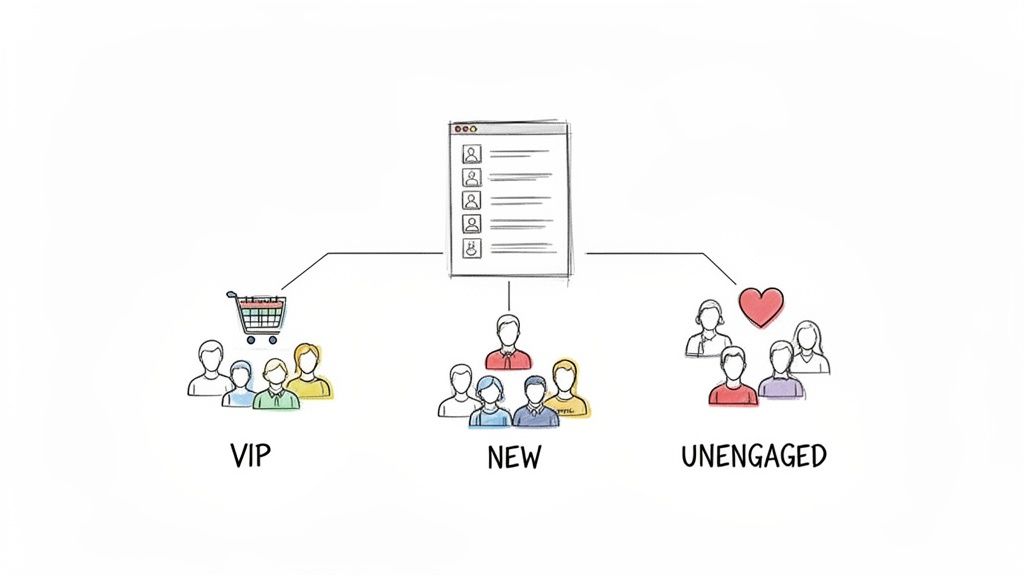
When you segment, you move from one-to-many broadcasting to a more personalized, one-to-few communication model. This simple shift is critical for building stronger relationships and driving conversions.
Segmentation allows you to personalize at scale. Instead of a one-size-fits-all drip sequence, you can create unique campaigns that speak directly to the needs, behaviors, and history of each group. A new lead requires a different message cadence than a loyal, repeat customer.
Practical Implementation Examples:
Key Insight: Effective segmentation is not about creating dozens of complex groups from day one. Start with 2-3 meaningful segments, measure their performance, and refine your strategy based on real engagement data.
To get started, focus on simple but powerful segmentation criteria. In Call Loop, you can use custom fields to tag contacts during import, making it easy to build targeted lists for your SMS and ringless voicemail campaigns. Regularly review how each segment performs and don't be afraid to create a segment for disengaged contacts to either re-engage them or clean your list. For more ideas, explore these customer segmentation examples to inspire your strategy.
Launching a drip campaign without a clear goal is like setting sail without a destination. To ensure your efforts are effective, you must first define what success looks like. Establishing specific, measurable objectives-whether it's boosting appointment bookings, driving product sales, or increasing event attendance-provides a clear target for your campaign and a benchmark for its performance.
Defining your key performance indicators (KPIs) upfront is a foundational drip campaign best practice. This allows you to track progress accurately and make data-driven optimizations. Without clear metrics, you're merely sending messages; with them, you're executing a measurable strategy.
Clear goals transform your drip campaign from a simple communication tool into a powerful engine for business growth. When you know precisely what you want to achieve, every SMS, voice broadcast, and ringless voicemail drop can be crafted to move recipients closer to that specific action. This focus eliminates guesswork and aligns your communication efforts directly with business outcomes.
Practical Implementation Examples:
Key Insight: Apply the SMART framework to your goals: Specific, Measurable, Achievable, Relevant, and Time-bound. A vague goal like "improve engagement" is far less effective than "increase webinar sign-ups by 25% over the next 30 days."
Before launching any campaign, document your baseline metrics. In Call Loop, you can monitor the analytics dashboard to track SMS delivery rates, voice campaign completion, and ringless voicemail drop success. Compare these KPIs against your initial goals to understand what's working and where adjustments are needed. For deeper insights, assign unique phone numbers or tracking links to different campaigns to attribute conversions accurately.
The effectiveness of a message is determined not just by what you say, but when you say it. A perfectly crafted message sent at the wrong time is often ignored. One of the most critical drip campaign best practices is to implement precise timing and frequency controls, ensuring your communications arrive when recipients are most likely to engage. This means strategically spacing messages by hours, days, or even weeks to build momentum without causing fatigue.
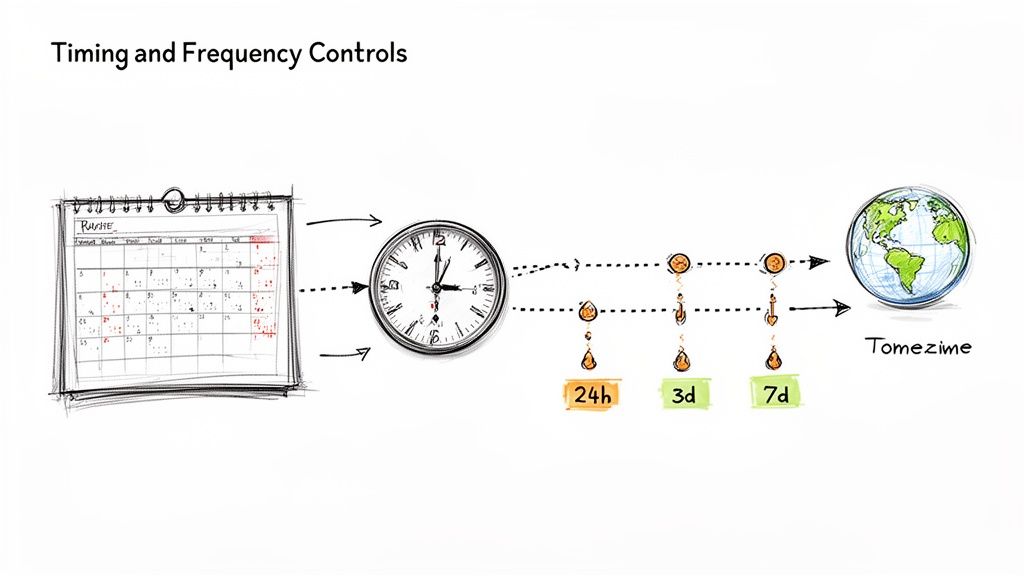
Controlling the cadence of your SMS, voice broadcast, and ringless voicemail drops prevents your audience from feeling overwhelmed. Thoughtful timing respects their schedule, demonstrates professionalism, and dramatically improves response rates.
Proper timing transforms a drip campaign from a random series of messages into a deliberate, persuasive conversation. It allows you to align your outreach with key events in the customer journey, such as a recent purchase, a missed appointment, or an abandoned cart. Sending a follow-up at the right interval keeps your brand top-of-mind and guides the user toward the next step.
Practical Implementation Examples:
Key Insight: Avoid overwhelming your audience by sending multiple message types on the same day. Space out your SMS and ringless voicemail drops to create a multi-channel sequence that feels helpful, not intrusive.
To get started, consider your audience's daily routine. B2B communications often perform best during business hours (9 am to 5 pm), while B2C messages may see higher engagement in the evenings (7 pm to 9 pm). In Call Loop, you can use advanced scheduling to send messages based on the recipient's local time zone, a crucial feature for national campaigns. To see how this works in detail, you can read more on how to schedule text messages for maximum impact.
The most sophisticated automation is ineffective if the message itself fails to connect. Each touchpoint in your drip sequence, from an SMS reminder to a ringless voicemail, must have a clear purpose and provide tangible value to the recipient. Your content should be concise, personalized, and built around a specific, compelling call-to-action (CTA).
This focus on purposeful messaging turns a passive notification into an active engagement opportunity. By crafting content that solves a problem or addresses a need, you build trust and guide contacts toward your campaign's primary goal.
Effective content is the engine of your drip campaign. A well-segmented list gets your message to the right person, but compelling copy is what motivates them to act. The goal is to make the next step obvious and easy, whether that’s confirming an appointment, using a discount code, or calling a sales representative back.
Practical Implementation Examples:
Key Insight: The best message content feels less like marketing and more like helpful communication. Use merge tags like [FirstName] and reference specific details like an [OrderID] or [EventName] to make every message feel personal and relevant.
To write better content, always define the single action you want the recipient to take. Match the tone to the channel: keep SMS conversational, voice broadcasts professional and clear, and ringless voicemail messages concise and personable. Always include required opt-out language (e.g., "Reply STOP to unsubscribe") to maintain compliance.
A powerful drip campaign is more than a series of random messages; it's a carefully choreographed sequence where each touchpoint builds upon the last. The goal is to guide a recipient through a journey, from initial awareness to a final conversion. Thinking of your campaign as a story with a beginning, middle, and end ensures that your messages feel connected and purposeful rather than disjointed.
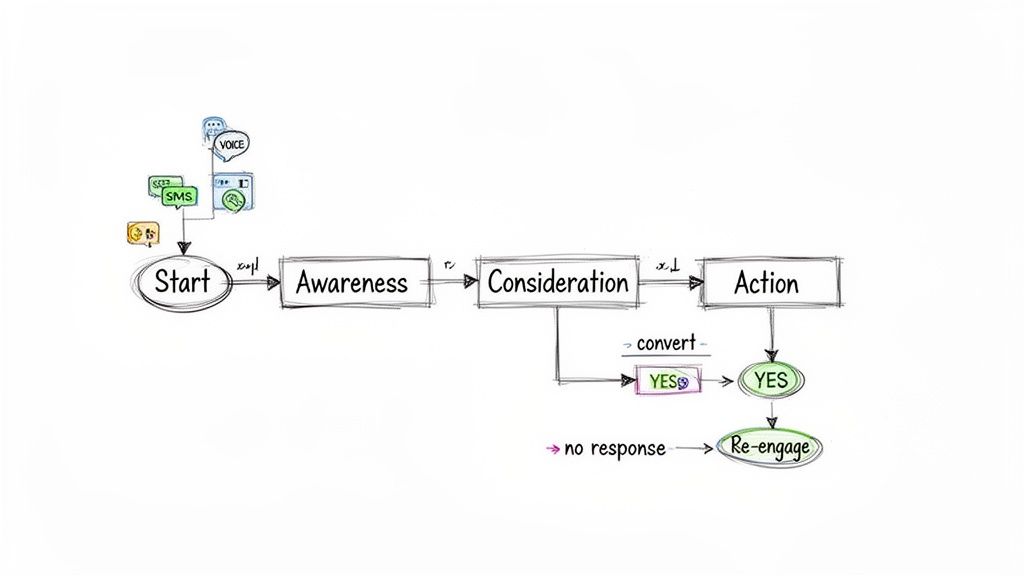
This sequential approach respects the customer's decision-making process. By mapping your messages to funnel stages like awareness, consideration, and action, you provide the right information at the right time, building trust and momentum toward your objective.
A logical flow prevents message fatigue and keeps your audience engaged. Instead of hitting them with a hard sales pitch immediately, you can warm them up with valuable information, handle potential objections proactively, and present your call to action when they are most receptive. This method is central to effective multi-channel drip campaign best practices.
Practical Implementation Examples:
Key Insight: Before building anything in your software, visually map out your entire campaign sequence on a whiteboard or flowchart tool. Define the goal for each step and consider how you will alternate channels like SMS, voice, and ringless voicemail to maintain engagement without being repetitive.
When creating your flow in Call Loop, consider building branches based on recipient actions. For example, if a contact replies "YES" to an SMS, they can be moved to a different sequence designed for interested leads, while non-responders continue on the original path. This dynamic approach makes your automation feel more responsive and personal.
Launching a drip campaign without a firm grasp of legal compliance is like building a house on a shaky foundation. Regulations like the Telephone Consumer Protection Act (TCPA) are not suggestions; they are federal laws with significant financial penalties for violations. Proper opt-in and opt-out management is the cornerstone of a responsible and effective communication strategy, protecting your business and building recipient trust.
Every message you send, whether it’s an SMS reminder, a voice broadcast, or a ringless voicemail, must adhere to strict rules. Honoring these regulations ensures your messages are welcomed rather than reported, preserving your sender reputation and the long-term viability of your campaigns.
Beyond avoiding fines that can reach thousands of dollars per violation, strong compliance practices build a healthier, more engaged contact list. When people know they have given explicit consent and can easily opt out, they are more receptive to your messages. This leads to lower complaint rates, higher engagement, and better overall campaign performance.
Practical Implementation Examples:
Key Insight: Compliance is not a one-time setup; it is an ongoing process. Regularly audit your consent records, stay updated on TCPA guidelines, and ensure your team understands the importance of immediately honoring every single opt-out request.
To begin, always secure express written consent before adding anyone to a drip campaign. In Call Loop, this is simplified with features like keyword opt-ins and built-in DNC list screening. Make sure every SMS campaign clearly states how to unsubscribe, and promptly remove those contacts from all future communication lists.
Relying on a single communication channel means you might be missing a significant portion of your audience. The best drip campaigns meet customers where they are by using multi-channel orchestration: the practice of combining SMS, voice calls, and ringless voicemail into a single, coordinated sequence. This approach accommodates different communication preferences and boosts your chances of making a connection.
Some recipients respond immediately to a text, while others are more likely to listen to a voicemail or answer a direct call. By orchestrating these channels, you can design a campaign that automatically escalates or shifts based on recipient behavior, creating a more persistent and effective outreach strategy.
A multi-channel strategy significantly increases contact rates. If a contact doesn’t respond to an initial SMS, a follow-up voice call or ringless voicemail might be what captures their attention. This layered approach ensures your message isn't just sent but is more likely to be received, which is a key part of drip campaign best practices. It also allows for more nuanced communication, using each channel for its specific strengths.
Practical Implementation Examples:
Key Insight: Start with the least intrusive channel (like SMS) and escalate to more direct channels (like voice calls) based on urgency and customer response. This respects the recipient's time while maximizing your campaign's visibility.
Within Call Loop, you can build these sequences easily. Create a trigger that sends an SMS, then add a delay. If the contact hasn't responded, the next step in the campaign could be a voice broadcast or a ringless voicemail, all managed from a single platform. Test different channel combinations to see what resonates most with your audience segments.
Launching a drip campaign without a plan to measure its performance is like navigating without a map. The most effective campaigns are not set in stone; they are living systems that evolve based on data. The practice of testing, measuring, and optimizing is what separates a good campaign from one that consistently delivers exceptional return on investment. This iterative process ensures your SMS, voice, and ringless voicemail sequences improve over time.
By methodically testing individual elements of your campaign, you can identify what truly resonates with your audience. This data-driven approach removes guesswork, allowing you to make informed decisions that compound your results.
Continuous optimization turns your drip campaigns into a powerful feedback loop. Each message sent provides valuable data on engagement, which you can use to refine your next send. This scientific approach helps you understand audience preferences for message content, timing, channel, and frequency, leading to higher response rates and conversions.
Practical Implementation Examples:
Key Insight: The goal of testing is not to find a single "perfect" message but to build a system of continuous improvement. Test one variable at a time, implement the winner, and then move on to the next element to optimize.
To get started, use Call Loop’s analytics to establish a baseline for your key metrics, such as delivery rate, response rate, and conversions. From there, form a hypothesis (e.g., "Sending a message at 2 PM will get more engagement than at 9 AM") and run a controlled A/B test. Always run tests long enough to gather a statistically significant sample size before drawing conclusions. Document your findings to build a playbook of what works for your specific audience.
A standalone drip campaign can be effective, but its true power is unlocked when it works in concert with your existing business systems. Integrating your SMS, voice broadcast, and ringless voicemail campaigns directly with your CRM or ecommerce platform automates your entire communication workflow. This connection turns your drip sequences into intelligent, responsive systems that react to customer actions in real-time.
This integration eliminates the need for manual list uploads and ensures data is always synchronized. When a lead submits a form, a customer makes a purchase, or a patient books an appointment, the right drip campaign can trigger instantly without any human intervention.
Connecting your tools creates a seamless customer journey. Actions taken in one system, like your CRM, automatically trigger communications in another, like Call Loop. This creates a highly relevant and timely experience for the user and frees your team to focus on high-value tasks instead of data management.
Practical Implementation Examples:
Key Insight: Don't build your drip campaigns in a silo. Map your entire customer journey first, then use integrations to automate the key communication touchpoints. Start with one critical workflow, test it thoroughly, and expand from there.
By connecting your essential business tools, you transform your drip campaigns from static message lists into a dynamic, automated engine for engagement and growth. To see how you can connect your favorite apps, you can review a list of available Call Loop integrations and start automating your workflows today.
A drip campaign’s performance is directly tied to the quality of its underlying data. Sending automated SMS messages, voice broadcasts, and ringless voicemail drops to inaccurate phone numbers or outdated contacts wastes your budget, harms your sender reputation, and can lead to compliance issues. Prioritizing list hygiene is a non-negotiable best practice for maximizing engagement and ROI.
Regular list maintenance involves removing inactive contacts, correcting bad numbers, and deduplicating records. This process ensures your carefully crafted messages reach valid, interested recipients, which improves delivery rates and protects your sender reputation with carriers. Clean data is the engine of any effective outreach strategy.
High-quality data ensures maximum deliverability and efficiency. Every invalid number on your list represents a wasted credit and a missed opportunity. Over time, unchecked lists accumulate bad data, leading to diminished campaign performance and potentially causing carriers to flag your number as spam, which can impact future delivery to valid contacts.
Practical Implementation Examples:
Key Insight: Treat your contact list as a living asset, not a static file. Consistent, scheduled maintenance is far more effective than a massive, infrequent cleanup. Proactive data hygiene saves money and improves results over the long term.
To get started, make number validation a standard step in your import process. Within Call Loop, you can use the built-in number validation tool to check your list before sending a large broadcast, catching bad data proactively. Schedule a monthly or quarterly audit to remove contacts who have not engaged in over six months and to merge any duplicate records. Regularly monitoring your bounce and undeliverable rates will help you spot data quality issues before they become major problems.
We've explored the essential pillars of building high-performing automated outreach, moving beyond simple message blasts to construct strategic, responsive conversations. Mastering these drip campaign best practices is not about finding a single magic bullet; it's about methodically assembling a powerful engine for engagement. It's the difference between shouting into a void and having a productive, one-on-one discussion with thousands of people at once.
The journey begins with a fundamental shift in perspective. Instead of viewing your audience as a monolithic block, you must see them as individuals with distinct needs and behaviors. This is where precise segmentation becomes your most powerful tool. By grouping contacts based on their actions, interests, or lifecycle stage, you lay the groundwork for messages that feel personal and relevant, not robotic and intrusive.
The real value of these strategies emerges when you connect the dots between each practice. A perfectly segmented list is only effective if you deliver the right message at the right time. This is where your multi-channel orchestration and timing controls come into play.
By layering these channels, you create a richer, more resilient communication sequence that respects customer preferences and dramatically increases the likelihood of a response. But this complex dance of timing and channels is meaningless without a clear destination. Every campaign must be anchored to specific, measurable goals, whether it’s driving sales, increasing event attendance, or re-engaging dormant leads.
Perhaps the most critical takeaway is that a "set it and forget it" mentality is the fastest path to failure. The most successful drip campaigns are living, breathing systems that evolve based on data. This is why a commitment to A/B testing, measuring, and optimizing is non-negotiable.
Key Insight: Your first draft of a drip campaign is not the final version; it's the starting hypothesis. Your data will tell you what's working and what isn't. Listen to it.
Are your open rates on a specific email lower than expected? Test a new subject line. Is the click-through rate on an SMS offer disappointing? Adjust the call to action or the timing of the send. Are subscribers dropping off after the third message? Re-evaluate the content and flow of that specific step. This iterative process of refinement transforms good campaigns into great ones. Adhering to compliance rules and maintaining a clean contact list are the operational foundations that make this sustainable growth possible.
Ultimately, adopting these drip campaign best practices is about building a scalable framework for trust. It's about delivering value at every touchpoint and proving to your audience that you understand their needs. By moving from theory to implementation, you can turn automated outreach into your most reliable engine for building relationships and driving consistent, predictable growth.
Ready to put these best practices into motion with a platform built for multi-channel success? Call Loop provides the integrated tools you need to segment audiences, build sophisticated drip campaigns with SMS and ringless voicemail, and track your results, all from one place. Start your free trial of Call Loop today and see how easy it is to build smarter, more effective automated campaigns.
Chris Brisson
Chris is the co-founder and CEO at Call Loop. He is focused on marketing automation, growth hacker strategies, and creating duplicatable systems for growing a remote and bootstrapped company. Chat with him on X at @chrisbrisson


Trusted by over 45,000 people, organizations, and businesses like


