
See a Demo
You're just one step away from seeing Call Loop in action.
Enter your information below to watch a demo right now.

You're just one step away from seeing Call Loop in action.
Enter your information below to watch a demo right now.

Silence doesn't mean ‘no.’ It often means ‘not right now.’ Your initial message is just the opening line in a world of constant digital noise; the real conversation starts with the follow-up. A well-crafted follow up text after no response can be the difference between a missed opportunity and a closed deal, a confirmed appointment, or a lifelong customer.
But what should you say? How long should you wait? And how do you avoid being annoying? This guide moves beyond guesswork and provides a playbook of field-tested follow-up templates designed for sales, appointments, events, and more. You will get specific, replicable strategies for each scenario, showing you not just what to send but explaining the strategic why behind the message.
We will break down seven distinct follow-up methods, analyzing the psychology that makes each one effective. You'll learn how to pair your texts with other channels, like a strategically timed ringless voicemail drop, to create a persistent yet professional outreach sequence. To maximize the impact of your text follow-ups, it's crucial to adhere to proven strategies like those outlined in SMS Marketing Best Practices to ensure effectiveness and maintain engagement. This article provides the tools you need to turn radio silence into meaningful conversations and, ultimately, measurable results. Let's get started.
This classic approach is a workhorse for a reason: it’s direct, respectful of the recipient's time, and incredibly effective. When you need a follow up text after no response, this method cuts through the noise by combining a gentle nudge with a simple, closed-ended question. It’s perfect for busy people who may have seen your first message but got distracted before they could reply.
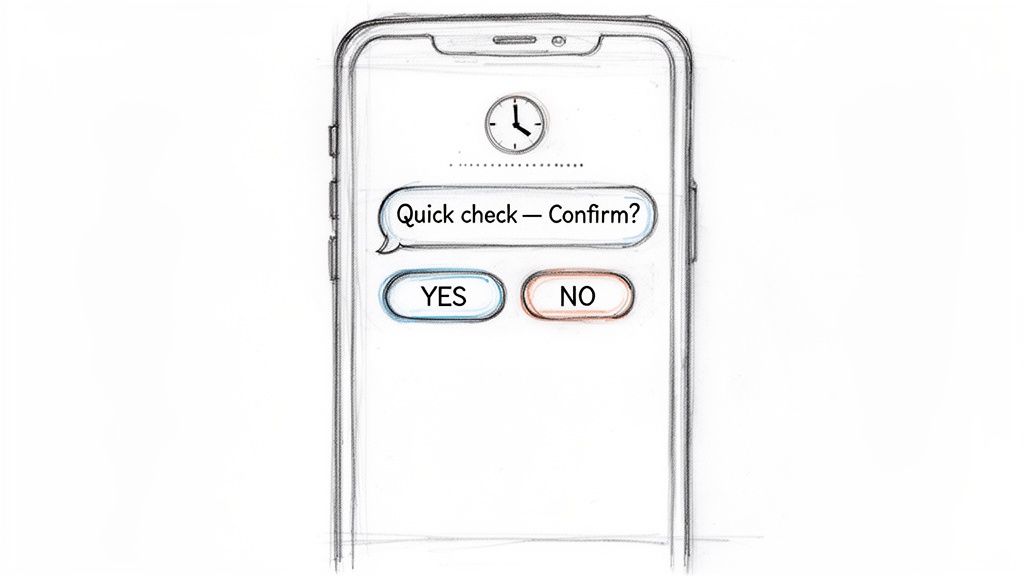
The core principle is to lower the barrier to response. Instead of asking someone to type out a full sentence or make a complex decision, you give them an effortless way to engage, often with a single word. This simplicity makes it easy for them to reply and gives you the clear data you need to take the next step.
The power of this technique lies in its adaptability across different business contexts. It's not just a single template, but a framework for getting a clear signal from your audience.
Healthcare Appointment Confirmation:
Hi [Patient Name], this is a reminder for your appointment with Dr. Smith on [Date] at [Time]. Please reply CONFIRM to keep your slot or RESCHEDULE to change it.Sales Lead Qualification:
[Prospect Name], following up on the proposal we discussed. Is solving [pain point] still a priority for you this quarter? A simple YES or NO is fine.Event & Webinar Attendance:
Hey [Name]! Quick question: are you still planning to join the webinar on [Topic] tomorrow? Reply YES, NO, or MAYBE.To get the most out of this follow up text after no response, timing and structure are key.
Reply STOP to unsubscribe. This is a legal requirement and builds trust.When a first message goes unanswered, simply repeating the request can feel nagging. The Value-Add approach sidesteps this pitfall by introducing a new piece of information or benefit, giving your contact a fresh reason to engage. This follow up text after no response isn't a reminder; it's a new opportunity that shifts the dynamic from a simple check-in to a helpful update.
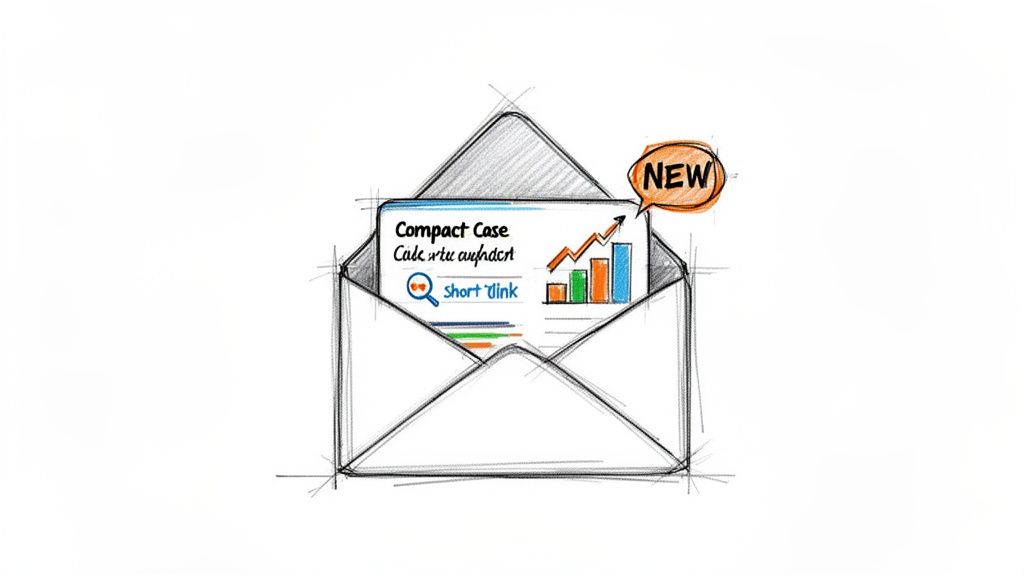
The strategy here is to re-ignite interest by adding something concrete to the conversation. Instead of asking "did you see my message?", you're saying "here's something else that might interest you." This method respects the recipient's silence while demonstrating that you're still thinking about their needs and are prepared to offer more value. It’s a powerful technique popularized by consultative sales teams and content marketers who understand that building relationships is about giving, not just taking.
This technique shines when you can connect a new benefit directly to the recipient’s potential interest. It transforms a cold lead into a warm conversation by providing timely, relevant information.
Sales Prospect Nurturing:
Hi [Name], I was thinking about our chat on [Topic] and thought you'd find this interesting. We just published a case study showing how [Similar Company] cut costs by 30% using our platform. See it here: [tracked-link]Local Business Promotion (Karate Studio):
Sensei John here from Premier Martial Arts. For this week only, all new members get a FREE uniform ($60 value). We have classes starting at [Time]. Reply SCHEDULE to book a trial!Healthcare Appointment Scheduling:
Good morning, this is the office of Dr. Evans. To better serve our patients, we've just added new evening appointment slots. Would [Date] at 6:30 PM work for your check-up?To make your value-add follow-up feel authentic and drive action, focus on relevance and delivery.
This strategy moves away from direct questions and instead aims to spark a recipient's natural curiosity. When a standard follow up text after no response isn't working, this method uses an intriguing statement or an open-ended question to create a "knowledge gap." It's a powerful technique, popularized by direct mail experts and modern growth hackers, that compels someone to click or reply simply because they need to know the answer.
The underlying principle is to break the recipient's pattern of ignoring messages. By presenting something unexpected or incomplete, you create a psychological pull that a straightforward reminder lacks. The goal isn't just to get a response; it's to re-engage an otherwise cold contact by making them want to take the next step.
This approach is highly versatile but requires a delicate touch. It must deliver on the promise it creates, providing genuine value to maintain trust.
Ecommerce Cart Abandonment:
Quick question about your cart: what's the one thing that would make you complete your order today? Let me know, I might be able to help. [link]Sales Prospect Nurturing:
[Prospect Name], we just published a short guide on what top firms in [Prospect's Industry] are doing to cut costs. Worth 2 mins? [link]Event & Webinar Promotion:
You won't believe who just confirmed they're speaking at our [Date] webinar. See the final lineup and grab your spot: [link]To successfully use curiosity, you must align the hook with the payoff.
Glad you saw the lineup! The session with [Surprise Speaker] will be great. Hope you can make it.This advanced strategy moves beyond a single follow up text after no response and into a coordinated sequence across multiple communication channels. It’s an orchestrated campaign that uses SMS, ringless voicemail, voice calls, and email in a predefined order to create multiple touchpoints without overwhelming the contact. This method acknowledges that people have channel preferences; some ignore texts but listen to voicemails, while others delete emails but respond to calls.
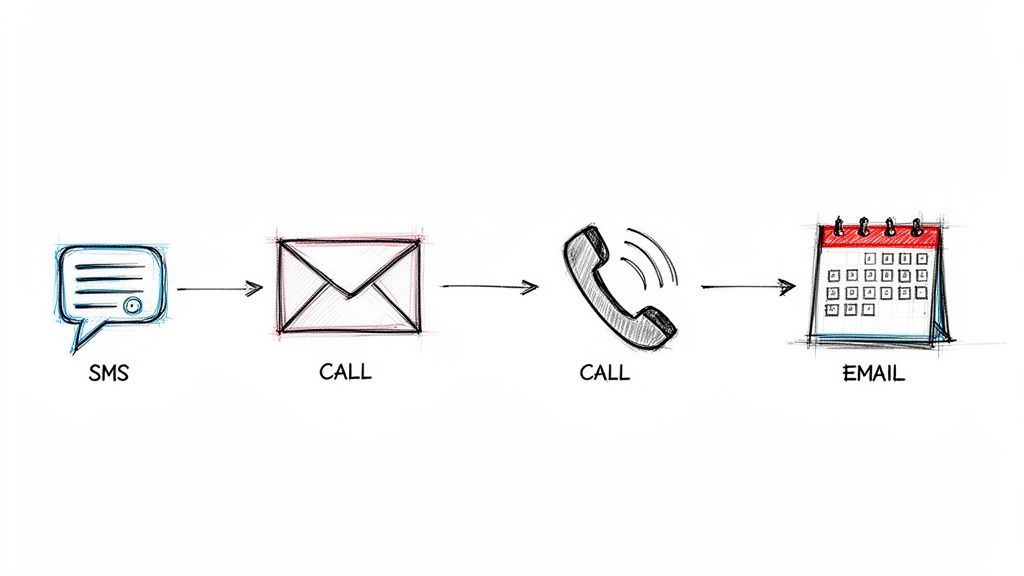
The core idea is to build a persistent, yet respectful, presence. By sequencing different message types over several days, you increase the odds of connecting with your audience on their preferred platform at the right time. This is a common practice among top-performing B2B sales teams and healthcare providers who need to ensure critical messages are received. Keywords like "ringless voicemail drop" and "voice broadcast" are central to this strategy, as they offer scalable ways to add a human touch to automated outreach.
An effective multi-channel sequence is more than just random outreach; it's a story told across platforms. Each touchpoint builds on the last, guiding the contact toward a specific action.
Healthcare Appointment Sequence:
High-Value Sales Cadence:
Event Promotion Drip:
To execute this strategy, you need precise timing and thoughtful channel selection. A poorly designed sequence can feel like spam, but a well-designed one feels like helpful, persistent service.
This technique taps into fundamental human psychology: our desire to be part of a group and our fear of missing out (FOMO). When a standard follow up text after no response isn't getting traction, introducing social proof or scarcity can create the urgency needed to prompt a decision. It shows the recipient that others are taking action and that the opportunity is limited, encouraging them to act before it's too late.
The strategy here is to shift the conversation from "should I do this?" to "I might miss out if I don't do this now." By providing concrete evidence of popularity or limited availability, you build credibility and make your offer more desirable. It's a powerful way to re-engage a contact who has gone silent, giving them a compelling new reason to reply.
This approach is highly effective in contexts where perceived value and popularity influence buying decisions. It's about more than just creating urgency; it’s about validating the recipient's initial interest with proof that others share it.
Ecommerce Cart Abandonment:
Hi [Name], looks like you left the Hyper-Flex Sneakers in your cart. Just a heads up, 47 people have bought this style today and we're down to the last 12 in your size. The 20% off sale ends tonight: [Link]Event & Webinar Registration:
[Name], quick note on the SEO Masterclass webinar. Over 93% of last month's attendees rated it 5 stars. We only have 15 seats remaining for Thursday's session. Secure your spot here: [Link]Local Service & Class Enrollment (e.g., Karate Studio):
⭐ [Name], we've had 8 new students join our adult Karate program this month! We now have just 3 spots left for the current term. Reply YES to reserve your spot and we'll call you to finalize.To make this follow up text after no response feel authentic and not overly aggressive, precision and honesty are essential.
This advanced technique moves beyond a simple reminder and demonstrates deep customer empathy. When you send a follow up text after no response, this method proactively identifies and addresses the most likely reason for the silence. It’s built on the idea that silence often isn't a "no," but a "not yet" blocked by a specific objection like cost, timing, or confusion.
The strategy here is to show you understand the prospect's hesitation and are ready to help them overcome it. By acknowledging a potential problem and immediately offering a solution or an alternative path, you lower the barrier to re-engagement and transform a dead end into a new conversation. This approach is highly effective in consultative sales and for high-value products where prospects need more than just a nudge.
This method requires a bit more insight into your audience, but the payoff is a significantly higher response rate from otherwise stalled leads. It shows you’re a problem-solver, not just a seller.
High-Ticket Sales:
Hi [Prospect Name], sometimes when I don't hear back it's because the price is a concern. If that's the case, we do have flexible payment options. Interested in a brief chat about it? Reply TALK.Ecommerce Abandoned Cart:
[Name], noticed you left the [Product Name] in your cart. If you have questions about sizing or shipping, I'm here to help! Just reply HELP and our team will get back to you.Local Service/Membership (Karate Studio):
Hey [Name]! Following up on your interest in our classes. If you're worried about the commitment, how about a free trial week, no contract required? Reply YES to claim it.To execute this follow up text after no response effectively, you need to anticipate your audience's mindset.
I know [objection] was a concern... is incredibly powerful.CALL, a TRIAL, or PRICING let the user choose their preferred next step.Reply STOP to end messages.This advanced method moves beyond simple reminders to build genuine rapport and respect for the recipient's preferences. It's a two-part strategy that combines research-backed personalization with a clear, permission-based approach to communication. This is the ideal follow up text after no response for building long-term relationships, as it shows you've done your homework and value the contact's inbox.
The core idea is to first establish a specific, personal connection and then empower the recipient to control how and when they hear from you. By offering "opt-down" choices (like receiving fewer messages) instead of a binary opt-out, you can retain contacts who are interested but overwhelmed, all while reinforcing trust and maintaining compliance.
This technique shines in regulated industries and high-value sales, where trust is a critical asset. It demonstrates professionalism and a client-first mentality.
High-Value B2B Sales:
Hi [Prospect Name], saw the news about your promotion to [New Title] on LinkedIn, congrats! Is this still a good time to discuss the [Project] proposal? Reply CALL for a quick chat.Healthcare & Patient Communication:
Hi [Patient Name], this is [Clinic Name]. To make sure you get important updates, please let us know how you prefer we contact you. Reply EMAIL, PHONE, or SMS. Reply STOP to opt out of all messages.Ecommerce & Subscription Services:
Hey [Customer Name], are our deals hitting your inbox too often? You can adjust your message frequency here: [preference-link] or just reply LESS to get only our biggest monthly deals.To execute this strategy effectively, you need a system that can manage personalization and preferences at scale.
Reply STOP. This is a legal requirement (TCPA) and a fundamental part of building trust with your audience.| Follow-up Type | Implementation complexity | Resource requirements | Expected outcomes | Ideal use cases | Key advantages |
|---|---|---|---|---|---|
| The Soft Reminder & Direct Question Follow-up | Low | Minimal copy and simple automation | Quick binary responses, high open rates | Appointment confirmations, quick sales checks, busy recipients | Low friction, high deliverability, preserves relationship |
| The Value-Add Follow-up | Medium | Content creation, link tracking, some personalization | Increased engagement, higher perceived value, better qualification | Sales, healthcare, marketing agencies, ecommerce | Adds new relevance, reduces spam perception, improves conversions |
| The Curiosity-Driven Follow-up | Medium | Strong copywriting, tracking links | Higher open and click rates, drives site visits | Ecommerce, events, SaaS, growth campaigns | Differentiates messaging, boosts clicks and engagement |
| The Multi-Channel Orchestrated Follow-up | High | Multiple channel tools, integrations, higher budget | Significantly higher engagement and response rates | Healthcare, enterprise sales, events, customer success | Cross-channel reinforcement, fits varied preferences, unified analytics |
| The Social Proof and FOMO Follow-up | Medium | Verified metrics, dynamic content, timers | Faster conversions for time-sensitive offers | Ecommerce, events, promotions, limited-offer sales | Leverages credibility and urgency to drive action |
| The Problem-Acknowledgment Follow-up | Medium | Segmentation, objection-handling assets, personalization | Reopens dialogue, reduces barriers, improves lead fit | B2B consultative sales, services, SaaS | Directly addresses objections, converts hesitant prospects |
| The Personal Connection & Permission-Based Follow-up | High | CRM integration, research, preference management | Higher-quality responses, stronger long-term engagement | High-value sales, healthcare, finance, regulated industries | Deep personalization, respects preferences and compliance |
We've explored a powerful arsenal of strategies for your follow up text after no response, moving far beyond simple, generic nudges. From the directness of the Soft Reminder to the strategic patience of the Multi-Channel Orchestrated Follow-up, each technique serves a specific purpose. You now have the templates and the timing guidance to re-engage prospects, confirm appointments, and close sales without coming across as pushy or desperate.
The true takeaway, however, is not just about having a list of messages. It's about understanding the psychology behind each one. Mastering the follow-up means recognizing when to add value, when to spark curiosity, and when to simply ask for permission to continue the conversation.
Having the perfect templates is a critical first step, but the real power comes from turning these individual tactics into a cohesive, automated system. Manually tracking every lead, every appointment, and every purchase to determine who needs a follow-up, when they need it, and which message to send is an impossible task that invites human error. This is where a multi-channel platform becomes your most valuable asset.
By building the seven strategies from this guide into automated sequences, you create an intelligent system that works for you 24/7. This system doesn't just send messages; it orchestrates conversations at scale.
Strategic Insight: Automation is not about removing the human touch; it's about scaling it. A well-designed sequence ensures every single person receives the right personalized message at the right moment, a feat impossible to achieve manually.
Relying on a single channel like SMS limits your reach. People have different communication preferences. An effective follow-up strategy meets them where they are most likely to engage.
This is why combining SMS with other channels is so effective:
Imagine a new sales lead comes in. An automated campaign can instantly send your initial text. If there’s no response after 48 hours, the system can automatically drop a personalized ringless voicemail. A day later, a final follow up text after no response can be sent, offering one last piece of value. This is the essence of turning strategy into action.
By combining smart automation, multi-channel sequencing, and the proven templates in this guide, you can finally conquer the communication gap. You will build stronger relationships with your audience, save countless hours, and ensure no valuable opportunity ever slips through the cracks again.
Ready to stop chasing leads and start building automated conversations? With Call Loop, you can easily create the multi-channel sequences we've discussed, blending SMS, ringless voicemail, and voice broadcasts into powerful follow-up campaigns. See how it works and start turning silence into sales by visiting Call Loop today.
Chris Brisson
Chris is the co-founder and CEO at Call Loop. He is focused on marketing automation, growth hacker strategies, and creating duplicatable systems for growing a remote and bootstrapped company. Chat with him on X at @chrisbrisson


Trusted by over 45,000 people, organizations, and businesses like


