
See a Demo
You're just one step away from seeing Call Loop in action.
Enter your information below to watch a demo right now.

You're just one step away from seeing Call Loop in action.
Enter your information below to watch a demo right now.

If your ecommerce sales have hit a wall, you’re in good company. The knee-jerk reaction for many is to just crank up the ad spend, but that’s a fast track to diminishing returns and sky-high customer acquisition costs.
There's a much smarter way to grow.
Instead of chasing one-off tactics, we're going to walk through a systematic, multi-faceted blueprint that optimizes every single stage of your customer's journey. It’s about making small, strategic improvements that stack up into massive revenue gains over time.
This guide isn't about generic advice; it's a battle-tested roadmap built on five core growth pillars. Think of it as a diagnostic tool. This framework will help you pinpoint the weak spots in your funnel and give you proven strategies to build a more profitable and resilient operation.
To really move the needle, you have to look at your business holistically. Just focusing on traffic while your conversion rate is leaking is like trying to fill a bucket with a hole in it. Real, sustainable growth happens when you strengthen the entire system.
The flowchart below shows how these five stages work together.
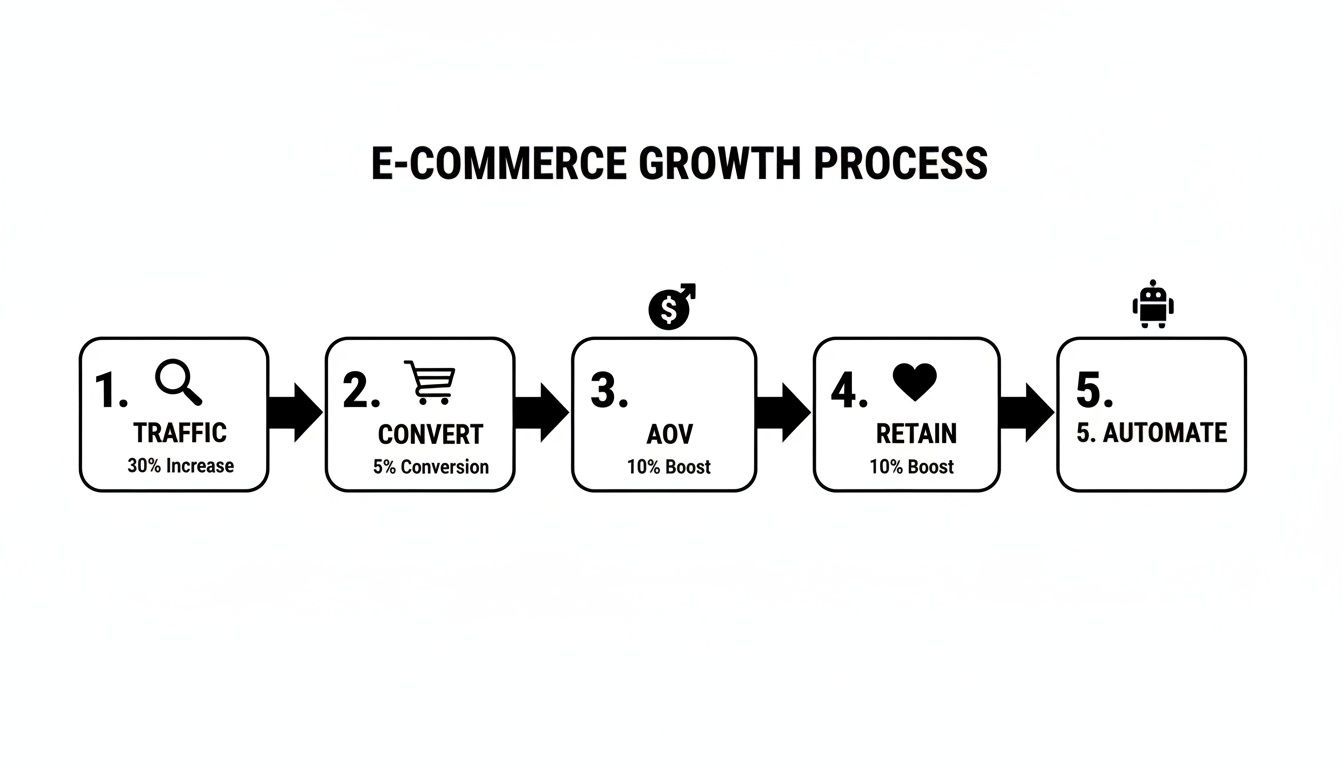
As you can see, growth isn't a straight line—it's a continuous loop. When you nail retention and automate your communication, you're actually feeding the top of your funnel by creating brand advocates and freeing up resources to acquire new customers more efficiently.
Here’s a quick look at the core strategies we're about to break down. This table sums up the game plan.
When you get these five areas dialed in, you create a powerful growth engine for your store. Each pillar reinforces the others, creating a compounding effect that drives predictable revenue and builds real, long-term customer relationships.
Now, let's dive into each one with actionable steps, real-world examples, and the KPIs you need to be tracking.
It’s a classic trap: pouring money into ads just to see your website visitor numbers go up. Raw traffic looks great on a report, but it means next to nothing if those visitors have zero interest in what you’re selling. The real way to boost ecommerce sales is to start by attracting high-intent traffic—people who are actively looking for the exact solution your products offer.
Think about it like this. Would you rather have 10,000 random people wander past your physical storefront, or 100 people who walked in because they know they need what's on your shelves? That second group is where the money is. Your digital strategy needs to do the same thing: focus on quality over sheer quantity.
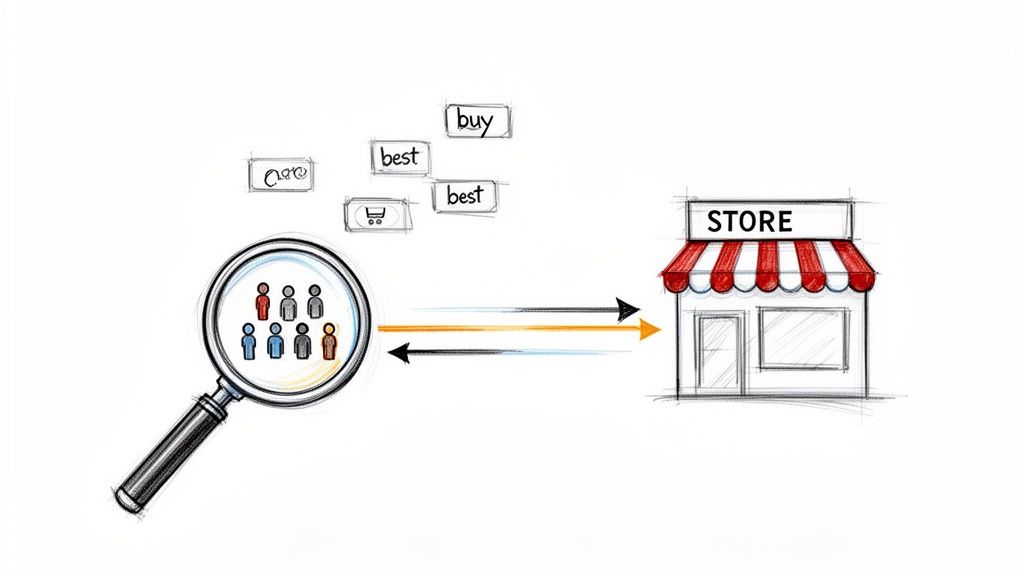
Making this shift starts with understanding the language your customers use. Stop guessing. It's time to dig into the exact phrases they’re typing into Google when they're ready to pull out their wallets.
Good keyword research isn't about finding the most popular terms; it’s about uncovering phrases that scream, "I want to buy something!" These are almost always longer, more specific queries. For instance, trying to rank for "running shoes" is a brutal, uphill battle that attracts a super broad audience. But targeting "best waterproof trail running shoes for women"? Now you’re talking to a user with a very specific need.
Here’s how to find these golden keywords:
Once you’ve got a solid keyword list, it's time to put it to work where it really counts. For a deeper dive into the fundamentals, you can check out this beginner’s guide to winning the SEO game without going crazy.
One of the biggest mistakes I see is businesses optimizing only their homepage. The real power is in meticulously optimizing individual product pages, category pages, and blog posts for long-tail keywords that are hyper-relevant to each specific offer.
Having the right keywords is only half the battle. Your content has to satisfy search engine algorithms and actual human beings. A product description stuffed with keywords but lacking any personality or persuasive punch simply won't convert.
Organic traffic is a fantastic long-term asset, but paid advertising can deliver results right now—if you do it right. The key is to ditch the broad, scattergun campaigns. Instead, laser-focus on retargeting and building lookalike audiences.
Retargeting campaigns are your secret weapon. They let you show ads specifically to people who have already visited your site, checked out a product, or even abandoned their cart. This is your warmest possible audience. You could even use ringless voicemail drops to follow up with leads who gave you a phone number but didn't finish their purchase, delivering a personal, non-intrusive nudge.
Lookalike audiences, on the other hand, put your existing customer data to work. Ad platforms like Facebook and Google analyze the traits of your best customers and then find new people with similar interests and behaviors. This dramatically improves your ad targeting and lowers your customer acquisition costs, ensuring a steady stream of qualified buyers comes your way.
Getting traffic to your store is just the first lap of the race. The real win, the part that actually grows your business, is convincing those visitors to pull out their wallets. This is where Conversion Rate Optimization (CRO) becomes your secret weapon, focusing on creating a seamless and trustworthy experience that guides people from browsing to buying.
A high-converting website feels effortless. Think of it like a perfectly organized retail store where you instantly find what you need, get your questions answered, and check out without a single moment of frustration. Every element, from your product pages to your final checkout button, has to be designed with this frictionless goal in mind.
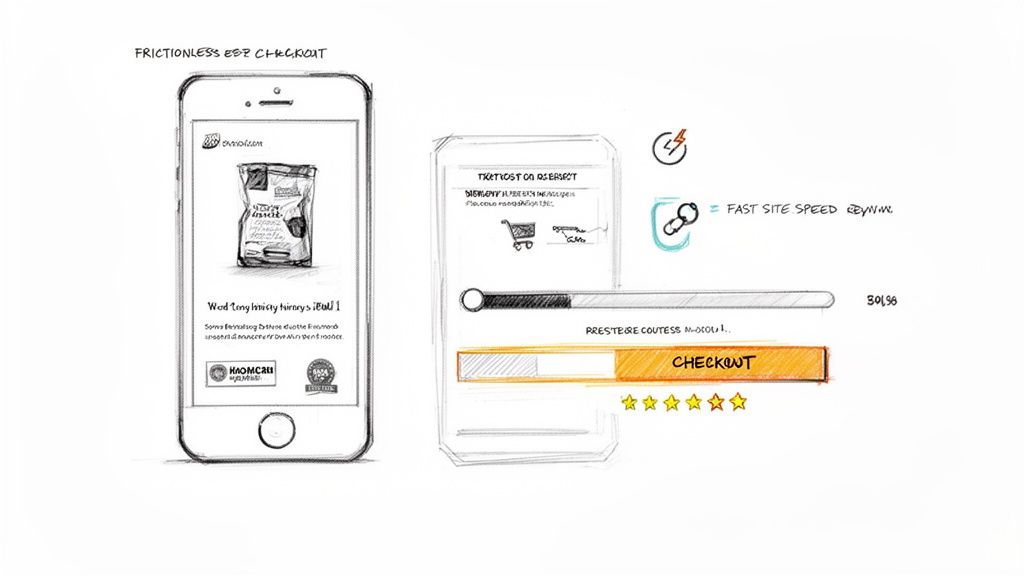
The process starts by hunting down every potential roadblock your customers might hit. To get this right, you have to consistently work to improve ecommerce conversion rates by dialing in your product pages and overall user experience.
Your product page is your digital salesperson. Its one and only job is to convince a potential customer that your product is the solution they’ve been looking for. A weak product page is often the number one reason a solid traffic strategy falls flat.
Let's start with your visuals. People can't touch or feel your products online, so high-resolution images from every conceivable angle are non-negotiable. Even better, add a short video showing the product in action; this one simple move can send your "add to cart" rates soaring.
But great visuals are only half the battle. Your copy needs to connect on an emotional level.
Cart abandonment is the silent killer of ecommerce revenue. You’ve done all the hard work to get a customer to the finish line, only for them to vanish into thin air. The usual culprit? A clunky, confusing, or surprising checkout process.
Your mission is to make checking out so simple it's practically automatic. Kill every unnecessary field and step. Offer guest checkout as the default—forcing someone to create an account is a notorious conversion killer. And be completely transparent about all costs, especially shipping, right from the start.
A surprise shipping fee at the final step is the fastest way to lose a sale. Customers see it as a breach of trust, and a shocking 48% of shoppers abandon carts because extra costs are too high.
The shift to mobile commerce isn't coming; it's already here and it's massive. Smartphones are now driving nearly 80% of retail website visits globally and generating the majority of orders. With global e-commerce hitting $6.88 trillion, treating mobile as an afterthought is a surefire way to get left behind.
A "mobile-friendly" site that’s just a shrunken-down version of your desktop experience won’t cut it anymore. You need a mobile-first design, built from the ground up for the small screen. That means big, easily tappable buttons, simple navigation, and forms that don't make you want to throw your phone across the room.
Site speed is everything here. A site that takes more than three seconds to load on mobile will see visitors bounce in droves. Every single second you can shave off your load time translates directly into more sales. A fast, intuitive mobile experience isn't a competitive advantage anymore; it's the bare minimum.
Acquiring new customers is a grind. It's expensive and time-consuming. The real secret to profitable growth? Getting more value from the customers you already have.
This is where two of my favorite metrics come into play: Average Order Value (AOV) and Customer Lifetime Value (LTV). When you focus on getting each customer to spend a little more per transaction, and then keep them coming back over the long haul, you build a much healthier, more resilient business.
Learning how to increase ecommerce sales isn’t just a traffic game. It's about making every conversion count for more. This process kicks in the second a customer lands on a product page, giving you the perfect chance to guide them toward a bigger, better purchase.
Upselling and cross-selling are classics for one simple reason: they flat-out work. The trick is to make your recommendations feel like you're genuinely helping, not just pushing more products. An upsell nudges them toward a better version of what they're looking at, while a cross-sell suggests a complementary item that makes their main purchase even better.
Let's say a customer is looking at a standard digital camera on your site.
Timing and relevance are everything. Don't just bombard them with random products. Use your data to show items that other customers frequently bought together. To really dial this in, it's worth digging into some proven strategies to increase Average Order Value on Shopify and make sure every sale is working harder for you.
Another fantastic way to bump up that AOV is by bundling products. Instead of making customers buy items one by one, group related products into a convenient package, usually with a small discount to sweeten the deal. This move not only feels like a great value for the customer but also makes their shopping experience a whole lot easier.
Think of a skincare brand. They could bundle a cleanser, toner, and moisturizer into a "Complete Morning Routine" kit. Suddenly, you're solving a bigger problem for the customer and naturally increasing the size of their cart. If you want to get really sophisticated with this, you can check out our guide on real-world customer segmentation examples to create bundles that are hyper-targeted to specific customer groups.
Bundling just clicks with shoppers. It hits on the psychology of convenience and value. They feel like they're getting a curated solution and a good deal, which removes the headache of hunting down and adding multiple items to their cart.
Your job isn't over when they click "buy." Far from it. The post-purchase experience is your golden opportunity to turn a one-time sale into a long-term relationship, which is how you dramatically increase Customer Lifetime Value.
A thoughtful thank-you email and proactive shipping updates are table stakes. A quick follow-up to make sure they're loving their order goes a long way, too. But you can also use this moment for a well-timed post-purchase upsell. Offer an exclusive, time-sensitive discount on a related item that they can only claim right after their initial purchase.
Better yet, think outside the inbox. Consider a follow-up using ringless voicemail. A week after their product arrives, you could drop a pre-recorded message into their voicemail, personally thanking them for their purchase and offering a special "welcome back" discount code. It's a personal touch that's far more memorable than another email, encouraging them to return and solidifying their loyalty to your brand.
Your most profitable customer is the one you already have. Hands down. While everyone obsesses over new traffic, the real secret to sustainable growth is hiding in your retention numbers. It costs a lot less to bring a current customer back than to chase down a new one.
This is where you graduate from relying solely on email and start building a powerful, multi-channel automation machine. The goal? To keep your brand top-of-mind and drive consistent repeat sales without you lifting a finger every time.
Think of it as creating a direct, personal line to your best customers. Email is a workhorse, for sure, but inboxes are crowded battlegrounds. By layering in more immediate channels like SMS, voice, and even ringless voicemail, you build a communication system that actually cuts through the noise and gets people to act. This is how you learn how to increase ecommerce sales predictably.

This isn’t about blasting your audience from all sides. It's about being smart—sending the right message on the right channel at the perfect moment. Each one has a specific job in your retention toolkit.
When you need to get a message seen right now, SMS is your tool. With open rates often clearing 95%, text messages are practically guaranteed to be read within minutes. This makes them absolute gold for any campaign that relies on urgency.
Here are a few high-impact ways we see brands using SMS automation:
Globally, the average cart abandonment rate is a staggering 70%. But here's the kicker: businesses that use automated SMS reminders are seeing recovery rates jump by up to 25%. Research shows SMS cart recovery campaigns hit a 41% open rate and pull in 5-10% conversion rates, crushing email's typical 2-3%.
SMS is perfect for quick, transactional messages, but voice adds a distinctly human touch that text can't replicate. It’s a fantastic way to make a big announcement feel more personal and important.
Imagine launching a major new product line. Instead of just another email, you could send a pre-recorded voice broadcast from your founder to your top VIP customers. That makes an impact.
For a more subtle approach, there’s ringless voicemail. This tech is slick. It lets you drop a pre-recorded audio message directly into someone's voicemail box without their phone ever ringing. It’s not intrusive, feels incredibly personal, and is perfect for follow-ups that don’t need an immediate reply.
Ringless voicemail is a game-changer for post-purchase follow-ups. Picture a customer getting a personal 'thank you' message from your founder a week after their order arrives, maybe with a special discount code for next time. That’s an experience they'll remember and tell their friends about.
The real magic happens when you stop looking at these channels as separate tools and start orchestrating them into coordinated campaigns. A smart automation flow can escalate your communication based on how a customer engages, making sure your message gets seen without being annoying.
Here’s a real-world example of a win-back campaign for a customer who hasn't bought anything in 90 days:
This tiered strategy respects the customer's inbox while strategically dialing up the urgency and personal touch at each step. By integrating these tools, you build an automated system that not only recovers potentially lost customers but also deepens loyalty and drives the repeat purchases that are the lifeblood of any thriving ecommerce brand. For more on this, check out our guide on building an effective multi-channel communication strategy.
When you're trying to grow your revenue, it's easy to get bogged down. The same questions tend to pop up for most ecommerce teams, and getting a clear answer can be the difference between spinning your wheels and moving forward.
Let's cut through the noise and tackle some of the most common questions we hear.
If you're looking for an immediate impact, zoom in on two things: recovering abandoned carts and dialing in your product pages.
An automated SMS cart recovery sequence is often the fastest path to clawing back lost revenue. Think about it: text messages have an insane open rate, somewhere near 98%. A lot of shoppers don't bail on purpose; they just get distracted. A simple, well-timed text is all it takes to bring them back.
At the same time, give your product pages some love. This can provide a near-instant lift. Add high-quality images and video, make sure your customer reviews are front and center for social proof, and check that your call-to-action button is impossible to miss. These aren't huge projects, but they directly tackle hesitation and can boost your conversion rate in days.
Don't ever underestimate the power of a single, well-timed SMS. A simple message like, "Did you forget something? Your cart is waiting!" can recover a surprising amount of otherwise lost sales, making it one of the highest ROI activities you can implement.
This is a big one, and the answer is simple: permission and value. Always.
Never, ever add a customer to a list without their explicit opt-in. That's rule number one. Once you have their consent, every single message you send needs to be genuinely useful or exciting for them.
Use SMS for time-sensitive stuff they'd actually want, like a flash sale alert, a back-in-stock notification for a product they were eyeing, or shipping updates. Save the less frequent, more personal channels like a voice broadcast or ringless voicemail for major announcements or VIP offers that feel truly special.
When customers know you respect their inbox (and their phone), you build trust. When you just blast them with noise, you create annoyance. It's that simple.
Looking at total revenue is great, but it's just the final score. It doesn't tell you how you won the game. To get the full story of your store's health, you need to watch a handful of key performance indicators (KPIs) together.
Tracking these metrics gives you a complete dashboard for your business. It shows you what’s really working and points you directly to the strategies that are driving sustainable, meaningful growth.
Ready to scale your customer outreach and drive more sales with powerful automation? Call Loop makes it easy to create and manage multi-channel campaigns using SMS, voice, and ringless voicemail. Start engaging your customers today.
Chris Brisson
Chris is the co-founder and CEO at Call Loop. He is focused on marketing automation, growth hacker strategies, and creating duplicatable systems for growing a remote and bootstrapped company. Chat with him on X at @chrisbrisson


Trusted by over 45,000 people, organizations, and businesses like


