
See a Demo
You're just one step away from seeing Call Loop in action.
Enter your information below to watch a demo right now.

You're just one step away from seeing Call Loop in action.
Enter your information below to watch a demo right now.

82% of consumers read their text messages within five minutes, and ecommerce marketers generate about $71 for every $1 spent on SMS marketing according to Notifyre's SMS marketing statistics roundup. That's why international texting deserves more respect than it usually gets.
Most guides stop at delivery. They treat an international text messaging service like a megaphone. Send the message, hope it lands, move on.
That's not how strong global outreach works.
If you're texting customers, leads, patients, registrants, or members across borders, a core challenge is building a conversation. That means choosing routes that can deliver, sender identities that people recognize, reply paths that don't break, and follow-up systems that combine SMS with voice and ringless voicemail when a text alone won't close the loop. In practice, the best global programs don't rely on a single channel. They use SMS for speed, voice for urgency, and ringless voicemail for non-disruptive follow-up that still feels personal.
Global mobile reach is already there. The growth opportunity comes from turning that reach into two-way customer conversations that move deals, bookings, renewals, and support cases forward.
That distinction matters. Plenty of teams can send an international text. Fewer can receive replies reliably, route them to the right team, recognize the sender, and follow up in a way that fits local expectations. A message delivered without a workable reply path is closer to a notification than a conversation.
SMS earns its place because it removes friction at the start. Customers do not need to download an app, create a login, or learn a new interface. The message arrives in a channel they already use on the phone they already carry. For global programs, that makes SMS a practical first touch for appointment reminders, order updates, lead follow-up, payment prompts, and support outreach.
The business value shows up after the send.
A strong international text messaging service helps companies keep the exchange going across borders. That means using sender identities customers recognize, setting up reply-capable numbers where regulations and carriers allow it, and connecting inbound messages to the CRM or support queue instead of leaving them stranded in a dashboard. In many markets, that setup starts with the right virtual phone number for business texting and replies.
International growth usually breaks at the handoff points. A prospect gets the text but cannot reply. A customer responds, but the message routes to the wrong inbox. A local carrier rewrites or blocks the sender ID, so the recipient treats it as suspicious. None of those failures show up if you only measure sends.
That is why SMS works best as part of a conversation system, not a broadcast tool. Text can open the loop fast. Voice can handle urgency or high-value cases. Ringless voicemail can support follow-up without creating another live call attempt. Used together, those channels cover more real-world situations than SMS alone.
A common mistake is treating global texting like domestic SMS with a country code added.
International messaging has more moving parts. Carrier routing differs by country. Sender IDs are not handled the same way everywhere. Inbound messaging may work in one market and fail in another. Compliance rules also shape what you can send, when you can send it, and how opt-outs must be handled.
The upside is still strong, but the winning approach is practical. Build for replyability, recognition, and follow-through from the start. If your international texting setup cannot support a real exchange, it will limit revenue even when delivery looks good on paper.
Think of an international text messaging service like a global postal operation for business messaging.
A personal text from your phone is like mailing a handwritten note to one person. Business texting is different. It's more like shipping thousands of time-sensitive parcels through customs, regional hubs, local delivery partners, and country-specific labeling rules. If any piece is wrong, delivery slows down or fails.
P2P messaging means person-to-person texting. That's what happens when one individual messages another from a normal handset.
A2P messaging means application-to-person texting. A platform, CRM, scheduling tool, or messaging app sends the message on behalf of a business. That's the category most companies need when they send reminders, promotions, support updates, alerts, or onboarding sequences.
The distinction matters because carriers treat business traffic differently. They expect clearer sender identity, more consistent compliance, and better handling of opt-ins and opt-outs.
Here's the practical view:
| Type | Best for | Main limitation |
|---|---|---|
| P2P | One-off personal conversations | Doesn't scale well for teams or campaigns |
| A2P | Business alerts, reminders, promos, support | Requires platform setup, routing, and compliance discipline |
Many teams don't need to master telecom jargon. They do need a working model of the stack.
If you need a quick primer on number options before choosing a platform, this guide on what a virtual phone number is is useful because it clarifies how business messaging numbers differ from a personal mobile line.
A lot of failed international programs don't fail on message copy. They fail because the business picked the wrong sender setup and expected the platform to fix it later.
A workable setup is simple on the surface. The business captures consent, stores clean numbers, assigns the right sender identity for each market, and routes inbound replies to a monitored inbox. The complexity sits underneath.
That's why buying an international text messaging service isn't just buying the ability to send. You're buying a system for identity, routing, compliance support, and response handling.
An international SMS doesn't travel in a straight line. It moves through a chain of systems, and every handoff can help or hurt delivery.
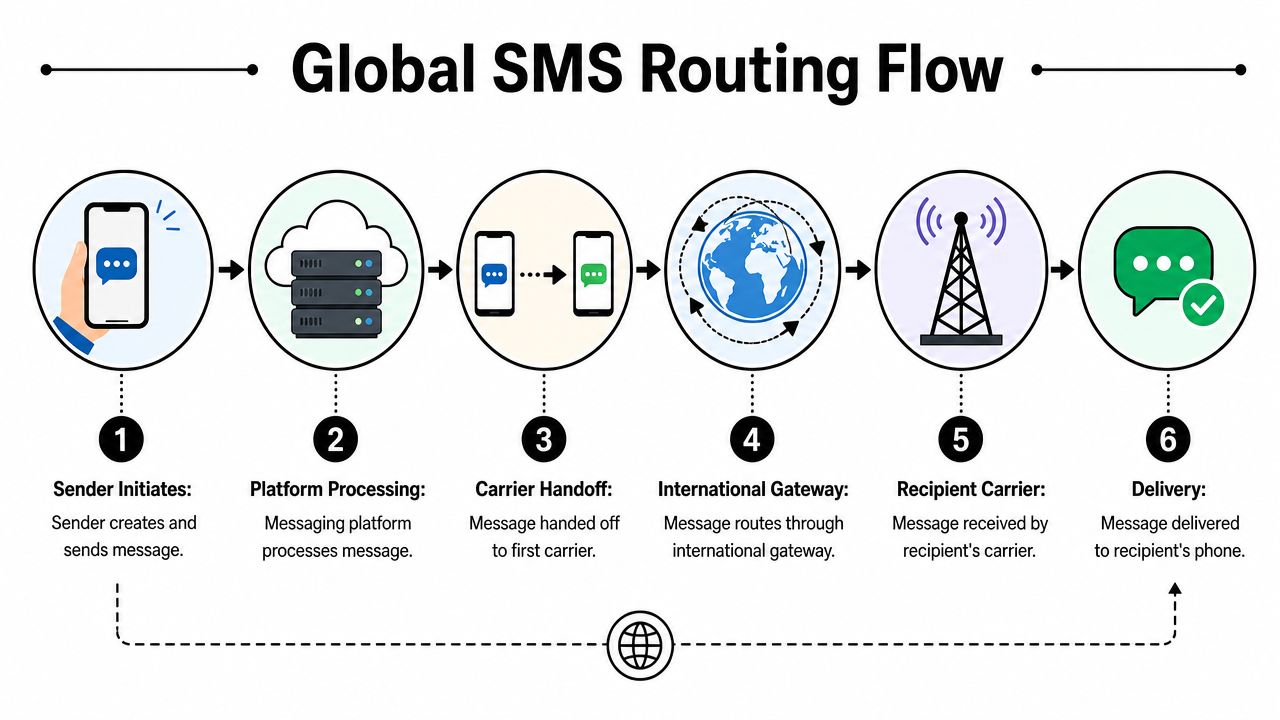
A sender starts the message in a platform. The platform processes it and passes it to a carrier or aggregator. That traffic then moves through international gateways before it reaches the destination carrier and the recipient handset.
That sounds clean on a flowchart. In reality, every checkpoint can apply its own rules. Content filters, sender format rules, unsupported character sets, and local carrier policies all affect whether the message arrives, arrives late, or gets rejected.
According to Sakari's breakdown of international SMS delivery mechanics, international A2P messages traverse multiple carrier networks, which can introduce latency. The same source notes that messages must be normalized to encodings such as GSM 7-bit or UTF-8, and non-compliant payloads are often dropped by intermediate carriers, reducing delivery rates by 5% to 15% in markets with strict filters.
The sender field shapes trust before a recipient reads a single word. If your sender looks foreign, generic, or inconsistent, response rates usually suffer.
Common sender options include:
| Sender type | What it looks like | Best use |
|---|---|---|
| Short code | Branded short number | High-volume, structured programs in supported markets |
| Long code or local number | Standard local-looking phone number | Conversational messaging and local trust |
| Toll-free number | Business-grade number often used for support or campaigns | Scaled outreach with recognizable business identity |
| Alphanumeric sender ID | Brand name instead of number | Markets where branded sender names are expected |
If you want a practical reference on branded sending, this article on sending SMS online with your company name shows how sender identity affects recognition and trust.
This is one of the least glamorous parts of international SMS, and one of the most expensive to ignore.
A plain English text may fit standard encoding rules. Add accented characters, non-Latin scripts, or emojis, and you may trigger different encoding behavior. That can fragment messages, alter length, or cause filtering problems if the route doesn't support the payload cleanly.
Field note: The message that looks perfect in your campaign builder can still fail in transit if the character set doesn't match what downstream carriers accept.
A practical workflow helps:
Domestic teams often assume one compliance policy is enough. International texting doesn't allow that shortcut.
Each country, and often each carrier, can enforce different expectations for business messaging. Some markets tolerate promotional traffic from known brands. Others are much stricter about sender registration, content categories, or reply handling. That's why routing and rules should be planned together. Good technical delivery with the wrong local approach still produces poor outcomes.
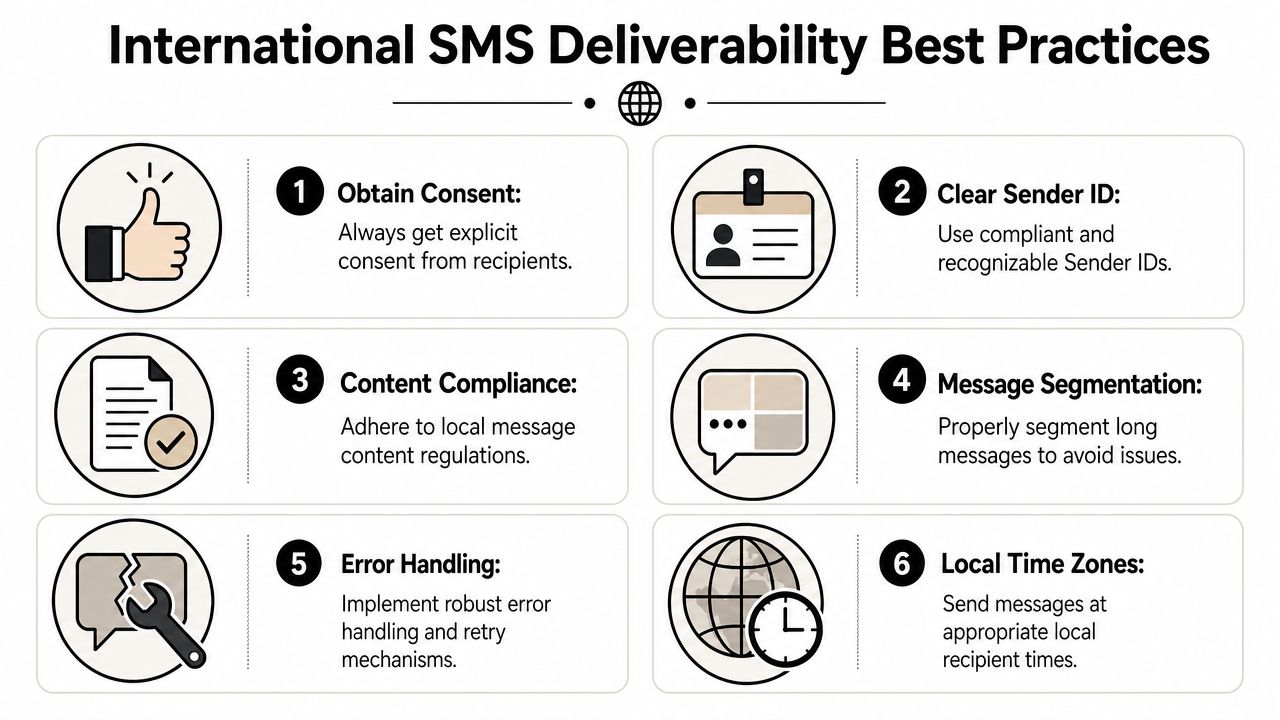
Deliverability isn't just a technical metric. It's a trust signal.
A message gets through when the platform routes it well, the carrier accepts it, and the recipient doesn't treat it like junk. Teams that only focus on the first part usually end up disappointed. Good international SMS programs earn deliverability through process.
Marketers often obsess over wording and ignore contact quality. That's backwards.
If your database includes stale numbers, malformed international formats, or contacts who never clearly opted in, no amount of smart copy will save the campaign. Clean records reduce avoidable failure before the message ever reaches a gateway.
A strong discipline looks like this:
Many brands assume SMS is universally welcome if the offer is good. That assumption causes friction fast.
Yotpo's guidance on international SMS marketing is useful here because it makes a point many teams ignore: brands should ask customers directly about preferences and begin with fewer messages until performance shows what local tolerance is. Some cultures may reject frequent SMS contact, even when the same cadence performs well elsewhere.
That means your send strategy should adjust by region.
Send fewer messages at the start than you think you need. It's easier to scale a trusted program than repair an annoying one.
Deliverability and response quality often improve when teams respect everyday human context.
Use local time zones. Keep opening lines clear. Avoid sloppy link behavior. Don't bury the purpose of the message in branded fluff. Recipients decide in seconds whether a business text feels useful or intrusive.
A simple operating checklist helps:
| Deliverability factor | Good practice | Bad practice |
|---|---|---|
| Timing | Send in recipient local time | Batch by your own office hours |
| Identity | Use a recognizable sender | Rotate confusing sender formats |
| Content | Clear purpose and concise CTA | Overloaded copy with too many links |
| Cadence | Build trust gradually | Repeated blasts with no reply logic |
Many programs underperform; they optimize for sends, not responses.
If the customer can ask a question, confirm an appointment, or reply with a simple keyword, the interaction feels legitimate. That doesn't guarantee perfect delivery, but it usually supports stronger engagement and better list health over time. In other words, deliverability is partly technical, partly behavioral. Carriers evaluate patterns, and recipients do too.
Choosing an international text messaging service is less about flashy features and more about failure prevention.
A platform can look polished in a demo and still break where it counts. The test is whether it supports two-way communication, handles country differences cleanly, and gives your team enough control to run responsible outreach at scale.
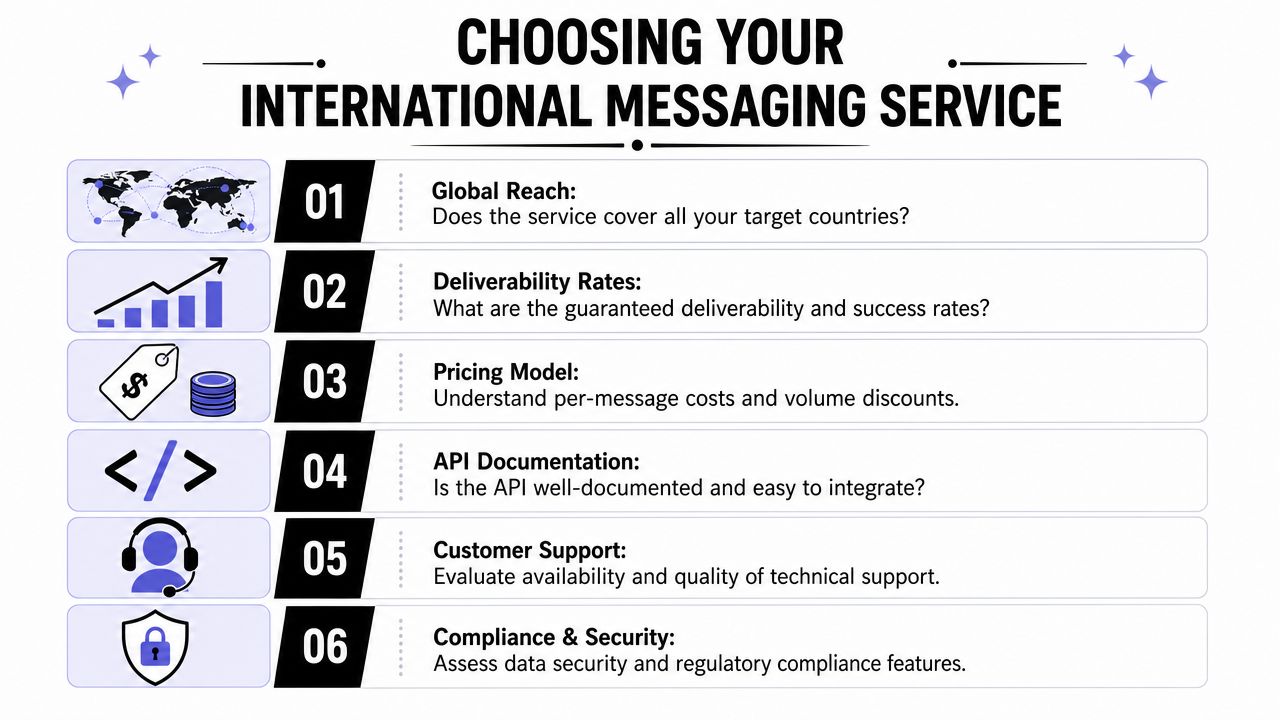
Start with a practical checklist, not a feature grid full of marketing language.
This is one of the most overlooked buying criteria.
Many low-cost or free tools let you send a message internationally but don't provide a true reply path. That creates what practitioners often run into as the replyability gap. A recipient gets the text, but can't reply directly in a way your team can manage inside the workflow.
The issue is documented in this Reddit discussion about free international SMS options, where users note that some services can send outbound messages while the receiver can't respond to that SMS directly. For a business, that's more than an inconvenience. It breaks sales follow-up, support resolution, opt-in confirmation, and patient communication.
If a platform can send internationally but can't support the reply experience you need, it isn't a communication system. It's a one-way broadcast tool.
Global outreach works better when your platform supports more than SMS.
Here's why. A text can prompt a response quickly. If no reply arrives, a ringless voicemail can leave context without interrupting the recipient with a live call. If the matter is urgent, a voice broadcast or direct call can escalate. This matters for event reminders, overdue invoices, appointment confirmations, lead nurturing, and service updates.
A useful selection lens is whether the platform helps your team coordinate these moves from one place instead of forcing disconnected tools.
Use these in demos and procurement reviews:
If you want an internal rubric, keep it simple.
| Buying criterion | Why it matters |
|---|---|
| Reply handling | Determines whether outreach becomes a conversation |
| Country-specific sender fit | Affects trust and filtering |
| Compliance support | Reduces legal and operational risk |
| Automation and sequencing | Makes follow-up repeatable |
| Multi-channel options | Improves response paths beyond SMS |
| Operational visibility | Helps teams fix issues quickly |
Teams rarely regret overchecking reply flows, compliance logic, and channel flexibility. They often regret assuming those things were included.
Global messaging programs break down at the handoff. The text is delivered, but the customer cannot reply, the team cannot see the response, or the next step comes through the wrong channel. The fix is to design for conversation from the start.
A good international program feels coordinated from the customer side, even when multiple systems are working underneath. SMS often starts the interaction because it is fast and familiar. The main work happens after that. Teams need to decide what should trigger a reply path, when a ringless voicemail adds useful context, and when a direct call is justified because the issue is time-sensitive or high value.
A global event organizer has three jobs. Confirm the registration, remind the attendee at the right local time, and recover no-shows before the session starts.
A practical sequence starts with SMS confirmation, followed by a reminder scheduled in the attendee's time zone. If a high-value registrant does not click or reply, ringless voicemail can add more detail without forcing a live call. On the day of the event, voice broadcasting makes sense for narrow start windows, last-minute room changes, or regional outages that require immediate attention.
Implementation tip: Build the sequence around local-time delivery first, then define the fallback. SMS handles the fast touch. Voicemail carries more context. Voice is best reserved for the update that cannot wait.
International ecommerce teams learn quickly that offer structure travels better than copy tone. The same discount can work in several markets, but urgency, phrasing, and follow-up cadence often need to change by region.
Start with a short text tied to a clear action, such as a product drop, restock, or sale window. Then segment follow-up based on behavior, not just geography. Customers who clicked but did not purchase may respond to a short reminder. VIP buyers who ignored the text may be better candidates for a ringless voicemail that sounds like service, not pressure. That trade-off matters. More follow-up is not always better follow-up.
Strong ecommerce messaging programs do more than translate copy. They adjust pressure, cadence, and channel based on customer value and recent behavior.
Implementation tip: Keep the first text simple, region-aware, and easy to act on. Add voice or voicemail only when extra context improves the customer experience.
Healthcare teams need more than message delivery. They need patient action and staff visibility.
Appointment reminders, follow-up prompts, refill notices, and no-show prevention all work well over text when the message is short and the next step is clear. But the operational risk sits in the reply path. If a patient replies to confirm, cancel, or ask for help, that response has to reach the right team quickly. Ringless voicemail also has a place here for patients who ignore text but listen to voicemail, especially for reminders that need a little more explanation.
SMS remains a practical channel because customers still read and respond to it across routine service interactions. For healthcare, that matters less as a market statistic and more as an operational fact. Patients use the channel. Staff can act on it. The workflow works only when replies route cleanly and compliance rules are built into the process.
Implementation tip: Map the reply workflow before launch. If staff cannot see, triage, and act on patient responses quickly, the reminder sequence creates extra noise instead of better attendance.
International messaging works best when each channel has a job. SMS starts the conversation. Voice handles urgency. Ringless voicemail adds context when a short text is not enough. The goal is not more sends. The goal is a reply, a completed action, or a smooth handoff to the next step.
That is the core playbook. Build for conversation first, then use automation to support it.
If you're ready to run international outreach as a coordinated conversation instead of a one-way blast, Call Loop gives you a practical way to combine SMS, voice broadcasting, and ringless voicemail in one platform. You can build follow-up sequences, manage compliant outreach, and support everything from promotions to appointment reminders without stitching together separate tools.
Chris Brisson
Chris is the co-founder and CEO at Call Loop. He is focused on marketing automation, growth hacker strategies, and creating duplicatable systems for growing a remote and bootstrapped company. Chat with him on X at @chrisbrisson


Trusted by over 45,000 people, organizations, and businesses like


