
See a Demo
You're just one step away from seeing Call Loop in action.
Enter your information below to watch a demo right now.

You're just one step away from seeing Call Loop in action.
Enter your information below to watch a demo right now.

It's one of the most frustrating notifications you can get: "message not sent."
That simple error message is a real headache, but it almost always points back to just a few common culprits. The problem isn't one single thing, but a symptom of issues that can range from a bad phone number in your list to aggressive carrier filtering.
Whatever the cause, it means your message—whether it's a critical update or a new promotion—never reached its destination.
When a message fails, it’s tempting to just guess what went wrong. But from our experience, a more systematic approach saves a ton of time and gets much better results.
For any business using outbound messaging, getting to the root cause is the first step. It's the only way to make sure your marketing promotions, appointment reminders, and other crucial communications actually land in your customer's hands.
Imagine launching a big SMS campaign only to discover that 2-5% of your messages simply vanished. That's the reality of "message not sent" errors. Industry data shows that hitting a perfect 100% delivery rate is nearly impossible because of how complex global telecom networks are.
Poor contact list hygiene is often the biggest offender. Outdated or invalid numbers can cause silent failures where you burn through credits without a single message getting delivered.
Failures can happen at a few different points in the journey, and they aren't just limited to SMS. You'll see similar issues pop up across other channels, too.
Let's break down the usual suspects:
A "message not sent" error is often just the tip of the iceberg. In the world of digital communication, it's a lot like dealing with email delivery problems. One of the most common reasons a message fails is when it "bounces." It's actually really helpful to understand what a bounced email is and how to fix it, because the same core principles often apply to SMS and other channels.
Whether you're sending an SMS, a voice broadcast, or a ringless voicemail, figuring out the specific reason for the failure is everything. Each channel has its own quirks.
For instance, an SMS is more likely to get snagged by content filters, while a ringless voicemail drop might fail if you send it to a number that doesn't have a voicemail box set up. Pinpointing the source helps you apply the right fix and, more importantly, stop it from happening again.
To make this easier, you can use this quick table to match the problem you're seeing to its most likely cause.
Think of this table as your first diagnostic step. It helps you quickly narrow down the possibilities so you're not just guessing in the dark. Once you have a good idea of the category, you can dive deeper into the specific fix.
So, that dreaded "message not sent" alert popped up again.
Your first thought might be to just hit resend and hope for the best. But let's be real, that's like trying to fix a car by just turning the key over and over. A much smarter move is to play detective. Think of that failure notice not as a dead end, but as your first clue.
Instead of guessing, you need to dive into your platform’s analytics. Your dashboard is packed with delivery reports that have the error codes and statuses to tell you exactly what went sideways. Learning to read these codes is the difference between a one-time fix and solving delivery problems for good.
This flowchart gives you a quick visual guide for where to start looking when a message fails.
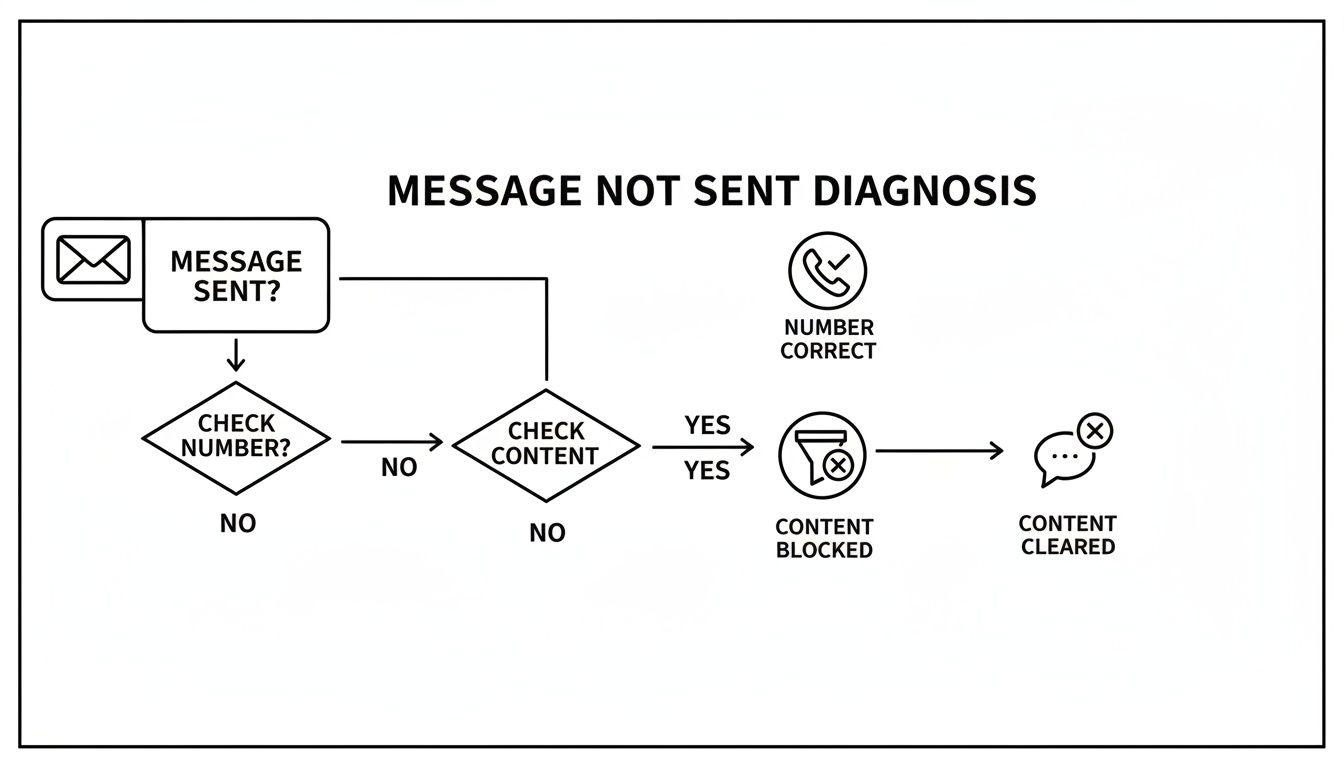
As you can see, your investigation will almost always lead you down one of two paths: an issue with the contact's number or a problem with the message content itself.
As you dig into those delivery reports, you'll see two kinds of failures pop up again and again: hard bounces and soft bounces. Knowing the difference is critical because it tells you what to do next.
I like to think of it this way: a hard bounce is a brick wall. Stop trying to send to that number. A soft bounce is more like a temporary detour; the message might get through later, or you might just need to try a different route.
Key Takeaway: Treat every hard bounce as an urgent reminder to clean your contact list. Pulling those invalid numbers is non-negotiable for good list hygiene. It protects your sender reputation and, just as importantly, it stops you from wasting money sending messages into the void.
Don't just look at individual errors; zoom out and search for bigger patterns. Are a bunch of your failures happening with one specific mobile carrier? That's a huge red flag that your message content is probably getting caught in their spam filters.
This is where a tool like a ringless voicemail drop can be a game-changer. A ringless voicemail isn't an SMS, so it completely sidesteps the carrier content filters that block text messages. It delivers your audio message right to their voicemail, giving you a powerful workaround when your texts just aren't making it through.
For example, let's say you see 15% of your SMS appointment reminders to Verizon customers are failing. Instead of giving up, you can segment that group and send them a ringless voicemail instead. You’ve not only solved the "message not sent" error, but you’ve also used your data to deploy a smarter, more effective communication strategy. That’s how you turn a frustrating error into a real business insight.
Let's talk about the real gatekeepers of your messages: the mobile carriers. They’ve rolled out incredibly sophisticated spam filters that have gotten stricter than ever. If your messages are consistently failing to send, these filters are almost always the reason why.
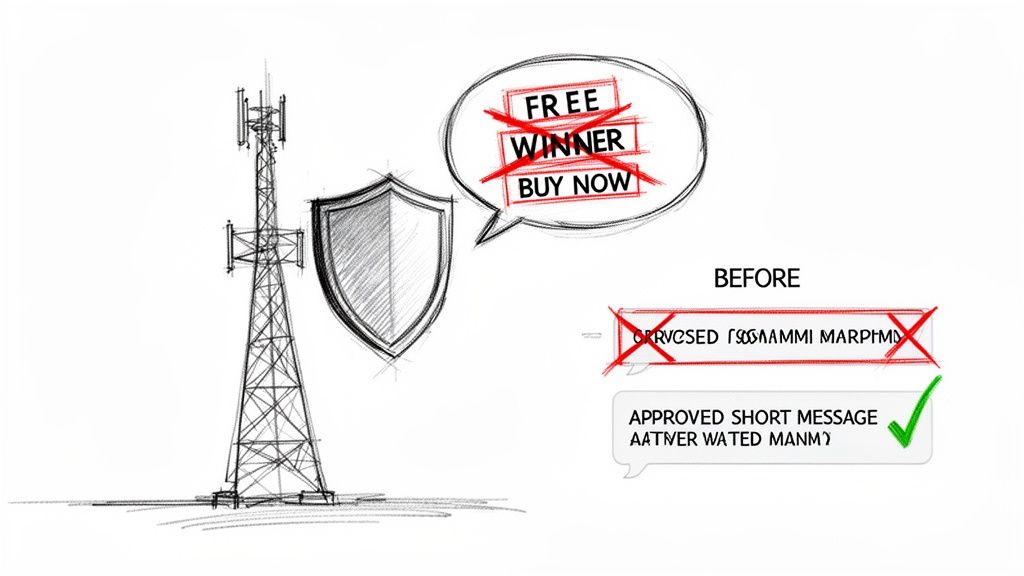
These filters aren't just a minor headache; they can be silent killers for your SMS and MMS campaigns. We’ve seen them silently block messages at rates of 10-20% for content that even slightly raises a red flag.
Big carriers like AT&T and T-Mobile are constantly scanning for spammy keywords ('free money'), too much capitalization, or sketchy URLs from public shorteners. They’ll just drop the message before it ever has a chance to hit your contact's phone.
The secret is to craft content that flies right under their radar. This means you need to know exactly what triggers these filters and learn how to sidestep those landmines completely.
I’ve seen this countless times—certain words and formatting choices are like waving a giant red flag at a carrier's spam filter. Just being mindful of these can make a world of difference in your delivery rates.
Sometimes, a few small tweaks to your wording can be the difference between a successful campaign and a list full of failures. For a deeper dive, check out our own resources on improving deliverability.
For instance, a karate studio might send a promo that gets blocked: "HUGE SALE! Sign up NOW for a FREE uniform! Click here: bit.ly/karate".
A much better, more deliverable version would be: "Hi [FirstName], we have a special offer for new students. Reply YES to learn more about our new student package, which includes a complimentary uniform. Txt STOP to unsub."
This same idea applies to email, too. If you want to improve email deliverability and avoid spam folders, it's smart to use specialized email warm-up tools to build your sender reputation.
If you're a business sending texts from a standard 10-digit phone number without registering it, you're fighting a losing battle. Getting your number registered as A2P 10DLC (Application-to-Person 10-Digit Long Code) isn't just a good idea anymore—it's absolutely essential.
Registering your number is how you tell carriers that you're a legitimate business. This process builds instant trust, giving your messages preferential treatment and drastically cutting the chances of being filtered.
Honestly, it's the single most important step you can take to avoid that dreaded "message not sent" error. Think of it as your express pass through the carrier's security checkpoints.
Think of your contact list as one of your most valuable business assets. If you let it get messy and outdated, you're practically guaranteeing you'll run into "message not sent" errors. It's a surprisingly common reason for delivery failures, but also one of the easiest to fix.
Ignoring list hygiene is like trying to drive with a flat tire—you won't get far, and you'll burn through a lot of money and effort for nothing. A clean list, on the other hand, means a much higher delivery rate. You stop wasting credits on messages that were destined to fail from the start.
The single most impactful thing you can do is scrub your contact list with a number validation tool before you send a single message. This process is a lifesaver. It automatically scans every number on your list and flags the ones that will cause problems.
It’s a simple but powerful way to identify and weed out:
Imagine you just imported 1,000 new leads. A quick validation scan might show that 5-10% of those are landlines or just plain bad numbers. By removing them before you launch your campaign, you've just prevented dozens of guaranteed delivery failures and protected your budget.
A healthy list isn't just about valid numbers; it's about having engaged contacts who actually want to hear from you. This is where the double opt-in method becomes your best friend. It simply asks a new subscriber to confirm their interest twice—once when they sign up, and again by replying to a confirmation text.
This two-step process does more than just get consent. It proves the person is actively using that number and is genuinely motivated to receive your messages. You can dive deeper into this with our double opt-in strategy in our detailed guide.
A contact who completes a double opt-in is a high-quality lead. They've raised their hand twice, signaling strong intent. This simple process dramatically reduces the chances of your messages being ignored or marked as spam, which helps protect your sender reputation with carriers.
Finally, you have to stop blasting your entire list with the same generic message. That’s a fast track to getting ignored or flagged as spam. The smart move is segmentation—dividing your main list into smaller, more focused groups based on things they have in common.
You could segment your contacts by:
When you send a super-relevant message to a smaller, targeted group, engagement skyrockets. That high engagement signals to carriers that your messages are wanted, which seriously lowers the risk of being blocked. This doesn't just fix "message not sent" errors; it makes every campaign you run that much more effective.
It’s incredibly frustrating when your perfectly worded text messages get shut down by aggressive carrier filters. You feel like you've hit a wall.
But what if you could just go around those SMS filters completely? That’s where ringless voicemail comes into play, and it's a powerful workaround.
Instead of sending a text that might get flagged, a ringless voicemail drop zips a pre-recorded audio message straight into someone’s voicemail box. Their phone never even rings. It's a totally different delivery path.
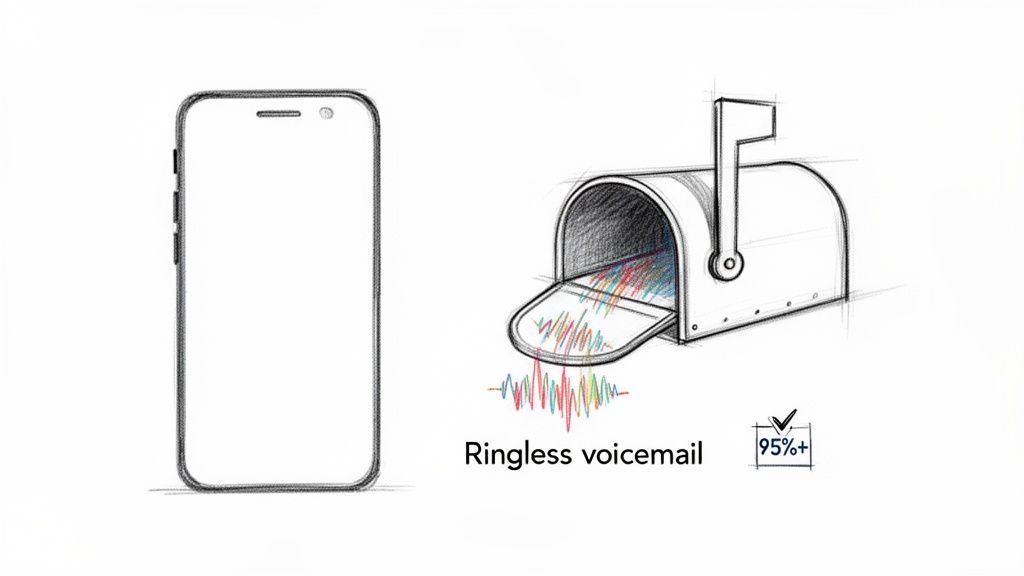
This method sidesteps the very carrier networks that scan and block SMS traffic. Because it’s talking directly to the voicemail server, it doesn't trigger the usual "message not sent" errors, which means you see a much, much higher delivery rate. In fact, we see success rates of over 95% with this approach all the time.
This channel is a fantastic solution for messages that are time-sensitive but don't need an immediate text conversation. It’s non-intrusive, making it a great fit for all sorts of situations where SMS just keeps failing.
Here are a few real-world scenarios where a ringless voicemail drop really saves the day:
These examples show how you can not only solve delivery headaches but also build a better connection with your audience. To get a better sense of what's possible, you can check out our deep dive into what ringless voicemail is in our detailed guide.
Maybe the best part about using a ringless voicemail drop is the pricing. With standard SMS, you often pay a credit just to fire off the message—it doesn't matter if it gets delivered or not. Ringless voicemail flips that on its head with a 'pay-per-successful-drop' model.
This means you only get charged when your message is confirmed as successfully delivered to the person's voicemail. If the number is a landline, disconnected, or can't receive a voicemail for any reason, you don’t pay a dime.
This model completely takes the financial risk out of failed messages. It makes the channel incredibly cost-effective because you know every dollar you spend is on a message that actually got through. When you're sick of wasting money on texts that go nowhere, this is a game-changer.
Even when you've done everything right, that "message not sent" error can still show up. It's frustrating, I know. To help you get answers fast, here are the most common questions we hear from users when they run into delivery problems.
This is probably the most common question we get, and it's a great one. Just because a number is valid doesn't mean your message is guaranteed to land. The number one reason for failure is carrier filtering.
Think of it as an automated spam blocker on the carrier's side. It can get triggered by all sorts of things, like using certain words, shouting in ALL CAPS, or using links that haven't been properly verified.
But carrier filters aren't the only culprits. Other issues can stop a message to a good number, including:
This depends entirely on what you're sending. With a standard SMS, you're charged a credit the second your message hits the carrier network. It's a "pay-for-the-attempt" model, whether it gets delivered or not.
But this is where a service like ringless voicemail really shines. It uses a 'pay-per-successful-drop' model, meaning you only pay when we confirm the voicemail has landed in the recipient's inbox. This is a game-changer for protecting your budget from wasted sends and a huge reason it's such a cost-effective tool.
When you use a pay-per-success model, you're essentially shifting the financial risk off your business. Every dollar you spend on a ringless voicemail campaign directly translates to a message that actually got there, cutting out the waste from failed attempts.
Keeping your messages out of the spam folder boils down to a few key things: consent, content, and cadence. First off, only message people who have clearly opted-in. This is non-negotiable and the bedrock of a good sender reputation.
Next, focus on clean, personalized content. Use merge fields to drop in a contact's name, steer clear of spammy-sounding language, and always use your platform's built-in, compliant link shortener. Finally, be smart about your sending cadence. Don't just blast out thousands of messages at once. Try scheduling them over a few hours or breaking your list into smaller, more targeted groups.
And this is critical: using a registered A2P 10DLC number isn't just a good idea anymore. It's absolutely essential for carriers to see you as a legitimate business sender.
The ways these two message types fail are completely different. An SMS failure is almost always a carrier-level issue. We're talking content filters, a disconnected number, or network blocks. These are the usual suspects behind a "message not sent" error for texts.
A ringless voicemail failure, on the other hand, is much less common. It really only happens if the system can't connect to the recipient's voicemail server. A perfect example is trying to send a ringless voicemail drop to a landline that doesn't have voicemail set up.
The huge advantage here is that ringless voicemail completely bypasses the content-based spam filters that plague so many SMS campaigns. This unique delivery path is exactly why it has a much higher delivery rate, making it your best bet when texts just aren't getting through.
Stop letting "message not sent" errors hurt your outreach. With Call Loop, you can leverage powerful SMS, voice, and ringless voicemail tools to ensure your messages are delivered every time. Discover how Call Loop can transform your communication strategy today.
Chris Brisson
Chris is the co-founder and CEO at Call Loop. He is focused on marketing automation, growth hacker strategies, and creating duplicatable systems for growing a remote and bootstrapped company. Chat with him on X at @chrisbrisson


Trusted by over 45,000 people, organizations, and businesses like


