
See a Demo
You're just one step away from seeing Call Loop in action.
Enter your information below to watch a demo right now.

You're just one step away from seeing Call Loop in action.
Enter your information below to watch a demo right now.

When you're building a list of contacts, getting them to sign up is only half the battle. Double opt-in is the two-step process that makes sure they really want to be there.
Think of it like a digital handshake. First, someone fills out your form. That's the initial greeting. But then, they have to confirm their interest through a follow-up email or text. That's the firm shake that seals the deal, verifying they explicitly want to hear from you.
At its heart, the double opt-in process is a quality control filter for your contact list. Instead of instantly adding someone the moment they hit "submit" (that’s called single opt-in), you add one crucial extra step.
This confirmation layer weeds out the tire-kickers, the accidental signups, and even the spam bots. It leaves you with a list of people who are genuinely interested in what you have to say.
This is a game-changer for any business doing automated outreach. Whether you’re a local gym sending SMS deals, an online store announcing a flash sale, or a service pro using ringless voicemail drops, a clean, engaged list is your biggest asset. Those who go through the second step are signaling they're ready to listen, making them far more likely to open your messages and far less likely to mark you as spam.
It might sound like a hassle, but the process is simple and the payoff is huge.
By requiring a confirmation, you're not just building a bigger list; you're building a better one. This approach prioritizes subscriber quality over sheer quantity, leading to more meaningful engagement and a stronger return on your marketing efforts.
Ultimately, this method builds a foundation of trust from the very first interaction. You're showing respect for their inbox, and in return, your marketing—from voice broadcasts to text campaigns—gets in front of an audience that's actually eager to listen. If you're just getting started, digging into different opt-in text message strategies can give you some great ideas. That one extra step is a small investment that pays off big time in engagement and campaign results.
The double opt-in process might sound complicated, but it’s really just a simple, three-step handshake between you and a new subscriber. It's an automated workflow designed to build a stronger, more genuine connection right from the very start.
This little journey ensures you’re only talking to real people who actually want to hear from you. This is true whether you're sending a quick SMS deal or a targeted ringless voicemail drop.
It all begins with the signup. This is the moment a potential subscriber gives you their contact info, usually through a form on your website or by texting a keyword to your number. For example, someone might pop their email into a form on your site to grab a 10% discount.
In the SMS world, this could be a customer at a local restaurant texting "DEALS" to a number they see on the menu. They've raised their hand, but they're not officially on your list just yet. Think of their status as "pending" until they complete the next step.
This is the biggest difference between single and double opt-in, as you can see in the diagram below.
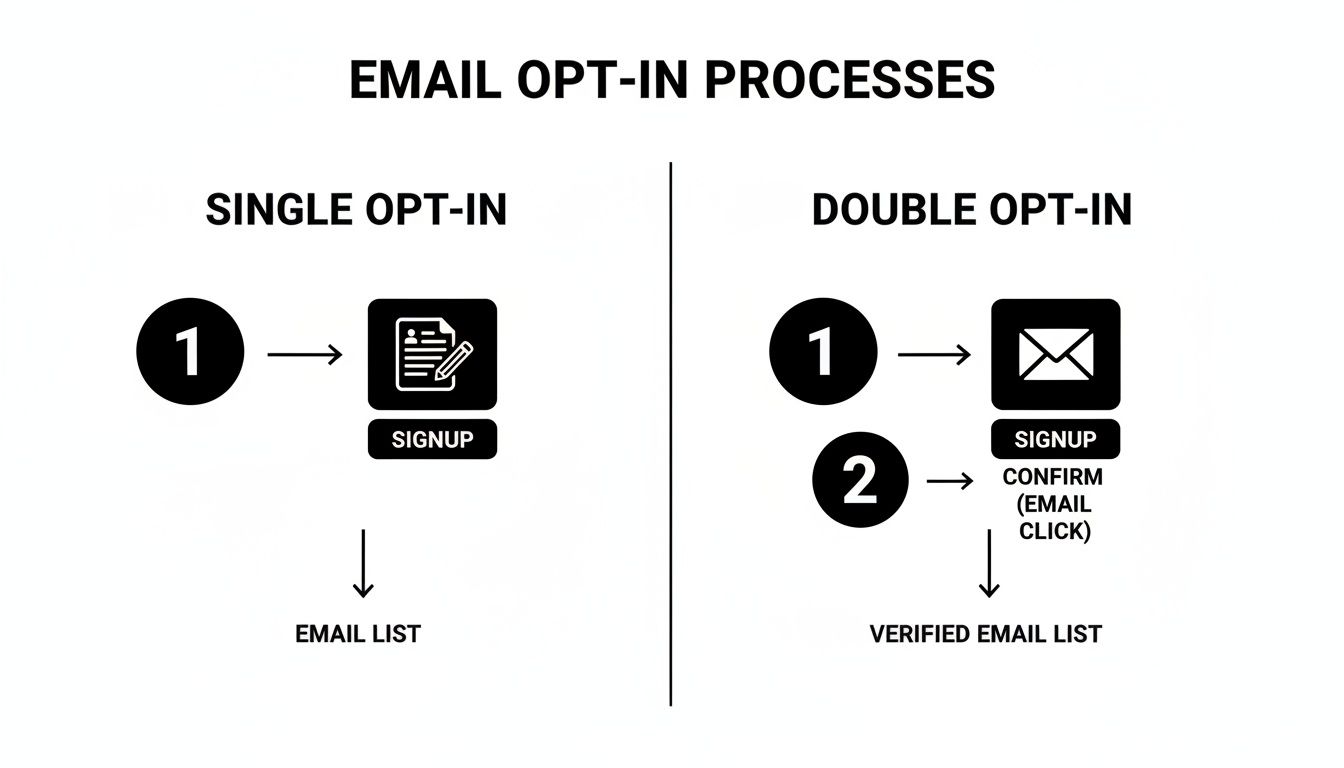
That extra verification layer is what double opt-in is all about, and it has a massive impact on the quality of your list and the proof of consent you have on file.
As soon as someone signs up, your system fires off an automated confirmation message. This is the real heart of what is double opt in. This message isn't for marketing; its only job is to ask the person to confirm they really meant to sign up.
For email, it’s usually a clean, simple message with a big button that says something like, "Confirm Your Subscription." For SMS, the automatic reply might say, "Thanks for your interest! Reply YES to confirm you want to receive updates from us." It's a quick, automated step that creates a clear record of their consent.
The last piece of the puzzle is the confirmation itself. The user has to take a specific action to seal the deal—either clicking the link in the email or texting back "YES." The moment they do, their status flips from "pending" to "active."
This final click or reply is the digital handshake. It’s undeniable proof that the subscriber knowingly and explicitly agreed to get future messages from you, whether it's a standard newsletter or something more advanced like voice broadcasts.
Only after they take this step are they officially added to your active marketing list. This simple, three-part process makes sure every single contact is verified, engaged, and compliant from day one.
Asking someone to take an extra step to join your list might feel a little backward. Aren't we supposed to make it easier for people to sign up? Why would you want to risk losing a potential subscriber?
The answer is simple, but it’s a game-changer: quality over quantity. The whole point of double opt-in isn't just to build a massive list; it’s to build the best list possible. That shift in focus is what leads to real marketing results and a much better return on your investment.
Think about it. Every message you fire off—whether it's an SMS alert, an email newsletter, or a ringless voicemail drop—has a cost attached to it. When your list is full of typos, fake email addresses, and people who aren't really interested, you're just throwing money away. Your messages bounce, your accounts get flagged, and your all-important sender reputation takes a nosedive.
Double opt-in is your quality control. It’s a powerful filter that makes sure only real, genuinely interested people make it onto your list. That single verification step dramatically cleans up your data, boosts campaign performance, and protects your most valuable marketing asset.
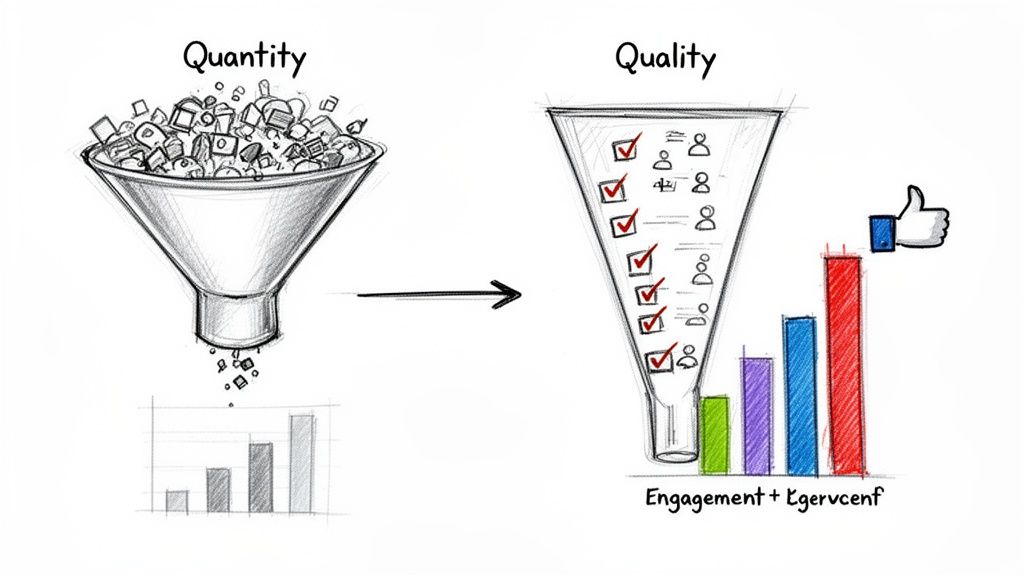
A verified list is an engaged list. Simple as that. When someone takes that extra second to click "confirm," they're raising their hand and saying, "Yes, I actually want to hear from you." This translates directly into tangible results that you’ll see in your bottom line.
A clean, verified list is the foundation of successful outreach. It ensures your messages land in front of a receptive audience, which is essential for turning subscribers into loyal customers.
This focus on quality isn't new. Double opt-in first showed up back in the mid-1990s as a way to fight spam, but it really took off after regulations like the 2003 CAN-SPAM Act and 2018 GDPR made explicit consent a legal requirement. The data backs it up, too, with some reports showing average open rates for verified lists can be significantly higher than single opt-in lists. It's clear that a strong sender reputation pays off, which is why thousands of businesses, from local karate studios using SMS to massive e-commerce brands, rely on this method. You can find more great insights about email opt-in strategies over at monday.com.
Your sender reputation is basically a credit score for your marketing efforts. Internet Service Providers (ISPs) and mobile carriers are always watching how people interact with your messages. High bounce rates, low engagement, and a flurry of spam complaints will tank your score, making it harder for your future messages to even get delivered.
Double opt-in is one of the single best ways to protect and build that reputation. By confirming every contact, you slash the number of hard bounces from bad email addresses or phone numbers. This sends a powerful, positive signal to providers, telling them you're a legitimate sender who maintains a high-quality list.
A better reputation means your SMS, ringless voicemail, and email campaigns are far more likely to land in the inbox instead of getting lost in the spam folder.
In the world of marketing, having proof of consent isn't just a nice-to-have—it's a legal necessity. Using a double opt-in process is your single best defense for staying on the right side of major regulations, saving your business from massive fines and legal headaches down the road.
Think of double opt-in as your digital insurance policy. It automatically creates a clear, documented audit trail for every single person who joins your list. This isn't just a name and number; it's a verifiable record showing the exact date, time, and IP address of someone explicitly agreeing to get your messages. That level of proof is priceless.
For any business marketing in the U.S., two laws are absolutely critical: the Telephone Consumer Protection Act (TCPA) for SMS and voice, and the CAN-SPAM Act for email. Both were created to protect people from messages they never asked for, and both hinge on having clear consent.
TCPA Compliance: This law is notoriously strict, especially about automated text messages and things like ringless voicemail. It requires "express written consent" before you can send marketing messages. Double opt-in delivers exactly that—an undeniable record of a user confirming they want to be contacted on their phone.
CAN-SPAM Compliance: While not quite as strict as the TCPA, CAN-SPAM still requires you to be transparent and give people an easy way to unsubscribe. A double opt-in list naturally weeds out anyone who signed up by mistake, which cuts down on the spam complaints that could put you in hot water.
This two-step confirmation is the gold standard for proving a subscriber gave you their permission. It shifts the conversation from "we think they signed up" to "we have documented proof they confirmed it." That’s a much stronger position to be in.
By creating this electronic paper trail, double opt-in essentially builds your legal defense before a problem ever arises. It’s a proactive way to manage risk across all your channels, from text messages to automated voice broadcasts.
If you have customers in the European Union, the General Data Protection Regulation (GDPR) sets one of the highest standards for consent anywhere in the world. GDPR is very clear: consent must be "freely given, specific, informed, and unambiguous."
A simple single opt-in can sometimes fall short of that standard, but double opt-in aligns perfectly with what regulators want to see. The first signup shows interest, but it's that second confirmation click that provides the clear, affirmative action GDPR demands. This two-part verification ensures you’re handling user data in a way that’s fully transparent and compliant. To dive deeper into these rules, it's a good idea to review a comprehensive anti-spam policy.
At the end of the day, double opt-in isn't just about building a higher-quality list; it's about building a safer, more defensible one. And that peace of mind is one of its greatest benefits.
Knowing the theory is one thing, but making double opt-in work for you comes down to a clear, smooth process. A solid implementation is all about guiding new subscribers through that confirmation step without any friction, turning their initial curiosity into a lasting connection.
It all starts with your signup form. Whether it's on a landing page or part of a text-to-join campaign, setting clear expectations is huge. Let people know they'll need to confirm their subscription. A simple line like, "Check your inbox to confirm!" or "Reply YES to get your coupon" can make a massive difference in your confirmation rate.
The second someone signs up, that confirmation message needs to hit their inbox or phone instantly. Any delay creates confusion and is a surefire way to lose subscribers. Your message should have one, and only one, clear purpose: getting that final click or reply.
For email, this means:
For SMS, the approach is even more direct: "Thanks for your interest! Reply YES to confirm and get your 15% off coupon. Msg&Data rates may apply." This is a killer combo—it pairs the confirmation request with the incentive they were promised, making the action feel both immediate and valuable.
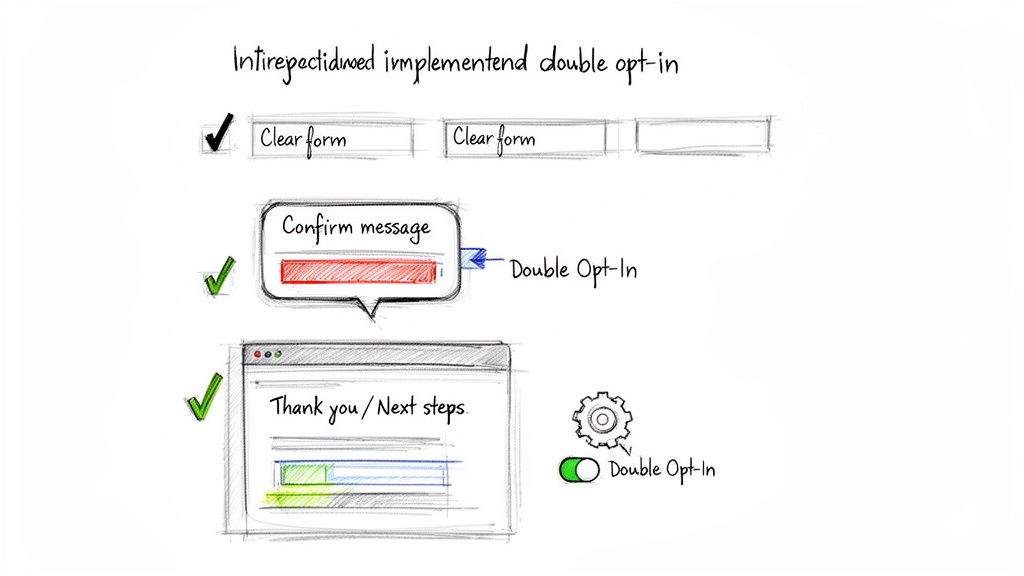
That page people see right after signing up? It's prime real estate. Don't waste it with a generic "Thanks." Use it to guide them to the next step. A clear message like, "Great! Now check your email for a confirmation link to finalize your subscription," keeps the momentum going.
Setting this up in a platform like Call Loop is a breeze. You can easily enable double opt-in for your text-to-join keywords, making sure every new SMS contact is verified from the get-go.
This whole process became a cornerstone of compliant marketing back in the early 2000s, right when spam concerns were really starting to boil over. By 2015, in the lead-up to GDPR, it saw widespread adoption, with industry benchmarks reporting confirmation rates between 65% and 90%.
By focusing on clarity at every single step—from the form to the thank you page—you make the confirmation process a natural part of the user journey. This maximizes your conversions and helps you build a high-quality list from day one.
This clean, two-step process doesn't just boost engagement; it also fits perfectly into your bigger outreach plans. For those looking to build more sophisticated sequences, diving into workflow marketing automation is the next logical move. When you combine a fully verified list with automated follow-ups, you can nurture leads effectively across SMS, email, and even ringless voicemail.
Even when you see all the benefits laid out, making a switch in your process is bound to bring up a few questions. Let's walk through the common concerns people have about what double opt-in really means for their list growth and marketing strategy. It's a crucial final step.
Think of this as the last gut check before you move forward. By tackling these points head-on, you can be confident you're making a smart decision that will pay off for years to come.
This is the big one, the question on everyone’s mind. The honest answer is yes, you might see a smaller initial list—but you’re losing the right people. Think of it less as a loss and more as an essential quality filter.
The folks you "lose" are usually because of typos, fake emails from bots, or people who were just clicking around with no real interest. These contacts would have probably just led to bounces, low engagement, or spam complaints anyway.
The people who take that extra second to confirm? They're telling you they're genuinely interested. That's how you build a healthier, more responsive list in the long run. It's a shift from chasing a large audience to building a quality audience, which is infinitely more valuable.
Here's where it gets nuanced. While major regulations like the TCPA and GDPR don't explicitly say "you must use double opt-in," they do demand clear, unambiguous, and provable consent. Double opt-in just happens to be the gold standard for hitting that high bar.
Why? Because it automatically creates a digital paper trail showing someone explicitly agreed to get your messages. That documented proof is your single best defense against compliance headaches and potentially massive fines. While it's not mandated by name, it’s hands-down the safest and most defensible way to run your SMS, email, and even ringless voicemail campaigns.
Adopting double opt-in isn't just about following a best practice. You're building a proactive defense that proves your commitment to permission-based marketing right from the very first touchpoint.
Getting more people to complete that second step really comes down to one thing: making the process fast, clear, and dead simple. A few small tweaks can make a huge difference in how many people finish the sign-up.
To get your confirmation rate as high as possible, focus on these simple actions:
Absolutely. Not only does it work perfectly for SMS, but it's also highly recommended for keeping your list TCPA compliant. The flow is direct, simple, and incredibly effective for verifying you have the right mobile number.
A typical SMS double opt-in is straightforward: someone texts your keyword (like "DEALS") to your number. Your system, like Call Loop, fires back an instant, automated reply asking them to confirm by texting "YES". Once they reply, they're officially and compliantly on your list, ready for future promos and even voice broadcasts. That two-step process gives you the explicit consent you need to market legally and effectively.
Ready to build a higher-quality, more engaged, and fully compliant contact list? Call Loop makes it easy to implement double opt-in for your SMS and voice campaigns, ensuring every subscriber is verified from the start.
Start your free trial today and see the difference for yourself!
Chris Brisson
Chris is the co-founder and CEO at Call Loop. He is focused on marketing automation, growth hacker strategies, and creating duplicatable systems for growing a remote and bootstrapped company. Chat with him on X at @chrisbrisson


Trusted by over 45,000 people, organizations, and businesses like


