
See a Demo
You're just one step away from seeing Call Loop in action.
Enter your information below to watch a demo right now.

You're just one step away from seeing Call Loop in action.
Enter your information below to watch a demo right now.

So, what exactly is a multi channel messaging platform?
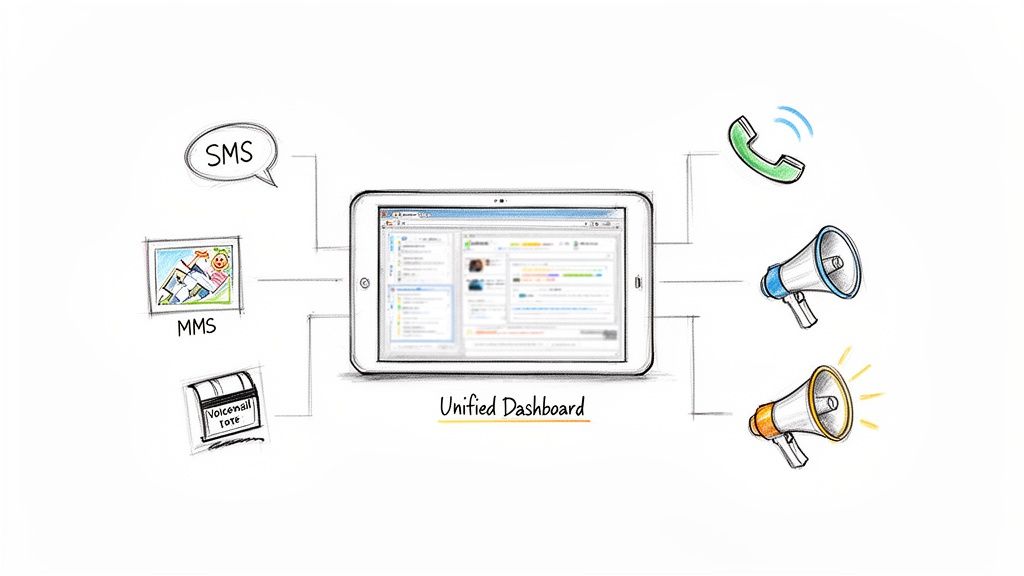
Think of it as the ultimate command center for all your customer conversations. It's a single piece of software that brings together all the different ways you talk to people—like SMS, MMS, voice calls, and even ringless voicemail—into one clean, unified dashboard. No more jumping between five different apps just to keep up.
Ever tried cooking a big meal with your ingredients scattered all over the house? Vegetables in the garage, spices in the bedroom, pots and pans in the living room... it would be a chaotic mess. You'd spend more time running around than actually cooking.
That's exactly what it feels like to manage customer communications without a unified system.
You're probably juggling one tool for texts, another for phone calls, and maybe a third for dropping voicemails. This scattered approach is a recipe for disaster. It creates data silos, leads to clunky customer experiences, and becomes a massive headache to manage. Each channel is an island, giving you no real way to see the full picture of a customer's journey.
A multi channel messaging platform cleans up the kitchen. It brings all your communication tools together, letting you orchestrate every single interaction from one streamlined interface.
To really see the difference, let's break it down.
Here’s a quick look at how a fragmented, single-channel approach stacks up against an integrated, multi-channel platform. The differences in efficiency and customer experience become pretty clear.
Moving to a multi-channel platform isn't just an upgrade—it's a fundamental shift in how you build and maintain relationships with your audience.
Instead of just blasting out messages into the void, a unified platform lets you build connected experiences. It’s built on the simple idea that customers hop between different channels and expect the conversation to follow them, seamlessly. The goal is to meet people where they are, using the method they prefer, without ever losing the thread of the conversation.
This integrated system gives you the power to:
The real magic of a multi-channel platform isn't just having a bunch of tools in one place. It's about making them work together. A text message can trigger a ringless voicemail follow-up, creating a layered outreach sequence that's far more effective than either tool on its own.
By bringing these channels under one roof, you graduate from running separate, disconnected campaigns to building truly cohesive communication strategies. You get a bird's-eye view of every interaction, which lets you make smarter decisions and send more personalized messages. That’s how you build real, lasting customer relationships.
To get a feel for how this fits into the bigger picture, it helps to understand the broader strategies at play, as covered in this A Guide to Multi Channel Marketing Campaigns. This context shows how individual messaging tactics are just one part of a much larger, more powerful plan for growth.
Think of a multi-channel messaging platform as your communication command center. It's not just one tool, but a whole suite of them working in harmony. Each feature has a specific job, but when you combine them, you can build something far more powerful than just sending a few messages here and there.
Getting a handle on these core features is the first real step to changing how you connect with your audience. We're moving beyond simple texts and into creating smart, automated conversations that guide people through their entire journey with your brand, from the first hello to becoming a loyal fan.
Let's break down the essential tools that make these platforms a game-changer.
Texting is still the most direct line you have to your customers, hands down. It boasts ridiculous open rates, often soaring above 98%. With SMS (Short Message Service), you can fire off quick, text-only alerts, reminders, and promos. MMS (Multimedia Messaging Service) kicks it up a notch, letting you drop in images, GIFs, and videos for a message that really pops.
A killer feature here is the text-to-join keyword. For example, a local gym could put up a sign that says, "Text FIT to 55555 for a free class pass." Just like that, you've captured a new lead and can even trigger an automatic welcome text without lifting a finger. It’s a super smooth way to grow your list with people who are actually interested.
Key Takeaway: SMS and MMS are the workhorses of any multi-channel platform. They give you that instant, high-visibility connection that’s perfect for time-sensitive deals and building a list of engaged subscribers.
What if you could leave a personal, heartfelt message right in someone's voicemail without their phone ever ringing? That’s the magic of ringless voicemail. This clever tech bypasses the live call and slips your pre-recorded audio directly into their voicemail inbox.
It’s a respectful, non-intrusive way to reach out that feels worlds more personal than a standard text or email. A real estate agent could use a ringless voicemail drop to follow up after an open house, thanking everyone for coming and offering to answer questions. It creates a genuine connection that a simple text just can't match, making it a seriously powerful tool for sales and follow-ups. This direct to voicemail approach is a game-changer.
When you have an important message that needs to reach a whole bunch of people all at once, voice broadcasting is your go-to. This feature lets you send a pre-recorded voice message to hundreds or even thousands of contacts simultaneously.
Think about these common situations:
A ringing phone demands attention in a way a text message sometimes can't. That makes voice broadcasting perfect for those urgent, can't-miss communications.
This is where a multi-channel messaging platform really starts to flex its muscles. Drip campaigns are automated sequences of messages sent out over a set period. But the real power is in combining different channels—like SMS, ringless voicemail, and voice calls—into one smart, coordinated workflow.
Imagine a new lead fills out a form on your website. A drip campaign could automatically kick off this sequence:
This kind of automated nurturing keeps your brand top-of-mind without you having to manually track every single lead. The market for these coordinated A2P (Application-to-Person) messaging solutions is exploding for a reason. Valued at USD 97.15 billion in 2025, it’s projected to hit USD 163.35 billion by 2033, which just shows how much businesses rely on these automated outreach tools. You can read more about this growing market over at databridgemarketresearch.com.
Finally, no outreach strategy is solid without the right guardrails and a way to measure what’s working. Good platforms have compliance tools baked right in to help you manage opt-ins, opt-outs, and follow all the rules. This keeps your messaging both effective and respectful.
Alongside that, you need solid analytics. You have to know which campaigns are hitting the mark and which are falling flat. Tracking metrics like delivery rates, click-throughs, and conversions lets you tweak your strategy and get the best possible return on your investment. If you want to see what a modern platform can do, feel free to explore our comprehensive feature set.
Knowing the features of a multi-channel messaging platform is one thing. But truly understanding why this approach blows single-channel efforts out of the water is what will make a real difference for your business.
It’s about creating a conversation, not just blasting out a one-off message.
Think about it this way. A customer gets an SMS about an upcoming sale. That’s helpful, sure, but it's just a single, isolated ping. Now, imagine that same customer gets the SMS, and a day later, receives a friendly, non-intrusive ringless voicemail from your team with a more personal reminder.
This layered approach doesn't just send a message; it creates a memorable interaction, building far more connection and trust than a single text ever could.
The real magic of a multi-channel strategy is its power to meet customers where they are, on their own terms. Some people are lightning-fast with texts, while others prefer to listen to a voicemail when they have a free moment. A unified platform lets you cater to all these preferences without missing a beat.
Instead of crossing your fingers and hoping one channel works, you're building a communication safety net. A missed text might be caught by a follow-up voice broadcast, making sure your message actually gets heard. This turns a series of disjointed messages into a smooth customer journey where every channel has the others' backs.
This concept map shows how different outreach tools like SMS, voicemail, and broadcasting can all work together from one central hub.
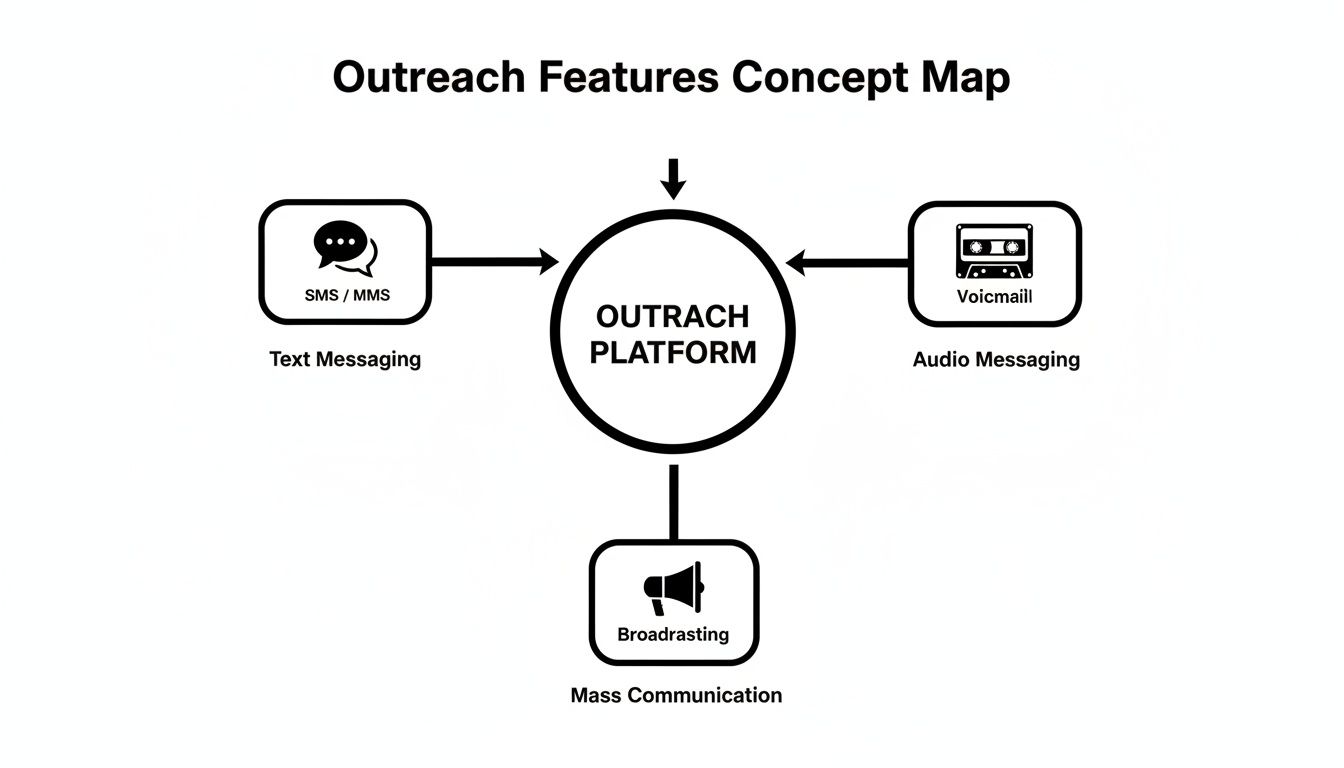
The image makes it clear: a true multi-channel platform isn't just about having a menu of options. It’s about weaving them into a single, powerful strategy.
And this isn't just a gut feeling; the data proves that integrated strategies deliver much better results than isolated efforts. When your channels are working in sync, you'll see a major lift in engagement, conversions, and customer loyalty. To dig deeper, check out this guide on how to build an effective multi-channel communication strategy.
The impact here isn't just theoretical—it shows up in real-world results that directly affect your bottom line. This isn't just another piece of tech; it's a strategic investment in your growth.
Just look at these practical examples:
A multi-channel platform bridges the gap between your message and your audience. By using the right channel at the right time, you make it incredibly easy for customers to hear you, engage with you, and ultimately, do business with you.
The evidence is overwhelming. Companies that adopt a coordinated, multi-channel approach see incredible gains. The data shows that businesses using these strategies achieve an 89% customer retention rate, compared to just 33% for those sticking to a single channel. On top of that, these customers deliver up to 30% higher lifetime value.
Ultimately, a coordinated approach makes sure your outreach is more than just background noise. It becomes a persistent, helpful, and welcome presence in your customer's journey, driving the actions that matter most.
A multi channel messaging platform isn't just a list of features on a pricing page; it’s a versatile toolkit that can be molded to solve the unique challenges of pretty much any industry you can think of. The real magic happens when you see how businesses apply these tools to real-world problems, turning abstract concepts into tangible results.
From a busy healthcare clinic to a fast-growing e-commerce shop, the ability to blend channels like SMS, voice, and ringless voicemail creates powerful, targeted communication that just plain works.
The demand for these kinds of integrated platforms is blowing up across the board. In fact, the global Communication Platform as a Service market was valued at USD 22.89 billion in 2025 and is projected to hit USD 108.12 billion by 2034. That explosive growth isn't just a random number; it highlights a universal need for businesses to get a better handle on their customer conversations. You can dig into more insights on this expanding market over at precedenceresearch.com.
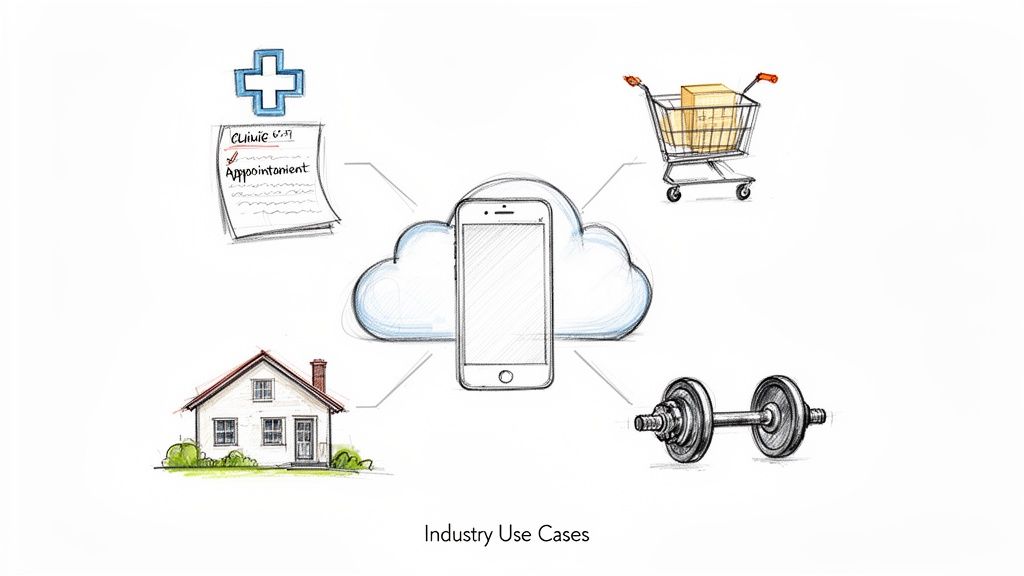
So, let's get specific and explore how different industries are putting these platforms to work.
For healthcare clinics and hospitals, clear and timely communication isn't just a nice-to-have—it's critical for patient outcomes. Missed appointments throw schedules into chaos and can seriously impact a patient's health. This is where a multi-channel approach is a game-changer.
A clinic can set up a simple automated sequence to slash their no-show rate. It might look something like this:
This layered strategy makes sure the message gets through, all while maintaining strict HIPAA compliance to keep patient data secure. You can find more details on how to apply these strategies in our article covering health care SMS best practices.
In the hyper-competitive world of online retail, getting a customer's attention and nudging them toward a purchase is the name of the game. E-commerce brands use multi-channel messaging to pop up at just the right moments in the buying journey.
For instance, recovering an abandoned cart is a massive priority. A brand could trigger a workflow that sends a timely SMS reminder an hour after a shopper bounces. If that doesn't do the trick, a ringless voicemail drop could follow up the next day with a special discount, adding a human touch that a generic email just can't match.
They also use flashy MMS campaigns to launch new products, sending vibrant images and GIFs that stop scrollers in their tracks.
Key Insight: For e-commerce, it’s all about cutting through the noise. Combining immediate channels like SMS with more personal ones like ringless voicemail creates a sense of urgency and connection that drives conversions.
Small and mid-sized businesses, from your local fitness studio to the neighborhood real estate agent, live and die by the strength of their local relationships. A multi channel messaging platform helps them stay connected with their community in a way that’s both efficient and personal.
Just think about these common scenarios:
Each of these examples shows how a single, unified platform can be tailored to nail specific business goals, proving its power and flexibility no matter what industry you're in.
Okay, so you're sold on what a multi-channel messaging platform can do. The next big question is: which one? This isn't a decision to take lightly. The right platform can feel like a superpower for your outreach, but the wrong one will just create headaches and slow you down.
The secret is to look past the flashy landing pages and dig into the core features that actually move the needle.
Think of it like hiring a new team member. You wouldn't just hire someone based on a slick resume, right? You'd check their skills, see if they mesh with your existing workflow, and make sure they can actually handle the job. You need to put these platforms through the same kind of vetting process to make sure they align with your business goals.
The good news is, this doesn't have to be some long, drawn-out process. A few targeted questions can help you cut through the marketing fluff and find a solution that's powerful, easy to use, and ready to grow with you.
Before you even think about pulling out a credit card, run through this checklist. If you can answer "yes" to these questions, you're on the right track to finding a platform that becomes a genuine asset, not just another line item on your monthly bill.
Once a platform passes the initial checklist, it's time to look at what really separates the good from the great. For me, it always comes down to two things: the quality of their analytics and how good their support team is.
Strong analytics are your roadmap for getting better results. If you can't see clear data on delivery rates, open rates, and conversions, you're just guessing. A great platform gives you a dashboard that turns all those numbers into insights you can actually use. When you’re looking around, checking out the best marketing automation software can give you a good benchmark for what top-tier analytics and reporting should look like.
You really find out what a platform is made of when something goes wrong. A responsive, knowledgeable support team can turn a potential disaster into a minor hiccup.
Seriously, don't underestimate the human element. Before you commit, test their support. Shoot them a few technical questions and see how quickly and thoroughly they respond. A company that invests in great support is a company that's invested in your success. Get this part right, and you'll have a partner, not just a tool.
Diving into multi-channel messaging is smart, but it's natural to have a few questions bubble up. Is it going to be a technical nightmare to set up? Is this even compliant? It's good to get these things sorted out before you jump in.
Let's tackle the most common questions we hear from businesses, so you can move forward with confidence. The good news? Modern platforms are built to be incredibly user-friendly. Getting started is usually a lot simpler than people think.
Honestly, it’s probably easier than you’re imagining. Launching your first campaign is a surprisingly straightforward process. Most platforms have a simple campaign builder that walks you through everything—uploading your contacts, writing your messages, and scheduling the whole sequence.
You definitely don't need to be a coding wizard. With integrations for tools like HubSpot and ActiveCampaign, plus thousands more through Zapier, connecting your existing customer data is a breeze. This means you can get automated workflows up and running without touching a single line of code.
Ringless voicemail is one of the most powerful—and most misunderstood—tools in the playbook. It's a technology that drops a pre-recorded audio message directly into someone's voicemail box without making their phone ring. Think of it as a way to leave a personal-sounding message for hundreds of people at once, but without interrupting their day.
When it comes to compliance, ringless voicemail generally falls into a less regulated category than live calls precisely because it isn't intrusive.
That said, it is absolutely critical to use a platform that plays by the rules. This means providing clear opt-out instructions and respecting Do-Not-Call (DNC) lists to make sure your outreach is both effective and respectful. As always, it's wise to chat with your legal counsel to ensure you're ticking all the right boxes.
Absolutely. While these platforms are killer for marketing and sales, their real power lies in their versatility. Smart businesses use them for all sorts of day-to-day operational messages.
Just think about these non-marketing uses:
At the end of the day, a multi-channel messaging platform is a flexible tool for automating and tracking any communication that matters, making it a go-to asset for nearly any department.
Ready to see how a unified messaging strategy can transform your outreach? With Call Loop, you can automate SMS, voice, and ringless voicemail campaigns from one easy-to-use platform. Start your free trial today and connect with your audience like never before.
Chris Brisson
Chris is the co-founder and CEO at Call Loop. He is focused on marketing automation, growth hacker strategies, and creating duplicatable systems for growing a remote and bootstrapped company. Chat with him on X at @chrisbrisson


Trusted by over 45,000 people, organizations, and businesses like


