
See a Demo
You're just one step away from seeing Call Loop in action.
Enter your information below to watch a demo right now.

You're just one step away from seeing Call Loop in action.
Enter your information below to watch a demo right now.

You write the message, build the segment, schedule the drop, and expect a clean campaign launch. Then the results come back uneven. Some recipients get the SMS. Some voice calls never connect. Some ringless voicemail drops fail before they even have a chance to land.
A lot of teams blame copy, timing, or the platform first. In practice, one of the most expensive problems sits much earlier in the workflow. It lives in the contact list.
Phone number formatting decides whether your message is routable before your campaign logic matters. If the number is malformed, the rest of your stack doesn't get a vote.
A contact record can look fine to a person and still be unusable to a messaging system. That mismatch is where campaigns subtly lose money.
A sales team exports numbers from a CRM. Marketing imports a spreadsheet from an event signup form. Support adds callback numbers collected by hand. All three sources can contain valid-looking entries like (212) 555-0199, 07911 123456, +1 250-555-0199 ext 3, or 0044 7911 123456. A human can usually infer what those mean. A delivery gateway can't rely on inference.
Formatting errors are hard to spot because they don't always break every record. A domestic campaign might still reach many U.S. contacts while international records fail. An SMS blast might perform differently from a voice job because each channel validates differently. Ringless voicemail adds another layer, because the destination number has to be normalized correctly before the drop can even be attempted.
Bad formatting is like putting the right street address on a package but the wrong country on the label. The package exists. The route does not.
The frustrating part is that these failures don't always look like formatting failures in reporting. Teams often read them as weak response, poor timing, or list fatigue. In reality, some portion of the audience never had a valid path to receive the message.
The damage shows up in several places at once:
Phone number formatting isn't cleanup work you handle later. It's the foundation under every outbound channel you run.
If you want one storage format that works across countries, carriers, and channels, use E.164. It is the international numbering standard that gives telecom systems a single machine-readable version of a phone number.
The rule is strict. The global standard for phone number formatting is defined by the ITU-T Recommendation E.164, which strictly limits international telephone numbers to a maximum of 15 digits. This specification mandates that conforming numbers consist only of digits and must begin with a plus sign (+) followed by a country code (E.164 standard overview).
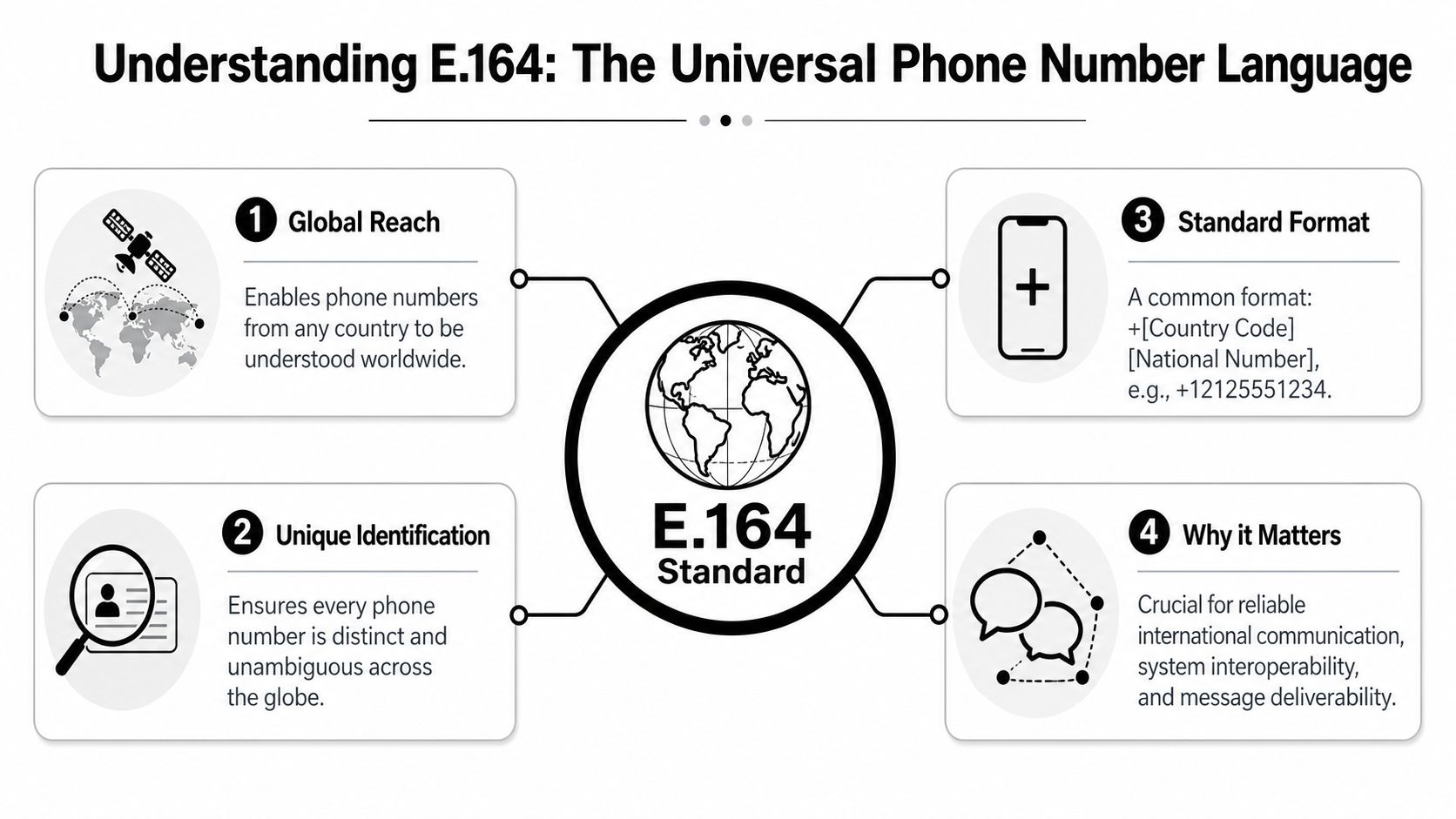
An E.164 number has three practical parts:
| Part | What it does | Example form |
|---|---|---|
| + | Marks the number as international | + |
| Country code | Identifies the country or numbering region | 1, 44, 49 |
| Subscriber number | The rest of the routable number | Varies by country |
The important detail isn't just the shape. It's the absence of ambiguity. There are no display extras in the canonical form. No spaces. No dashes. No parentheses. No "ext". Just the plus sign and digits.
People prefer readable formatting because it's familiar. Systems prefer canonical formatting because it's dependable. Those are different jobs.
A CRM field can display a number nicely for a rep. A delivery engine needs a single normalized string so validation, routing, compliance checks, and deduplication all operate on the same value. That's why teams that care about deliverability separate display format from storage format.
Practical rule: Collect flexibly, store canonically, and display politely.
If you're reviewing your own intake and validation flow, Call Loop's guide to phone number validation is a useful reference point for what clean number handling should support operationally.
Users don't enter numbers in telecom format. They enter them in the format they know.
That creates a constant translation problem. Your database needs one global standard, but your contacts arrive in local habits. Some include spaces. Some include national trunk prefixes. Some assume the country is obvious because it's obvious to the person typing it.
The easiest place to see the difference is North America. In the North American Numbering Plan (NANP), telephone numbers follow a 10-digit structure (NPA-NXX-XXXX) but render as +1NPANXXXXXX under E.164 rules. Unlike in other countries, the leading '0' trunk digit is never used in NANP numbers, and the +1 prefix is mandatory for international validation (NANP structure reference).
Here is the practical contrast:
| Human-entered local form | What the user means | International storage form |
|---|---|---|
(212) 555-0199 | U.S. number | +12125550199 |
212-555-0199 | U.S. number | +12125550199 |
07911 123456 | UK mobile with local trunk prefix | Needs country-aware conversion |
030 901820 | German local format | Needs country-aware conversion |
North America is relatively simple because the domestic structure is stable. Other regions require more careful parsing because area codes and national formats vary, and local dialing conventions can include prefixes that don't belong in international storage.
A trunk prefix is the digit used for domestic dialing in some countries, commonly 0. It helps locally. It can break routing when carried into international form.
That means normalization can't be "just remove punctuation and slap on a country code." It has to understand the country context. Germany is one example where the domestic form and the international form differ in a way your system needs to handle correctly. If you're dealing with regional workflows, temporary verification flows, or country-specific onboarding, this guide to anonymous SMS verification for Denmark is a useful example of how local numbering context affects number handling in practice.
A local number is written for a person in that country. An international number is written for every system outside it.
The operational lesson is simple. Never trust visual familiarity. Translate every national format into a single global format before it reaches your sending database.
The cheapest place to fix number quality is the form field. If the input experience fights the user, the backend inherits a mess.
Organizations often over-correct here. They add rigid masks, force one domestic pattern, and assume structure equals quality. It doesn't. Data shows that 78% of users prefer free-form input without input masking, yet most implementation guides still force rigid masks that can increase error rates. This gap directly impacts outbound messaging, where 30% of campaign failures stem from incorrectly formatted international numbers (phone input UX discussion).

A mask like (###) ###-#### works for a narrow slice of users. It breaks down fast when someone enters a non-U.S. number, pastes from their contacts, or includes a country code. The mask signals "we only understand one kind of number," even if your business serves multiple markets.
Worse, masks often create false confidence. The field looks neat, but the system still may not know the user's country, whether a prefix should be removed, or whether the final value is valid for routing.
The best phone number formatting UX is flexible on the surface and strict underneath.
There is a real tension between what looks readable and what routes cleanly. Parentheses, spaces, and dashes help people scan numbers. They don't belong in the canonical value that powers SMS, voice broadcasting, or ringless voicemail.
That split is healthy when you handle it intentionally. Let users see familiar formatting at the edge. Convert to a standards-compliant value before the record hits the database.
Don't force users to think like a telecom gateway. Build the form so your system does that work for them.
Once the number hits your application, politeness ends and discipline starts. You then turn messy user input into a dependable asset.
Normalization means taking whatever the user entered and converting it into one stored format. For outbound messaging, that format should be E.164. A key strategy for outbound platforms is storing numbers in E.164 format (e.g., '+14155550123') to enable automated validation. Emerging trends include AI-driven normalization that uses contextual clues before stripping characters, a nuance missing from older guides that advocate stripping all non-digits indiscriminately (international phone normalization guide).
A solid backend pipeline usually follows this sequence:
libphonenumber rather than custom regex rules.Custom parsing logic tends to work until it meets edge cases. Then it fails imperceptibly. Libraries built for telephone data exist because local numbering rules are too inconsistent to manage reliably with a handful of handcrafted patterns.
The common shortcut is to strip every non-digit character and assume the result is clean. That works for some domestic records and creates subtle damage elsewhere. If you remove structure before understanding the country context, you can erase clues that matter.
A better approach uses parsing first, cleanup second. The order matters.
| Approach | Result |
|---|---|
| Strip first, guess later | Fast, but error-prone for international data |
| Parse with country context, then normalize | Slower to implement, much safer in production |
If you're evaluating verification workflows alongside normalization, Call Loop's article on verifying phone numbers online is worth reviewing as part of the larger hygiene process.
Store one canonical value. Not a mix of local display versions, half-normalized imports, and manually edited variants.
That single rule pays off everywhere. Deduplication gets easier. Compliance checks get cleaner. Channel orchestration becomes simpler because SMS, voice, and ringless voicemail all reference the same destination record instead of trying to reconcile multiple versions of the same number.
Most formatting mistakes are small enough to survive a casual glance. That's what makes them expensive.
A number can look close enough to correct while still failing validation, carrier routing, or campaign execution. The most damaging errors usually come from mixing local habits with international requirements, then assuming the system will sort it out.
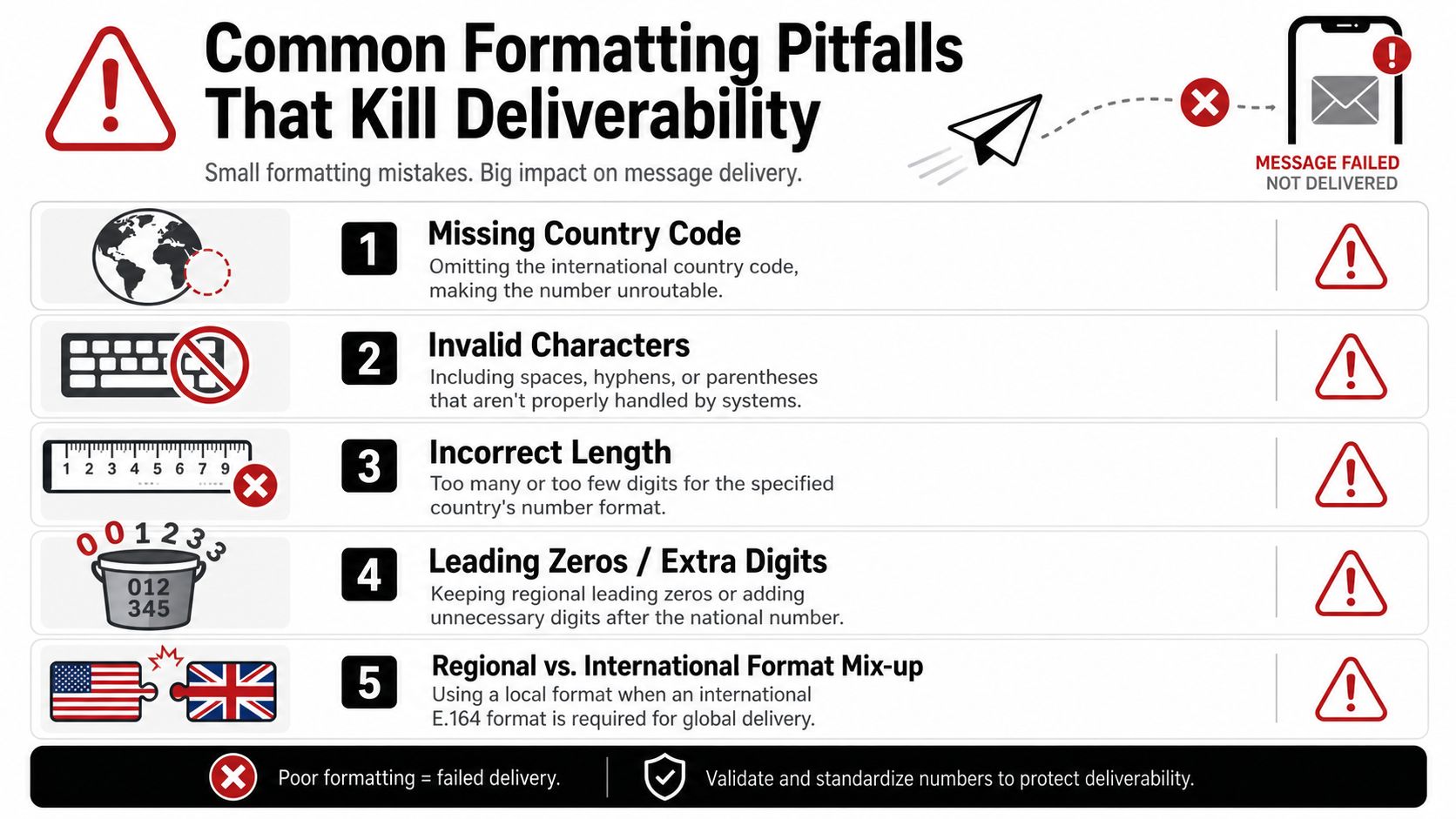
One of the clearest examples is mishandling the trunk prefix during international conversion. Retaining the local trunk prefix '0' after adding the country code (e.g., converting UK '07911' to '+4407911') creates an invalid 16-digit string that fails validation and causes message delivery failure in SMS and voice gateways, as the E.164 standard has a strict 15-digit maximum (validation example for E.164 failures).
Other mistakes are less dramatic but still costly:
Formatting issues don't only hurt SMS. They ripple through voice and ringless voicemail too. If the destination number isn't normalized correctly, the message path breaks before content quality matters.
This is the phone equivalent of email deliverability hygiene. The same way marketers troubleshoot inbox placement with tools and process, messaging teams need to treat destination formatting as infrastructure. If you're interested in the parallel on the email side, Mailwarm's email deliverability fix guide is a useful comparison point.
Clean formatting doesn't improve a weak offer. It does ensure a strong offer actually gets a chance to land.
Use this checklist when reviewing imported or user-submitted numbers:
| Red flag | Why it fails |
|---|---|
| No plus sign with international number | The route may be ambiguous or invalid for global delivery |
| Local trunk prefix kept after country code | Creates an invalid international number |
| Spaces and punctuation stored in the main phone field | Increases parsing inconsistency across systems |
| Notes appended to the number | Breaks validation and automation |
| Different formats for the same contact | Causes duplicate records and channel conflicts |
When delivery reports look uneven, pair campaign metrics with delivery status notifications. That gives you a cleaner way to separate content issues from contact-formatting failures.
Phone number formatting looks like a back-office detail until you run outbound campaigns at scale. Then it becomes one of the clearest lines between a reliable program and a noisy one.
The pattern is consistent. Teams that allow natural input, normalize carefully, and store a single canonical number create fewer downstream problems. Their SMS campaigns route more cleanly. Their voice broadcasts run with less friction. Their ringless voicemail drops have a better chance of reaching the intended inbox because the destination record is already usable.

If you want a dependable system, keep the rules simple:
Good phone number formatting protects more than deliverability. It protects reporting, compliance workflows, deduplication, segmentation, and channel coordination.
That matters most in multi-channel programs. A single malformed destination can break an SMS follow-up, a voice reminder, and a ringless voicemail touch in the same sequence. Fixing the number at the source is far cheaper than troubleshooting each failure later.
The best campaign optimization often starts before the first message is ever sent.
If you want a platform built for clean outreach across SMS, voice broadcasting, and ringless voicemail, Call Loop gives you the tools to validate numbers, automate follow-up, support compliant messaging, and turn better phone number formatting into better campaign execution.
Chris Brisson
Chris is the co-founder and CEO at Call Loop. He is focused on marketing automation, growth hacker strategies, and creating duplicatable systems for growing a remote and bootstrapped company. Chat with him on X at @chrisbrisson


Trusted by over 45,000 people, organizations, and businesses like


