
See a Demo
You're just one step away from seeing Call Loop in action.
Enter your information below to watch a demo right now.

You're just one step away from seeing Call Loop in action.
Enter your information below to watch a demo right now.


So, how do you actually verify a phone number online? It's a process of running a number through a few checks to confirm its format, carrier, line type, and whether it’s even active. This isn't just about tidying up a list; it's about making sure your messages actually get delivered, saving you money and protecting your all-important sender reputation.
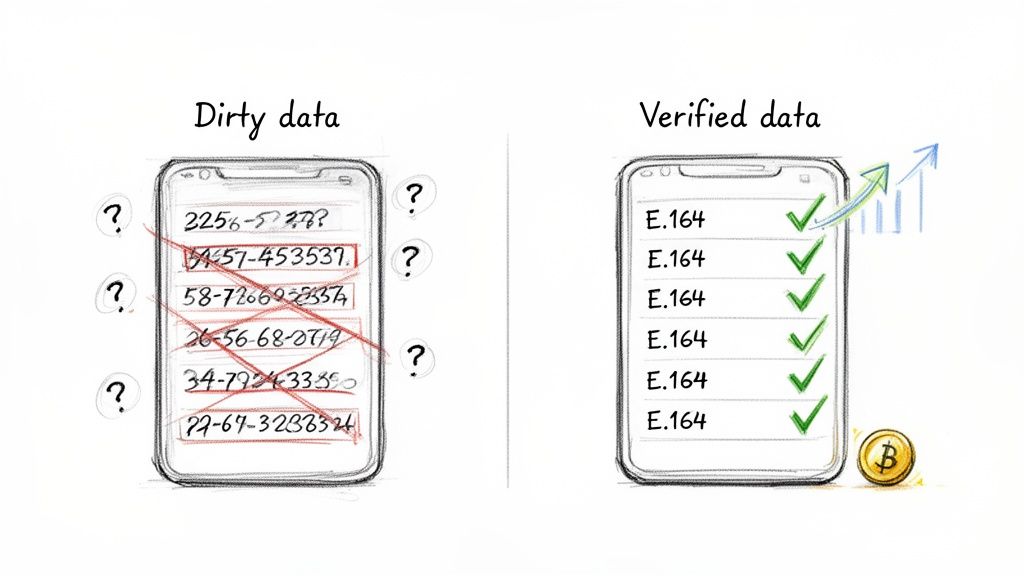
Let's be real—your contact list is the engine for your entire outreach strategy. Every failed text, undelivered ringless voicemail, or call to a disconnected number isn't just a small hiccup. It’s a direct hit to your budget and a lost chance to connect with a potential customer.
Bad phone numbers are a silent killer for campaigns. They eat up your budget by sending messages into the void and, worse, they start to wreck your sender reputation with carriers. When carriers see you sending to a bunch of dead numbers, they're more likely to flag your future messages as spam. It's a super common reason why texts won't deliver.
When you push "send" on a campaign to a list full of junk—invalid formats, disconnected numbers, or the wrong line types—the fallout is predictable and painful. A ringless voicemail drop to a list of landlines is a total waste. An SMS campaign will just bounce off VoIP numbers that aren't set up to receive texts.
Bad data guarantees bad results. Verifying your phone numbers isn't just some extra step; it's fundamental to getting any real ROI and making sure your messages actually land where they're supposed to.
This isn’t just a big-business problem, either. Whether you’re a local shop confirming appointments or an e-commerce brand sending out deals, clean data is everything. It means every dollar you spend has the best shot at reaching a real person.
There's a massive trend toward identity validation for a reason. The global market for it hit USD 11,496.0 million in 2023 and is only climbing, which shows just how critical good phone data has become.
Ultimately, taking the time to clean your contact list gives you some huge wins:
When you verify phone number online, you’re turning your contact list from a potential liability into your most powerful tool for growth.
When you need to verify phone number online, it’s not just a one-and-done check. The process is really a series of checks, kind of like a background investigation for a phone number. Each step digs a little deeper, giving you a clearer picture of whether a number is valid, reachable, and right for your campaign.
Let's break down what's actually happening behind the scenes.
First things first, you have to clean up the number itself. A number like (555) 867-5309 is easy for a human to read, but it’s a mess for automated systems. This is where E.164 formatting becomes your best friend.
This global standard strips away all the brackets, dashes, and spaces, and turns the number into a clean, universally recognized format: +[Country Code][Subscriber Number]. That messy number now looks like this: +15558675309. This isn't just a cosmetic change; it's a critical first step. Without it, your systems can't reliably connect to carrier networks around the world.
With a clean, standardized number, the next step is to figure out what you’re actually dealing with. A carrier lookup will tell you who the provider is—think Verizon, AT&T, or a smaller regional player. This alone can sometimes be a clue about the number's quality.
But the real gold is in determining the line type. Is it a:
Knowing the line type is non-negotiable. Trying to send an SMS to a landline is just throwing money away. Worse, it racks up your bounce rates, which eventually hurts your sender reputation with carriers. We've talked before about how our own lookup services are built around this crucial distinction in our guide on PhoneCheckr.
To put it all together, here’s a quick summary of how these layers build on each other to give you a complete picture of a phone number's validity.
| Verification Layer | Primary Purpose | Key Question Answered |
|---|---|---|
| Syntax & Formatting | Standardize the number into the global E.164 format. | Is this number formatted correctly for any network? |
| Carrier & Line Type | Identify the network provider and phone type. | Is this a mobile, landline, or VoIP number? |
| Live Status Check | Confirm if the number is currently active and reachable. | Is this phone turned on and connected to the network right now? |
Each of these checks answers a fundamental question, moving you from a raw piece of data to an actionable contact number you can rely on for your campaigns.
The final piece of the puzzle is the most important one: is the number even active? A live status check answers this question by confirming if the phone is actually connected to the network and able to receive a call or text at that exact moment.
It’s the difference between knowing a number could be real and knowing it is real.
This is usually done with something called a Home Location Register (HLR) lookup. Think of the HLR as a giant, real-time database run by carriers that tracks every phone on their network. A quick, passive "ping" to this database can tell you if a number is active, inactive, or has been ported to another carrier—all without the user ever knowing.
Beyond these standard methods, you can also look up a phone number using unconventional methods to gather even more data, but these three layers are the foundation. By combining formatting, line type identification, and a live status check, you get a complete and accurate profile of every number, ensuring your messages get delivered and your money is well spent.
Picking the right way to verify phone number online isn't a one-size-fits-all decision. The method that’s perfect for a high-security login is total overkill for cleaning up a contact list. It’s all about matching the tool to the task at hand.
The whole decision really boils down to a single, critical question: do you need to confirm the user is holding their phone right now, or do you just need to know the number is real without them ever knowing you checked? This splits the options into two distinct camps: passive and active verification.
Think of passive verification as your behind-the-scenes data cleanup crew. These methods work silently, giving you valuable intel on a phone number without ever bothering the user. The go-to tool for this is a simple API-based lookup.
When you ping a verification API with a phone number, it runs a few checks in the blink of an eye:
This is the perfect approach for scrubbing large contact lists or for low-friction signups where you just need to make sure the number is valid before it hits your CRM. The goal here is to gather intelligence without interrupting the user experience.
Active methods are a different beast entirely. Here, you’re asking the user to do something to prove they have access to the phone. This is your best bet for security-focused actions like creating a new account, resetting a password, or enabling two-factor authentication.
The two most common ways to do this are:
Be warned, though: active methods add friction. Every second a user waits for a code or a call is a chance for them to get distracted and abandon the process. We’ve seen that snags with SMS OTPs are a major reason why people drop off during sign-ups.
This chart makes it easy to see how you'd message someone after you've validated their number.
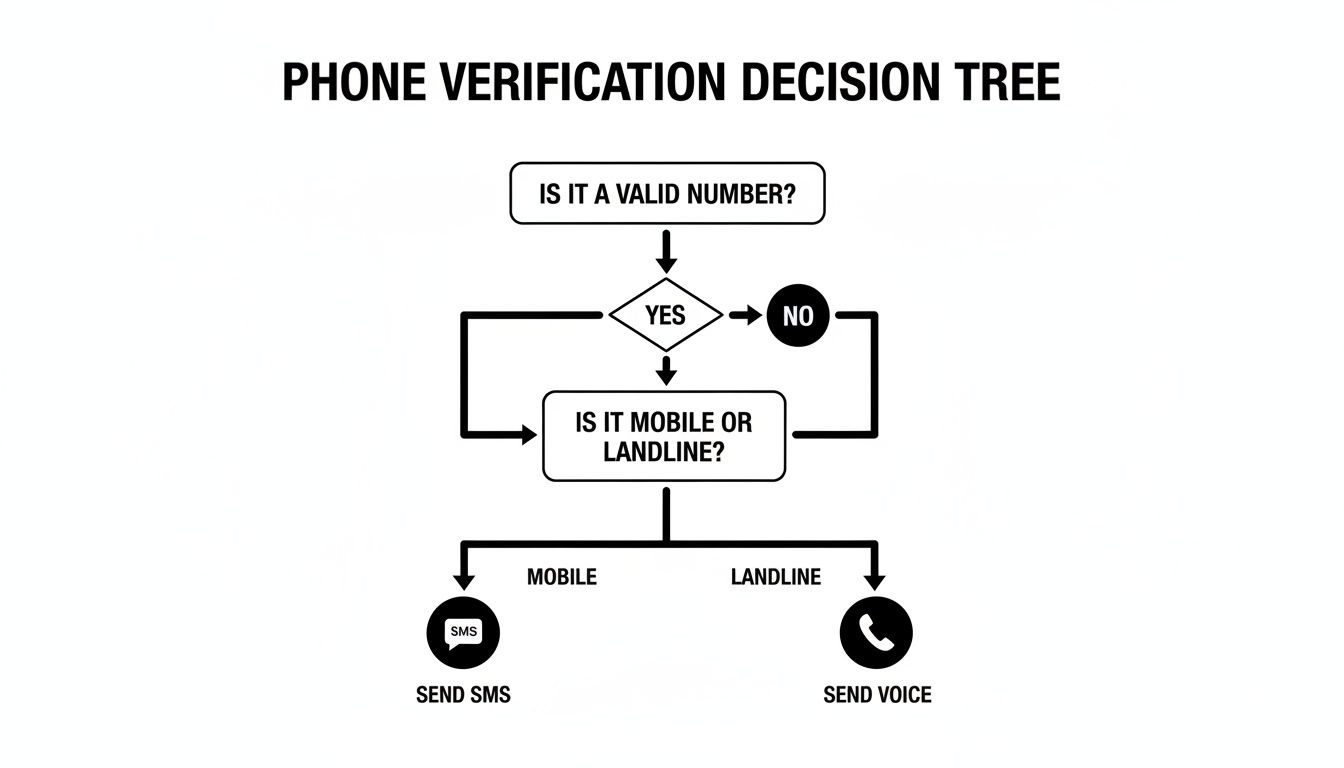
Once you know a number is valid, the line type tells you exactly what to do next. Mobile numbers are perfect for SMS, while landlines are best reached with a voice call.
Knowing the line type isn't just a "nice-to-have"—it's absolutely essential for running smart, multi-channel campaigns.
Take ringless voicemail, for example. It's an incredibly powerful tool, but it only works if you're sending to the right numbers. Trying to send a ringless voicemail to a landline is a complete waste of money. Even worse, it racks up failed deliveries that can damage your sender reputation over time.
By first using a verification API to filter for mobile numbers, you ensure your ringless voicemail campaigns hit their mark. Platforms like Call Loop lean on this data to optimize every send, charging you only for successful drops and protecting your campaign's ROI. This is how verification goes from a simple data check to a core part of your messaging strategy.
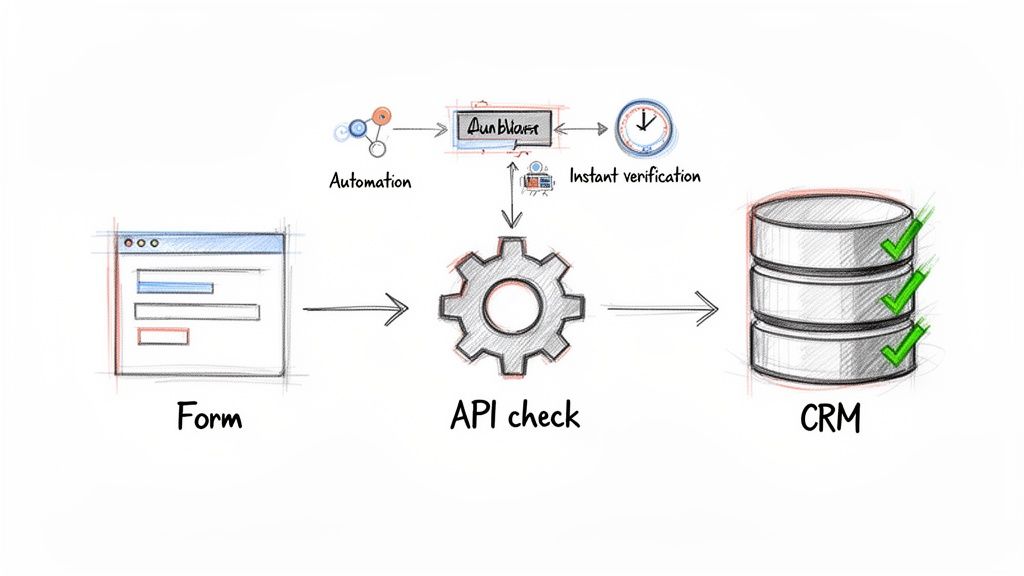
Alright, knowing what to do is one thing, but actually putting it to work is where you see the results. Automating your phone verification process is the key to finally stop wasting time manually cleaning lists and start building a high-quality contact database on autopilot.
This is all about connecting a verification service directly to the tools you already use every day, like your web forms or CRM.
Imagine a new lead fills out a form on your site. Instead of that number just landing in your database unchecked, an automated workflow kicks in. It instantly checks if the number is a valid mobile, a landline, or disconnected altogether. This real-time feedback is how you build a pristine contact list without lifting a finger.
The real engine behind all this automation is the API (Application Programming Interface). Think of an API as a bridge that lets your software—like your website's contact form—"talk" to a phone verification service to get an instant answer.
You can set these workflows up in a couple of ways. If you have a developer on hand, they can integrate a verification API directly into your backend systems. But for most of us, tools like Zapier make this process incredibly simple, with zero coding needed.
For example, you could create a "Zap" that fires every time a new contact gets added to your HubSpot or ActiveCampaign account. The process would look something like this:
With a simple automation like that, every single contact is pre-qualified. Now, when you want to send out a ringless voicemail blast, you can just build a segment of contacts tagged as "Mobile" and know your messages will actually be delivered.
Integrating verification into your workflow turns data collection from a passive chore into a smart, active process. You’re checking every number right at the source, guaranteeing quality from the very first touchpoint.
Not every verification needs the same level of security. You can—and should—tailor your automated workflows to match how important the interaction is.
A single-step verification is perfect for lower-risk situations. This is a quick, passive API check that happens instantly in the background when someone signs up for a newsletter or downloads a guide. It validates the number's format and line type without interrupting the user at all, keeping your data clean.
On the other hand, a multi-step verification is your go-to for high-value actions, like creating a new account or confirming a big purchase. This flow might start with that same passive API check, but if the number is valid and mobile, it follows up with an active verification, like an SMS one-time-password (OTP). This two-part process confirms both the number's validity and that the user actually has the phone in their hand.
Ultimately, automating how you verify phone number online is about being more efficient and more accurate. It ensures your marketing budget is spent reaching real people, it protects your sender reputation, and it helps you build a contact list you can actually trust.
Getting phone number verification right is about more than just the tech. It’s about building trust with your audience and making sure your business stays on the right side of the law. When you set out to verify phone number online, you're not just ticking a technical box; you're showing respect for your contacts.
The absolute cornerstone of all this is explicit consent. Before you even think about sending a message or dropping a ringless voicemail, you need clear permission. This isn't just a nice-to-have; it's a non-negotiable rule under regulations like the Telephone Consumer Protection Act (TCPA). For a full breakdown, check out our guide on what express consent really means for your campaigns.
You have to find that sweet spot between rock-solid security and a smooth user experience. If your verification process is too aggressive, people will get frustrated and just leave. But if it's too loose, you open the door to bad data and serious compliance headaches.
The trick is to match the verification method to how important the action is.
For something low-risk, like a newsletter signup, a quiet, passive API check is perfect. It cleans your list without ever getting in the user's way. But for sensitive stuff—like a password reset or confirming a big appointment—you'll want to use an active method like an SMS OTP. That's when you absolutely need to confirm the person owns that phone.
The best verification process is one the user barely notices. It should feel like a natural part of the interaction, not a roadblock. A seamless experience builds trust and shows respect for your customer's time.
Don't wait for a problem to pop up. Managing compliance from the get-go protects your brand's reputation and helps you avoid some pretty hefty fines. This really boils down to a few key habits:
When you bake these practices into your system, verification stops being a chore. It becomes a way to build stronger customer relationships built on trust and respect, turning what seems like a burden into a real competitive advantage.
As you start to dig into verifying phone numbers online, a few common questions always pop up. I get it. You want to make sure you're investing your time and money wisely. Let's walk through some of the most frequent questions I hear to clear things up.
Honestly, it almost always costs far less than the money you’re burning by sending messages to dead numbers.
Basic API checks, the kind that just confirm a number's format and tell you if it's a mobile, landline, or VoIP line, are incredibly cheap. We're talking fractions of a cent for each lookup. Think of it as a super affordable insurance policy for your marketing budget.
Sure, more advanced methods like a real-time network ping or an active SMS OTP will cost a bit more. Most verification services run on a pay-as-you-go model or have tiered subscriptions. But that tiny cost upfront saves you from wasting money on texts that never arrive and protects your sender reputation from the damage that high bounce rates cause.
Yes, absolutely. Any verification service worth its salt is built for global reach. The key is to standardize all your numbers into the E.164 format (like +44 for the UK or +61 for Australia). A good tool will do this for you automatically.
Once the number is in the right format, it can be checked against the carrier network in its specific country. If you have customers around the world, this isn't just a nice-to-have feature; it's essential for making sure your messages actually connect.
The core difference often comes down to this: Validation checks if a number looks right, while verification confirms if it's real and reachable. You need both for truly clean data.
People often use these terms interchangeably, but they're two different, crucial steps in cleaning your data.
Phone Validation is all about the format and syntax. It’s a quick check to see if a number even looks plausible. Does it have the right number of digits for its country? Is it structured correctly?
Phone Verification takes it a big step further. This is where you confirm the number's status in the real world. Is it an active line on a carrier network that can actually get a call, an SMS, or even a ringless voicemail?
A truly solid data hygiene process uses both. You validate the format first to weed out the obvious junk. Then, you verify the remaining numbers to confirm they're live and worth contacting. This two-part approach is how you make sure you're not just collecting data, but collecting data you can actually use.
Ready to stop wasting money on bad data? Call Loop provides instant phone number verification to clean your lists, improve deliverability, and maximize your ROI. See how Call Loop can optimize your outreach today!
Chris Brisson
Chris is the co-founder and CEO at Call Loop. He is focused on marketing automation, growth hacker strategies, and creating duplicatable systems for growing a remote and bootstrapped company. Chat with him on X at @chrisbrisson


Trusted by over 45,000 people, organizations, and businesses like


