
See a Demo
You're just one step away from seeing Call Loop in action.
Enter your information below to watch a demo right now.

You're just one step away from seeing Call Loop in action.
Enter your information below to watch a demo right now.

Political text messaging is the use of SMS and MMS messages by campaigns, parties, and advocacy groups to communicate directly with voters.
The real political battlefield isn’t on a debate stage or in a town hall anymore. It’s the screen in a voter's pocket.
Political text messaging has shot to the forefront of campaign outreach for one simple reason: it provides a direct, personal, and immediate line to voters that no other channel can touch. An email gets buried, and a flyer gets tossed. But a text message? That commands attention, boasting an average open rate of over 98%.
That kind of direct access is why its use has exploded. During the 2024 U.S. election cycle alone, political campaigns fired off a mind-boggling 25 billion text messages. That's a huge 50% jump from the 2022 midterms.
This massive surge shows how peer-to-peer (P2P) texting, where a real person manually sends each message, has become the workhorse for modern voter outreach and GOTV (Get Out The Vote) efforts.
To illustrate just how massive this operation is, take a look at the sheer volume of texts sent in just a few key states.
This table breaks down the approximate number of political texts sent during a major election cycle in several key states, highlighting both the scale and the partisan activity.
| State | Total Texts (Approx.) | Republican Texts (Approx.) | Democrat Texts (Approx.) |
|---|---|---|---|
| Florida | 2.1 Billion | 1.2 Billion | 900 Million |
| Pennsylvania | 1.8 Billion | 800 Million | 1 Billion |
| Ohio | 1.5 Billion | 950 Million | 550 Million |
| Arizona | 1.3 Billion | 600 Million | 700 Million |
| Georgia | 1.1 Billion | 500 Million | 600 Million |
As you can see, we’re not talking about a small side project. This is a core part of how modern campaigns talk to millions of voters every single day.
While texting is the star player, the smartest campaigns know not to put all their eggs in one basket. They build a more powerful outreach machine by mixing in a few complementary technologies.
This creates a much more dynamic and effective way to connect with people.
Here are the key tools in a modern outreach stack:
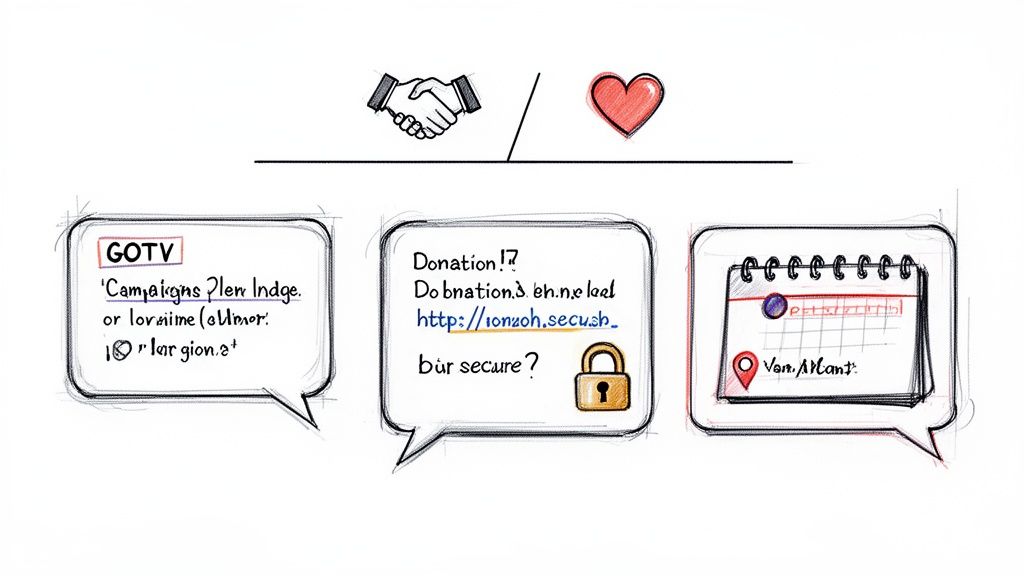
Political Text Messaging (SMS/MMS): This is your go-to for rapid, wide-scale communication. It’s perfect for sending GOTV reminders, last-minute fundraising asks, and event invites.
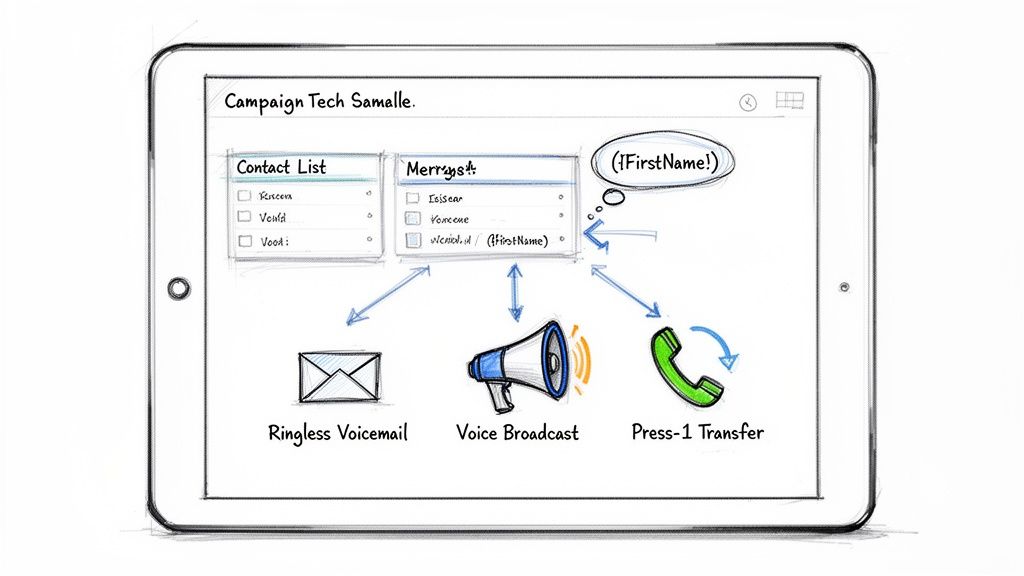
Ringless Voicemail: This clever tech drops a pre-recorded audio message straight into a voter’s voicemail box—without making their phone ring. It’s a fantastic way to deliver a personal-sounding message from the candidate that feels less intrusive than a live call.
Voice Broadcasting: You can use this for automated "robocalls" or to run "Press-1" campaigns, which let interested voters instantly connect to a live volunteer or get sent to a donation page.
Think of it like a coordinated team. Texting is your quick-footed messenger, ringless voicemail is your personal envoy delivering a heartfelt note, and voice broadcasting is your town crier making a big announcement. When they work together, your message doesn't just get sent—it gets heard.
This layered approach helps reinforce the campaign's message across multiple touchpoints. Even organizations outside of politics can learn from this; for example, understanding how a mass texting service for nonprofits works can provide a great blueprint.
By combining these tools, campaigns can run a more effective, compliant, and impactful operation that truly moves the needle.
Let's talk about the legal side of political texting. Getting this right isn't just about dodging fines—it's about making sure your messages actually get delivered. One slip-up, and mobile carriers can block your numbers, shutting down your entire outreach program when you need it most.
The whole legal puzzle really centers on one major law: the Telephone Consumer Protection Act (TCPA). If you’re running a campaign, you need to understand it. Its whole purpose is to shield people from unwanted automated calls and texts, which is why the way you send messages is so incredibly important.
The TCPA has very strict rules against using an Automated Telephone Dialing System (ATDS)—or an "autodialer"—to contact someone without their permission. This single point is why most political texting relies on a method called Peer-to-Peer (P2P) texting.
P2P (Peer-to-Peer): Think of this as one-to-one, at scale. A real person, a volunteer or staffer, has to physically hit "send" for every single text. The software helps queue up the messages, but it can't fire them off automatically. Because a human initiates each text, courts have generally agreed that P2P systems are not autodialers. This makes P2P the go-to compliant choice for reaching out to voters from public lists.
A2P (Application-to-Person): This is when a software application sends messages automatically without a person involved in each send. Appointment reminders and shipping alerts are classic examples. To use A2P, you absolutely must have express written consent from every recipient first. For a large-scale voter outreach campaign, that’s a tough bar to clear. You can learn more in our guide on what qualifies as express written consent.
For a political campaign, this isn't a small detail; it's everything. P2P is your compliant path for cold outreach to voter files. A2P is what you use for your warm list of supporters who have already signed up to get text updates from you.
This chart really boils down the core compliance question you have to answer before sending any text.
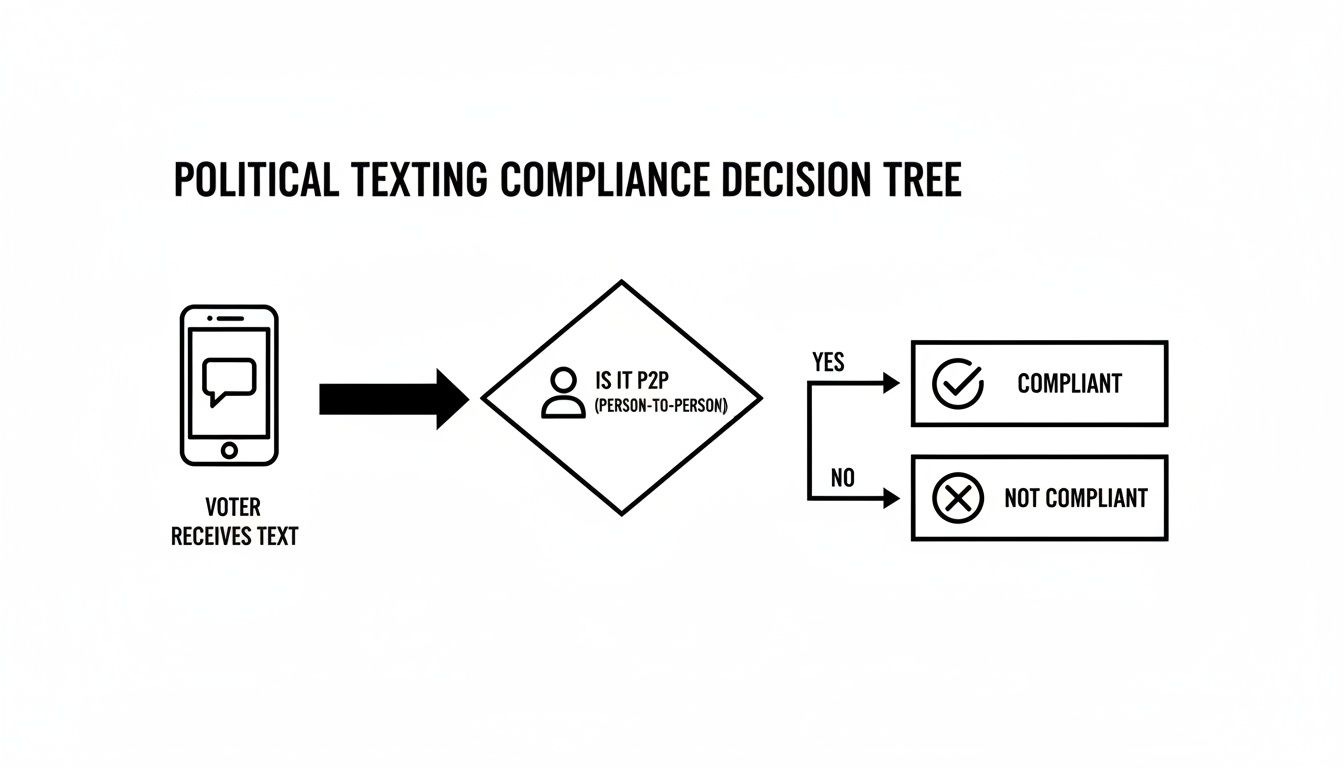
The takeaway here is simple: having a human in the loop is the key factor that keeps most political texting programs on the right side of the TCPA.
Beyond the P2P vs. A2P distinction, there are a few other non-negotiable rules you have to follow. Ignore these, and you risk carriers flagging your messages as spam and blocking them.
A common myth is that political texts get a free pass on all the rules. While it's true that non-commercial political messages are exempt from some Do-Not-Call list rules, they are not exempt from TCPA rules about autodialers or carrier guidelines.
Here are the key compliance must-haves:
Mandatory Opt-Out Language: Every first text you send must have clear instructions on how to opt-out, like "Reply STOP to end." This is a fundamental rule for all text outreach, and your platform must honor those STOP requests instantly.
Campaign Registration: Carriers now require political campaigns to register with The Campaign Registry (TCR). This is a vetting process that proves you're a legitimate sender, which dramatically improves your deliverability and keeps your messages out of the spam filter.
Choosing the Right Number: The phone number you text from matters. 10DLC (10-Digit Long Code) numbers are the standard, local-looking phone numbers approved for high-volume P2P texting. They're essential for any registered campaign. Toll-free numbers are another option, but they come with their own set of verification steps.
Stick to these rules—use P2P for voter file outreach, include clear opt-outs, and register your campaign—and you’ll have a solid foundation for a political texting program that’s both successful and legally sound.
While the key to staying compliant is having a human press "send" on each text, that doesn't mean your team is stuck managing a million messages from their personal phones. Far from it.
The engine behind any modern political texting program is a specialized software platform. Think of this as the mission control for your entire outreach operation. It gives your staff and volunteers the tools they need to manage huge contact lists, send personalized messages at scale, and juggle thousands of conversations without going crazy.
It's the difference between hand-addressing envelopes and running a full-scale professional mailroom. This is the tech that brings structure, efficiency, and oversight, turning a simple list of phone numbers into a voter engagement powerhouse.
At the heart of it all are two features that separate a generic blast from a message that actually connects: segmentation and personalization.
Great outreach isn't about yelling at everyone. It's about whispering the right thing to the right person at the right time. That’s where contact list segmentation comes into play. A solid platform lets you slice and dice your master voter file into smaller, more focused groups based on just about any criteria you can think of.
Imagine you need to send a last-minute reminder about where to vote. Blasting that message to an entire state would be pure chaos. Instead, you can segment your list with surgical precision.
This ability to create hyper-targeted lists is a game-changer. It makes sure your messages are always relevant, which skyrockets their impact and keeps you from being seen as just another spammer.
Think of it this way: segmentation turns your voter file from a phone book into a highly organized Rolodex. You can instantly pull the exact contacts you need for any specific outreach effort, making your campaign smarter and more efficient.
Once you've got your segmented list, the next job is to make every single message feel personal. This is done with merge tags, which you might also hear called custom fields. They’re simple placeholders you drop into your message template that the software automatically fills in with info from your contact list.
Instead of a cold, generic message like, "Hi, vote for our candidate," you can send something that feels much more human:
"Hi [First Name], it's Sarah with the Jones campaign. Early voting in [County Name] ends this Friday. Can we count on your support for Jane Jones, [First Name]?"
Using merge tags like [First Name] or [County Name] instantly changes the tone. It feels less like a broadcast and more like a one-to-one conversation. That small detail makes a huge difference in how voters receive your message and helps build a real connection.
The best campaign tech doesn't just stop at texting. It integrates multiple channels into one cohesive strategy. While political text messaging is often the anchor, adding voice tools creates a powerful one-two punch.
Ringless Voicemail: This tech is brilliant. It delivers a pre-recorded audio message directly to someone's voicemail without ever making their phone ring. It’s perfect for sending a heartfelt, personal-sounding message from the candidate that feels much less intrusive than a robocall. Campaigns often use ringless voicemail drops for critical GOTV reminders or to share a quick, inspiring story.
Voice Broadcasting: For big announcements, voice broadcasting lets you send a recorded message to thousands of phones at once. But its real power comes from enabling Press-1 transfer campaigns. In this setup, a voter can hear a message about volunteering or donating, and if they're interested, they simply press "1" on their keypad to be instantly connected with a live person from your campaign. It creates a seamless bridge from interest to action.
Knowing the rules of the road and having the right tech is one thing. But the real magic of political texting happens when you craft a message that actually makes someone do something.
A great text can be the difference between a supporter hitting the "donate" button or just scrolling past. It can be the nudge that gets a voter to the polls instead of staying on the couch.
This is where your campaign's strategy gets real. The winning campaigns aren't just blasting out texts; they're sending the right texts at the right time to get specific, measurable results. Let's dig into the core ways to use political SMS and the messages that make them work.
Every text you send needs a clear goal. Are you raising money? Recruiting volunteers? Getting out the vote? Each objective requires a slightly different approach.
Here are the heavy hitters of political text messaging.
1. Get-Out-The-Vote (GOTV) Reminders
This is the bread and butter of any campaign, especially in those frantic final days before an election. A simple, timely reminder is proven to boost turnout.
2. Fundraising Appeals
Texting is a fundraising powerhouse because it's just so easy. You can take a supporter from reading your appeal to completing a donation in less than a minute. The friction is incredibly low.
3. Event Invitations
Trying to pack a town hall or get boots on the ground for a canvassing weekend? SMS gets the word out faster and more directly than almost any other channel.
The secret to all of these is a conversational tone and a single, crystal-clear call-to-action. Don't ask for a donation and a volunteer shift in the same text. Keep it personal, direct, and simple.
Blasting a message out is only half the battle. The real opportunity comes when people text you back. Unlike a TV ad or a piece of mail, texting opens up a direct line for a real conversation.
This is your chance to answer questions, address concerns, and build a genuine relationship. When someone replies, your team can engage one-on-one, provide helpful info, and update their profile in your CRM. That kind of personal touch turns a passive supporter into a passionate advocate.
This engagement is also crucial for Political Reputation Management, allowing you to correct misinformation and build trust at a personal level.
Of course, with 97% of voters carrying a mobile phone, the space is getting crowded. Early 2024 data showed that political spam texts tripled compared to the same period in 2022. Legitimate campaigns have to work harder than ever to prove they're authentic. You can see the full analysis of 2024 election spam trends to understand the landscape.
So, how do you know if your message is actually working? You test it.
A/B testing is a simple but incredibly powerful way to optimize your texts. The idea is easy: you write two versions of a message (Version A and Version B) and send them to a small slice of your list.
You can test just about anything:
Track which version gets more clicks, replies, or donations. Once you have a winner, you send that version to the rest of your audience. It's a straightforward process that guarantees you're always using the most effective message possible. For more on building a list that's ready and willing to engage, check out our guide on opt-in text strategies.
Sending millions of messages is one thing. Knowing if they actually work is another. That’s what separates a winning campaign from one that’s just making noise.
Success in political texting isn’t about volume; it’s about the actions your messages inspire. Are your fundraising appeals bringing in cash? Are your GOTV reminders actually getting people to the polls? Answering these questions means turning raw data into a smarter, more effective strategy.
Think of it like any other form of outreach. You have to track the right performance marketing metrics to know what’s hitting the mark. For a political campaign, this means translating standard metrics into tangible political results.
Let's dive into how you can track what's really going on and make sure your efforts are paying off.
To get a clear picture of what’s working, you need to look beyond simple delivery reports. The most valuable data comes from seeing how voters actually interact with your messages. Your messaging platform should give you a dashboard with a straightforward view of these key indicators.
Here are the essential metrics to keep an eye on:
While hard data like CTR gives you part of the story, the actual replies you get are pure gold. The sentiment behind voter responses gives you rich, actionable intelligence that a simple percentage just can't.
Are voters asking supportive questions, or are they voicing frustration? Digging into the tone and content of their replies helps you get a real feel for the public mood, spot hot-button issues, and tweak your messaging to better address what voters actually care about. This is where your volunteers become an invaluable listening post for the entire campaign.
And the amount of feedback can be staggering. In December 2023 alone, for example, Americans got a whopping 253 million political robotexts. One report analyzing this firehose of data found that California voters received over 303 million texts—split almost evenly between Republican and Democrat campaigns—while Texas saw 44 million texts, mostly from the GOP. Discover more insights about these political messaging trends. This just shows the massive scale at which campaigns have to analyze feedback.
The real magic happens when you connect your political texting data with your campaign's central Customer Relationship Management (CRM) system.
When your messaging platform and CRM are integrated, every text, click, and reply is automatically logged into a voter's profile.
This integration creates a single, unified view of every voter's journey. You can see the full story, from the first text they received to the donation they made last week, and the volunteer shift they signed up for today.
This complete picture lets you measure your campaign's true return on investment (ROI). You can directly attribute donations to specific text campaigns, pinpoint your most engaged supporters, and build laser-focused lists for future outreach. It transforms your texting program from a simple broadcast tool into a core part of your data-driven campaign machine.
The playbook for winning elections is getting a major tech upgrade. While the core of any good campaign—a clear message and an authentic connection—isn't going anywhere, the tools we use to get that message out are becoming smarter, more visual, and way more connected.
This isn't about throwing out what works. It’s about making it better. The future is about weaving SMS, voice, and new tech into a single, seamless conversation with voters, making your outreach feel personal even when it’s happening on a massive scale.
Artificial intelligence (AI) is about to take a much bigger seat at the campaign strategy table. We're moving beyond just using a voter's first name. AI will let campaigns sift through huge piles of data to personalize messages based on a voter's specific interests or how they've interacted with the campaign before—all at a speed no human team could match.
You'll also see more AI-driven chatbots stepping in. These bots can handle the frontline questions, like "Where do I vote?" or "What's the candidate's stance on X?", and even flag interested voters for a live volunteer. This frees up your team to have the meaningful, in-depth conversations that really swing votes.
Texting isn't just about text anymore. It's going visual. We're going to see a huge uptick in campaigns using MMS (Multimedia Messaging Service) to send content that really grabs a voter's attention.
Campaigns will lean more heavily on:
But these visuals won't exist in a vacuum. They'll be one piece of a much larger, more coordinated outreach plan.
The winning campaigns of tomorrow will be masters of the multi-channel approach. Imagine a voter gets a ringless voicemail from the candidate, followed by a text with a link to RSVP for a virtual town hall, and then a final voice broadcast on Election Day as a get-out-the-vote push.
This kind of layered strategy makes sure your message sinks in. By combining political text messaging with powerful tools like ringless voicemail drops and well-timed voice broadcasting, you create a richer experience that guides a voter all the way from simply being aware of your campaign to actively supporting it.
If you've ever gotten a political text and wondered, "How did they get my number?"—you're not alone. As texting becomes a go-to tool for campaigns, voters and staff alike have questions. Let's clear up some of the most common ones.
The short answer? It was likely sent by a real person, not a robot.
Campaigns get phone numbers from public voter registration files, which are completely legal for them to use for outreach. They use platforms for Peer-to-Peer (P2P) texting, where a human volunteer has to physically press "send" on every single message. Because a person is involved, it isn't considered an "autodialer" and doesn't need the same prior consent that a commercial marketing text would.
The quickest way to stop texts from a specific campaign is to reply with a standard opt-out word like “STOP” or “UNSUBSCRIBE.”
Any reputable campaign is required to honor these requests immediately. This will stop that particular campaign from texting you, but keep in mind, you might still get messages from other campaigns using different numbers in the future.
It all comes down to the human element.
Think of it this way: P2P is like a volunteer personally sending you a quick note. A2P is more like getting an automated alert from your bank. For reaching new voters, campaigns almost always stick with P2P to stay on the right side of the law.
Ringless voicemail is a neat piece of tech that drops a pre-recorded audio message right into someone's voicemail box without making their phone ring. It’s become a favorite tool for campaigns for a few good reasons.
They use it to deliver personal-sounding messages from the candidate or send out critical get-out-the-vote reminders on Election Day. Since it doesn't interrupt a voter's day with a ringing phone, it's seen as much less intrusive than a traditional robocall. This makes ringless voicemail drops an incredibly powerful way to deliver a high-impact message at scale, adding a real human voice to a digital outreach campaign.
Ready to create powerful, multi-channel outreach campaigns that drive results? Call Loop provides the tools you need for compliant political text messaging, ringless voicemail, and voice broadcasting. Learn more and get started today.
Chris Brisson
Chris is the co-founder and CEO at Call Loop. He is focused on marketing automation, growth hacker strategies, and creating duplicatable systems for growing a remote and bootstrapped company. Chat with him on X at @chrisbrisson


Trusted by over 45,000 people, organizations, and businesses like


