
See a Demo
You're just one step away from seeing Call Loop in action.
Enter your information below to watch a demo right now.

You're just one step away from seeing Call Loop in action.
Enter your information below to watch a demo right now.

Reminder text messages are an absolute game-changer for any business that relies on appointments. They're a simple, automated way to send a quick heads-up to your clients before their scheduled time, and this one little strategy consistently blows email and phone calls out of the water.
The result? Less lost revenue and happier customers.
An empty chair in your waiting room or a missed consultation isn't just a minor hiccup—it's money walking out the door. Every no-show throws your schedule into chaos, wastes your team's valuable time, and takes a direct hit at your bottom line.
Businesses have tried it all, from endless phone calls to hopeful emails, but one method has proven time and again to be the most effective and, frankly, the one clients actually prefer.
That winner is, without a doubt, reminder text messages.
The reason for their success is incredibly simple: texts are immediate, personal, and almost always get read. With open rates hitting an insane 98%, often within just a few minutes, you can be confident your message is seen. That's a world away from emails that get buried in a crowded inbox or just flat-out ignored.
Bringing in an SMS reminder system does more than just fill your calendar. It creates a positive ripple effect across your entire operation, boosting efficiency and making your clients feel valued.
You'll see a few key benefits right away:
A reminder text message works because of its directness. It cuts through all the digital noise to deliver a crucial piece of information right when it's needed, making life easier for both you and your customer.
Let's look at a quick comparison to see why SMS is the clear winner for appointment reminders.
As you can see, SMS leads the pack in nearly every category that matters for timely reminders.
Research backs this up, showing that appointment reminders sent via SMS lead to a no-show rate of just 19%—making them far more reliable than email. Especially in critical fields like healthcare, a staggering 85% of consumers say they prefer to get appointment reminders through text.
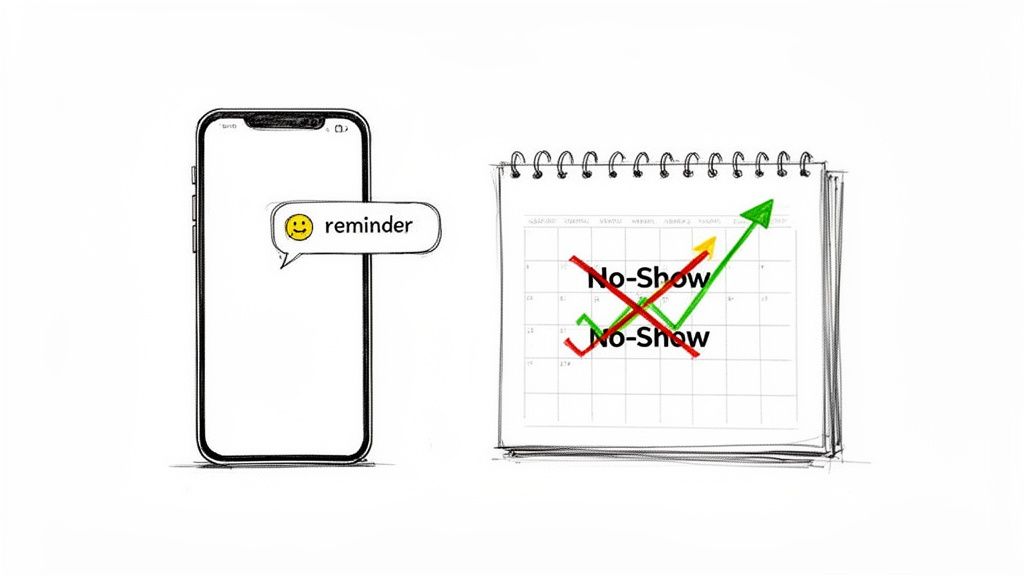
While SMS is your heavy hitter, you can build an even stronger strategy by layering in other tools, especially for those high-value appointments.
For instance, try pairing your text reminders with a ringless voicemail. This cool tech drops a pre-recorded message right into someone's voicemail without their phone ever ringing. This technique, often called a voicemail drop, adds a personal layer to your automated reminders.
Imagine this: you send a text reminder 48 hours before a big consultation. Then, 24 hours out, a friendly and personal ringless voicemail from the provider lands in their inbox. This multi-touch approach not only reinforces the appointment but adds a human touch that builds a much stronger connection with your clients. This is just one of many great ways to reduce no-show appointments.
Ultimately, thoughtful communication does more than just cut down on no-shows. It goes a long way to improve overall customer experience, showing clients you respect their time and are dedicated to providing a top-notch service from beginning to end.
It's one thing to know that reminder texts work, but it's a completely different ballgame to write one that gets an instant, positive response. The perfect message is a careful blend of clarity, brevity, and just a touch of personality. It needs to give your client all the essential info at a glance without feeling like a robot sent it.
The key is to think of your message as a welcome guest on their phone's lock screen, not an annoying interruption. A well-crafted text respects their time and genuinely makes their life a little easier. When you get it right, the message is so helpful they can't imagine not getting it from you.
Every single effective reminder message, whether you're a salon, a clinic, or a consultancy, shares a few core components. These are your non-negotiable building blocks for creating clear, actionable texts that clients will actually appreciate and act on.
Here’s the bare-bones checklist for every reminder you send:
[FirstName]) makes the message feel like it was sent to them, not a faceless list. This little touch works wonders for engagement.The most successful reminder text messages are direct and concise. They deliver all the value in under 160 characters, providing every necessary detail and a simple way to respond. This respects both your client's time and their attention.
Generic messages get generic results. If you seriously want to cut down on no-shows, you need to tailor your reminders to different points in their journey with you. Here are a few battle-tested templates you can swipe and adapt for your own business.
This one is all about locking in the appointment and setting expectations right from the get-go.
Template:Hi [FirstName], this is [Your Business Name]. You're all set for your appointment on [Date] at [Time]. We look forward to seeing you! Reply HELP for questions.
Why it works: It's immediate, it's reassuring, and it gives them a simple channel to ask questions if something comes up.
This is your most critical message for stopping no-shows in their tracks. Think of it as the final, friendly nudge.
Template:Hi [FirstName], a friendly reminder from [Your Business Name] about your appointment tomorrow, [Date], at [Time]. Please reply C to confirm or call us at [Phone Number] to reschedule.
Why it works: The call-to-action is direct and dead simple. Offering an effortless confirmation path (Reply C) gets clients to mentally and physically commit to showing up.
The conversation shouldn't stop just because the appointment is over. A quick follow-up shows you value their business and opens the door for reviews and future bookings.
Template:Hi [FirstName], thanks for visiting [Your Business Name] today! We hope you had a great experience. We'd love it if you could share your feedback here: [Link]
Why it works: It’s a polite, no-pressure way to gather valuable reviews while making the client feel appreciated. The short link makes it easy to click.
For high-value appointments or clients who might need an extra nudge, you can get a little more sophisticated. Pairing your automated text reminders with a ringless voicemail can be an incredibly powerful one-two punch. A ringless voicemail, sometimes called a voicemail drop, delivers an audio message directly into their voicemail inbox without ever making their phone ring.
Picture this sequence: An automated reminder text message goes out 48 hours before the appointment. Then, 24 hours out, a personal, pre-recorded voicemail from you or your team lands in their inbox. This multi-channel approach feels far more personal and dramatically increases the odds of the appointment sticking, adding a human touch that builds much stronger client relationships.
The real power of reminder texts isn't just the message—it's the timing. If you're sending texts manually, you're creating a logistical nightmare for yourself that just won't scale. The magic really happens when you build a smart, automated system that runs quietly in the background, making sure every client gets the right nudge at the perfect moment.
This is where you can truly "set it and forget it." By building automated sequences, you design a customer journey that feels personal and attentive, but you don't have to lift a finger for each individual appointment. It's all about creating a reliable workflow that stops no-shows in their tracks.
Here's a look at a basic automated reminder workflow, showing the simple journey from booking to the final text.
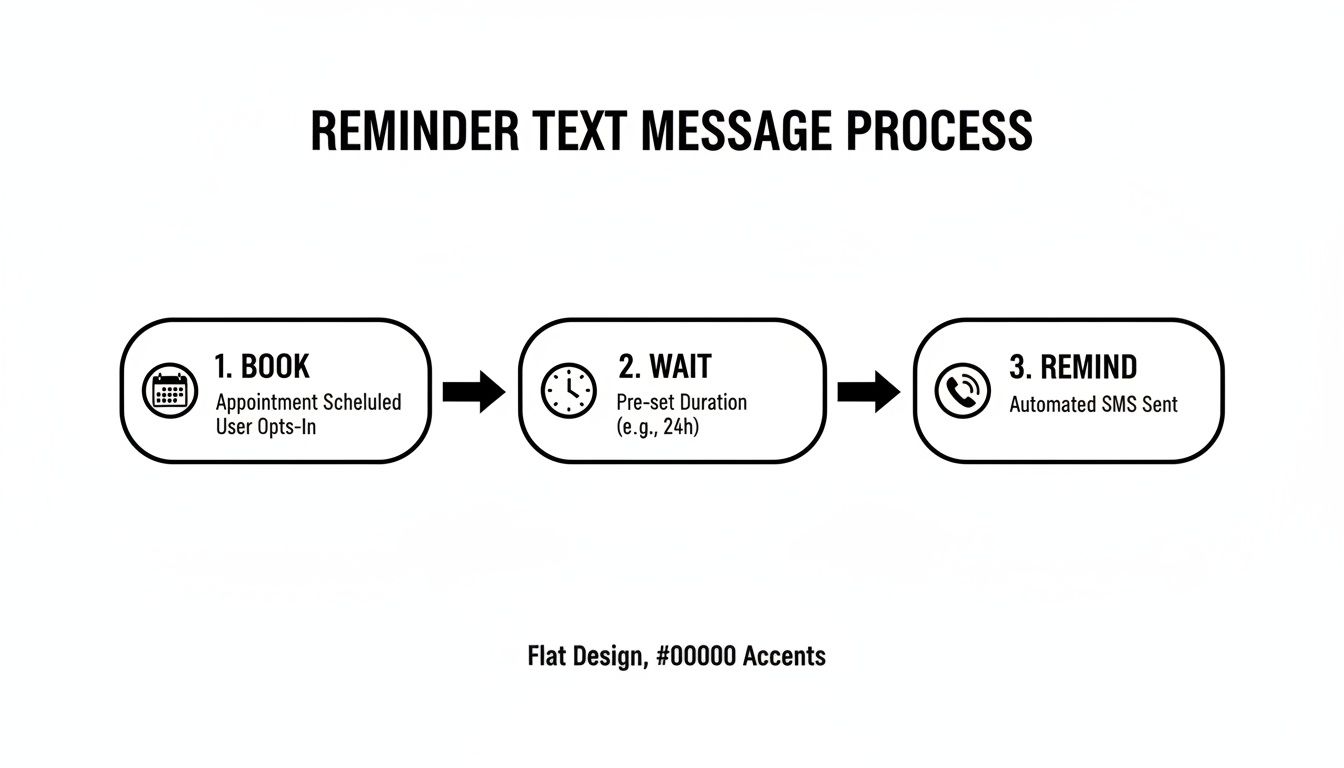
This simple, three-step process—Book, Wait, Remind—is the foundation of any great system. It cuts out the manual work and ensures every client gets a consistent experience.
Sure, a one-size-fits-all reminder is better than nothing, but a tailored sequence is where you'll see the biggest impact. The goal is to create a series of perfectly timed messages that guide a client from the second they book their appointment to the moment they walk through your door.
This multi-touchpoint strategy keeps the appointment top-of-mind without feeling spammy. A well-structured sequence might look something like this:
The most successful automated campaigns I've seen are built on precise timing. Data consistently shows that a text sent 24-48 hours in advance is the sweet spot for allowing schedule adjustments, while a final reminder a few hours before is crucial for preventing day-of no-shows.
For high-value appointments or clients who appreciate a more personal touch, you can take your automated sequence to the next level by mixing in other channels. A ringless voicemail is an incredible tool for adding a human element to your reminders.
This tech lets you drop a pre-recorded audio message straight into someone's voicemail box without their phone ever ringing. It’s personal and high-impact, but not disruptive.
Imagine this powerful, layered sequence:
This combo of SMS and voice creates a follow-up system that feels incredibly personal. It helps build stronger client relationships and makes it almost impossible for them to forget. If you're looking for more ideas on timing, you can explore different approaches on how to schedule text messages for maximum impact.
Not all clients are the same, so why should your reminders be? Smart automation lets you segment your audience and tailor your messages.
For instance, you could create a specific sequence just for new customers. Their first reminder might be a bit warmer, maybe include a link to directions, or offer a quick tip on how to prepare for their visit. This small bit of customization makes a fantastic first impression.
On the other hand, your sequence for long-time, loyal clients might be more concise and to the point. The ability to create these different paths, or "drip campaigns," is what turns a basic reminder system into a sophisticated client communication engine.
Reminder texts are a fantastic way to connect with your clients, but it's a channel that comes with some important rules. Ignoring them isn't just a slap on the wrist; it can lead to some seriously hefty fines and hurt the reputation you've worked so hard to build.
Getting a handle on SMS compliance isn't just optional—it's absolutely essential for any business sending texts.
The biggest one you need to know in the U.S. is the Telephone Consumer Protection Act (TCPA). This is the federal law that lays out the ground rules for how businesses can contact people by phone and text. The core idea is simple: you need permission before you hit send.
Before a single reminder goes out, you need what’s called "express written consent." That might sound intimidatingly formal, but it's really just about having a clear, documented record that someone has agreed to get texts from you.
And you can't just assume you have it.
Consent needs to be crystal clear. Just because someone gave you their phone number to book an appointment doesn't automatically mean you can start sending them marketing texts. While the rules are often a bit more relaxed for transactional messages like appointment reminders, getting explicit consent is always the smartest, safest move.
The best way to do this is to have customers actively check a box or sign a form that plainly states they agree to receive reminder text messages from you. This creates a digital paper trail that keeps your business protected.
You can dive deeper into the nuts and bolts by checking out a detailed guide on how to properly set up your text opt-in process. It’s the best way to make sure you're building your contact list on a solid, compliant foundation right from the start.
Staying on the right side of the law is about more than just that initial permission. It's an ongoing commitment to communicating respectfully and transparently with your clients.
Here are a few critical habits to weave into your SMS strategy:
If you're in the medical, dental, or therapy world, you've got an extra layer of rules to think about: the Health Insurance Portability and Accountability Act (HIPAA). This law is all about protecting the privacy and security of what's known as Protected Health Information (PHI).
When you send appointment reminders, you have to be careful not to disclose sensitive health details. Using a HIPAA-compliant messaging platform isn't just a good idea; it's a must. These platforms are built with the necessary security, encryption, and business associate agreements to keep patient data locked down while still letting you send helpful reminders.
Even a simple reminder text can be considered PHI, so partnering with a platform designed for these requirements is non-negotiable. It protects your patients' privacy and shields your practice from serious legal trouble. Following these rules gives you the confidence to run your campaigns effectively and, most importantly, ethically.
Your reminder text message system shouldn't be another island in your tech stack. Let's be honest, real efficiency happens when it talks to the other tools you rely on every single day. When you connect your SMS platform with your CRM, calendar, and other business software, you stop being a reminder manager and start running a fully automated communication engine.
This simple shift turns a basic reminder into a seamless part of your customer experience. Instead of your team wasting time cross-referencing schedules and manually firing off texts, the whole process just hums along quietly in the background, triggered by the actions you’re already taking.
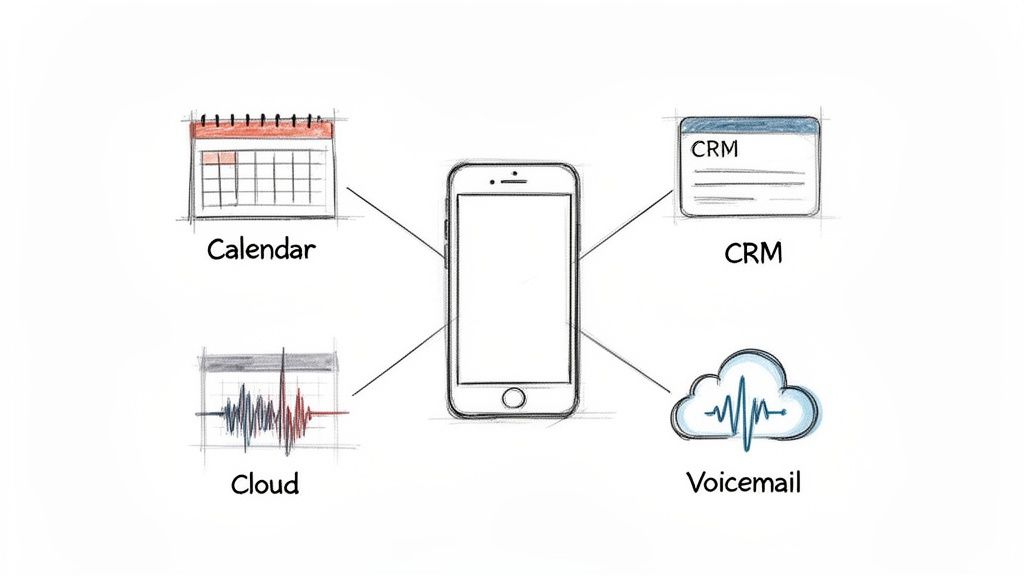
Think about this common scenario: a new appointment gets booked and lands on your Google Calendar. Without integration, someone on your team has to remember to go into your SMS tool and schedule a reminder. With integration, that new calendar event automatically kicks off a pre-built reminder sequence. No manual work needed.
That's the power of connecting your systems. The worldwide embrace of SMS for business isn't a fluke; it's a direct response to what customers want. About 65% of the world's population—that's roughly 5 billion people—actively use text messages, making it the most accessible channel out there.
And here in the U.S., where 97% of adults have phones that can receive texts, plugging this into your workflow is just plain smart business. You’re simply meeting customers where they already are.
The good news? These integrations are no longer complex coding projects. Platforms can act as a bridge, letting you create powerful "if this, then that" workflows between your favorite apps without writing a single line of code.
Let's look at a few real-world examples of how this plays out, turning tedious tasks into automated wins.
The goal of integration is to make your reminder system an invisible, yet indispensable, part of your operation. It should react to your daily activities, ensuring no client ever slips through the cracks due to human error.
Once your basic integrations are humming along, you can layer in more advanced tactics for those high-value interactions. One of my favorites is integrating ringless voicemail drops. A ringless voicemail sends a pre-recorded audio message directly to someone's voicemail inbox—their phone never actually rings.
This adds a powerful, personal touch that a text message just can't match. It’s far less intrusive than a cold call but feels more human than a standard text.
Here’s what an advanced, integrated workflow could look like for a high-priority client meeting:
This level of automation ensures nothing is forgotten, frees up your team's time, and creates a professional, attentive experience for your clients from the moment they book.
Jumping into SMS reminders for the first time? You probably have a few questions. That's a good thing. To help you get started on the right foot, I've pulled together the most common questions we get from business owners and laid out some straightforward answers. Let's clear up the practical details so you can move forward.
While there's no single magic hour, a solid rule of thumb is to stick to normal business hours, roughly 9 AM to 5 PM, in your customer's local time zone. Sending a text 24-48 hours before an appointment gives people plenty of notice to reschedule if something comes up.
Then, follow it up with a final nudge 2-4 hours beforehand. This works as a quick, helpful prompt right when they need it. Good SMS platforms will handle the time-zone scheduling for you, so your messages always land at a respectful time.
Yes, and it's not even close. The numbers speak for themselves. Text messages have an almost unbelievable open rate of up to 98%, and most of those are read within minutes. That kind of instant visibility is something email just can't compete with.
Email, on the other hand, averages around a 20% open rate. It's easy for an important reminder to get lost in a cluttered inbox or flagged as spam. When you absolutely need someone to see a time-sensitive message, SMS is the clear winner for cutting down on no-shows.
The power of a reminder text is its ability to cut straight through the digital noise. An email might sit unread for hours, but a text notification on a lock screen gets attention immediately. It’s perfect for anything urgent.
Absolutely. This is where modern SMS platforms really shine. You can build simple, two-way automated conversations that save you a ton of time and give your customers a slick experience. It all works by setting up workflows that trigger actions based on keywords in their replies.
For example, you could set it up so that:
This kind of automation frees up your staff from tedious manual work and gives clients the convenient, on-demand service they expect.
Ringless voicemail is a clever tool that drops a pre-recorded audio message directly into someone's voicemail box without making their phone ring. It’s a fantastic way to add a human touch to your follow-up without interrupting their day. It's an effective and non-intrusive alternative to a direct phone call.
You can pair it with your text reminders for a more personal, multi-channel approach. This voicemail drop technique reinforces the message and helps build a stronger connection with your clients.
Imagine an automated workflow like this:
Combining a quick text with a friendly voice makes your communication stand out. It shows a level of care that people notice, turning your reminder system into a tool for building relationships, not just managing logistics.
Ready to put no-shows in the past and automate your appointment reminders? Call Loop gives you all the tools—from SMS and two-way messaging to ringless voicemail and easy integrations. Find out how simple it is to build a reliable reminder system at https://www.callloop.com.
Chris Brisson
Chris is the co-founder and CEO at Call Loop. He is focused on marketing automation, growth hacker strategies, and creating duplicatable systems for growing a remote and bootstrapped company. Chat with him on X at @chrisbrisson


Trusted by over 45,000 people, organizations, and businesses like


